SIG SAUER - Never Settle

Archive for the ‘Contracts’ Category

DroneShield Receives $9.7m Latin American Contract

Thursday, July 10th, 2025

– A $9.7 million package of three standalone contracts for a defence end customer in a Latin American (LATAM) country

– Delivery and payment due Q3-Q4 2025

DroneShield (ASX:DRO) is pleased to announce it has received a package of three standalone contracts for its handheld and on-the-move counter-drone systems. The contract sum is $9.7 million, with DroneShield’s privately owned in-country reseller that is contractually required to distribute the products to a defence end customer in a LATAM country. DroneShield expects to deliver all equipment throughout Q3 and Q4 2025, with cash payment expected in Q3 and Q4 2025. No additional material conditions need to be satisfied.

DroneShield has previously received two standalone contracts from this reseller for this defence customer in December 2024 and January 2025 totalling approximately $10.8 million, with all imports, deliveries, and payments handled on-time and in a highly professional manner. There is no obligation for any additional contracts from this reseller or the customer.


Pictured: DroneShield DroneSentry-X Mk2 counter-drone system

Oleg Vornik, DroneShield CEO, commented: “In 2025, DroneShield has successfully delivered products, capability, and training into the Latin American market. With a substantial pipeline, diversified over multiple countries and customers, DroneShield is anticipating further developments in 2025 in this region.”

Learn more at droneshield.com.

Robotican Announces Delivery of Dozens of ROOSTER Hybrid Drone Systems to European Special Forces

Wednesday, July 9th, 2025

Combat-proven ROOSTER system recently secured official NATO registration, reinforcing its operational credibility and alignment with allied defense standards.

Omer, Israel – 8 July 2025 – Robotican, a leading Israeli pioneer in the development of autonomous robotic and drone technologies, proudly announces the successful delivery of dozens of ROOSTER hybrid drone systems to European special operations forces, intervention units, and infantry teams.

These deliveries represent a significant operational milestone for Robotican’s flagship system. Building on this momentum, the ROOSTER has recently secured official NATO registration, reinforcing its status as a trusted solution that meets the requirements and standards of NATO military forces.

The ROOSTER is a compact, hybrid tactical drone that merges aerial agility with robotic ground mobility, making it uniquely suited for indoor, subterranean, and GPS-denied environments. Its ability to rapidly shift between flying and rolling allows for energy-efficient operation in complex and confined spaces. The integrated protective cage enables a unique robotic rolling capability, allowing the ROOSTER to maneuver across challenging terrains and access confined areas that are inaccessible to conventional drones. The system is capable of extended missions, with a typical 90 minutes of overall active operation and up to 5 hours in standby mode. It features robust MESH communication that enables up to three ROOSTER units to work together as a team—even in environments with no external communication. The Rooster is equipped with a built-in day/night IR sensitivity camera and visible/IR illuminators.


Designed for flexibility, the ROOSTER supports a range of swappable sensor payloads, including thermal imager, oxygen and radiation detectors. These capabilities make it ideal for a wide range of missions, including tactical reconnaissance, urban search & rescue, hazardous materials response and industrial safety inspections. Lightweight, rugged, and operable by a single user, the system can be deployed quickly from a tactical backpack, offering forces immediate situational awareness with minimal exposure.

“The ROOSTER was developed as a strategic response to the growing need for precise intelligence in challenging environments where access is limited and situational awareness is critical” said Hagai Balshai, CEO of Robotican. “By enabling forces to gather critical data before operational breach, it significantly reduces risk and enhances mission planning. Its adoption by the Israeli Ministry of Defense and Home Front Command, alongside elite European & US


Special Operation Forcess, reflects its field-proven value. NATO registration further positions the ROOSTER as a trusted asset for allied operations in the modern battlespace.”

US Army Seeks Suppliers for up to 10,000 Low-Cost Drones per Month

Wednesday, July 9th, 2025

Last week, Army Contracting Command, on behalf of Program Executive Office (PEO), Aviation, released a Sources Sought notice entitled, “Uncrewed Aircraft Systems (UAS) for the United States Army.” It complements an earlier RFI which was issued in April for Purpose Built Attritable Systems (PBAS).

This is great news. While the acquisition system has been slow to adapt to this requirement, Brigade and Division commanders are creating the capability out of hide, using Soldiers who have off-duty experience with drones, paired with 3D printing. Unfortunately, none of it is effectively resourced in manpower, training, or O&M funding. An acquisition of this magnitude will get the Army on its way to learning how to use this capability and incorporate it across the entire formation. Soldiers will adapt quickly and soon be able to employ FPV drones along with other systems to enhance ISR, precision targeting, EW, and low-cost mass effects via swarms.

This new Sources Sought focuses more on cost without the constraints of performance, payloads, and other requirements in the previous announcement. The goal of this Sources Sought is to deliver low-cost UAS solutions into Army formations rapidly and reduce “gold plating.” The Army understands UAS production capacity must expand across the industrial base.

As I mentioned when the PBAS RFI was released, I refer to attritable drones as the “155 shell of the future.” The reason I use that comparison is that a 155mm shell is about $3000. The Army is looking to pay up to $2000 for each of the proposed PBAS but I think that’s a bit low. The availability of these systems, built with US sourced parts (or reliable allied country), is a national imperative.

From the Sources Sought Notice:

“The Army requires low-cost unmanned aerial systems for immediate fielding with up to 10,000 air vehicles within 12 months. The ability to deliver systems at or below our threshold cost is the primary weighted measure.  The system performance characteristics will distinguish systems meeting this core requirement.  The production capability as well as the ability for Soldiers to modify and repair are additional distinguishing characteristics. The intent for modifications is to ensure Soldiers are able to add simple payloads (such as 30mm mortars, grenades, or other lethal payloads) and non-lethal capabilities based on mission needs without vendor involvement in the field. These systems may also be utilized as targets during Counter Unmanned Aircraft Systems (C-UAS) training and other training exercises. Likewise, Soldier repair is needed to allow units to fully understand their equipment and stay in the fight while waiting for additional systems / spare components.”

The number of 10,000 per month is also significant as it is the low end of the number of attritable drones Ukraine claims it expends each month in operations against Russia. This number can surge to 30,000 per month or even higher. The question is, how can the US Army consume that many drones per month during peacetime? Well, for one, 10,000 is the surge capacity and they don’t pan to get there immediately, although I think the requirement will be far beyond just 10,000 per month of we end up in Large Scale Combat Operations. While FPV drones aren’t as capable as exquisite precision guided systems, they are a fraction of the cost and can be produced in a fraction of the time. Ukraine enjoys federated production of drones in workshops and cellars as much as in factories and produces hundreds each night. Second, the Army will use these drones for Counter Unmanned Aerial System training. So far, there hasn’t been much opportunity to go after live systems. This is an opportunity for the Army (and others in DoD) to conduct some simultaneous live training for both offensive and defensive UAS capabilities.

Accessing to the request, potential vendors of PBAS must be able to deliver the following:

  • – Unit cost for air vehicle less than $2,000.00.
  • – Additional dependent equipment to include ground control station/controller, communications equipment, goggles, batteries, and charging station for one to many controllers to UAS. Cost for these items will be fairly considered during response evaluation.
  • – Production capability to deliver an initial quantity of systems by 30 September 2025 with the ability to quickly ramp production and deliver larger quantities up to 10,000 air vehicles within 12 months.
  • – The ability for our Soldiers to modify, within reason, the system with a variety of third-party payloads, armaments, and munitions without vendor involvement
  • – The ability for our Soldiers to repair the system without vendor involvement
  • Furthermore, systems must be 2020 NDAA Sec 848, 2023 NDAA Sec 817 and American Security Drone Act of 2023 (2024 NDAA, PL 118-31, DIV A, Title XVIII, Subtitle B, SEC. 1821) compliant or demonstrate a path to compliance.

    Most important about this action? Funding is available to achieve this capacity expansion. Lack of capital has held many manufacturers back.

    The Army is seeking white papers which are due by 1600 hours CST 18 July 2025.

    Visit for sam.gov full details.

    I am concerned that there still isn’t a PBAS Interface Control Document which would help both DoD and industry create Modular Open System Architecture drones which become plug and play for the integration of end effectors, comms, guidance, and motors. This would alleviate the concern over which components will work with which drones as everything would work together. Executing this scale of acquisition before establishing these standards is putting the cart before the horse.

    Despite my concern, I am very excited about this action and look forward to the Army executing and obtaining an attritable FPV drone capability at the smallest units and all across the formation.

    Eric Graves

    Founder

    SSD

    Saab Receives Order for Ground-Based Air Defence from Sweden

    Thursday, July 3rd, 2025

    Saab has received an order from the Swedish Defence Materiel Administration (FMV) for the mobile short-range air defence solution RBS 70 NG with missiles. The order value is approximately SEK 1.5 billion and deliveries are scheduled 2027-2028. This order was booked in Q2 2025.

    The order also includes equipment which will enable the Swedish Armed Forces to integrate the system on a Mobile Short-Range Air Defence (MSHORAD) solution in the future. 

    “We are continuously contributing to strengthening the capabilities of the Swedish Armed Forces and Saab’s air defence systems play a vital role in keeping Sweden’s skies secure,” says Görgen Johansson, head of Saab’s business area Dynamics.

    Saab’s MSHORAD system with RBS 70 NG features an automatic target tracker and a built-in night sight and provides the user with capability to defeat threats including aircraft, drones and missiles from distances of up to nine kilometers.

    DroneShield Receives $9.7m Latin American Contract

    Wednesday, July 2nd, 2025

    ·        A $9.7 million package of three standalone contracts for a defence end customer in a Latin American (LATAM) country

    ·        Delivery and payment due Q3-Q4 2025

    DroneShield Limited (ASX:DRO) (DroneShield or the Company) is pleased to announce it has received a package of three standalone contracts for its handheld and on-the-move counter-drone systems. The contract sum is $9.7 million, with DroneShield’s privately owned in-country reseller that is contractually required to distribute the products to a defence end customer in a LATAM country. DroneShield expects to deliver all equipment throughout Q3 and Q4 2025, with cash payment expected in Q3 and Q4 2025. No additional material conditions need to be satisfied.

    DroneShield has previously received two standalone contracts from this reseller for this defence customer in December 2024 and January 2025 totalling approximately $10.8 million, with all imports, deliveries, and payments handled on-time and in a highly professional manner. There is no obligation for any additional contracts from this reseller or the customer.

    Pictured: DroneShield DroneSentry-X Mk2 counter-drone system

    Oleg Vornik, DroneShield CEO, commented: “In 2025, DroneShield has successfully delivered products, capability, and training into the Latin American market. With a substantial pipeline, diversified over multiple countries and customers, DroneShield is anticipating further developments in 2025 in this region.”

    US Army Awards $4.9 Million Contract for More FN M240L Medium Machine Guns

    Tuesday, July 1st, 2025

    (McLean, VA — July 1, 2025) FN America, LLC is pleased to announce that it has been awarded a $4.9 million contract to supply the U.S. Army with additional FN® M240L medium machine guns. The M240L was originally adopted by the U.S. Army in 2010, after a joint development effort with FN to create a lighter, yet durable, medium machine gun.

    The M240L has been the cutting-edge for lightweight medium machine guns with an overall weight reduction of five pounds from its predecessor, the FN M240B, without any impact to performance or longevity. The 18 percent weight reduction was achieved by incorporating titanium into the design, including the receiver, and introducing new manufacturing methods to adjust for the material properties.

    “The M240L continues the collaborative effort between FN, the U.S. Army and the individual soldier to provide the most effective weapon systems for the warfighter,” said Mark Cherpes, President and CEO for FN America, LLC. “The development saw the introduction of new materials along with new manufacturing techniques that have paved the way for the future generation of military equipment. We are extremely proud of this product and look forward to working with the U.S. Army to deliver against this contract.”

    The M240 general purpose machine gun (7.62x51mm NATO), derived from the FN® MAG 58, was adopted by the U.S. military in the late 1970s, and has been in continual service since being introduced. FN has created multiple variants of the M240, including the M240 coaxial, the M240B, M240L, M240D and M240H models.

    Throughout its history, FN has been one of the largest suppliers of small arms to the U.S. military and continues to develop innovative, future technology. In addition to the M240 and its variants, the company currently holds contracts for the FN® M249 lightweight machine gun; the FN® MK 46, MK 48, MK 17 and MK 20 SSR for USSOCOM and various other contracts.

    For more information about FN’s military product line or current U.S. military contracts, please visit www.FNAmerica.com.

    First Success for Rheinmetall Ermine – Dutch Ministry of Defence Orders 20 Manned/Unmanned Ground Vehicles for Ukraine

    Friday, June 27th, 2025

    The Dutch Ministry of Defence has, on behalf of the Ukraine Task Force, signed a contract with the Ede-based subsidiary Rheinmetall Defence Nederland B.V. to supply 20 Ermine vehicles. The Minister of Defence signed the contract with Rheinmetall on the 24th of June during the NATO Industry Summit in The Hague.

    The variants now ordered are manned/unmanned ground vehicles. These are to be delivered to the Ukrainian armed forces, strengthening their capability for casualty evacuation near the frontline. The vehicles are to be delivered in 2026. In this configuration, a cooperation with other Dutch companies like DEMCON defense & security systems B.V. & Abiom Communication Systems (ACS) B.V. has been set up as a force multiplier. This national cooperation among industry and MoD will further develop knowledge and capabilities for the Armed Forces of the Nether­lands and Ukraine. Quote by Coen van Leeuwen, CEO of Rheinmetall Defence Nederland B.V.: “We are grateful for the trust in our capacities. Ermine is an innovative and capable solution for the modern battlefield.”

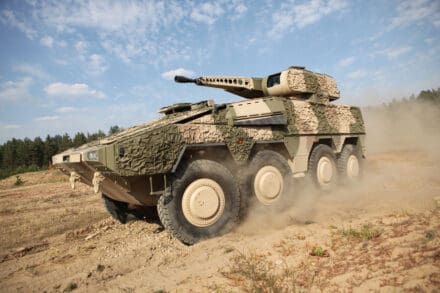
    The Ermine (Hermelin) family of small vehicles represents a new generation of mobility, combining tactical transport with a mobile energy source (microgrid). Operational creativity is at the core Ermine’s design. Its features enable it to act as an effective force multiplier. 

    The modular Ermine family currently consists of an UGV, a side-by-side buggy and a quad. Various 4×4 and 6×6 variants are available. All vehicles are based on the same diesel-electric hybrid drivetrain and base platform. This gives the Ermine maximum modularity with unrivalled agility. Thanks to the hybrid technology, up to one ton of payload, and a range of more than 1,000 kilometres are possible, depending on the vehicle’s configuration. Up to four Ermine vehicles can be transported by cargo helicopters such as the CH-47 or CH-53. 

    This contract marks the first significant milestone for the Ermine and will, by supporting the Ukraine armed forces, also boost the defence industry in the Netherlands. 

    INVISIO Secures SEK 145 Million Order for Dismounted Soldier Systems

    Friday, June 27th, 2025

    INVISIO has received a significant order from a new European customer for its dismounted soldier systems. Deliveries are to be completed during 2025.

    The order covers INVISIO’s personal communications systems providing a market leading hearing protection and seamless communication capabilities. The order, which includes the new INVISIO X7 in-ear headset, INVISIO Control Units and intelligent cables, has a value of approximately SEK 145 million.

    The recently launched INVISIO X7 in-ear headset sets a new standard for usability, offering market-leading hearing protection combined with exceptional comfort, easy insertion, and crystal-clear communication—even in the most demanding environments.

    INVISIO’s control units enable users to manage all aspects of communication, accommodating both individual preferences and mission-specific requirements—core elements of the solution delivered to this customer.

    Lars Højgård Hansen, INVISIO CEO, said: “This is another substantial order for our dismounted soldier systems. We are very pleased that our solutions are re-affirmed once again as meeting the very high expectations of users operating in the most critical and challenging conditions and that we can add another important customer to our network.”

    invisio.com