Phantom Lights

Archive for the ‘Contracts’ Category

Has The Army Already Made Their Next Generation Weapons Decision? Winchester Selected To Operate Lake City Army Ammunition Plant

Saturday, September 28th, 2019

Yesterday, the Department made this announcement:

Olin Winchester LLC, East Alton, Illinois, was awarded a $28,313,481 fixed-price with economic-price-adjustment contract for production of small caliber ammunition and the operation, maintenance, and modernization of the Lake City Army Ammunition Plant. Bids were solicited via the internet with three received. Work will be performed in Lake City Army Ammunition Plant in Independence, Missouri, with an estimated completion date of Sept. 27, 2029. U.S. Army Contracting Command, Rock Island Arsenal, Illinois is the contracting activity (W52P1J-19-F-0742).

Although it’s a very significant win for Olin Winchester, it has even larger implications for the Army’s future.

Lake City Army Ammunition Plant is a government owned, contractor operated facility. Most of the US military’s small arms ammo comes from that plant. It is currently run by Northrop Grumman, but that is all about to change.

Interestingly, Winchester is also teamed with AAI Textron on the US Army Next Generation Squad Weapons Program. For NGSW the Army seeks new ammunition, carbine, and automatic rifle to replace the current 5.56mm NATO M4A1 and M249 Squad Automatic Weapon. Although, at its very heart, NGSW is an ammunition development program. The ammunition will deliver the effects the Army is seeking as it retools to fight a near-peer competitor.




While one would argue that the government should have selected a cartridge and then challenged industry to build the best weapons to fire it, that’s not what they did. In NGSW, they gave industry a performance envelope and specified a caliber, offering 6.8mm projectiles to industry. Seeking performance similar to a .270 Win Short Mag, and instructing then to shed 20% weight over existing ammunition, they left the cartridge design to industry.

As the Army enters phase two of NGSW, they have down selected to three competing systems: AAI Corporation Textron Systems teamed with Olin Winchester for ammunition, General Dynamics OTS teamed with True Velocity for ammunition and SIG SAUER with their own ammunition solution. Of these, both Textron and GD’s solutions rely on polymer cases. Only SIG uses a metal case and it is a three-piece design combining steel and brass.

Here are the three competing ammunition offerings:

AAI Textron/Olin Winchester

General Dynamics OTS/True Velocity

SIG SAUER

Due to the costs associated with a wholesale change in both weapons and ammunition, the Army is understandably concerned with controlling costs by owning Intellectual Property associated with these designs. They are going to want as much of the data rights as possible transferred to them. Imagine the huge advantage Team AAI Textron will now have during final negotiations because their ammunition producer is running the factory it will be produced in.

One might argue that this contract award was made in a vacuum. After all, Program Executive Office Soldier owns the NGSW program and Joint Program Executive Office Armaments and Ammunition owns Lake City. But thanks to the Army’s recent Futures Command reorganization, both PEOs have representatives on the Lethality Cross Functional Team and are fully aware of one another’s activities, combining efforts of many programs, with special emphasis on NGSW. Remember, it’s really an ammunition program.

What’s more, LCAAP is old. It requires constant upkeep and the transition to a new ammunition for NGSW will require an entire new wing of the plant to be manufactured. Estimates are rumored to be around three-quarters of a billion Dollars to accomplish these capital improvements. If you look at the award, Winchester will hold the contract for the next decade. The Army plans to start rolling out NGSW in 2022.

The implications are of the value of producing the ammunition are even larger, as both Air Force and Marine Corps have signed on to NGSW. Naturally, United States Special Operations Command is also monitoring the program. One would expect close allies to join the US, once systems are fielded and show promise. All told, they are going to purchase a lot of ammo over the life of this program.

To be sure, Winchester is a capable company, currently selected to produce the new 9mm ammunition for Modular Handgun System. their ability to produce quality, safe and accurate small arms ammunition is without doubt. What’s interesting is their teaming with AAI Textron on the Case, Telescoped round which is unlike any currently fielded small arms ammunition. Not only is the design significantly different, resembling a shotgun round loaded with a sabot, but it requires an entirely new weapon operating system, with a rotating breech and the ammunition, both projectile and cartridge moving forward through the works, akin to an assembly line. Once again, they will have a serious leg up, knowing how to produce this unique cartridge and running the plant it will be built in, if CT ammunition is selected, of course.

After all, munitions are the gift that keeps on giving. An army will only buy so many weapons, but the munitions it fires are expendable. They’ve got to constantly be purchased. So is this contract award an indication of the shape of things to come, in the form of Case, Telescoped? Or, is it a guarantee that Winchester comes home a winner on NGSW, no matter which ammunition type is selected by the Army?

NGSW is an ammunition program, with weapons thrown in because something has to shoot it. The Army has already decided who will make that ammo. Now, they’ve got to decide what it will look like.

SOFWERX – Science and Technology Small Business Innovation Research

Wednesday, September 25th, 2019

Like all commands, USSOCOM has unique requirements and it needs industry’s help solving them. The SBIR program is an opportunity for small businesses to conduct federally funded research.

See the list of topics and instructions at www.acq.osd.mil/osbp/sbir/solicitations. For additional details, visit www.sofwerx.org/sbir.

The event will be held at SOFWERX in Tampa, 19 – 20 November. Submit by 23 October 2019.

Aspetto Wins Coveted $9.9M IDIQ Contract from DHS CBP

Friday, September 20th, 2019

September 18, 2019 – Fredericksburg, VA

Aspetto, Inc., a leading manufacturer of armor and nylon solutions, is awarded a single Indefinite Delivery, Indefinite Quantity (IDIQ) five-year contract for Ballistic Plate Carrier System’s. The Department of Homeland Security (DHS), U.S. Customs and Border Protection (CBP) posted a requirement for a Ballistic Plate Carrier System to be used for training and law enforcement operations. The effort is integral to providing effective Use of Force equipment to officers and agents within CBP. The contract was open competition with no set-asides and encouraged the contractors to develop a solution that increased user efficiency and comfort. Aspetto offered their patented KWIQ Clip that provides the end user swift donning and doffing as well as robust load-bearing capabilities.

The company is honored to support the brave Border Patrol Agents who are working tirelessly to ensure our national security.

For more information, please visit www.Aspetto.com

A Federally Recognized 8(a) Entity GSA Contract # GS-07F-146GA

Contact:
Walter Clarke
VP Government Sales
540.547.8487
Email: walter.clarke@aspettoinc.com GSA Contract # GS-07F-146GA

Despite Ending Civilian Carbine Sales, Colt Still In The Game

Friday, September 20th, 2019

Although Colt has announced they will no longer manufacture carbines for civilian sales, they continue to support government contracts.

Announced by the US Department of Defense for 19 September, 2019.

Colt’s Manufacturing Co. LLC, West Hartford, Connecticut, was awarded a $41,924,594 firm-fixed-price Foreign Military Sales (Afghanistan, Bahrain, Djibouti, Federated States of Micronesia, Hungary, Jordan, Kuwait, Lebanon, Macedonia, Marshall Islands, Palau, St. Vincent and Grenadines, and Tunisia) contract for production for the M4 and M4A1 carbines. One bid was solicited with one bid received. Work locations and funding will be determined with each order, with an estimated completion date of Sept. 18, 2024. U.S. Army Contracting Command, New Jersey, is the contracting activity (W15QKN-19-D-0116).

Is The Army Looking to Expand Use of MOLLE 4000 Airborne Rucksack to General Purpose Forces?

Thursday, September 19th, 2019

Terry Baldwin sent me a link the other day with this note:

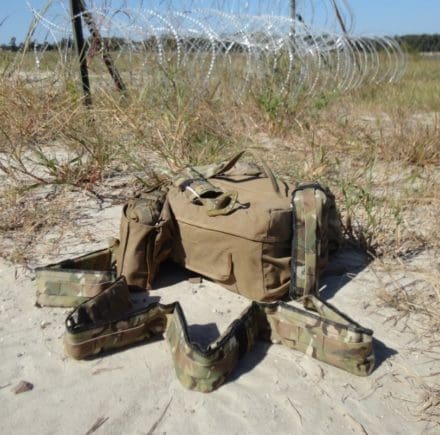
I admit, this particular item of kit has really captured my interest. It seems from the pictures that the “final” version of the rucksack is even more of a large ALICE-clone than the prototypes suggested. The rigging geometry, likewise, would be very familiar to you or me. It also appears, from a separate slide briefing that it is being considered not only for Airborne units but also as a possible Service-wide replacement for the Molle Large. Note, the standard Molle waistpad / belt used with the prototypes has been replaced by what looks like an OCP version of the pad /belt on the Marine’s FILBE pack. The shoulder straps also have  a new 4-point connection arrangement above the envelope pad. Interesting stuff.

He had run across a sources sought notice from earlier this year. The Army is looking to build more of its new MOLLE 4000 Airborne Rucksacks. What is interesting is the description. Up to now, it has only been intended for airborne troops.

Considering the numbers of 130,000 packs and the Army’s concentration on modernizing it’s Close Combat Forces, this looks like a possible fielding for the BCTs.

Here’s the info on the MOLLE 4000 Ruck:

“The new MOLLE Rucksack for Airborne and General Purpose Forces [ emphasis added] is a Government-owned design. It has an approximately 4000 cubic inch capacity and made of 1000 Denier nylon coated fabric, has an external frame, adjustable shoulder straps and an adjustable waist belt. The exterior of the rucksack has multiple storage pockets and pouches of varying dimensions. The interior of the main compartment of the rucksack has a pouch for carrying a radio / hydration bladder or other similarly sized equipment. The interior of the main compartment of the rucksack has a center zippered flap that divides the main compartment into two approximately equal upper and lower halves. The bottom of the rucksack has a separate [Air Items] storage compartment and above that a zippered access into the lower part of the main compartment.”

LTC Terry Baldwin (USA, Ret) contributed to this report.

US Army Seeks IDEAs for Next Generation Squad Weapons

Wednesday, September 18th, 2019

The US Army is all-in on upgrading its Small Arms for Close Combat Forces to a Next Generation Squad Weapons configuration.

Not only have the proceeded to Phase II of their search for a new Automatic Rifle and Carbine chambered in 6.8mm by downselecting weapons from General Dynamics OTS, SIG SAUER and AAI Textron Systems, but they’ve just put out a call to industry asking for their NGSW IDEAs.

Through the Innovative Designs & Engineering Assessment (IDEA) Program, Project Manager Soldier Weapons, is seeking information on new, innovative, enabling technologies that can be applied to NGSW weapons, fire control, and/or ammunition. These technologies will be used for experimentation, technical evaluation, and/or assessment of operational utility focused on enhancing system performance, sustainment, and/or training. This information will advise/inform future NGSW requirements and may compliment or be integrated into existing programs such as the NGSW weapons, ammunition, and fire control.

With so many parallel efforts going on at once, it’s obvious they want these weapons to be ready as quickly as possible.

Vendors who want to participate have until the end of the year to submit, but my advice is to send a submission in as soon as possible, for proper consideration.

Rheinmetall’s Lynx KF41 Infantry Fighting Vehicle downselected for Australian’s Land400 Phase 3 program

Wednesday, September 18th, 2019

Rheinmetall is pleased to confirm the Lynx KF41 Infantry Fighting Vehicle (IFV) has been selected by the Commonwealth of Australia to compete in the Risk Mitigation Activity (RMA) trials for the $15 billion LAND 400 Phase 3 program.

Lynx KF41 is a next generation tracked, networked and highly protected IFV which meets the stringent military requirements of LAND 400 Phase 3. The Australian Army needs a networked, protected and enabled IFV for close combat – to close in and defeat an enemy in the most dangerous and lethal environments for Australian soldiers.

Rheinmetall will deliver three Lynx IFVs to compete in RMA trials to be conducted in Australia. If successful, the Lynx IFV fleet will be manufactured in Queensland at Rheinmetall’s new Military Vehicle Centre of Excellence at Redbank south west of Brisbane.

Rheinmetall Defence Australia Managing Director, Gary Stewart, said: “We welcome the Commonwealth’s decision to select Lynx KF41 for the RMA trials and look forward to demonstrating the capability of our next generation infantry fighting vehicle.”

“We believe Lynx is the best vehicle in its class for Australian needs and it sets new standards in protection, mobility, lethality and knowledge needed to survive and defeat any adversary,” Mr Stewart said.

“Rheinmetall has developed this vehicle so it is positioned at an ideal level of maturity when Australia needs it to enter service in 2026 – and it has the inherent growth capacity and a growth path to extend these capabilities through its 40+ year life.”

Rheinmetall is already delivering an Australian Industry Network for Land 400 that builds an industrial capability in Australia. This includes creating high technology enduring jobs for hundreds of Australians by localising design and manufacturing expertise in electro-optics, weapon systems, fire control and sensor systems, turret manufacturing, variant design and manufacture, integration, armour systems, simulation, training and fleet sustainment.

Ben Hudson, Global Head of Rheinmetall’s Vehicle Systems Division, said: “We are delighted to have been selected in Australia for the next phase of this important program.”

“Design, development and manufacture of the Lynx in Australia for the Australian Defence Force will build on the advanced manufacturing jobs at our new MILVEHCOE as well as a strong national industrial network of Australian small and medium businesses across Australia,” Mr Hudson said.

Rheinmetall is delivering 211 8×8 BOXER Combat Reconnaissance Vehicles (CRV) to the Australian Army from 2019 after the vehicle was selected by the Commonwealth after 12 months of RMA trials by ADF personnel in 2016-2017.

Both the BOXER and Lynx are modular. That means the vehicles can be reconfigured to achieve many different missions with high commonality. This allows for reconfiguration of the fleets for emergent operational needs, providing greater mission flexibility, reducing through-life costs, enabling faster introduction of new technology, and optimising ongoing fleet management.

“Rheinmetall has taken all of the significant benefits of BOXER and ensured they are part of the Lynx KF41 package,” Mr Stewart said, “with significant commonality between the vehicle fleets.”

“Extending our partnership with Army and the Commonwealth to deliver the Lynx for Land 400 Phase 3 would deliver a fully integrated armoured vehicle fighting force for the ADF.”

www.rheinmetall.com

OSS Begins Shipping SDMR Suppressors

Tuesday, September 17th, 2019

Millcreek, UT – September 17, 2019  OSS Suppressors LLC has begun shipments for the first Elite-QD (EL-QD 762) suppressor units as part the Heckler & Koch® (H&K) contract to deliver between 5,000 and 6,000 complete M110A1 Squad Designated Marksman Rifle (SDMR) systems to the U.S. Army.

“OSS is very honored to have been selected as the official suppressor for the Squad Designated Marksman Rifle.  Coming on the heels of our selection as the official suppressor for the Compact Semi-Automatic Sniper System (CSASS), it’s extremely gratifying to be able to deliver the superior suppression and precision these mission critical programs demand,” said John Spurrier, CEO OSS Suppressors. “OSS’s patented Flow-Through™ technology is increasingly being acknowledged by military programs around the world as the only suppression solution that allows weapon systems to run reliably while delivering exceptional sound suppression, accuracy and durability – in the most extreme conditions.”

“We’re proud and privileged to work with Heckler & Koch to support their SDMR contract and deliver this much-needed capability to every squad in the Army,” said Dennis Cunningham, Director Government Business Development and Sales.

The EL-QD 762 is a Flat Dark Earth (FDE) variant of the commercially available Helix-QD (HX-QD 762).

• Learn more about the EL-QD 762 here.

• View EL-QD 762 technology and testing White Paper here.

For more information on the SDMR contract, please visit hk-usa.com.