XC3 Weaponlight

Archive for the ‘Contracts’ Category

USSOCOM Selects Nightforce for Ranging – Variable Power Scope Program to Equip Semi-Automatic Sniper Weapon Systems

Thursday, June 10th, 2021

Nightforce Optics is proud to announce that another variant of the ATACR product line has been selected to fill the Ranging – Variable Power Scope (R-VPS) component of the Miniature Aiming Systems – Day Optic (MAS-D) Program. The MIL-SPEC ATACR™ 4-20×50 F1 will be integrated as the Mid-Range and the Designated Marksman solutions for US Special Operations Command’s current and future anticipated Semi-Automatic Sniper Weapon Systems. The R-VPS will round out a complete family of Variable Power Scopes awarded to Nightforce Optics within the MAS-D Program.

As part of a life cycle replacement program and capabilities enhancement, the Nightforce MIL-SPEC ATACR 4-20 is optimized to provide improved target detection and identification, as well as hit probability, for engagements out to 1200m.
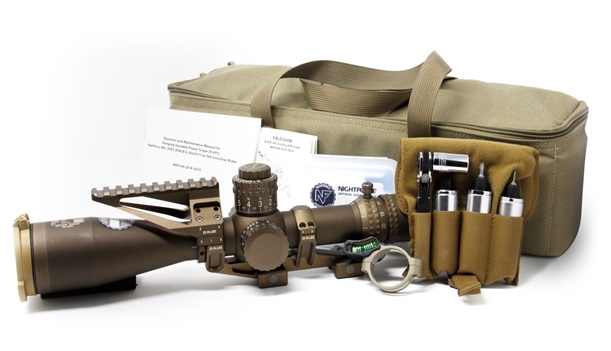
“We are both proud and humbled to realize another Nightforce ATACR model selection within the VPS family of scopes for USSOCOM. While a new benchmark for us, the real benefit is the continuity it brings to the end user. Now, regardless of weapon system, they will have commonality in adjustment features and ancillary components ”, said Nightforce’s MIL-GOV-LE Business Development Manager, Tod Litt.

The Nightforce MIL-SPEC ATACR 4-20 offers excellent performance in intermediate range target detection as well as reliable mechanical adjustment. The optic feature Nightforce’s exceptional ED glass, 0.1 Mil-Radian adjustment value for both windage and elevation, the Horus Vision TREMOR3 reticle, and a tan, hardcoat anodized finish. Like the previous VPS Program solutions the R-VPS is provided as a system, utilizing a purpose-built Nightforce scope mount and laser range finder integration platform. When employed as a complete solution, the SOF end-user’s ability to detect, range, and receive a firing solution correlates well with the semi-automatic weapon capability it is intended to enhance.

The new optics are to augment multiple systems in the SOCOM inventory and are intended to support the MRGG (Mid-Range Gas Gun) once it is fielded.

For more information on Nightforce Optics, please visit www.nightforceoptics.com, or for more details on military contracts, email Glenn Lass, MIL-GOV-LE Program Manager at glass@nightforceoptics.com.

Safran Optics 1 Delivers 4000th Laser Target Locator Module II to US Army

Tuesday, June 8th, 2021

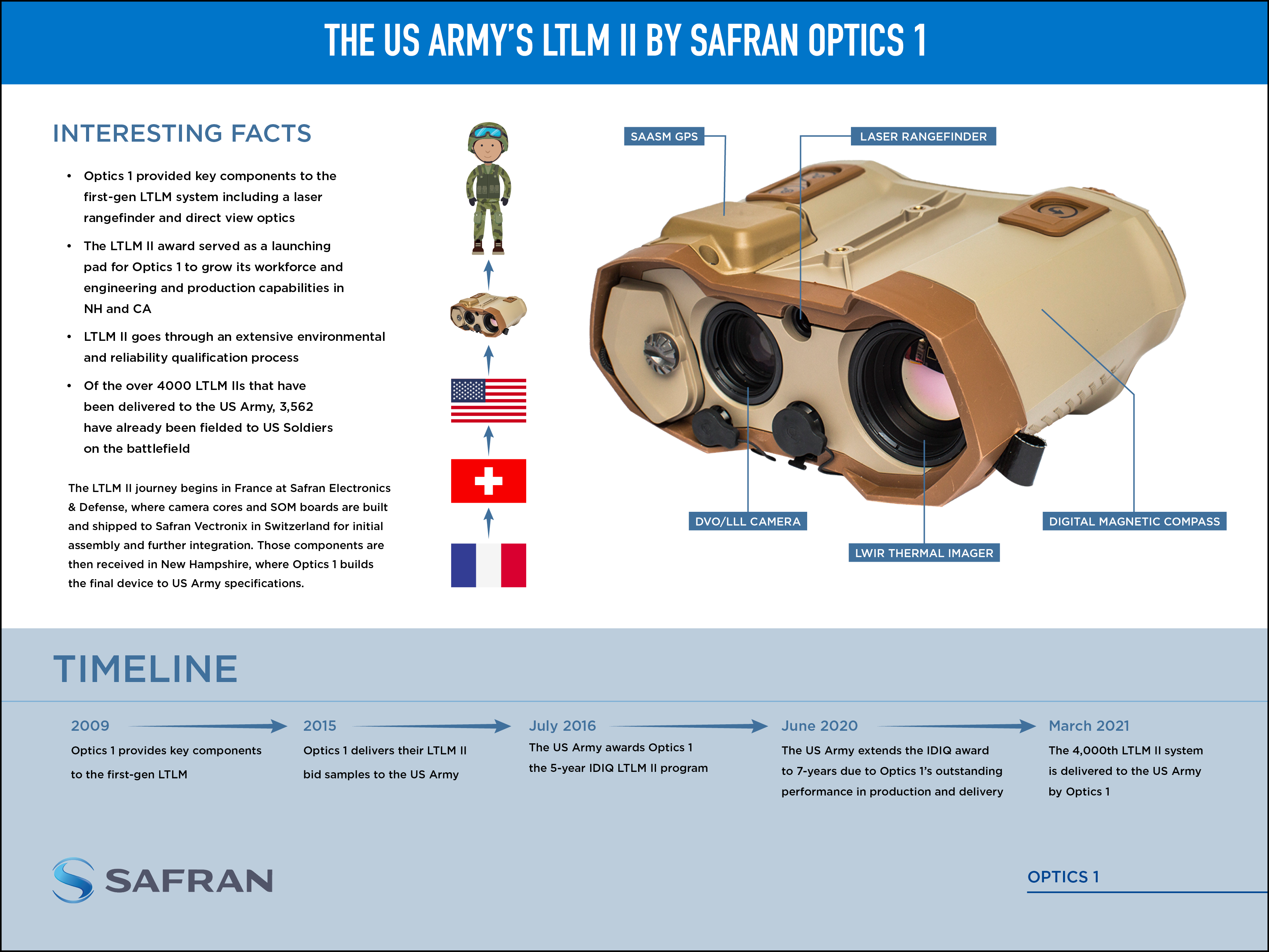
Safran Optics 1 recently celebrated a milestone. They have delivered the 4,000th Laser Target Locator Module (LTLM) II to the US Army.

For more than a decade, LTLM has served the US Army as a laser targeting system to help dismounted Soldiers identify targets day and night in all battlefield and climate conditions. Initially, Optics 1 provided direct view optic and laser rangefinder components for BAE Systems’ device, but as it matured and transitioned to LTLM II, Optics 1 became the prime contractor winning a five-year IDIQ contract in 2016.

Based in New Hampshire, Optics 1 leverages an international supply chain with two other companies, Safran Electronics and Defense and Safran Vectronix. Camera cores and SOM boards originate in France and are shipped to Switzerland for initial assembly. Optics 1 then builds the final device to US Army specifications here in the US.

Optics 1 President and CEO, Joe Bogosian shared, “when talking about the 4,000th LTLM II, we must start with the end goal, and that is Optics 1’s support for the US Soldier in successfully conducting their mission and returning safely.”

They have consistently met the Army’s contractual needs for on-time and high-quality deliveries.

In fact, it’s involvement in this very program that allowed Optics 1 to grow their workforce and expand into other programs like the US Special Operations Command Enhanced Clip-on Thermal and SWIR Imager (ECOTI/ECOSI) programs, the Integrated Compact Ultralight Gun-mounted Rangefinder (ICUGR) for the US Marine Corps Squad Range Finder program, and the ECOTI for the USMC Squad Binocular Night Vision Goggle.

But they don’t sit on their laurels. During a recent visit I was shown a few new systems which will be released soon.

CBP Purchases B&T USA GLO6 Less Lethal Launcher Systems

Monday, June 7th, 2021

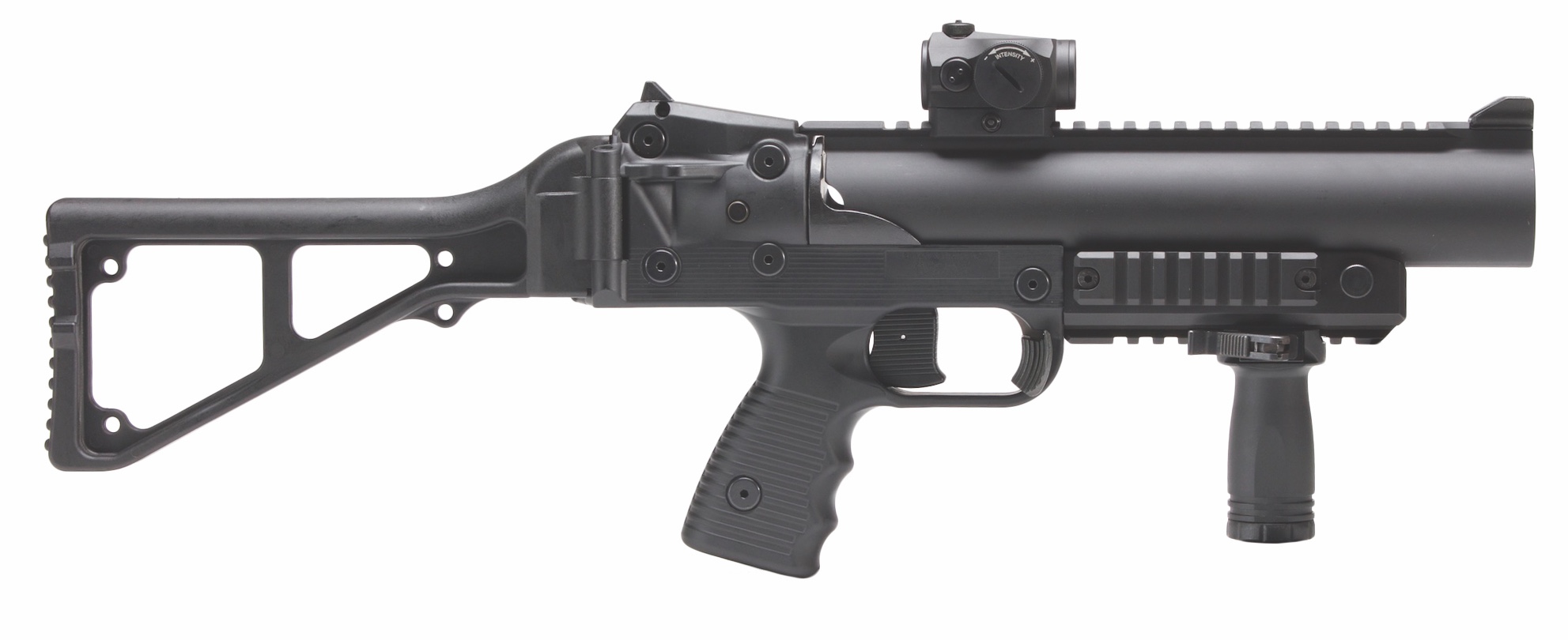
US Customs and Border Protection, part of the US Department of Homeland Security is purchasing 150 B&T USA GL06 Less-Lethal Launchers. This is the latest B&T USA procurement by CBP, who has purchased a sizable number of APC9K-G submachine guns by leveraging the US Army Sub Compact Weapon contract. The vehicle contract was modified earlier this year to allow other agencies to purchase from it and to supply Glock and SIG compatible lower receiver groups.

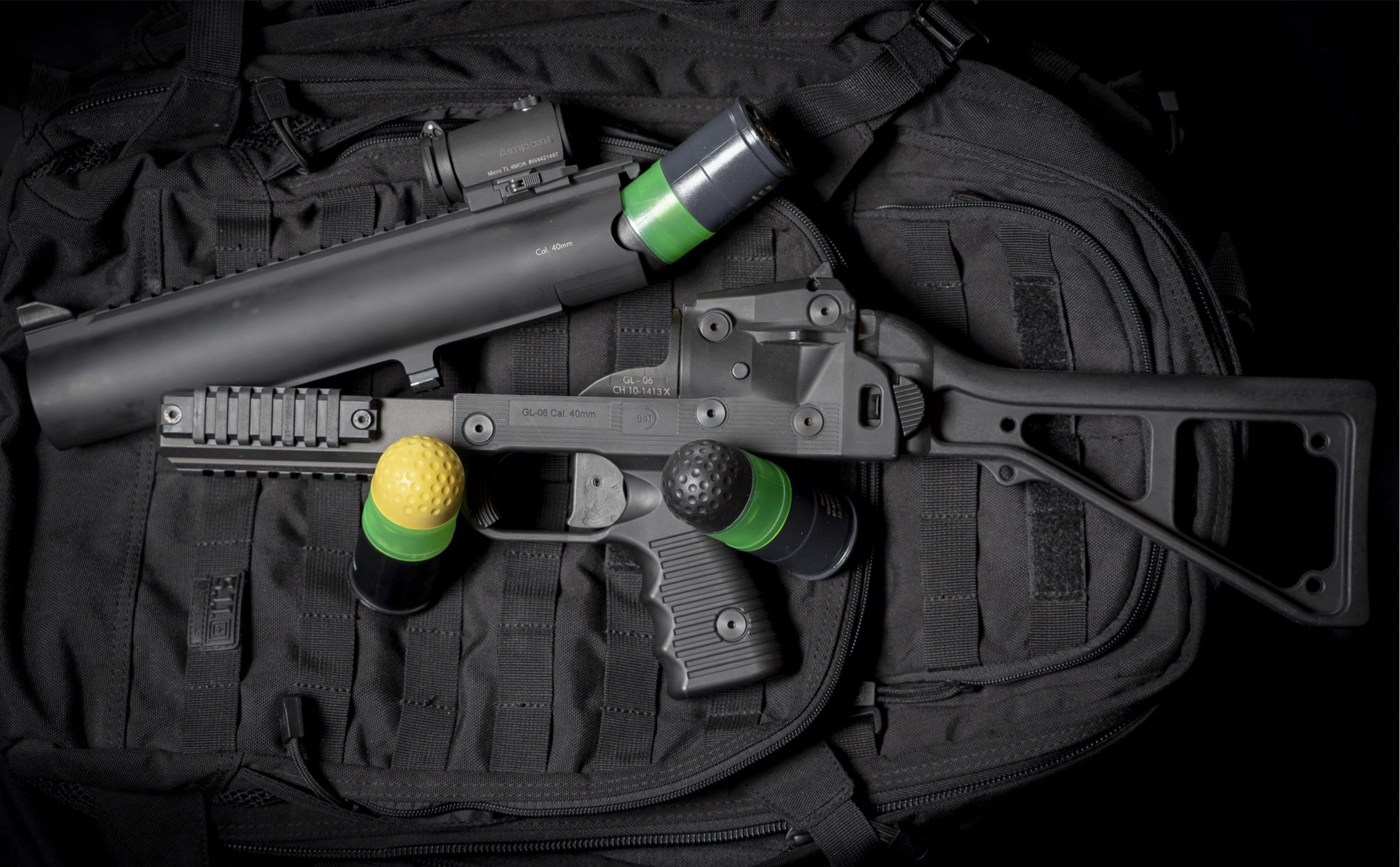
The GL06 is a shoulder-fired less lethal system capable of firing a complete range of lethal and less-lethal 40x46mm munitions and impact rounds through its fully rifled bore — delivering unmatched accuracy at standoff distances out to, and beyond, 40 meters. The GL06 is claimed to be lighter and more compact than other stand-alone platforms of the same class, yet is capable of greater accuracy, has superior ergonomics and offers a greater flexibility in munition selection to include the company’s own SIR and SIR-X (Safe Impact Rounds).

CBP GL06s will be delivered as configured from B&T USA, fitted with Aimpoint Micro TL optics, as well as their quick-detach optic mounts and vertical forward grips.

bt-arms.com

Inventus Power Awarded Nine-year, $1.25 billion Contract to Supply Conformal Wearable Batteries to the U.S. Army

Thursday, June 3rd, 2021

Inventus Power, a global leader in the design and manufacture of advanced battery systems for military, medical, commercial, and industrial markets today announced it has been awarded a $1.25 billion contract to supply Conformal Wearable Batteries to the U.S. Army over a nine-year period.

The United States Department of Defense released this contract information on its website on May 12, 2021.

Inventus Power, the inventor and current producer of warfighter wearable power, has been working closely with the U.S. Army for over a decade. In 2010, Inventus Power invented the Conformal Wearable Battery (CWB) for the U.S. Army, and since then, has delivered over 100,000 CWBs for its Nett Warrior Program and Small Unit Power programs as the sole source supplier.

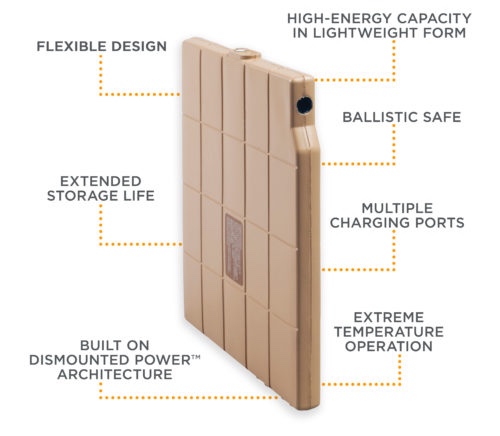
Inventus Power’s CWB 150 (14.8V; 152Wh) is a safe, flexible, and wearable power source designed to increase the mission effectiveness of the warfighter. It is the only fielded and proven battery that meets 100% of the U.S. Army’s requirements and exceeds the MIL-PRF-32383/4A specification in several areas critical to warfighter safety and mission accomplishment. Its anti-ballistic and antipropagation technologies make it one of the most advanced battery systems in the industry.

“We take pride in our long-standing partnership with the U.S. Army and our commitment to supply them with the most advanced centrally-powered source available – CWBs,” stated Mark Fiedler, Program Executive and Vice President of Government Programs and Support (GPS) at Inventus Power. “We are proud of this opportunity to continue to support our U.S. Military during its modernization effort. Our CWB is a proven product that meets the power, performance, and safety needs of today’s soldiers while reducing their overall weight burden.”

Technological advances have equipped today’s soldiers with more portable electrical systems than ever before. As their power needs continue to grow, future advancements in wearable power will need to offer higher energy density without increasing a soldier’s weight load or risk in battle.

“Inventus Power practices a process of continuous improvement for all our products and our CWB continues to evolve to meet the central power source requirements for warfighters,” stated Ilyas Ayub, Executive Vice President of Global Product Development at Inventus Power. “With our deep-rooted history of designing safe, innovative, and reliable power solutions for mission-critical applications, we are confident in our ability to design and develop more advanced, next-generation CWBs to meet the increasing energy needs of the modern soldier.”

www.inventuspower.com

Rheinmetall Delivers the First 25 Boxer 8×8 Combat Reconnaissance Vehicles to the Australian Army

Wednesday, June 2nd, 2021

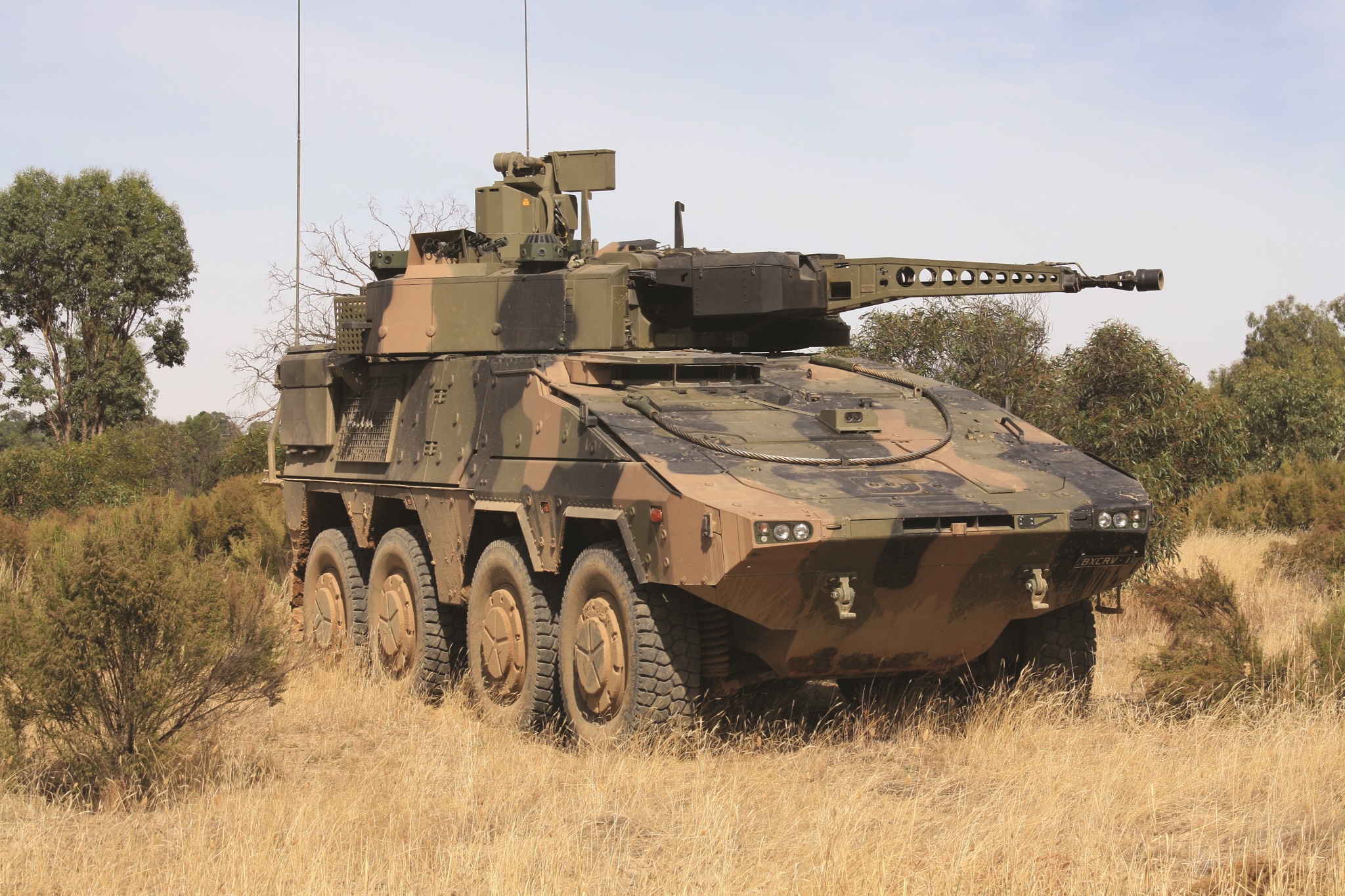
Rheinmetall is pleased to announce the delivery of the first 25 Boxer 8×8 Combat Reconnaissance Vehicles (CRV) to the Australian Army under the $5.2 billion LAND 400 Phase 2 Mounted Combat Reconnaissance Capability project.

Minister for Defence, Hon. Peter Dutton MP visited Rheinmetall Defence Australia’s Military Vehicle Centre of Excellence (MILVEHCOE) in Redbank, Queensland, to review the Boxer vehicles.

Rheinmetall will deliver a total of 211 Boxer 8×8 Vehicles in different versions, 131 will be the CRV variant. They will replace the Army’s Australian Light Armoured Vehicles (ASLAV) under LAND 400 Phase 2. Delivery of the first 25 vehicles enables Army to continue towards Initial Operating Capability on schedule as Rheinmetall moves into the next phase of the LAND 400 Phase 2 program.

Rheinmetall Defence Australia Managing Director Gary Stewart said Boxer’s levels of survivability and mobility was proving a game changer for Australia’s armoured cavalry.

“Boxer is now enabling the capabilities that allow Army to fight, survive and win on the modern, complex battlefields of today and tomorrow,” Mr Stewart said.

“And Rheinmetall is simultaneously delivering early combat vehicle capability to the Australian Defence Force while creating a sovereign industrial capability in combat vehicle design and manufacture.”

Mr Stewart said delivery of these initial vehicles was only possible by taking advantage of the current production lines in Germany, and using this approach as part of technology transfer activities to ensure Australian workers and suppliers become familiar with manufacturing techniques for highly complex military vehicles.

Rheinmetall Defence Australia has over 30 Australians currently living and working in Germany, working at Rheinmetall sites and learning from German colleagues. This is fostering close co-operation and a genuine partnership to realise the capability for the Australian Army.

“Australian engineers, project managers, welders, technicians, trainers and more are living and working with their colleagues in Germany to build a deep understanding of Rheinmetall products and, crucially, acquire the skills and certifications to transfer this expertise and intellectual property to Australia,” Mr Stewart said.

“This kick-starts the knowledge base for a sovereign Australian capability and is complemented with our engagement with the Australian TAFE sector and universities to ensure we build enduring pathways from our education institutions into the military vehicle manufacturing industry, enabling graduates to understand what we do today so they are ready to tackle the challenges of tomorrow.”

The MILVEHCOE is the focal point of the Boxer Australian Industry Capability (AIC) program. It is where Rheinmetall will undertake Australian design, manufacture, testing, training and support of the Boxer vehicles and training systems. The MILVEHCOE provides a sovereign facility where Defence, industry and research organisations can innovate and collaborate on the Australian Boxer and other defence programs.

Development, production and integration work is well underway within the MILVEHCOE as plant and equipment is installed and commissioned across the main production facility. This work is a key component of knowledge transfer activities for full rate Boxer production in Australia. This is scheduled to commence in Australia after commissioning of the MILVEHCOE Boxer production line is complete.

This approach to Australian Industry Capability has allowed Rheinmetall to accelerate involvement of Australian companies into the first 25 vehicles. This has resulted in Rheinmetall awarding contracts to more than 20 companies to supply products and services, and ensuring that Australian SMEs are building and supplying components onto every Australian Boxer vehicle.

The Boxer – versatile and battle-tested

The Boxer is a heavily protected 8×8 wheeled armoured vehicle. Its modular architecture enables a variety of variants unmatched by any other vehicle system. This multifaceted diversity underlies the Boxer’s rapid growth. Already today, new variants and upgrades are being planned. To date, some 1,200 vehicles in more than 20 different configurations are under contract by four NATO nations: Germany, the Netherlands, Lithuania and the UK. Moreover, Australia – a close partner of NATO – has ordered a total of 211 Boxer vehicle in several different versions, the first of which have now been delivered. 

Civil Air Patrol Awards $2.1 Million Contract to Persistent Systems to Supply AERONet system

Thursday, May 27th, 2021

Airborne Extensible Relay Over-Horizon Network will connect emergency managers to remote rescue and disaster relief teams

For Release on March 30, 2021

NEW YORK– March 30, 2021 – Persistent Systems, LLC (“Persistent”), an industry leader in mobile ad hoc networking (MANET) technology, announced today it has been awarded a $2.1 million contract to supply AERONet to Civil Air Patrol, the civilian auxiliary of the U.S. Air Force.

Persistent will outfit nine aircraft, 21 dismounted ground units, six vehicles and three tactical operations centers with AERONet, or the Airborne Extensible Relay Over-Horizon Network, an IP-based MANET capability that can facilitate:

• Disaster relief and emergency aid,

• Drug interdiction and other law enforcement missions,

• Intelligence, surveillance and reconnaissance,

• Personnel recovery operations,

• Close air support, and

• Joint force and joint nation operations.

The contract follows multiple earlier ones that included AERONet equipment for five aircraft, three dismounted units, one vehicle and one tactical operations center, along with spares.

“With AERONet, Civil Air Patrol will be able to conduct disaster relief and emergency aid missions far more effectively,” said Adrien Robenhymer, Persistent’s VP of Business Development for Air Force and Intelligence Community Programs. “Teams that otherwise would have had to operate in isolation can now connect back to a tactical operations center and be guided by medical professionals.”

Separate AERONet enclaves can also be federated at a regional hub, so different organizations can better coordinate their activities and avoid working at cross-purposes, Robenhymer added.

The AERONet kit for a Civil Air Patrol aircraft includes two MPU5 tactical networking devices, each operating on separate radio frequency bands and using a different set of multiple-input and multiple output antennas, said Gabe Pagliere, Persistent Systems project engineer and lead on the company’s AERONet efforts.

“When the tactical operations center and deployed ground teams are not in range of each other, they can relay their communication through the AERONet equipment on the airplane,” Pagliere said. “This enables their communication to extend across long distances, over terrain and around obstructions.”

Persistent Systems successfully conducted an AERONet demonstration in August linking an aircraft to a tactical operations center and a beyond-line-sight unit on the ground. The link delivered a live video feed to simulate how medical doctors could provide remote assistance from anywhere in the world. The demonstration proved that robust network connectivity could save lives during a disaster relief effort.

“Following that, we completed our first AERONet integration with an international customer,” Robenhymer said, “and we are already supporting multiple domestic and international implementations of this capability.”

www.persistentsystems.com

Rheinmetall Supplying Portuguese Army with 1,500 LM-LowProfile Laser Modules

Tuesday, May 25th, 2021

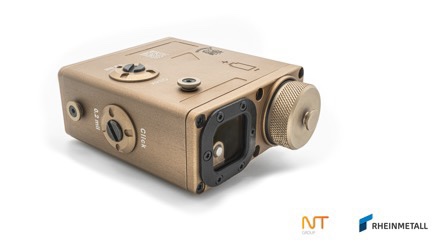
The Portuguese Army has awarded Rheinmetall an order for 1,500 LM-LowProfile laser modules. The contract, booked back in October 2020, calls for delivery of the devices in three lots. Delivery is to be complete by the third quarter of 2021. The order is worth a figure in the low single-digit million-euro range. In carrying out the order, Rheinmetall is cooperating closely with its local sales partner, NT Group Portugal.

Developed by Rheinmetall Soldier Electronics of Stockach, Germany, the minute LM-LowProfile laser module is designed for use on compact assault rifles, but it is also suitable for other small arms. The device, weighing around 160 grams and 85 mm long, can be attached to any standard assault rifle via a standard interface as defined by MIL-STD 1913/NATO STANAG 4694. Owing to its low height (25 mm), it can be used in combination with daylight optics. Nor does it interfere with the line of sight. Owing to the alignment of the laser along the running axis, the device lends itself particularly well to weapons without removeable mechanical sights (rear and front sights). Powered by a CR123 battery, the LM-LowProfile features visible and infrared target markers as well as a focusable infrared illuminator. All of the integrated lasers can be regulated in parallel by means of block adjustment. They can be remotely controlled via a trigger cable or by means of a single push button directly on the device. The LM-LowProfile is watertight at depths of up to 30 metres for up to two hours. Adding a tactical weapon light further enhances the laser module’s operational effectiveness. Rheinmetall has already supplied the Portuguese Army with a weapon light in an earlier order.

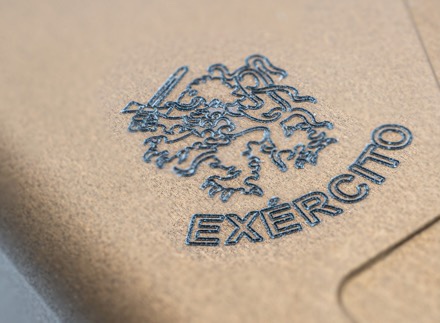
In comparative trials conducted by the Portuguese military, the device outshone its various rivals with regard both to ergonomics and performance. Moreover, the LM-LowProfile offers the added advantage of not being subject to America’s strict ITAR export regulations. Laser engraving can be used to individualize the devices.

Delivery is already underway. This is the third order from Portugal in the space of three years, underscoring the great trust the Portuguese military places in Rheinmetall’s soldier systems expertise.

Fresh Success for the Rheinmetall Mission Master: Her Majesty’s Armed Forces Order Four More Robotic Vehicles

Wednesday, May 19th, 2021

Rheinmetall has achieved another sales success in the United Kingdom. The British have ordered four more Mission Masters under the second phase (Spiral 2) of their Robotic Platoon Vehicle programme. Rheinmetall had already succeeded in placing its robotic vehicle in the Spiral 1 subproject of the UK’s RPV programme, which tests how unmanned vehicles can boost the firepower and capabilities of dismounted combat troops at platoon level.

Having already procured four Mission Master vehicles with cargo modules in the spring of 2020, the British military will now be acquiring four more Mission Masters, equipped this time with a fire support module to explore potential future capabilities.

The contract was awarded at the end of February. Delivery of the four Mission Master – Fire Support vehicles will take place between May and August 2021. The order, which will be handled by Rheinmetall Canada, also encompasses training and support activities as well as spare parts. Based in the UK, the joint venture company Rheinmetall BAE Systems Land will also be supporting the project.

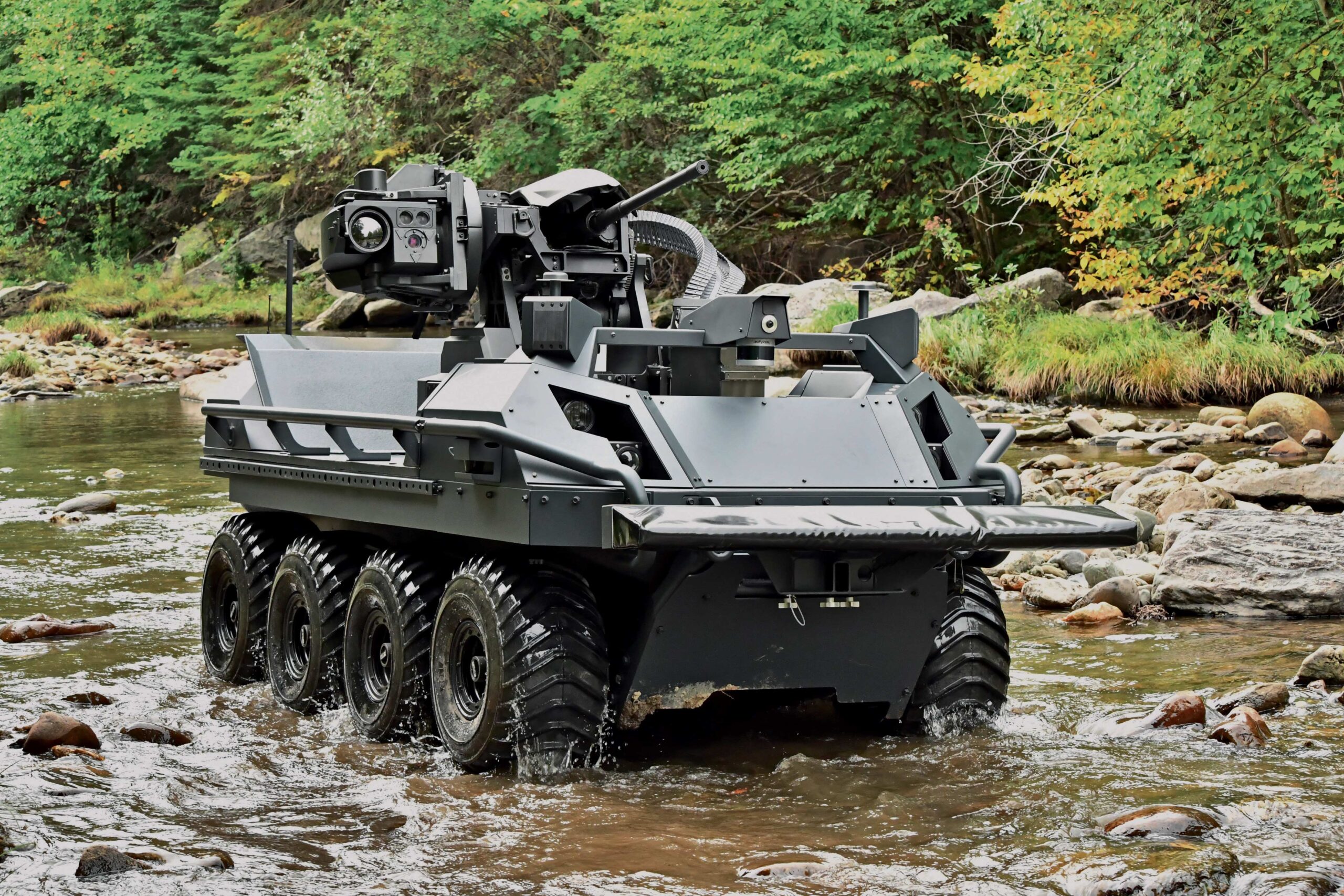
Boasting a whole host of innovative features, the Mission Master’s nerve centre is the Rheinmetall PATH autonomy kit. It comprises a suite of advanced sensors and perception algorithms that assure rich situational awareness, enabling the vehicle to find the safest route through the surrounding environment. This ensures that the vehicle can navigate challenging terrain safely and complete its mission successfully, without collisions.

Featuring a built-in security circuit board, a tablet computer running Rheinmetall command and control software lets the operator steer the platform and control the weapon station in a safe wireless way.
The Mission Master – Fire Support is armed with the Rheinmetall Fieldranger Multi, a remotely controlled weapon station. Targets are never engaged autonomously: there is always a human in the loop. Fully stabilized, the 7.62mm cal. Fieldranger Multi features a wide vertical and horizontal slewing range, thus assuring high accuracy and effectiveness even at long distances.

Rheinmetall Mission Master – Focusing on the future with robotics and autonomy

Robotics is already changing the modern battlefield. The Rheinmetall Mission Master is a modular, autonomous, unmanned ground vehicle designed to enhance the operational effectiveness of troops tasked with carrying out a wide array of activities. Thanks to the Mission Master vehicle, soldiers can count on artificial intelligence and robotic muscle when performing dull, dirty, and dangerous tasks – the three Ds – and, more importantly, they can carry out their missions in greater safety.
Ready for deployment, the Mission Master can serve either as an autonomous or semiautonomous element of a combat team.

Designed for maximum flexibility, the Mission Master can be outfitted for a multitude of different operations thanks to modular, quickly mountable build-ons. Besides logistic tasks, it can perform in a variety of other roles, including surveillance, security, casualty evacuation and CBRN detection. The Mission Master can also serve as a mobile radio relay station.