Salomon Forces Genesis MID GTX

Archive for the ‘Drone’ Category

Army Paratroopers Integrate Drones, Night Operations in Historic Company Live Fire

Thursday, May 14th, 2026

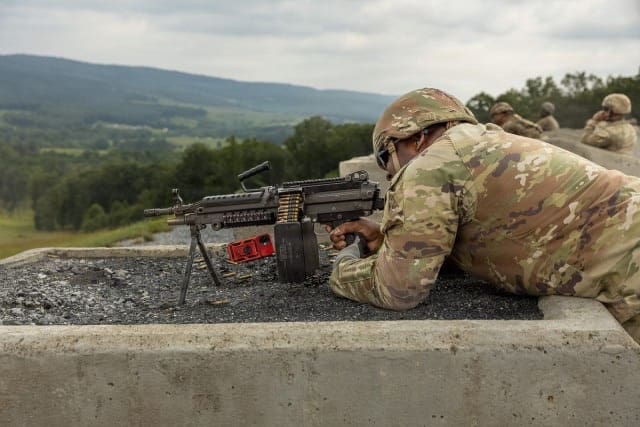
More than 700 paratroopers assigned to the 2nd Infantry Brigade Combat Team, 11th Airborne Division, executed a historic company live-fire exercise at the Infantry Squad Battle Course at Joint Base Elmendorf-Richardson, Alaska, April 27-May 8.

The event marked the brigade’s first exercise incorporating friendly kinetic and strike small unmanned aerial systems with paratroopers employing first-person-view drones to strike simulated enemy positions and defend against live adversaries in the form of drones.

“This was the first time our companies had organic FPV drone pilots executing live-fire strikes on critical targets,” said Army Capt. Ian McKibbin, lead range safety officer and member of the brigade operations staff. “The drones, built with components from [the] 11th Airborne [Division] Innovations [Team] and the [2nd Infantry Brigade Combat Team, 11th Airborne Division], Multifunctional Reconnaissance Company, were entirely controlled by the units on the ground. No live munitions were used, but the effect and accuracy were tremendous.”

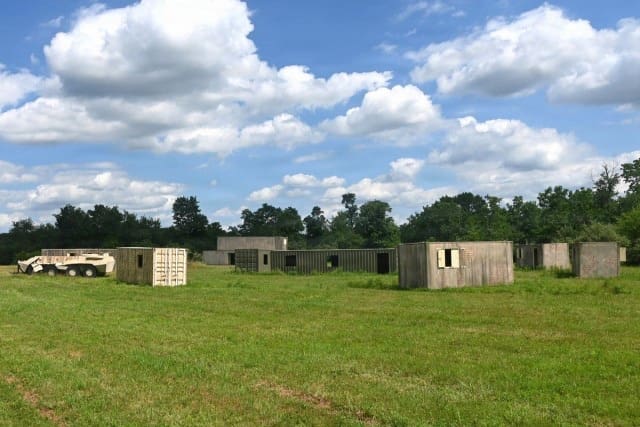
The exercise challenged paratroopers to clear a six-room shoot house, breach wired obstacles, clear trench systems and engage reinforced bunkers, all while reacting to contact from enemy drones. The small UAS attacked with simulated munitions, forcing commanders to rapidly employ counter-small UAS and adapt their tactics in real time.

“Company live fires are designed to be complex and demanding,” McKibbin said. “This event was especially difficult due to the presence of hostile drones, which observed friendly movement and actively attacked with simulated munitions. It’s the first time we’ve had a live, thinking enemy in the form of these drones for this type of training exercise.”

Day and night lanes were executed with both blank and live ammunition. Parachute flares illuminated targets during night engagements, enabling soldiers to protect maneuvering squads and provide signaling or degrade enemy night vision capabilities.

The entire company maneuvered on the lane, with commanders assigning platoons and squads to objectives. The event validated company commanders’ ability to integrate direct and indirect fires and demonstrate proficiency in complex, live-fire operations.

The event included participation from three battalions and extensive support from brigade headquarters. The small UAS also captured video of critical points for maneuvering elements, enabling near-real-time after-action reviews for companies.

“This exercise represents a significant step forward in integrating new technology and realistic threats into our training,” McKibbin said. “Our paratroopers demonstrated adaptability, teamwork and the ability to fight and win in a complex environment.”

By Army MAJ Ian Roth, 11th Airborne Division

Steadicopter Unveils Golden Eagle Mothership Architecture for Stand-Off ISR and Aerial Force Projection

Wednesday, May 13th, 2026

New operational concept transforms rotary RUAS into an airborne deployment hub for distributed ISR, strike support and long-range mission flexibility

May 12, 2026 – Steadicopter Ltd., a developer and manufacturer of rotary unmanned aerial systems, introduced an advanced operational architecture for its Golden Eagle RUAS, unveiling a “Mothership” concept specifically designed for sustained operations in contested and denied environments. The concept transforms the rotary unmanned platform into a long-range aerial deployment carrier capable of transporting and releasing ISR drones and precision effectors deep into operational theaters while maintaining stand-off survivability.

Modern conflict environments are characterized by layered air defenses, electronic warfare pressure, and the growing vulnerability of high-value aerial assets. Within these threat landscapes, survivability is no longer defined solely by endurance and range, but by the ability to generate close-range intelligence and precision strike effects without exposing the primary platform. The Golden Eagle Mothership concept addresses this requirement by combining long-distance projection with deployable, low-signature systems that operate directly over target areas.

What differentiates this architecture is the inherent advantage of rotary unmanned systems. Unlike fixed-wing UAVs, the GoldenEagle can conduct stable, persistent hovering for pinpoint deployment of drones at precisely controlled coordinates. This capability enables covert insertion behind terrain features, urban structures, or maritime obstacles with exceptional accuracy. The platform’s ability to operate at very low altitudes further enhances survivability, allowing terrain-masked approaches that minimize detection during insertion phases.

At the same time, the Golden Eagle can transition to higher altitudes to function as a communications relay node, extending datalink reach and ensuring secure real-time transmission from deployed micro-systems back to command centers. This vertical flexibility, low-altitude penetration, stationary hover for deployment, and high-altitude data relay, creates a multi-layered operational envelope uniquely suited for contested environments.

Under the Mothership concept of operations, the Golden Eaglelaunches from naval vessels or remote land bases and conducts long-range transit outside hostile air defense coverage. Once positioned at stand-off range beyond short-range air defense and MANPADS envelopes, the system deploys compact ISR drones capable of penetrating closer to objectives at low altitude and reduced acoustic and radar signatures. These micro-UAS assets deliver high-resolution electro-optical and infrared intelligence directly over the area of interest, generating an additional operational layer of close-proximity awareness.

This proximity layer significantly enhances decision cycles by providing immediate visual confirmation, pattern-of-life analysis, and dynamic target tracking from positions that would otherwise require ground teams or manned aircraft exposure. In high-risk environments, such close-range intelligence can determine the difference between strategic restraint and decisive action.

When required, the architecture also enables precision kinetic operations at extended distances. Loitering munitions or armed micro-systems can be deployed from the mothership configuration, delivering precision strike capability while the primary RUAS remains outside the threat envelope. The rotary platform’s hover stability ensures controlled release conditions, optimizing trajectory and target acquisition from the outset.

The concept is particularly suited for cross-border ISR missions, counter–A2/AD probing, maritime and littoral security operations, special forces overwatch, and strategic infrastructure monitoring. In naval scenarios, the Golden Eagle can launch from offshore platforms, approach at low altitude to avoid coastal radar detection, deploy ISR drones over shoreline targets, and reposition at altitude to maintain communications continuity.

By integrating rotary-wing maneuverability with distributed unmanned deployment, Steadicopter’s Golden Eagle Mothership concept introduces a scalable model for operating deep inside contested environments without increasing exposure of high-value assets. It combines endurance, hover precision, altitude adaptability, and modular payload integration into a single survivable architecture.

With this development, Steadicopter continues to advance rotary unmanned capabilities for modern threat landscapes—where operational reach, survivability, close-range intelligence, and precision strike must coexist within one integrated and flexible system.

The Golden Eagle Mothership architecture is designed to operate as part of a broader, interoperable ISR environment, including participation in the multidomain ISR ecosystem being developed by World View, an Ondas company. Through this ecosystem, Steadicopter is aligning its rotary unmanned systems with stratospheric, aerial, and datacentric ISR layers to support distributed sensing, taskoncue operations, and rapid decisionmaking across domains. The approach reflects a shared commitment to collaborative CONOPS, systemtosystem interoperability, and scalable mission integration in support of complex operations.

Beez Combat Systems FPV Goggle Tactical Headband Strap

Saturday, May 9th, 2026

The FPV Goggle Tactical Headband Strap is engineered for operators who demand reliability when it matters most. Designed from the ground up for tactical drone operations, this headband system eliminates the failure points found in stock goggle straps. 

The 2″ elastic headband paired with dual 2″ triglids provides a dialed-in fit with maximum comfort during extended wear, while the 1″ webbing and 1″ triglid system broadens compatibility across virtually every major FPV goggle platform on the market 

The FPV Goggle Tactical Headband Strap is purpose-built to keep your power source secure during tactical operations. The battery strap can be moved/removed to which ever position works best for the operator 

For additional information and availability –  Beez Combat Systems

Dogface Soldiers Integrate Drones, Electronic Warfare During Raider Density

Friday, May 8th, 2026

FORT STEWART, Ga. — U.S. Soldiers assigned to 1st Armored Brigade Combat Team, 3rd Infantry Division, are redefining how modern warfare is fought during Raider Density, an intensive training event conducted from April–May designed to prepare units for large-scale combat.

Across the installation’s training areas, Soldiers are adapting to a battlefield where information, speed and innovation are as critical as firepower, taking on expanded roles as battlefield technology integrators who connect emerging capabilities directly into maneuver formations.

The concept is rooted in multi-domain operations, or MDO, which synchronizes effects across land, air, cyber and electromagnetic domains. During Raider Density, Soldiers are applying it by employing unmanned aircraft systems and electronic warfare tools at the lowest levels to sense, understand and act within complex environments.

“It’s best to put UAS assets at the company level because it allows them to be used more freely,” said Sgt. Ian Anglin, a UAS operator with 1st ABCT. “At lower levels, they’re quickly accessible and ready to be used at a moment’s notice.”

For cavalry scouts, this shift is transforming reconnaissance by pairing traditional observation with quadcopter drones and EW capabilities, enabling them to identify targets, monitor movement and interpret activity within the electromagnetic spectrum with greater speed and precision. For Soldiers integrating EW at the maneuver level, maintaining proximity to the formation is critical.

“Staying with the formation allows us to get close enough to intercept those systems while maintaining good security,” said Sgt. Griffin Quimby, assigned to the 10th Brigade Engineer Battalion, 1st ABCT.

By integrating UAS and EW into a single sensing framework, Soldiers can confirm targets, share real-time intelligence and speed up decision-making, increasing responsiveness across maneuver elements.

“Having UAS allows us to scout the battlefield before we’re out there,” said Anglin. “We can relay enemy positions and direct or indirect fire missions.”

Elements of 5th Squadron, 7th Cavalry Regiment have demonstrated this integration during the exercise, reflecting a broader effort across the brigade to place advanced capabilities in the hands of junior Soldiers, enabling them to adapt quickly and shape the fight at the tactical level.

“If we want to be able to counter UAS and EW or improve our own EW capabilities, we’re going to have to allow the Soldiers to innovate,” said Quimby.

As Raider Density continues, Soldiers of 1st ABCT are reinforcing that success in future conflicts depend on both advanced technology and the Soldiers who employ it. This approach to integrating emerging systems at the lowest tactical level is emerging as a key component of the division’s readiness across multiple domains.

“Integrating with maneuver formations allows Soldiers to see what’s ahead,” said Anglin. “It allows them to survive.”

– SGT Jonathon Downs

U.S. Army Expands Company-Level SUAS Solutions By Adding Three New Systems

Thursday, May 7th, 2026

REDSTONE ARSENAL, Ala. – The U.S. Army expanded the company-level Small Unmanned Aircraft System (SUAS) portfolio for priority Transformation in Contact (TiC) units by selecting three additional vendor solutions. Led by the Capability Program Executive (CPE) Aviation’s Project Manager for Uncrewed Aircraft Systems (PM UAS), this capability expansion supports the Department of War’s (DoW) Drone Dominance priorities, expedites Army TiC initiatives, accelerates Soldier feedback, and informs requirement refinement.

The vendors and their respective systems are AeroVironment’s Vapor CLE, Mistral Inc.’s Thor, and Quantum Systems’ Vector AI. These systems were selected as TiC candidates following a flight capability demonstration and a manufacturing readiness assessment, which validate performance and equip warfighters with drone technology faster, in accordance with DoW’s Drone Dominance efforts.

“TiC units provide invaluable feedback to shape technology requirements,” said Lt. Col. Michael Carroll, SUAS Product Manager. “Our Soldiers are directly informing requirements that will allow us to continue delivering the best UAS products to meet the demands of our fighting formations.”

These platforms join the currently fielded Performance Drone Works (PDW) C-100 and Anduril Ghost-X systems placed in many Army formations, bringing the company level UAS portfolio to five different systems with their own set of unique capabilities and designs that enable a tailored approach to battlefield effects.

38 Sierra Introduces Drone Incident Response Training (DIRT): Counter-UAS Training for Grounded Drone Response

Wednesday, May 6th, 2026

Barboursville, VA — May 5, 2026 — 38 Sierra, a Virginia-based provider of specialized counter-UAS training, announces Drone Incident Response Training (DIRT), a specialized training program designed to prepare personnel to safely assess and manage grounded, crashed, suspicious, or potentially weaponized unmanned aircraft systems (UAS).

Most counter-UAS training focuses on detection, airspace monitoring, and drone interdiction. DIRT focuses on what happens after the drone is on the ground.

Whether a drone is abandoned, has crashed, is found near sensitive infrastructure, or is associated with suspicious activity, the operational challenge changes the moment it becomes a grounded aircraft. At that point, personnel must be prepared to assess the situation safely, manage the scene, preserve evidence, and support informed escalation.

DIRT was developed to address that operational gap.

A Practical Program for Grounded Drone Response

Drone Incident Response Training (DIRT) is a counter-UAS training program built specifically

around the operational challenges associated with grounded drone incidents. Rather than

focusing exclusively on aerial detection or interdiction, DIRT prepares personnel for the critical phase that begins once a drone is on the ground.

DIRT emphasizes:

  • Safe assessment of grounded, suspicious, or potentially hazardous drones
  • Hazard recognition and risk-informed decision-making
  • Reporting, scene control, and escalation procedures
  • Evidence preservation and support to follow-on response
  • Operational continuity during drone-related incidents

DIRT is designed to provide actionable, immediately applicable procedures for personnel responsible for managing drone incidents in real-world operational environments.Mission-Specific Training for Real-World Incidents

DIRT is structured as a mission-specific training program designed around the environments,

risks, and response requirements each organization is most likely to face.

38 Sierra currently delivers DIRT for:

  • Critical Infrastructure
  • Law Enforcement
  • Executive Protection
  • Aviation & Airport Security
  • Maritime & Port Security
  • Event & Stadium Security
  • Corrections
  • Military Facilities
  • Bomb Squads & EOD

Each course is built around the operational realities of that environment, ensuring personnel receive relevant, role-specific guidance aligned to the incidents they are most likely to encounter.

“When a drone is on the ground, the problem has just begun. DIRT was developed to ensure personnel can recognize hazards, assess risk, and respond safely during that critical phase of the incident,” said Patrick McCrone, Co-Founder of 38 Sierra.


Scenario-Based Training Built for Practical Application

To support DIRT delivery, 38 Sierra develops realistic inert UAS threat training aids and support tools that enhance hands-on instruction and scenario-based exercises.

These tools are used to support:

  • Hazard recognition training
  • Scenario-based practical exercises
  • Response evaluation and decision-making drills
  • Controlled simulation of grounded drone threat situations

These supporting tools are integrated to improve realism and reinforce functional application without introducing risk.

Built on Operational Experience

DIRT is informed by operational experience, real-world threat analysis, and direct contributions to the development of grounded drone response procedures.Co-Founder Patrick McCrone is an Explosive Ordnance Disposal (EOD) professional with over two decades of experience in counter-IED operations, weapons technical intelligence, and grounded unmanned aircraft system response. He previously served as a Technical Lead at the U.S. Army Combat Capabilities Development Command (DEVCOM) C5ISR Center, where he led work focused on UAS threats, radio-controlled improvised explosive devices, and grounded drone response procedures. He was responsible for developing the initial doctrine for U.S.

Military EOD response to grounded small unmanned aircraft systems, helping establish formal tactics, techniques, and procedures for a previously unaddressed operational gap.

Preparing Personnel Before the Incident Occurs

DIRT is built for the personnel most likely to encounter the drone first.

In many cases, that is not a specialized response unit. It is a patrol officer, facility security professional, corrections officer, military security element, or frontline employee expected to make immediate decisions in uncertain conditions. 38 Sierra provides practical training and the tools necessary to ensure those personnel are prepared to assess grounded drone incidents safely, maintain control of the scene, and support informed follow-on response.

To learn more about Drone Incident Response Training (DIRT), visit: www.38Sierra.co

Eerie Company: A New Threat at the Joint Multinational Readiness Center

Wednesday, May 6th, 2026

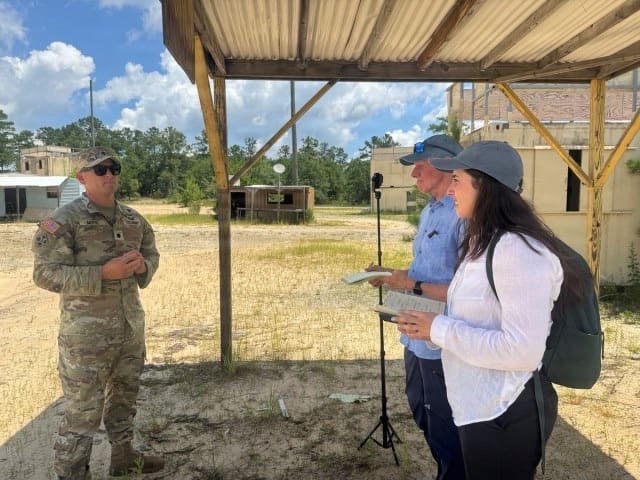
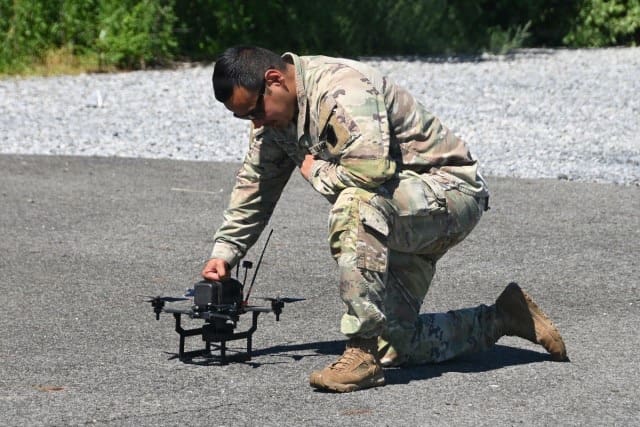
HOHENFELS, Germany — Soldiers assigned to the newly established Eerie Company, 1st Battalion, 4th Infantry Regiment, used first-person-view drone systems to enhance reconnaissance capabilities during Joint Multinational Readiness Center exercises in Hohenfels, Germany.

Acting as the opposing force during the exercise, the company replicated a modern battlefield threat by combining emerging drone technology and electronic warfare with traditional infantry tactics, creating a realistic training environment for rotational units.

Established in December, Eerie Company specializes in short-, mid- and long-range reconnaissance to provide timely, accurate battlefield intelligence. The unit was created to address the evolving demands of modern warfare and to increase situational awareness across the battalion.

“The rate at which modern warfare is moving, and due to current conflicts, this company was established to help bridge that gap and be the eyes and ears of the battalion,” said Army Capt. Luther Salmon, company commander.

One of the primary systems the company employs is the Archer, a first-person-view drone used to replicate emerging aerial threats observed in ongoing global conflicts, including the war in Ukraine.

Army Spc. Ryan Hatcher, an infantryman and subject matter expert on the system, emphasized its effectiveness during training.

“It’s pretty good for an FPV,” Hatcher said. “Other FPVs we’ve flown here in Hohenfels, Germany, we’ve only been able to max out at eight to 10 minutes of battery life.”

Hatcher added that operating first-person-view drone systems is not limited to a specific military occupational specialty, which allows Soldiers from across the formation to qualify as drone pilots and contribute to reconnaissance efforts.

He said the Archer can be configured for multiple roles, including intelligence, surveillance and reconnaissance. In some scenarios, similar systems may be equipped with munitions, allowing Soldiers to train on identifying the differences between armed and unarmed drones.

Due to its limited range, the system is primarily employed in defensive operations, providing units with a close-range aerial perspective of the battlefield and enhancing their ability to detect and respond to threats.

Through the use of drone technology and specialized reconnaissance elements, Eerie Company continues to adapt to the rapidly changing operational environment, ensuring the battalion remains prepared for modern combat scenarios.

By SSG Troy Wharton

AEVEX Joins Persistent Systems’ Wave Relay Ecosystem

Tuesday, May 5th, 2026

Wave Relay® MANET as preferred network for Atlas UAS, Mako and Mako Lite USVs

NEW YORK – May 5, 2026Persistent Systems, LLC (“Persistent”), a leader in advanced networking solutions, announced today that AEVEX, a defense technology company providing autonomous unmanned systems and mission solutions for U.S. and allied customers, has joined Persistent’s Wave Relay® Ecosystem. AEVEX is integrating the Wave Relay® MANET into its Atlas unmanned aerial system (UAS) and its Mako and Mako Lite unmanned surfaced vessels (USVs).  

• Atlas is a Group II UAS supporting ISR and precision-strike mission variants;  

• Mako and Mako Lite are modular unmanned surface vehicles equipped for ISR, maritime sensing, communications relay, and mission?tailorable payloads.

The Wave Relay® Ecosystem is an industry alliance of unmanned systems and sensor companies leveraging the Wave Relay network to unite warfighters and battlefield technology on a common fabric of connectivity.

“Prior to AEVEX joining the Ecosystem, our Wave Relay® MANET was integrated into their Atlas UAS, which was selected for the Army’s Launched Effects-Short Range program following successful testing,” said Ed Fahrenkrug, Director of Programs at Persistent Systems. “We are excited to be partnering with a leader in precision strike unmanned systems and build on the Army’s success to meet future operational needs.”

The addition of AEVEX extends the Wave Relay® Ecosystem across a broader set of unmanned platforms. Persistent believes autonomoussystems will soon outnumber warfighters on the battlefield, and networking systems, sensors, and warfighters into a common operating picture will require both resilience and high networkscalability. The Wave Relay® MANET provides that scalable communication fabric today.  

“We chose Persistent’s Wave Relay® MANET for communications because of its high scalability, resilience to Electronic Warfare (EW),collaborative behavior, targeting, and intelligence collection,” said Chris Robinson, Vice President of Business Development at AEVEX. “Additionally, Persistent’s Cloud Relay™ capability supports global connectivity in contested environments.”

With AEVEX as the 20th Wave Relay® Ecosystem partner, the Wave Relay® MANET has become the standard network uniting unmanned systems, sensors, devices, and warfighters on a global fabric of connectivity.