SIG SAUER - Never Settle

Archive for the ‘Guest Post’ Category

Repurposed Technology Could Help Protect Soldiers

Thursday, November 23rd, 2023

By Aeriel Storey

Army engineers use inkjet printers to replicate explosives samples for testing, training 

ABERDEEN PROVING GROUND, Md. — An unlikely fusion of ink, ingenuity and integrated teamwork is applying an existing technology to the challenge of sampling and detecting explosives.

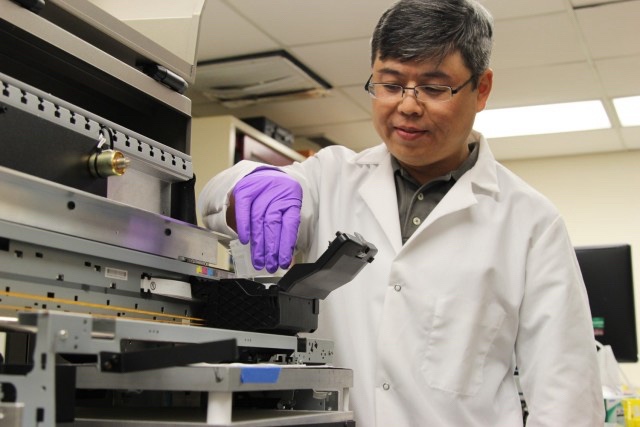
At the U.S. Army Combat Capabilities Development Command Chemical Biological Center, a team of engineers have adapted inkjet printing technology to deposit trace amounts of explosive materials onto surfaces that can be used to test sampling and detection methods.

Since 2010, DEVCOM CBC’s electronics engineers, Raphael Moon and Norman Green, have been working on developing the unique capability by using a commercial off-the-shelf printer that deposits explosive materials on a multitude of surfaces accurately, evenly, and reproducibly.

Their idea to replace the printer’s original ink with explosive materials came from an earlier program that required the use of commercial inkjet printers to replicate detonation patterns. To bring that concept into fruition, a multidisciplinary team consisting of Kevin Hung, Erik Roese, Ashish Tripathi, Erik Emmons and Dr. Jason Guicheteau was established.
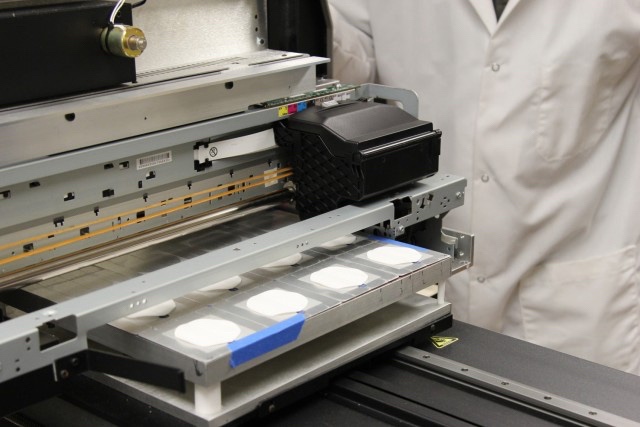
“We had to test for about a year before we felt very comfortable trying to print explosives and chemicals correctly,” Moon said of the development process. “The idea of replacing the material in an ink cartridge is simple, but the properties of the chemicals need to be considered for it to work. The ink must have the right viscosity, surface tension and a suitable solvent that maintains the consistency of the ink throughout the printing process that does not damage the printer.”

Precision and accuracy have always been at the forefront of the development process for the system to produce reliable results, allowing for control and accuracy within a microgram. To achieve these results, the team created and tested various ink solutions and engineering options. “We’re really lucky because we’re in an organization where multiple disciplines are all in one building,” said Hung, a software engineer at DEVCOM CBC. “We were able to leverage everybody’s knowledge and experience to contribute to the inkjet project. It was really a team effort.”

Since its inception, the program has demonstrated that the inkjet printer can duplicate samples with high precision, accuracy, scalability, and flexibility for a wide array of various use cases.

One program that the inkjet printer has been applied to includes the NATO Research Task Group. The program uses trace amounts of explosives to create test and evaluation standards. The program has allowed the team to display the inkjet printer’s ability to print on realistic substrates that would accurately reflect trace detection of explosives in the field.

“We are printing on substrates that replicate materials normally found among debris from detonated devices including car parts, pieces of walls, ceilings, and floors,” said Roese, CBC’s electrical engineer on the project. To print such precise solutions onto objects that vary in size, shape, and curvature is groundbreaking for modern-day printing, and creates a pathway for future developments of systems alike.

At DEVCOM CBC, a team of engineers have adapted inkjet printing technology to deposit trace amounts of explosive materials onto surfaces that can be used to test sampling and detection methods.

These breakthroughs are integral for experimentation and have proved to be applicable in the field. Most recently, the team has been successful in assisting the military on training their working dogs to detect explosives by printing small amounts on sample coupons, as opposed to using traditional bulk quantities. The coupons were buried to simulate sub-surface explosives detection. The test received positive feedback from Soldiers testing in the field and opened more avenues for which the printer could be applied.

The highly customizable system can be used for various projects, requiring in-depth involvement from the inkjet printing team to assist on the specific needs and requirements of the project. “We have developed this system to be accurate and reproducible, so if there are certain parameters that a user needs, we can replicate those requirements for them,” said Hung. “We can also create new inks to mimic instances that users would see in the field.”

The idea has even expanded to include an additional printer, called a nano-plotter, that can be used for smaller, more precise material applications. The team is continuing to pursue projects they can support that allow them to push the boundaries and capabilities of the inkjet printers.

AXL Advanced + V•XV CONCEPTS Merger Announcement

Wednesday, November 22nd, 2023

It all started backstage at a concert where a deal would be negotiated that would lead to VXV and AXL joining forces.

Since duals to the death were outlawed in 1859, both teams chose a modern solution to decide who would acquire the other.

After winning 4 out of 7 games of Russian Roulette UNO™, AXL is honored to announce that VXV Concepts has been acquired by AXL Advanced, with all VXV Concepts employees joining the AXL team.

VXV Concepts will continue to operate as its own brand through VXVconcepts.com, with all the resources AXL offers.

Both teams are excited about the future and look forward to releasing innovative products in 2024!

Please note that VXV Concepts products are currently built to order and will transition to in-stock like AXL offers in early 2024. Product and order questions can be directed to support@VXVconcepts.com or support@AXLadvanced.com

www.VXVconcepts.com

www.AXLadvanced.com

Air Force Reserve Component Launches Direct Commission Program; Constructive Service Credit for Cyberspace Warfare Operations Career Field

Wednesday, November 22nd, 2023

By Secretary of the Air Force Public Affairs

ARLINGTON, Va. (AFNS) —  

The Department of the Air Force has announced that the Air Reserve component has initiated a direct commission and constructive service credit program memo for people interested in serving in the cyber security and cyberspace warfare operations career fields.

Brig. Gen. Terrence Adams, deputy principal cyber advisor to the Secretary of Defense and senior military advisor for Cyber Policy, made the announcement on behalf of the Air Force at the Aspen Institute Cyber Summit in New York.

“As our nation faces tough challenges in the cyberspace warfighting domain, the Air Force Reserve needs the best talent America has to offer,” Adams said. “The Cyber Direct Commission program is designed to attract highly skilled cyber professionals from industry and enlisted career fields who want to serve their nation in a part time capacity.”

Enlisted personnel and civilians qualified to serve as Air Force Warfighter Communications Operators (17D) and Cyberspace Effects Operators (17S) can earn a direct commission as an Air Force officer. Also eligible are personnel who are qualified to earn a cyberspace engineer/agile software developer – Cyberspace Engineering “Z” prefix as outlined in the Air Force Officer Classification Directory.

“This program will allow the service to access cutting edge talent and leverage private sector skills to make us more competitive in the changing world environment,” said Alex Wagner, assistance secretary of the Air Force for Manpower and Reserve Affairs.

A review board will determine if candidates are eligible for constructive service credit for prior commissioned service, advanced education, and special training or experience.

Constructive service credit is used to determine initial grade, rank and service for promotion eligibility and is usually granted in year-long increments.

Applicants must meet the following criteria:

·?? Be eligible for a commission in the Air Force, including physical standards for entrance

·?? Possess or be eligible for a top secret/sensitive compartmented information security clearance

·?? Have a quantifiable record of leadership, management or supervisory experience in academia, civilian and/or military organizations (preferred)

·?? Have qualifying advanced education, specialized training and/or experience in cyber-related fields as outlined in the memo

Candidates will incur an initial four-year Selective Reserve obligation from the date of appointment or commission and an additional four-year Inactive Ready Reserve obligation. They will also be required to complete the U.S. Air Force Officer Training School program. Their monthly reserve obligation will depend on the needs of their units, training requirements and mission requirements.

This program follows a regular Air Force pilot program for direct commissioning into cyber career fields and constructive service credit launched in 2020.

This is the first time the reserve component has opened direct commissions to career fields other than lawyers, chaplains and medical personnel. The service may consider expanding the direct commission program to other reserve and Guard career fields in the future.

Career fields that may be considered are operations analyst, intelligence, security forces, chemist, nuclear chemist, physicists, nuclear physicists, developmental engineer and acquisition manager.

Developing the Next Generation of Air Force Special Warfare Cadet Programs

Tuesday, November 21st, 2023

By Headquarters Air Force A3 Air Force Special Warfare Directorate

Air Force Special Warfare (AFSPECWAR) continues to refine its academic year and summer programs to help AFROTC and USAFA cadets prepare to be Special Tactics Officers (STOs), Tactical Air Control Party Officers (TACPOs), and Combat Rescue Officers (CROs).

Now in year three, USAFA’s formalized “Special Warfare Club” (SWC) academic year materials benefit two areas — first, they are available for AFROTC Detachments to download and develop or refine their own SWC; second, they are used in the 2, two-week Special Warfare Orientation Courses (SWOC) official summer programs.

The information and exposure will help cadets prepare physically and mentally prior to attending a selection for Special Warfare, called Phase II.  The 19Z Special Warfare Officers (STO/TACPO/CRO) are the only officer specialties which require successful selection at a pre-commissioning screener to begin their respective training pipelines, according to Col. John M. Graver, individual mobilization augmentee to the director of AF/A3S Air Force Special Warfare.

“With no previous experience, many cadets do poorly, negatively impacting unit readiness. Now, we provide them a safe introduction to the events and evaluation criteria,” said Graver. “Without a formalized method to prepare, cadets have proven to develop unsafe habits.”

Currently, filling commissioning slots for the 19Z AFSC is a challenge shared by both AFROTC and USAFA.

“We want cadets to be successful. Our program includes over 30 academic and physical lesson plans, risk management, and templates to organize their SWCs, along with opportunities to learn from contracted coaches, thereby mitigating risk for Detachment commanders,” added Graver.

The last SWOC was held in June and July 2023 at the Air Force Academy in Colorado Springs, Colo. where 80 AFROTC and USAFA cadets participated; with more than 20 cadets-in-charge and over 20 uniformed and civilian staff from USAFA, AFROTC, MAJCOMs, and Air Force and Army flying units assisting with the training.

SWOC involves over 40 events to prepare cadets for the “Phase II” pre-commissioning screener. These included land and water fitness sessions, troop leading procedures, small unit tactics, decision making, as well as planning and executing global access, precision strike, and personnel recovery missions.

Additionally, AFROTC cadets can participate in AFRS-led Special Warfare AFROTC Weekend (SWAW) events, which are conducted 8-10 times throughout the academic year at various detachments hosting these weekend events around the country.

“We want to provide interested cadets as many opportunities as possible to prepare,” said Maj. Eric Atchison, Air Force Recruiting Service. “Between these SWAW events, the 2-week SWOC opportunities in the summer, and an increased number of Special Warfare Clubs at Detachments, we can prepare as many cadets as possible to succeed as leaders in the Special Warfare community. It’s an extremely challenging and rewarding career like no other, and we are looking for the right young men and women who have what it takes to succeed, no matter the odds.”

AFROTC detachments with interest in developing or refining their cadet Special Warfare Club should expect to receive another message this fall on these opportunities, and may reach out to Maj. Atchison for additional information at eric.atchison.1@us.af.mil

Beez Combat Systems SPECTRALFLAGE Helmet Cover

Monday, November 20th, 2023

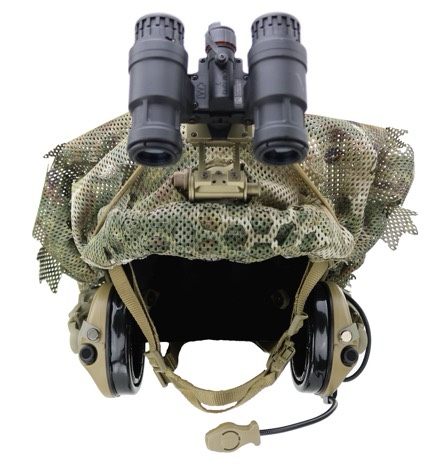
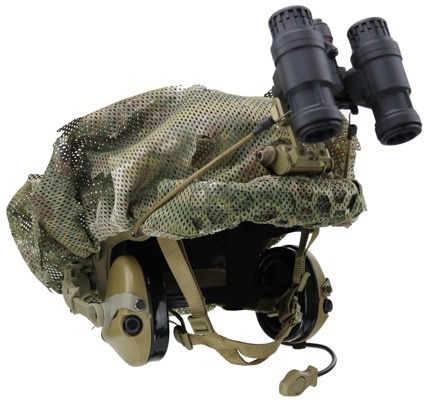
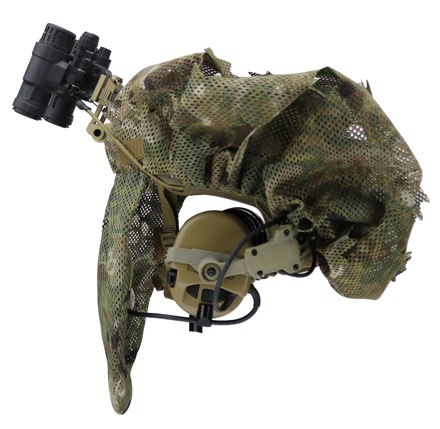
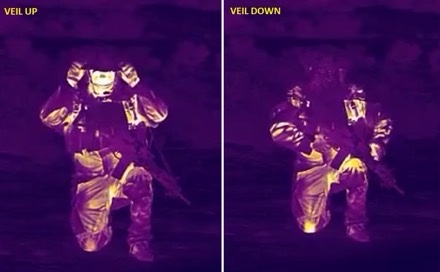
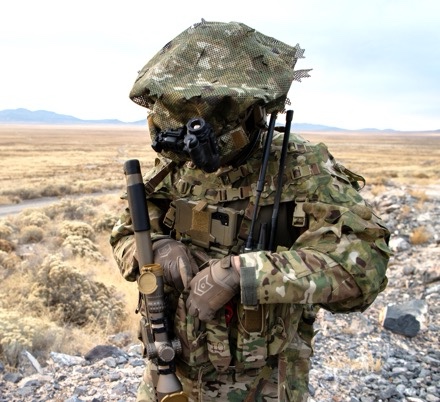
The Predator Ghillie™ SPECTRALFLAGE Helmet Cover reduces the VIS (physical visual), UV, NIR and thermal signatures (6µm ~ 15µm, high end of MWIR, LWIR, FIR) of the individual to help avoid being observed and/or targeted by ground-based detection, sUAS, and UAS near-peer threats.

The Predator Ghillie™ SPECTRALFLAGE Helmet Cover uses complex, next-generation engineering to accomplish the unimaginable: multispectral signature reduction for the individual war fighter against real world thermal and night vision technology, while simultaneously providing a 3D visual breakup.

The Predator Ghillie™ SPECTRALFLAGE Helmet Cover is another piece of the SPECTRALFLAGE camouflage system designed to reduce thermal signature around the head, face, and neck.This is the next evolution in advanced thermal mitigation for the end user. New threats on the battlefield require new solutions as advanced thermal detection and aiming devices rapidly evolve.

Made with the most advanced military grade A-TACS camouflage patterns the Predator Ghillie™ SPECTRALFLAGE Helmet Cover provides physical 3D visual breakup, granting the end user the most advanced concealment solution primarily designed for urban, desert, and open environments.

Fitting on Mid/High/Fast cut helmets, the Predator Ghillie™ SPECTRALFLAGE Helmet Cover is easy and fast to deploy, as well as small enough to fit into a pocket or small pouch.

The Predator Ghillie™ SPECTRALFLAGE Helmet Cover is the next advancement in concealment technology. On the battlefield of today, tomorrow, and the future; multispectral concealment is the way.

For additional information and availability – Beez Combat Systems

US Army Soldiers and NATO partners earn highly coveted expert badges

Monday, November 20th, 2023

By SPC Jet Cortez

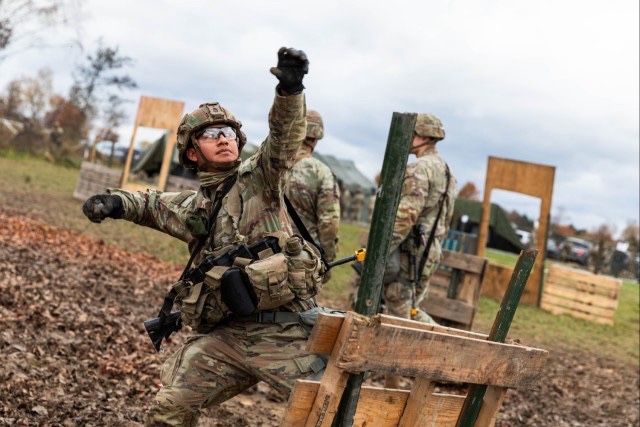
VILSECK, Germany — U.S. Soldiers and NATO partners participated in an event known as ‘E3B’ Nov. 6 to 10.

The 2nd Cavalry Regiment hosted and provided the opportunity, training, and evaluations necessary for candidates to receive the Expert Infantry Badge, Expert Soldier Badge, and Expert Field Medical Badge.

“Being in your own head can be one of the biggest challenges,” said U.S. Army Pfc. Simon Jack, an Infantryman assigned to Apache Troop, 1st Squadron, 2nd Cavalry Regiment. “Just remember to relax, you’ve done it before, and just go through the steps like you did in training.”

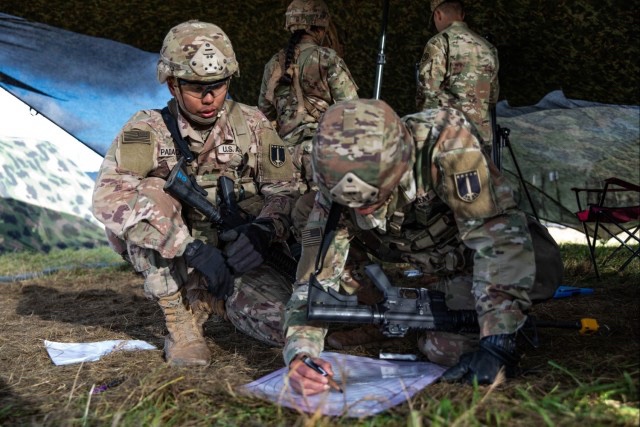
Prior to the start of testing for E3B, the candidates went through a training phase for two weeks, sharpening their technical and tactical knowledge to be successful in the numerous tasks ahead.

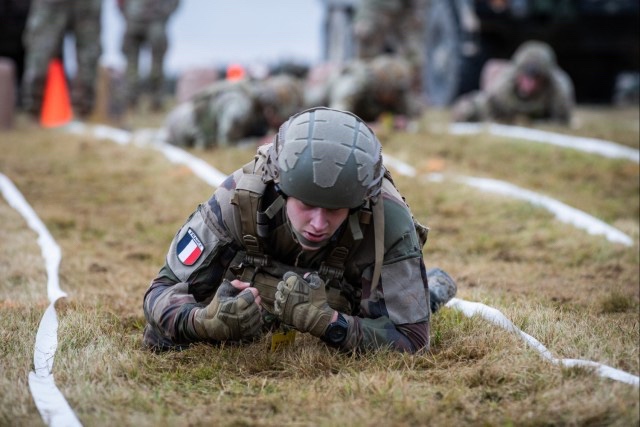
During evaluation week, Soldiers were required to pass the Expert Physical Fitness Assessment, land navigation, three evaluation lanes with 10 tasks each: the patrol lane, weapons lane, medical lane, and then a 12-mile ruck march.

The amount of candidates narrowed down gradually. Each lane had graders evaluating every candidate, testing their ability to complete tasks correctly with various “go” and “no-go” scenarios.

“You’ve got to put in the hours and the work to make sure that you learn all 30 of these tasks and are able to complete them in a proficient manner, because if you’re not, then this is one of those badges that is going to be very difficult for you to get,” said U.S. Army Capt. Ben Do, a field artillery officer assigned to 3rd Battalion, 27th Field Artillery Regiment.

“It’s definitely one of those things that you have to be fully dedicated to,” said Do.

Regardless of the outcome, Soldiers gained experience that they can use to teach others and become more reliable and capable leaders for their units.

“At the end of the day, we are getting a whole bunch of training that we can bring back to our troops and increase lethality,” said U.S. Army Sgt. Dylan Mecca, a horizontal construction engineer assigned to the 15th Engineer Battalion.

Out of the 1,700 candidates who participated in the E3B event, there were 548 candidates who earned their respective badges at the graduation ceremony.

Specific titles were given to candidates who earned their respective badges without receiving a single no-go in their particular lane, acknowledging the candidates’ efforts to execute every task of each event. These titles include “True Blue” for EIB, “No Blood” for EFMB, and “Perfect Edge” for ESB.

“Once you wear the badge, it doesn’t mean that you can just brain dump it,” said Do. “People are gonna look to you to be the subject matter expert on any of the 30 tasks that you completed.”

With the conclusion of E3B 2023, U.S. Soldiers and NATO partners successfully engaged in the given opportunity to develop lethality, interoperability, and test their skills, which are vital assets for maximizing mission success in real-world environments to deter enemy forces.

To view more photos and videos of this event visit this website.

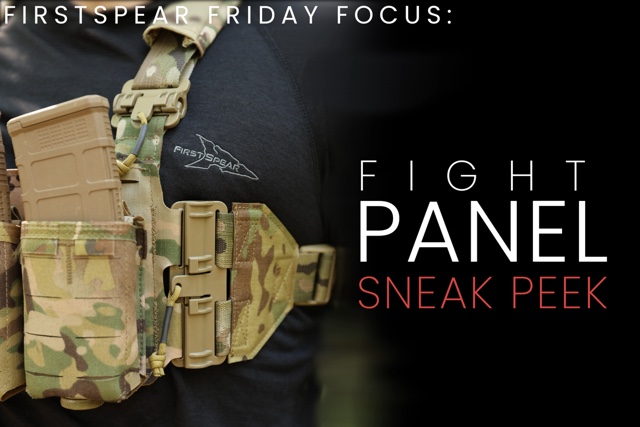
FirstSpear Friday Focus – Fight Panel Sneak Peek

Friday, November 17th, 2023

A search for panels, placards and chest rigs these days will reveal linear products that function well in one or two of these realms. What if a chest rig could go beyond the shoulder straps? What if a placard could go beyond the hook and loop? What if all of these could be wrapped into a modular and functional kit… with Tubes?

FirstSpear didn’t have to ask what if, those at the Tip of The Spear asked this of us… we answered the call. Coming December 2023.

Visit FirstSpear to find American Made kit and accessories, Built For The X.

Army Test and Evaluation Command Hosts Multi-domain Operations Test Demonstration

Friday, November 17th, 2023

ABERDEEN PROVING GROUND, Md. — The U.S. Army Test and Evaluation Command executed its first Multi-Domain Operations Distributed Live, Virtual, Constructive Initial Operational Capability Demonstration across ATEC’s geographically diverse sites on Oct. 19.

This demonstration was the culmination of an ATEC enterprise modernization project, comprised of eight ATEC subordinate organizations on a distributed network, to establish an MDO scale distributed LVC test environment.

“The key focus of this event was to tie the ATEC subordinate organizations across the country on a distributed test network,” said Dr. Ken LeSueur, lead technical coordinator of the event supporting the U.S. Army Redstone Test Center. “We wanted to exercise a mixture of live, virtual and constructive elements operating on an MDO scale test scenario across that environment, collect data in that environment and push toward real-time visualization and analysis of that data.”

The event executed seven MDO land, air, space and cyberspace scenarios, that consisted of more than 60 live military systems, virtual assets and constructive simulations. Transformative data collection, real-time display and cloud-based data analytics on the representative tactical and simulated systems were executed in the event.

Mason Rowe, who served as the data collection, reduction, analysis and visualization lead for the event with the U.S. Army Evaluation Center, provided insight on the importance of near real-time analytics. “The significance of what we demonstrated today with our near real-time data analytics is proving that by embedding analysts and evaluators into the test itself, we can provide in-stride, data-driven insights using data dashboards and visualizations throughout test execution. Rather than waiting weeks after a test to have analysis ready datasets on-hand, we were able to shorten the data collection-reduction-analysis timeline to less than 60 seconds using automated, cloud-based processes.”

“This is beneficial for everyone,” said Rowe. “The testers will know what’s going on during the test allowing gaps to be identified so they can be immediately addressed rather than needing to schedule a follow-on test. The system owners will know what’s going on with their system allowing deep dives into the data to troubleshoot any errors or problems that can be fixed on the spot. And leadership will be provided the up-to-date insights and the health status of how a test is running through ongoing assessment of the data that was collected … ‘Is it the right data, does it answer your learning demands that you have for this test and is it going to be worthy for use in evaluation after the fact.’”

Paul Weimer, division chief for the cyber and electromagnetic affects division with ATC, explained that given where the Army is headed with MDO, the only way to get there is by learning how systems interoperate at scale, and that capability was highlighted in this demonstration. “This occurred in an environment where you’ve got live systems interacting with virtual systems cooperatively at scale. Innovative networks, constructive simulations and a talented workforce made that possible. If you embrace and invest in modeling and simulation early in the acquisition process, it will pay dividends throughout the life cycle of a system.”

“This exercise brought a lot of firsts for ATEC. Even though the concept of doing distributed testing isn’t new, it really hasn’t been done at the scale and complexity that we touched on today. This is a significant step in the right direction, but we are not at the end goal. We were able show the test and evaluation community what is in the realm of possible, but this effort also helped us identify our strengths, weaknesses, and gaps so we can take the right steps to achieve full operational capability to support the Army experimentation and testing.”

Although all the ATEC subordinate organizations were involved in the demonstration, ATC and RTC were the backbone behind this effort. According to LeSueur, RTC has had an extensive history of LVC distributed testing and ATC has the chamber, resources and infrastructure. “Each organization was essential in bringing this together. I think we moved all ATEC up a significant notch being able to perform this type of testing and methodology. We accomplished a lot of training across the command doing this.”

The Test Resource Management Center’s Joint Mission Environment Test Capability Multiple Independent Levels of Security Network served as the foundation for the demonstration. It was managed and supported by TRMC’s National Cyber Range Complex, and the network was tailored for this event. “From project initiation through execution, TRMC’s NCRC project planners and network designers worked closely with ATEC to establish new network nodes at several ATEC sites as well as configure, test and tune the network for the application,” said Weimer.

James Amato, ATEC’s executive technical director/deputy to the commander, stated that leveraging TRMC’s capabilities will enable us to link our capability with other services and allies so we can literally test like we fight, as a joint and combined force.

ATEC Commanding General, Maj. Gen. James J. Gallivan, concluded the demonstration by stating, “this capability gives the Army an environment to support distributed user involved developmental and operational system-of-systems experimentation and testing at scale.”

The MDO Distributed LVC IOC falls under the digital transformation line of effort within the ATEC Next Campaign Plan, with an end goal to have systems and processes in place to perpetually modernize the people, equipment and infrastructure to remain trusted by senior leaders for decisions.

Brian Kelly, ATEC’s chief data officer, said that ATEC is leading test and evaluation for the Army through an enterprise-wide digital transformation that leverages a hybrid cloud environment to develop a data mesh. The ATEC data mesh leverages various Army enterprise cloud services to expose and control access to data for DoD and its partners. “ATEC’s digital transformation is well underway and will serve as a shining example of an Army Business Mission Area organization meeting the intent of HQDA CIO and G6 data and cloud strategies.”

By Lindsey Grubb