TYR Tactical

Archive for the ‘Guest Post’ Category

Army Leverages Virtual Reality to Understand Network Influence

Saturday, June 5th, 2021

RESEARCH TRIANGLE PARK, N.C. — Immersive virtual reality isn’t just for amusement parks, the U.S. Army is funding research that uses it to understand group dynamics.

The U.S. Army Combat Capabilities Development Command, known as DEVCOM, Army Research Laboratory funded scientists at Kent State University’s Electrophysiological Neuroscience Laboratory to create an immersive virtual reality lab that can be used in tandem with their other biophysiological technologies to advance an interdisciplinary understanding of group dynamics.
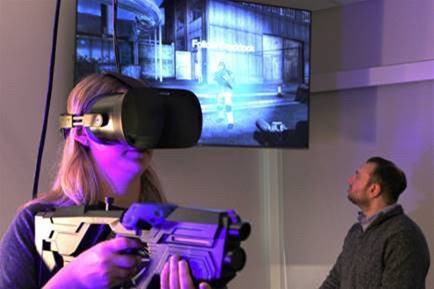
Immersive reality combines virtual reality with images, sounds, or other stimuli to provide an engrossing environment.

According to Dr. Bruce West, a senior Army scientist, the military is becoming increasingly reliant on small special operations teams, but little is known about how small groups function in these extreme environments. The research team uses cutting edge electrophysiological and physiological equipment to probe team functioning and decision-making under threat.

“In order to make valid and efficacious practical recommendations for small special operations teams in the modern global military context and other threat environments, Soldiers can benefit by training in immersive virtual environments to make them feel like they are really there,” said Dr. Lisa Troyer, program manager, social and behavioral sciences, ARL. “The immersive virtual reality system at Kent State University is developing more valid, impactful knowledge about how teams and individuals navigate dangerous environments.”

The lab includes cutting edge virtual reality headsets with three-dimensional eye tracking and omnidirectional treadmills, which can be integrated with EEG and other emerging biometric technologies.
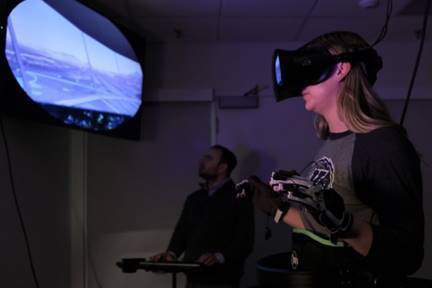
“With this lab, ENLoK is generating path-breaking social science discoveries,” Troyer said. “The team’s efforts are leading the use of immersive virtual reality and capabilities to identify neurological signals of influencers in groups that can support Army missions by better understanding Army influence networks as well as adversarial groups.”

In earlier research, also funded by ARL and published in Social Psychology Quarterly, the Kent research team conducted a series of experiments manipulating status and used brain activity analyses to successfully identify neurological signals during social interaction that are unique to others’ perceptions of high status actors and their influence over group members.

“Understanding the consequences of status-based behavior in a variety of settings, including small team contexts, can help the Army prepare and train for modern military operations,” said Dr. Will Kalkhoff, ENLoK’s director and professor of Sociology at Kent State University. “The Army can also use the knowledge we are developing to better understand how influencers in allied groups support Army missions through their social networks or how adversarial groups mobilize.”

Now, the research team at Kent State is partnering with MILO, an Ann Arbor, Michigan-based component of Arotech’s Training and Simulation Division that provides immersive training solutions for military and law enforcement organizations around the world. The objective is to improve police and military readiness by integrating rigorous social science with emerging technologies already in use throughout the Department of Defense.

“Support and assisted facilitation of this kind of social research is exactly why we established the MILO Cognitive Division,” said Robert McCue, MILO’s general manager. “Our ultimate goal is to advance the scientific understanding of behavior and decision-making under threat and, in so doing, reduce danger to our servicemen and women and improve mission success by facilitating team functioning under threat.”

By U.S. Army DEVCOM Army Research Laboratory Public Affairs
FirstSpear Friday Focus: Two-Point Quick Release Sling

Friday, June 4th, 2021

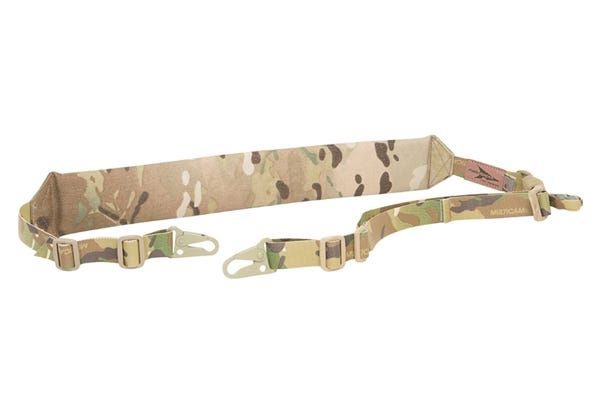
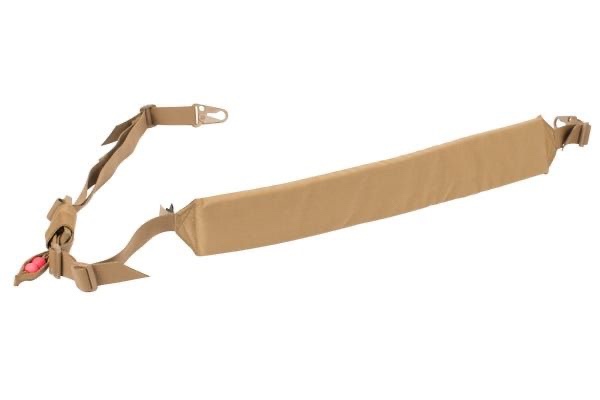
This week’s Friday Focus is taking a look at the FirstSpear Two-Point Quick Release Sling. ?

• Quick release buckles
• Rapid adjustment
• Oversized padding

The Two-Point Quick Release Sling is the ideal accessory for any rifle. It is able to adjust rapidly and comes with oversized padding for added comfort. The quick release buckles are a reliable proven system which allows the wearer to breakout of the sling, if needed. Perfect for light or heavy weapons.

Available in coyote, multicam, black and ranger green.

For more information about FirstSpear slings, check out www.first-spear.com/two-point-quick-release-sling.

5th SOS Tests New Aircrew Protective Mask for C-130 Enterprise

Friday, June 4th, 2021

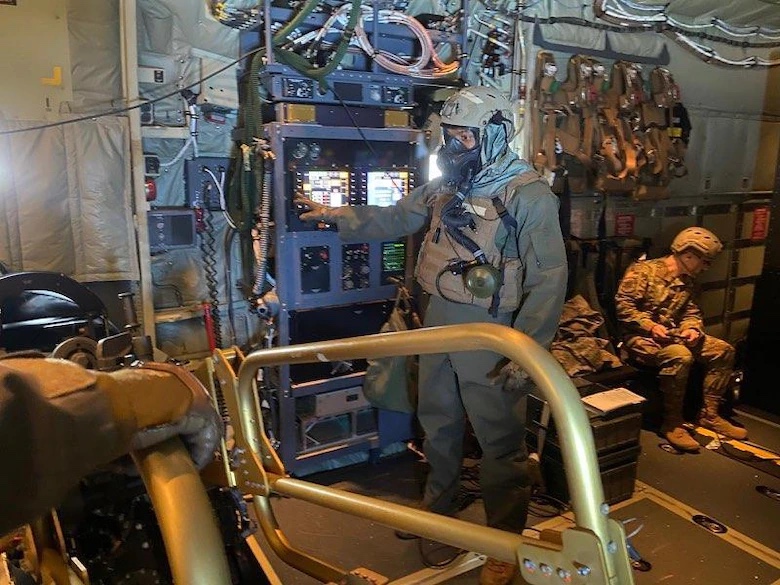
HURLBURT FIELD, Fla. — The 5th Special Operations Squadron demonstrated the unique capabilities of the unit while testing a new protective mask for the 53rd Wing. 

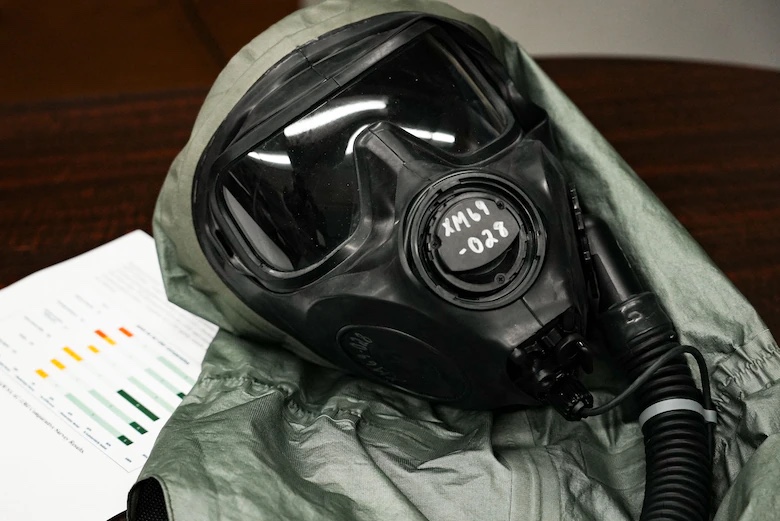
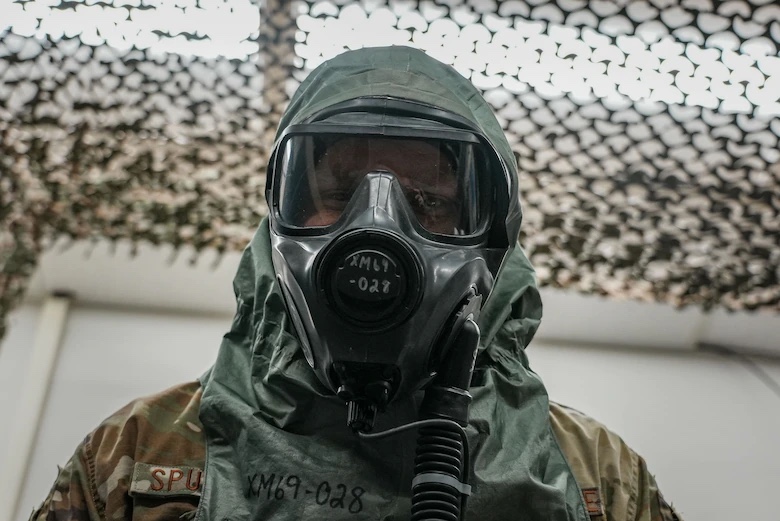
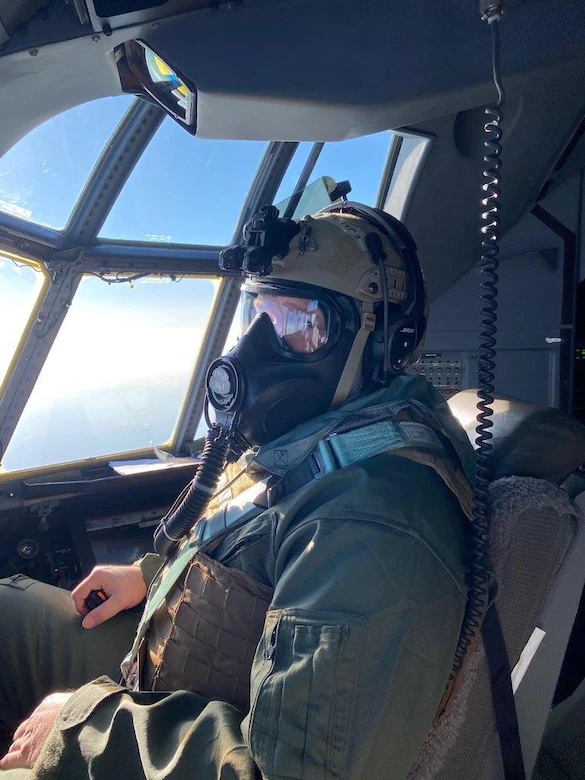
The squadron tested the Joint Service Aircrew Mask for Strategic Aircraft, which is slated to replace the current Aircrew Eye and Respiratory Protection System equipment. The equipment protects aircrew against Chemical, Biological, Radiological and Nuclear threats in the air.

The 28th Test and Evaluation Squadron, which falls under the 53rd WG at Eglin Air Force Base, Florida, is responsible for testing new equipment in electronic warfare, armaments and avionics, chemical defense, reconnaissance, and aircrew training devices. They selected the 5th SOS to assist in testing the mask.

“The 5th SOS is perfect for the test because we’re all instructors and evaluators with thousands of flight and combat hours,” said Maj. Justin Eulberg, 5th SOS AC-130J Ghostrider evaluator and pilot. “It was very natural for the 5th to take on that role and apply our experience to the ergonomics of this equipment.”

Eulberg was one of the pilots flying during the JSAM SA tests.

The 28th TES needed a dynamic environment with many moving components to test the practicality of the new system. The 5th SOS operates AC-130J Ghostriders, which offer a diverse culmination of specialties all happening within a limited space, creating the ideal testing environment for the new system.

“We’ll have gunners in the back moving around loading ammo, sensor operators talking over radios and pilots flying, so the work load is heavier [than a standard airframe,]” said Eulberg. “In their own terms, [the 28th TES] wanted to test it on one of the most difficult airframes last.”

JSAM SAs are more comfortable and designed to include a helmet and hood in the event of a CBRNE threat, according to aircrew who conducted the assessment. The dual helmet-mask design is also capable of supporting communications equipment, doesn’t fog up as easily as the AERPS and doesn’t require a second blower to provide oxygen.

“I’m 100 percent for this new system, I think it could potentially save lives downrange” said Master Sgt. Justin Spurling, 28th TES aircrew flight equipment manager. “The updated technology will keep our aircrew safe in a CBRNE environment and is much easier to maintain.”

Spurling assessed and routed the results of the test to Air Combat Command for further evaluation.

The 5th SOS was the last squadron to test the JSAM SA before C-130 platforms across the U.S. Air Force could field the system. The tests yielded positive results, rating higher than the AERPS in a range of topics from hypoxia prevention to ease of respiration.

“We have our fingers in a lot of different pies, not just training at the school house,” said Eulberg. “We also conduct tests and augment our active duty counterparts. Our participation in the test changed the future of how we protect aircrew against CBRNE threats.”

The tests lasted eight days and required aircrew to evaluate the effectiveness of the mask in a variety of scenarios. 

“These tests play an important role in the larger modernization of the Air Force,” said Spurling. 

Reserve instructors and evaluators have conducted similar tests in the past on new equipment and processes that fall under United States Special Operations Command priorities such as crew workload tests.

“The 5th SOS is in a unique position because of how diverse the expertise is within the squadron,” said Eulberg. “We offer a unique melting pot of experience, there’s just not another squadron like it in the Gunship community.”

To see more examples of how the 5th SOS and other squadrons throughout the 919th Special Operations Wing continue to leverage technology and innovation, follow us on Facebook and Instagram.

By SrA Dylan Gentile, 919th Special Operations Wing

USMC Modernizing Intel System, Reducing Size

Thursday, June 3rd, 2021

MARINE CORPS BASE QUANTICO, Va. —

Marine Corps Systems Command is in the process of fielding a modernized version of an intelligence system that provides critical information to commanders on the battlefield.

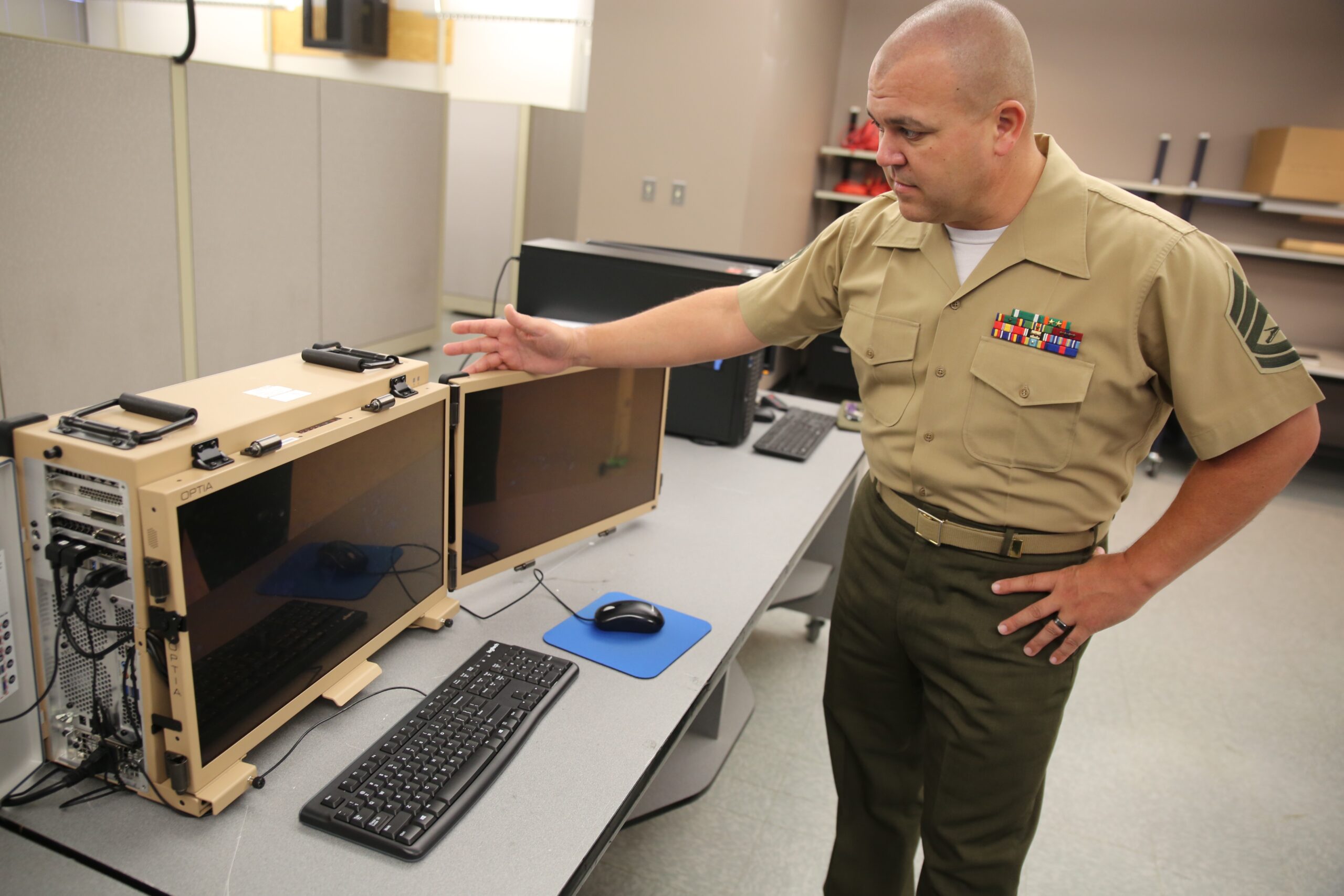
The Distributed Common Ground/Surface System-Marine Corps is a mobile, secure and integrated intelligence system that Marines can leverage to inform commanders about threats and other information on the battlefield.

“DCGS-MC brings all the information on the battlefield to a central location, where it can then be analyzed to support the commander’s decision-making,” said Gunnery Sgt. Travis Godley, with DCGS-MC at MCSC.

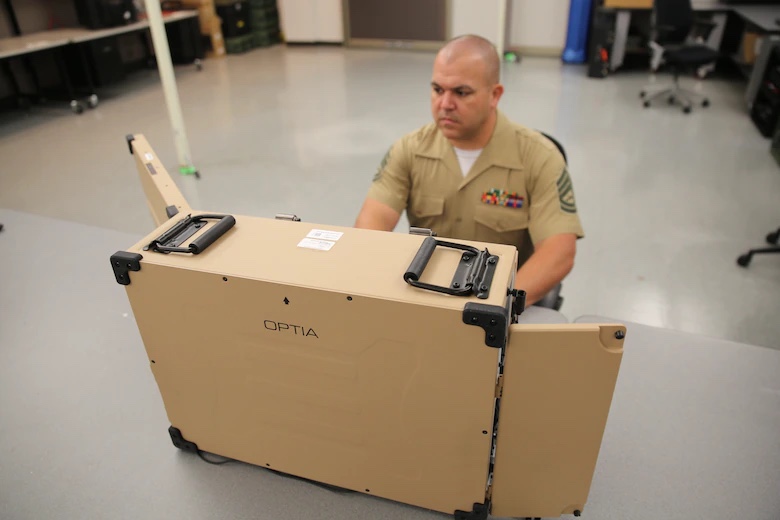
This new version of DCGS-MC comprises updated computer hardware and software connected to the Marine Corps Enterprise Network. The system includes sensors to collect data, antennas to receive information, and workstations for analysts to review info and produce reports.

The modernized technology also includes a geographic intelligence capability that collects satellite imagery and intelligence information. This enables Marines to create maps and other intelligence products to inform the commander’s decision.

“The new DCGS-MC capability is a modern approach for the Marine Corps to perform intelligence tasks,” said Master Sgt. John Phillips, an MCSC representative who contributed to the DCGS-MC project. “This system will ultimately make Marines’ jobs easier.”

MCSC has begun fielding the modernized system to Intel Marines. Phillips projects the first round of fielding to conclude in July 2021 and for the system to be fully fielded by the end of 2022.

Improvements over legacy system

Col. Dave Burton, MCSC’s program manager for Intelligence Systems, pinpointed notable improvements the new DCGS-MC has over the original system.

The first improvement involves weight. The system was designed to provide a flexible hardware and software solution to decrease size and power requirements while increasing the capability of Marine intelligence analysts.

The legacy system, fielded from 2014 to 2016, required multiple hardware, including up to four servers. Burton said the newer DCGS-MC decreases the amount of hardware needed for use, reducing the technology’s size, weight and modularity.

He said a reduction in weight ultimately increases overall efficiency.

“DCGS-MC is in line with the [Commandant’s Planning Guidance] to lighten the load of Marines and modernize the Marine Corps,” said Burton. “Instead of having separate servers for individual programs, you can combine a number of different servers into one.”

The system also enables increased battlefield mobility, an area of focus in 38th Commandant of the Marine Corps Gen. David Berger planning guidance. Berger emphasized the importance of employing mobile, operationally relevant and relatively easy-to-sustain capabilities.

“This system provides additional flexibility to support tactical operations as we support Marine operations,” said Thomas Roebuck, MCSC’s product manager for DCGS-MC. “It also provides a much more modern toolset.”

Roebuck said the newer capability also enables users to migrate data to the cloud. He explained that units can leverage the cloud capability to perform various tasks even when disconnected from the enterprise network.

“As we move forward from a technology perspective, [cloud migration capabilities] become increasingly important,” said Roebuck. “That allows the information to freely flow in between the tactical user all the way up to the intelligence community.”

MCSC also ensured that DCGS-MC was interoperable, allowing Marines to exchange critical information with other services, including the Army, Air Force and Navy. Interoperability fosters collaboration and increased communication among the joint forces, said Phillips.

“Not only are we interconnected with the Marine Corps Enterprise Network, but we can also support the joint mission with the Navy because this technology was designed in a way to be interoperable with Navy intelligence systems as well,” said Phillips.

The new DCGS-MC capability is a modern approach for the Marine Corps to perform intelligence tasks. This system will ultimately make Marines’ jobs easier.

Master Sgt. John Phillips, an MCSC representative who contributed to the DCGS-MC project

An expedited acquisition

According to a 2016 report, the average major defense acquisition program that reported between 1997 and 2015 took about seven years from initiation to the start of fielding.

MCSC fielded the updated DCGS-MC just over two years after initiation, as the Marine Corps has been implementing new, more agile methods of acquiring products. The expedited acquisition process puts a significant intelligence capability in Marines’ hands more quickly, said Phillips.

“The command is at a transition point, where we’re looking at more agile methods of acquisition,” said Phillips. “We intentionally pursued this acquisition cycle in a condensed timeline, and the end result will benefit all parties involved.”

Throughout 2020, MCSC held several user evaluation events for the new DCGS-MC. Marines from 3rd Marine Aircraft Wing and operators from Marine Corps Forces Cyberspace Command tested the equipment and provided valuable feedback the DCGS-MC team used to enhance the capability.

“Seeing Marines interact with this new system and the new capabilities being provided is something incredible to see,” said Godley. “Not only Marines interacting with the capabilities, but also bringing up new ways to do things.”

Godley explained how the Marine Corps once employed “runners” who collected intelligence information on the battlefield to inform commanders. The modernized DCGS-MC provides this data through electronic means.

“DCGS-MC brings that information back to the commander to make an informed decision while also disseminating it throughout the forces so that lower-level commanders can also make decisions,” said Godley. “It allows for all levels of the Marine Air-Ground Task Force to access critical information, which benefits the entire Marine Corps.”

By Matt Gonzales, MCSC Office of Public Affairs and Communication, Marine Corps Systems Command

MCSC Modernizing Communication Gear to Enhance Electronic Warfare

Tuesday, June 1st, 2021

QUANTICO, VA —

The Marine Corps is modernizing and reshaping its force for the future naval expeditionary fight.

Future naval warfare, specifically in the Indo-Pacific region, will require increased mobility and active communication to circumvent difficult situations. Improving battlefield communication is a major aspect of the Marine Corps’ modernization efforts to meet this future fight.

Over the past few years, Marine Corps Systems Command has begun acquiring new, cutting-edge communication technology to support future battlefield objectives, particularly those that may affect the Indo-Pacific battlespace.

“Our modernization investments provide Marines capabilities with redundancy and resiliency across the electromagnetic spectrum so Marines can communicate, conduct command and control, increase situational awareness and enable informed decision-making in the battlespace,” said Col. Robert Bailey, portfolio manager for MCSC’s Command Element Systems.

The electromagnetic spectrum encompasses the entire range of wavelengths or frequencies of electromagnetic radiation emitted through communication devices, such as radios and tablets. Bailey said the Marine Corps intends to operate effectively in this complex and dynamic environment against adversaries looking to do the same.

To support this goal, the Marine Corps has invested in capabilities that improve communication and increase situational awareness.

“We must ensure that Marines’ communication and navigation systems have the ability to continue to operate in a denied, degraded and low-bandwidth electromagnetic environment.”

Col. Robert Bailey, the portfolio manager for MCSC’s Command Element Systems.

Bailey said navigating this environment requires providing the right set of command and control, communication, and situational awareness applications and services when disconnected from the Marine Corps Enterprise Network.

“The Command Element Systems portfolio at SYSCOM is providing the capabilities that will enable commanders to maneuver within the information environment,” said Bailey.

Navigating the electromagnetic spectrum

In recent years, MCSC has focused its efforts on providing Marines with ways to securely and effectively transmit data while on-the-move in an ever-evolving battlespace. Bailey noted how effective communication links sensors to shooters and supports commanders in making well-informed, rapid decisions.



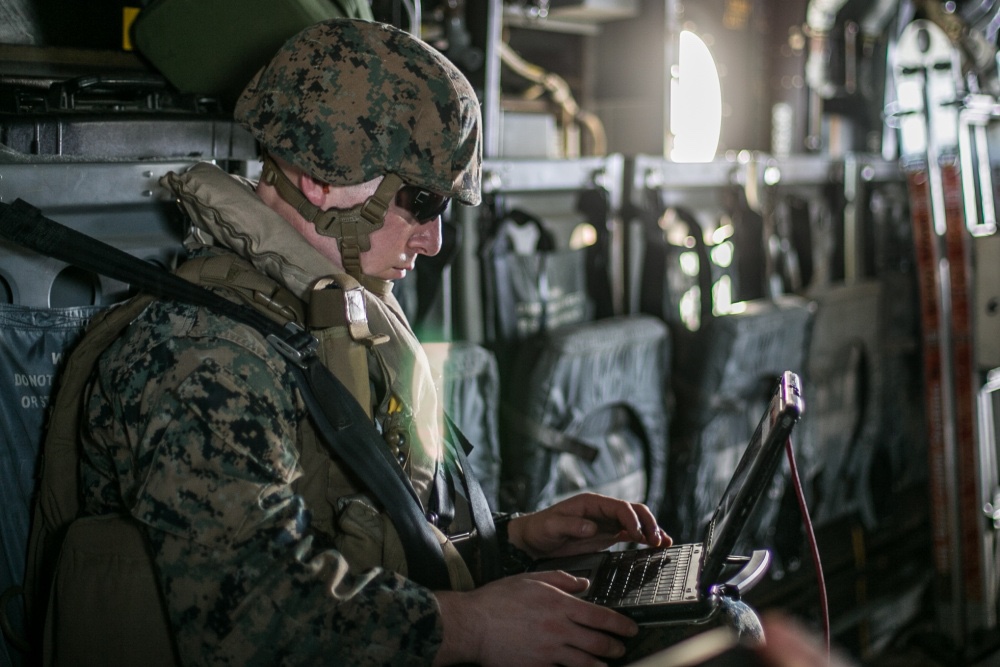
Networking On-the-Move is a mobile, satellite communication system that enables Marines to connect to networks and communicate while mobile or stationary on the battlefield, enabling flexibility when portions of the electronic spectrum are denied.

“The NOTM capabilities provide Marines with internet on the move, similar to inflight internet or cellular service while driving,” said Lt. Col. Austin Bonner, a product manager with MCSC’s Command Element Systems portfolio. “Marines can employ NOTM to securely transmit critical information to commanders and increase situational awareness in hostile environments.”

The vehicle kit, which began fielding in 2015, comprise both air and ground capabilities Marines to seamlessly share data and communicate over video and by voice.

NOTM can be used on most ground and air platforms, from a Joint Light Tactical Vehicle to an MV-22 Osprey, said Bonner.

Navigation systems are also important when operating in electromagnetic environments. The Military GPS User Equipment is a next-generation, handheld navigation capability that provides positioning, navigation and timing capabilities to warfighters while executing missions.

Bailey said MGUE enables Marines to operate in an increasingly contested electromagnetic environment.

“MGUE is effectively a GPS modernization program designed to increase resiliency and PNT capability in the current and future contested environments,” said Bailey. “It reflects a natural evolution of GPS technologies.”

MCSC has also been developing a family of systems to create an advantage for Marines and joint forces in electronic warfare.

In 2020, MCSC began developing the MAGTF Electronic Warfare Ground Family of Systems, which helps Marines sense, attack and defend against electromagnetic threats.

MEGFoS is a series of portable technologies that can be used at fixed sites, on tactical vehicles or while dismounted to maneuver effectively within the electromagnetic spectrum. It includes common, multiservice interfaces to share information across the joint forces.

MEGFoS helps Marines sense, attack and defend against electromagnetic threats, said Bailey. These capabilities comprise a vehicle-mounted electronic technology and counter radio-controlled improvised explosive devices.

“This family of systems will enable Marines to command the electromagnetic spectrum against a peer adversary, providing the Marine Corps the ability to maneuver effectively inside the spectrum and deny our adversaries that ability,” said Greg Schmidt, product manager for MCSC’s Electronic Warfare Systems.

MCSC also oversees intelligence systems that will help the Marine Corps achieve future goals.

In 2020, MCSC began fielding the Integrated Broadcast Receiver. The IBR is a rugged, tactical terminal that provides critical situational awareness information in real time for air, ground and maritime operations.

The IBR provides commanders with direct access to critical, time-sensitive intelligence data that can be used in environments with little internet connectivity. It enables Marines and commanders to leverage data to support Marine Corps missions, such as connecting sensors to shooters.

“We need to ensure that data is available to Marines, commanders and other decision-makers at the right levels, in the right amounts and at the time of need,” said Bailey. “IBR helps us accomplish this goal.”

Rendering desired outcomes

Thirty-eighth Commandant of the Marine Corps Gen. David Berger outlined in his Planning Guidance his vision to redesign the Corps and meet future naval objectives to align with the National Defense Strategy.

Bailey said effectively maneuvering within the electromagnetic spectrum is crucial to meeting the commandant’s vision for achieving force design objectives and winning the future fight.

“To compete and win against our adversaries in our security environment today, the Marine Corps must be properly organized, trained and equipped,” said Bailey. “Changing how we train and operate, organize and equip the Marine Corps is the fundamental call to action of [Force Design 2030].”

Increased, effective communication is a catalyst in meeting future objectives on the battlefield, said Bailey. This cannot be accomplished without innovative equipment and modern wargaming analytical tools tailored to a 21st century battlespace.

MCSC is delivering modern capabilities designed to communicate data, support critical decision-making and enable action.

“It’s about getting information to Marines in a usable way that makes sense, so they can make decisions that render desired outcomes in communications-disadvantaged environments,” said Bailey. “Our goal is to make sure our Marines are never in a fair fight, and these investments we’re making to meet modernization objectives give Marines that competitive advantage.”

Matt Gonzales, Marine Corps Systems Command

SCUBAPRO Sunday – Memorial Day

Sunday, May 30th, 2021

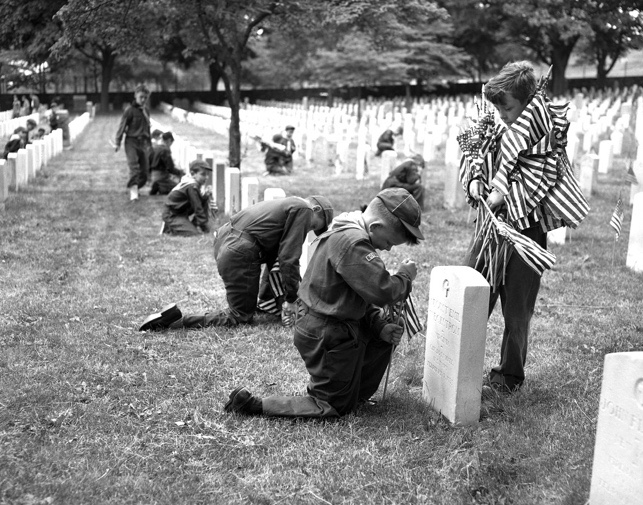
Shortly after the Civil War, what is now known a Memorial Day began as Decoration Day. The reason for that name is because it was a day on which Americans, both North and South, would decorate the graves of soldiers who died in the Civil War.

Maj. Gen. John A. Logan, who lead a group for Northen Civil War veterans, declared in 1868 that Decoration Day would be observed annually on May 30. The date was chosen only for the reason that it didn’t coincide with any battles fought. It was a day for the North and South to honor their fallen and decorate their graves. After World War I, the holiday was broadened to include service members who died in all of the country’s wars, not just the Civil War.

Multiple cities claim to be the birthplace of this holiday, but President Lyndon Johnson formally gave the honor to Waterloo, N.Y. in 1966. Up until 1971, Memorial Day was observed on May 30th, the date Logan had selected for the first Decoration Day, but in 1968, Congress passed the Uniform Monday Holiday Act, which established Memorial Day as the last Monday in May to create a three-day weekend for federal employees. The same law also declared Memorial Day as a federal holiday and created a day for everyone to take time to reflect and honor the fallen. That did not go into effect until 1971.

Most people look at the Memorial Day weekend as the unofficial start of summer, mattress and furniture sales, or a day for cooking out. I know most of the people that read SSD will understand the real meaning. This is a day to remember the fallen service men and women of the military who have gone before us. Like most holidays in the U.S., it has been turned into just a weekend for sales and people to try and make money. But please take the time to think about the fallen and their families who have, as President Lincoln said, “Laid so costly a sacrifice upon the altar of Freedom.” We truly are lucky to live in the greatest country in the world, where “the pursuit of happiness” is a guaranteed right. You are never asked to do anything for it other than maybe do jury duty. But some people chose to serve for whatever reason and some died because they chose to serve.

There are a couple small things you can do. One is, if you fly an American flag, lower it to half staff until noon. Then at noon raise it all the way up until sunset. Second, in the year 2000, the National Moment of Remembrance was passed by Congress that says at 3pm local time, take a moment in your own way to remember the fallen.

Memorial Day is not Veterans Day. I have heard so many people say, “oh, this weekend, we should really thank a veteran”.  This isn’t for us; it is for the people who never came home and for their families.

Lastly, I wanted to say something about what to say to someone else on Memorial Day as a greeting. Please do not say “Happy Memorial Day”. This is a little thing, but it’s like saying happy funeral day. So, if you feel like “Happy Memorial Day” isn’t appropriate, try saying, “I hope you have a nice/good Memorial Day”. Never forget that, for some people, every day is Memorial Day.

Long Live the Brotherhood

FirstSpear Friday Focus: OEM Spotlight Shaw Concepts

Friday, May 28th, 2021

It’s Friday and this week is our third installment of our OEM Partner Series. We’ll take a look at an OEM company that FS has partnered with and the equipment they produce. Check out all American company, Shaw Concepts.

How did Shaw Concepts originate?

Shaw Concepts, LLC. started after emailing a custom gear maker (before the boom in gear markers this past year) to get a quote for a carrier I designed only to find out they wanted a thousand dollars to do it. I talked with one of the riggers at the paraloft who mentioned I could just get a sewing machine for that much and do it myself, so I did just that. I made my own carry and some other equipment and that generated interest around the barracks. So I made some gear for people around the barracks and sewed name tapes to cammies. Eventually I decided to make an Instagram page to showcase some of the work. On April 16, 2019, I started the IG page and that’s when it really started took off.

Why was the ARC series created?

The ARC Series of equipment started due to dissatisfaction with gear on the market and a belief that I could improve it. The ARC Carrier was the first product and was born from identifying some issues and missing features in other plate carriers. I created a carrier that featured solutions to the previous carriers challenges. Some of those issues were comfort, a lack of placard acceptability, maritime ditch capability, expanding plate bags and aftermarket adaptability. Other items joined the ARC suite that resolved other issues and bridged gaps in the market. The ARC Suite continues to grow today.

There are many options for private label manufacturing all around the world, how did you select FirstSpear?

I knew of FirstSpear already having used some of their equipment and during my search for a manufacturer was pleasantly surprised to discover they also offered OEM manufacturing. I was familiar with the quality of the equipment and wanted to find an OEM that would be able to offer consistent quality sewing. It also was great that FirstSpear has the FirstSpear Tubes™ as I am a fan of them and I use them in a good number of my products.

Why was made in the USA important to Shaw Concepts?

American Manufacturing is important for several reasons. The first is Berry Compliance to meet military regulations. Some may view it as an obstacle, but we believe the military should utilize American made goods as this is a supply security issue and a matter of national integrity. The second is the providing of good paying American jobs. This ties into the third reason, which is American Self Reliance. The world and especially the global market is extremely interconnected, which has left America extremely dependent on foreign goods and labor, which is a glaring security issue. This leaves us vulnerable to sabotage or simple bad luck as Shaw Concepts holds an “America First” belief and approach.

Why did you select Tubes™ as your fastener of choice for your carrier?

There are a decent amount of hardware options on the market and most of them are great at certain tasks. FirstSpear Tubes are another great option that are also unique in how they are designed and how they can be implemented. The key difference we’ve noticed is how minimal the distance is between the two items the Tube marries up. This can best be seen on cummerbunds and our RAID Pouch. Other buckles would leave a much larger gap and when it comes to gear the more real estate you can open up to be used the better.

Another aspect is the ease AND intentionality of connecting and disconnecting. Other buckles exist that can be easily disconnected but are difficult to reconnect. The impressive thing about FirstSpear Tubes is that they are designed in a way that requires intentional directional disconnection that is also easy to perform while also making it simple to reconnect one handed. There are some alternatives to FirstSpear Tubes that are more economically attractive but lack this functionality.

What sets your product apart from others on the market?

What sets Shaw Concepts products apart is a mix of personal investment in the quality of the equipment as well as unique designs introduced. Some ideas are based on a wishlist of items I wish I had at different points in Force Reconnaissance and other ideas are based on trying to make certain items more comfortable to wear or easier to use. We were the first to introduce the Tubed Hanger Pouch and have since been copied by other companies. The same goes for a good number of our other designs as well.

For more information about Shaw Concepts, check out: shaw-concepts.com

For more information about FirstSpear and OEMs, contact sales@first-spear.com.

Air Force Releases Updated Fitness Test Score Breakdown

Friday, May 28th, 2021

WASHINGTON (AFNS) —

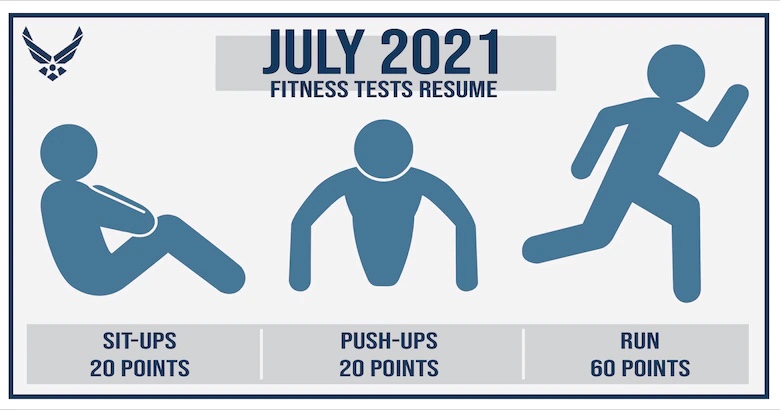
The Air Force will resume physical fitness testing July 1 with only three components: push-ups, sit-ups and the 1.5-mile run.

Without the waist measurement as a scored component, push-ups and sit-ups will increase from 10 to 20 points each, while the 1.5-mile run will remain at 60 points. Scoring will fall into five-year age groups, as opposed to the previous 10. Updated charts can be found here.

The waist measurement will no longer be required as part of the physical fitness test but a separate assessment of body composition, as required by DoD Instruction 1308.3, will continue starting in October. Testing for body composition may continue to use some form of waist measurement and may be administered during PT testing to reduce scheduling and administrative burdens, but body composition will not be a component of the PT test itself. Further details on the body composition program will be released at a later date.

The Air Force has also worked on alternative strength and cardiovascular testing exercise options with plans to announce them in the coming weeks. Once announced, members and fitness monitors will have approximately six months to familiarize themselves with use and execution of the alternative testing options prior to having them available in January 2022. Members will have a choice of which testing options they choose for their physical fitness assessment components. The six-month timeline will help ensure fitness assessment cells are prepared to train physical training leaders to administer tests using the new options.

“We are moving away from a one-size-fits-all model,” said Air Force Chief of Staff Gen. CQ Brown, Jr. “More testing options will put flexibility in the hands of our Airmen – where it belongs. We know not all Airmen maintain their fitness the same way and may excel in different areas. Alternate components provide choices while still providing a mechanism to determine overall fitness.”

These changes align under the Air Force’s Action Order Airmen, people-first approach.

“Physical fitness is an important part of our everyday lives, it’s more than just a test – it’s a way of life, our readiness and ultimately our future success,” said Chief Master Sgt. of the Air Force JoAnne S. Bass. “July 1st is a chance to refocus on building a lifestyle of fitness and health, and I know our Airmen will be ready.”

For additional information, Airmen can visit myPers or the Air Force’s Personnel Center’s fitness program page.

The Space Force will follow these policies until service-specific fitness policies are developed and fielded.

Secretary of the Air Force Public Affairs