Salomon Forces Genesis MID GTX

Archive for the ‘Guest Post’ Category

Stryker Brigades Targeted for the Army’s Integrated Tactical Network

Saturday, January 9th, 2021

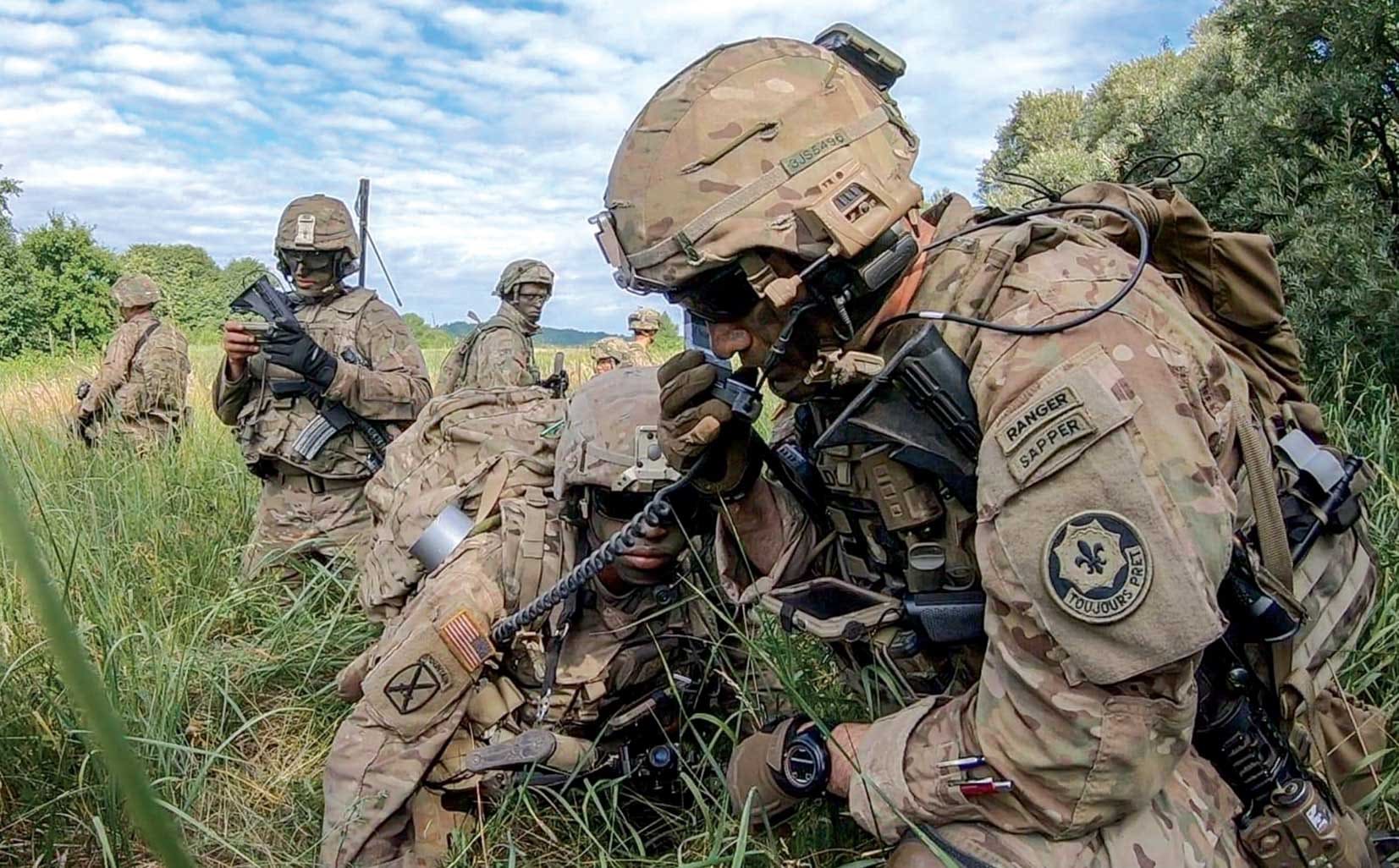
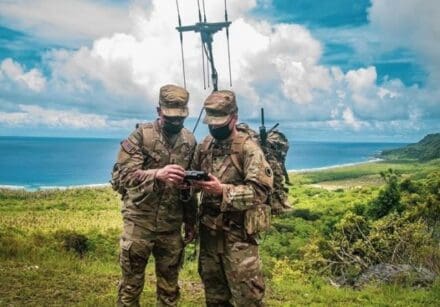
ABERDEEN PROVING GROUND (APG), Md. (January 5, 2020) – Following the successful integration of its new more flexible and expeditionary network capability into dismounted units, the Army is now focused on delivering the same capabilities to Stryker brigade combat teams.

To produce uniform equipment packages for these Integrated Tactical Network (ITN) components across multiple Stryker variants, the Army has been conducting a Capability Set (CS) 21 ITN Stryker characterization effort with the 2nd Cavalry Regiment (2/CR), since April 2020. The effort will support the iterative modification of integrated ITN component designs into these vehicle platforms.

On the current timeline, the characterization will conclude in fiscal year (FY) 2022, making 2/CR the first Stryker unit equipped partially with CS21 ITN.

The Army first fielded CS21 ITN to the 1st Infantry Brigade Combat Team, 82nd Airborne Division in October 2020, with the next ITN fielding set for the 173rd Airborne Division this month.

“We are excited to move to this next phase of CS21, which will enhance mounted, on-the-move and at-the-quick-halt ITN capabilities,” said Lt. Col. Brandon Baer, product manager for Helicopter and Multi Mission Radios (HAMMR), assigned to the Program Executive Office for Command, Control, Communications-Tactical (PEO C3T).

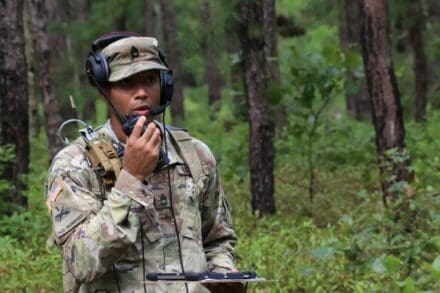
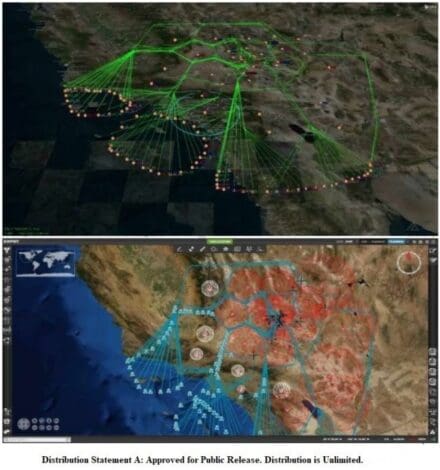
The ITN approach injects new commercial components and network transport capabilities into the Army’s tactical network environment to provide maneuver brigades and below with smaller, lighter, faster and more flexible communications systems. Adding mounted ITN capabilities allows commanders to maintain battalion-wide terrestrial voice and data network and enables Soldiers to operate over the Secure But Unclassified (SBU) enclave while transitioning between dismounted and mounted operations.

“SBU continues to be the game-changing capability enabled by the ITN,” Baer said. “It allows data to be categorized according to its classification, which will be just as critical for our mounted units because data at battalion and below is often perishable and unclassified.”

To execute the CS21 ITN Stryker characterization, personnel from the HAMMR team are collaborating with engineers and technicians from the U.S. Army Combat Capabilities Development Command (DEVCOM) at the C5ISR Center Prototype Integration Facility (PIF), at APG. With Strykers at hand in the integration bay, the team will identify the most effective use of the limited space inside the vehicles, and then design and build the streamlined hardware required to integrate the ITN kits into the vehicles.

To ensure realistic operational requirements the PIF Team is directly collaborating with 2/CR, currently via video conferences due to COVID-19 travel restrictions.

“We have been conducting user juries remotely, which allowed the 2/CR Soldiers to show us their vehicle space restrictions, and in turn allows us to show them how much space our proposed designs will claim,” said Jim Leary, C5ISR PIF project engineer.

The 2/CR conducts missions using multiple commander and infantry carrier Stryker variants, with infantry carrier configurations most prevalent.

“Each vehicle within the 2/CR may require something unique to perform its mission, but our goal is to design a one-kit-fits-all variant approach,” Leary said.

The characterization led to the production of two unique ITN equipment kits. Kit one will be populated in almost every Stryker variant and features the mobile broadband kit for 4G LTE network capabilities, 2nd Generation Manpack radio, a mounted two-channel leader radio and a unique power distribution box, Leary said.

Kit two, slated for only the Command Vehicle Stryker variant, includes a Tactical Server Infrastructure computer, a Silvus radio, a Tactical Radio Integration Kit box, tactical cross domain solution and a power distribution unit, Leary said.

“Both kits will include various mounts, cabling, hardware and installation instructions, and will be adaptable to integrate into other 2CR tactical vehicles such as High Mobility Multipurpose Wheeled Vehicles, medium tactical vehicles (MTVs) and the MTV replacement, the Joint Light Tactical Vehicle, if available,” he said.

The most recent video conference user jury with the 2CR featured the team’s final proposed component designs and recommendations on where to place them in the vehicles’ available space, Leary said.

“Our last review was mostly favorable,” Leary said. “Next we will send PIF-produced 3D models of the kits to the 2/CR so that they can confirm the space we’re claiming is accurate or provide an alternate location for unique vehicle configurations.”

Following a verification and validation effort to systematically assess each component’s performance, and provided COVID travel restrictions are lifted, PM TR and PIF personnel will travel to the 2/CR in Germany to integrate CS21 ITN into Strykers from May through August.  The entire characterization effort will culminate with a squadron-level exercise in September 2021, which will lead to the formal evaluation of the next capability set, CS23, in FY 2022.

“Our goal is always to build a design that repeats itself over and over again as opposed to making a unique design for every vehicle,” Leary said. “In doing so we save money, reduce the logistics footprint across multiple vehicle types, but most importantly, we make it as easy as possible for integration efforts across the entire force.”

By Kathryn Bailey, PEO C3T Public Affairs

FirstSpear Friday Focus: Skirmisher Firearms Training Bag

Friday, January 8th, 2021

Keep your gear organized. The Skirmisher Firearms Training Bag is designed as a range pack. The possibilities for smartly organizing your kit are endless.

• Fits 1 AR style take-down rifle
• Holds 3 full sized handguns
• Magazine attachment straps
• Spacious pockets for accessories
• Multiple carrying styles

The Skirmisher Firearms Training Bag facilitates transportation and organization of your firearms and ammunition along with related accessories. Discrete and smartly arranged, this system can hold up to 3 full-sized handguns with or without lights in protected pockets. It will also fit 1 AR style take-down rifle which can be secured with an included retention strap. There is also room for associated training gear such as ear/eye pro, magazines, boxed ammunition, and a top center bin for loose ammunition.

The Skirmisher also comes with four magazine attachment straps to contain magazines. Each strap is capable of holding multiple magazines and secure to the bag with hook and loop. The bag can be transported backpack style, single strap style or carried from a continuous-length webbing handle. Padded in all key areas to protect lights, lasers, and optics, the Skirmisher takes maximum advantage of design and material to provide you with a total training enhancement.

It’s available now in coyote, black, ranger green and multicam. Dimensions are 25? X 13? X 4?.

To check out more gear, head to: www.first-spear.com/skirmisher-firearms-training-bag

New Reserve Parachute Testing Seeks to Eliminate Potential Premature Activations

Friday, January 8th, 2021

FORT BRAGG, North Carolina — Certified parachute test jumpers here finished 23 risk reduction jumps with the T-11R Single Pin Troop reserve parachute, making sure it works as it should during equipment test jumps.

The Airborne and Special Operations Test Directorate (ABNSOTD) tested the chute from both rotary winged and fixed winged high performance aircraft to eliminate the potential for premature reserve activations.

Any necessary changes were made to address the previous version’s premature activation thought to be caused by wind blast, according to Lt. Col. Derek Johnson Chief, Test Division at ABNSOTD.

“Testing promotes and delivers a safe, and more durable piece of equipment to the Warfighter,” said Johnson. “Soldiers relish in participating in day-to day testing. It ignites their enthusiasm to rig and load a piece of equipment which will ultimately serve our future Soldiers during combat missions.”

After the risk reduction jumps, ABNSOTD conducted 53 operational static line jumps during daylight hours to be fully certified by the Natick Soldier Research, Development, and Engineering Command located at Natick, Massachusetts.

While employing a host of risk reduction measures to ensure potential test items are safe and effective from the intended user’s standpoint, test events with the T-11R kicked off with new equipment training.

Parachute Riggers participated in New Equipment Training to learn the assembly of the chutes new components and closing of the pack tray.

“There is a huge increase in the amount of information that is provided to Soldiers who are given the opportunity to practice what they are learning in the form of hands-on training,” said Mrs. Shonda Strother, editor with ABNSOTD.

Testing new airborne equipment enables Soldiers the opportunity to provide feedback to the Army concerning current Soldiers needs in the field, according to Staff Sgt. Robert Whan, 2nd Battalion, 508th Parachute Infantry Regiment’s Battalion Air NCO.

All airdrop test iterations were airdropped with Soldiers in full combat equipment as if they were jumping into a combat operation.

“The T-11R Single Pin reserve parachutes were then inspected for any damage in order to make sure they can hold up to the high demands of the airborne mission,” said Sgt. 1st Class Katherine Greene, ABNSOTD’s T-11R test noncommissioned in charge.

The new T-11R Single Pin pack tray is manufactured from the same materiel as the current issue item. The current T-11R version has a square shaped look while the redesign has a rectangle shape.

The re-designed pack tray includes a change where the reserve ripcord handle is now a single pin pull, and a change in the geometry of the reserve handle eliminates the risk of windblast.

A plastic viewing window also assists the jumpmaster when inspecting the curve pin during jumpmaster personnel inspection. The reserve handle remains a textile type.

Story by Mr. William Slaven, Airborne & Special Operations Test Directorate, U.S. Army Operational Test Command

Some of photos by Jim Finney, Airborne & Special Operations Test Directorate, U.S. Army Operational Test Command

Ten Weeks in Thailand: 1st SFG(A) Green Beret is First US Soldier to Complete Royal Thai Army’s Ranger School

Thursday, January 7th, 2021

Wearing Royal Thai Army (RTA) fatigues and black leather boots, a U.S. Army Green Beret wades waist deep through a swamp carrying a heavy rucksack and an old-fashioned Mannlicher M1888 bolt-action rifle. With soaked feet and pain spreading through tired muscles, there are still miles left to trudge.

The night prior, he slept an hour because of a successful patrol in the swamps. On nights where the patrols are unsatisfactory, he’s lucky for a half hour of uninterrupted sleep in the quagmire. Twenty-two hours out of the day are devoted to patrolling.

The other 72 days of the RTA Ranger School are just as relentless. Earning the Royal Thai Army Ranger Badge is a grueling effort, but high attrition rates are unusual for the course. The candidates rely on one another to push each other through to the end, whether it means carrying another’s rucksack for five weeks due to a broken ankle or a quick nudge to awaken a tired teammate. From Oct. 17 to Dec. 29, 2020, a Green Beret with 1st Special Forces Group (Airborne) attended the RTA’s Ranger School in the Kingdom of Thailand and earned the Thai Ranger Badge along with recognition as the course’s distinguished graduate.

Furthermore, he became the first U.S. servicemember to attend in more than 40 years, and the first to graduate the course in its modern form. Life changing is what Ranger School is, the Green Beret said. You can’t write or call your family back home; here, your family are your brothers and instructors.

The Green Beret was recognized as a valued teammate whom instructors came to rely on. As the course progressed, instructors placed him in key positions to facilitate the successful completion of missions within his platoon.

“It’s a lifetime bond here,” he said. “I will always remember these guys and I will always keep in contact with them. It’s like brother-to-brother mentorship.”

Ranger School consists of different phases: mountain, forest, swamp, maritime and urban combat. In each phase, a candidate is assessed on the positions of squad or platoon leader, medic, pace man and map, and compass man.

“As a Green Beret, we’re supposed to be masters of the basics,” the Green Beret said. “This course took me back to the basics. For instance, navigating off one map per platoon…In an [Operational Detachment Alpha], you have eight maps plus GPS.”

To pass RTA Ranger School, you must compose operations orders and lead squad or platoon-sized elements on missions. All interactions between teammates and instructors are in Thai.

“You have to be fluent in this language,” he said. “The instructors don’t speak English and there are no translators here.”

As well as being fluent in Thai, the Green Beret is U.S. Army Ranger qualified and drew a contrast between U.S. and RTA Ranger Schools. In U.S. Army Ranger School, a severe enough injury would result in a medical drop from the course, he said. At Thai Ranger School, instructors encourage Ranger Buddies to help one another by shouldering the weight of an injured soldier.

The course was comprised of students from U.S. Army Special Forces, Royal Thai Army, Royal Thai Police, Royal King’s Guards, and the Royal Thai Special Mission Unit. Of the 198 who started the course, 187 graduated.

According to the award write up given by the RTA, the Green Beret’s conduct demonstrates the value the U.S. Army places on equal partnership in support of the U.S.-Thai alliance. His performance set the example for future U.S. Army attendees to the RTA’s Ranger School.

“It’s not so much what he gives to my formation, but what he gives to our entire force at-large in that he is a tactical and cultural diplomat for our country and Army,” said the Soldier’s Company Commander from 1st SFG (A). “The skills that he comes back with and the relationships he forged while there will better prepare both countries to operate with each other for our mutual defense.”

Story by SGT Anthony Bryant, 1st Special Forces Group (Airborne)

DC Guard to Wear Black ID Vests for Inauguration

Wednesday, January 6th, 2021

District of Columbia National Guardsmen will wear a black identification only vest during the activation for demonstrations in Washington D.C., June 5 to 7, 2021.

The black identification vest is not body armor nor a tactical vest. It is the traditional uniform worn by the D.C. National Guard members in multiple domestic operations including Presidential Inaugurations, the COVID-19 pandemic response, the 4th of July celebration and the “Anniversary March on Washington” in the last year.

More than 300 Guardsmen are supporting the District of Columbia from Jan. 5 to 7, 2021, at the request of Mayor Muriel Bowser and Dr. Christopher Rodriguez, Director of the D.C. Homeland Security and Emergency Management Agency, on behalf of the D.C. Metropolitan Police Department and D.C. Fire and Emergency Services.

The request for support was approved by the Secretary of the Army, the Hon. Ryan D. McCarthy.

By Capt. Tinashe Machona | D.C. National Guard

Department of the Air Force Directs Commanders to Review Unit Emblems, Mottos, Nicknames, Other Official Symbology

Wednesday, January 6th, 2021

WASHINGTON (AFNS) —

The Department of the Air Force directed commanders to conduct a comprehensive review of official and unofficial unit emblems, morale patches, mottos, nicknames, coins and other forms of unit recognition and identity to ensure an inclusive and professional environment within 60 days from Dec. 23, 2020.

Commanders, at the squadron level and above, will remove any visual representation, symbols or language derogatory to any race, gender, sexual orientation, ethnicity, religion, age or disability status to ensure an inclusive and professional environment.

The directive came in the form of a memorandum from Secretary of the Air Force Barbara Barrett, Air Force Chief of Staff Charles Q. Brown, Jr., and Chief of Space Operations John W. Raymond.

“It is critical for the Department of the Air Force to embody an environment of dignity, respect and inclusivity for all Airmen and Guardians,” the memo stated. “Our core values demand we hold ourselves to high standards and maintain a culture of respect and trust in our chain of command.”

According to Air Force Instruction 84-105, “Organizational Lineage, Honors and Heraldry,” emblem designs and mottos should reflect favorably on the United States Air Force, be original, distinctive, dignified, in good taste and non-controversial.

“Their continued use (of derogatory symbols and language) ostracizes our teammates undermining unit cohesion and impeding our mission readiness and success … Our diversity of experience, culture, demographics and perspectives is a force multiplier and essential to our success in this dynamic global environment … We must ensure all our Airmen and Guardians are valued and respected,” the memo emphasized.

Commanders should consider emblem and motto guidance in AFI 84-105 and consult their historians, staff judge advocates and equal opportunity specialists during the review.

Always Ready: 86th Aeromedical Evacuation Squadron Executes Negatively Pressurized Conex-Lite Training Mission

Tuesday, January 5th, 2021

RAMSTEIN AIR BASE, Germany (AFNS) —

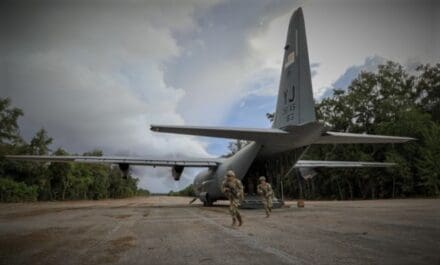
The 86th Aeromedical Evacuation Squadron held a COVID-19 patient movement training using the Negatively Pressurized Conex-Lite at Ramstein Air Base, Dec. 14-18.

The week-long training ended with a proof-of-concept flight on a C-130J Super Hercules, solidifying the entire process of U.S. Air Forces in Europe and Air Forces Africa COVID-19 patient transfer capabilities for the 86th Airlift Wing.

“It was the first time an NPC-L has taken off, at least in U.S. European Command, having a training mission on it, all the assets, and coordinating the integration from the ground piece to the in-flight piece,” said Capt. JD Pilger, 86th AES training flight commander. “Previously, everything was done on the ground, so this is a big deal. The capstone for the week was getting this thing airborne and proving this concept and capability for EUCOM.”

Operations such as these are historically placed within the Air Mobility Command, specifically at Joint Base Charleston, South Carolina. The initial force training was only conducted there for the entire Air Force, which would then piece together teams and send on deployments to provide this capability operationally.

In July, however, AMC started a flagship initiative to send certified trainers to Ramstein AB to certify 86th Medical Group and 86th AES personnel to be the initial cadre on the NPC-L. This established an organic capability located overseas, therefore widening the pool of certified personnel to the force, said Maj. Josh Williams, 86th AES operations flight commander.

From the 721st Aerial Port Squadron, loading the NPC-L onto the aircraft to the 86th MDG and 86th AES infectious disease team ensuring proper personal protective equipment was worn during each scenario, multiple units were called upon to contribute to the training.

“The training was for developing another force package for the 86th AW, to enable us to move COVID-positive patients utilizing the NPC-L,” Pilger said. “The force package entails members from the 86th MDG, the 86th AES and additional folks over at Landstuhl Regional Medical Center, such as our Critical Care Air Transport Team.”

The NPC-L is a smaller version of the Negatively Pressurized Conex, an isolated containment chamber intended to transport individuals with infectious diseases like COVID-19. While the NPC is used on C-17 Globemaster III, the NPC-L was developed for use on a C-130J.

“Pursuant to a U.S. Transportation Command joint urgent operational need request, (the NPC) was fielded, and the follow on to that was the NPC-L,” Williams said. “That is what we’ve now developed our teams and force packages within the 86th AW to support. (The NPC) is actually loadable on a C-130 and can transport patients in EUCOM, as well as U.S. Africa Command.”

Up to nine ambulatory patients, four litter patients, two CCATT critical care patients, or variations thereof, can be transported in the NPC-L.

During the training, Airmen were presented with various patient-transfer scenarios and worked together to execute the mission both on the ground and in the air.

“It was a true team sport throughout the whole thing,” said Capt. Zachary Gooch, 86th AES operations support flight commander. “We could not have done it without the support from Air Terminal Operations Center, maintenance or the medical group.”

Having this organic capability enables Ramstein to provide COVID-19 patient movement overseas without the need for assets deployed from AMC.

“I think we proved that this can be done without having a deployed asset that rolls in and sets up shop,” Gooch said. “We did it, basically, from grassroots.”

By SrA John R. Wright, 86th Airlift Wing Public Affairs

‘A Tribute to Persistence:’ SecAF Presents Air Force Cross to Special Tactics Airman

Monday, January 4th, 2021

CANNON AIR FORCE BASE, N.M. (AFNS) —

Snapped awake by the sound of belt-fed machine gun fire, then-Senior Airman Alaxey Germanovich, a 26th Special Tactics Squadron combat controller, surveys the compound he had dozed off in after several sleepless days of combat.

“I look around and I don’t see any of my American teammates,” Germanovich said. “(At that moment I said to myself) I need to find my friends right now.”

Grabbing his helmet and rifle, Germanovich bolted out of the compound and into the fight, where he saw several of the Army special forces Soldiers he was embedded with huddling for cover from behind a small rock.

“I knew then that I had to go get to my teammates and help them,” he said.

Germanovich’s base instinct would quickly turn into a grueling battle for survival, but it was those selfless impulses to save and protect his teammates that proved to be the difference between life and death for many of his teammates on that fateful day.

SecAF commends combat controller for valor

Secretary of the Air Force Barbara Barrett presented the Air Force Cross to now-Staff Sgt. Germanovich during a ceremony at Cannon Air Force Base Dec. 10.

Germanovich was awarded the medal, second only to the Medal of Honor, for his actions April 8, 2017, during combat operations against enemy forces in Nangarhar Province, Afghanistan.

“This Air Force Cross is a tribute to your persistence (Staff Sgt. Germanovich),” Barrett said. “You risked your life and weathered blistering enemy fire to save the lives of others.”

In attendance were Col. Matthew Allen, 24th Special Operations Wing commander, the 7th Special Forces Group (Airborne) team Germanovich was attached to during the combat operations, and Germanovich’s family and friends.

Following the ceremony, Germanovich led those in attendance in memorial pushups to commemorate the event, the firefight and the ultimate sacrifice paid during the clash by Army Staff Sgt. Mark De Alencar, a special forces Soldier assigned to 7th SFG (A) and a member of the team Germanovich was assigned to.

“This battle was a case study in toughness and extraordinary competence,” Allen said. “But it was also a case study in love. The type of love that demands teammates fight for one another and give everything they have.”

Germanovich’s actions as the air-to-ground liaison for his special operations forces team were credited with protecting the lives of more than 150 friendly forces and the lethal engagement of 11 separate fighting positions.

Facing hell, calling for fire

A native of Boiling Springs, South Carolina, Germanovich enlisted into the Air Force in November, 2012, with two goals in mind.

“I always knew I wanted a challenge,” Germanovich said. “I wanted to have a direct impact on the battlefield wherever I went.”

Five years later, both of those wishes would be granted when he deployed to Afghanistan and embedded with 7 SFG (A) Soldiers and their Afghan partners.

During his tour, the joint force was tasked with clearing several valleys in Nangarhar of fighters. As the multi-day operation progressed and the coalition forces pushed the insurgents closer to the Afghan border of Pakistan, the fighting became more and more violent. It reached a head as Germanovich sprinted through heavy enemy fire to help the Special Forces Soldiers on that fateful day.

After reaching the rock his teammates were pinned down behind, Germanovich began to call in airstrikes to try and suppress the attack.

“It was working to a degree,” Germanovich said. “But we were still receiving extremely effective fire, and one of our partner force members had gotten shot.”

To evacuate the wounded Afghan commando, Germanovich began to call for strikes extremely close to their position in order to create more separation between the coalition forces and the insurgents.

“As the bombs were falling out of the sky, I started screaming at everybody to run for cover,” Germanovich said.

After the partner force member was evacuated, the special operations forces team launched their counter-attack. A separate unit from across the valley was able to pinpoint a key enemy bunker during the firefight, and Germanovich’s element, led by De Alencar, crawled their way towards the position.

Once the fire team reached the top of the bunker, Germanovich and De Alencar dropped grenades into its entrance. Then, as Germanovich secured the opening and De Alencar and the other Special Forces Soldiers began to breach the bunker, insurgents ambushed the team from hidden positions to the south, mortally wounding De Alencar.

“The situation just became complete and utter chaos,” Germanovich said. “The team and I had expended all of our ordnance engaging enemy targets. We expended all of our grenades, there was no more pistol ammunition, and we were out of ammo completely.”

Lying prone with no cover from the attack, Germanovich put out a call to an AC-130W Stinger II gunship aircraft that was leaving the area in order to refuel.

“As they were leaving, I said ‘if you don’t come back, we’re dead.’” Germanovich said.

The gunship did return and began to fire on the enemy fighters, which gave Germanovich and the soldiers the opportunity to move away and evacuate De Alencar.

“All the while, we’re still taking effective fire from the enemy,” Germanovich said. “We began dropping ordnance and basically bombing up this mountainside until we got to safety.”

Germanovich’s actions proved decisive on that battlefield and demonstrated the enormous impact of Air Force Special Operation Command’s precision strike mission, which provides ground force with specialized capabilities to find, assess and engage targets.

“You (Germanovich) told me earlier that you did what any one of your teammates would have done in the same situation,” Allen said. “But we don’t know that. We do know what you did that day: face and devastate a numerically superior enemy … this is why America’s enemies do not take us head on.”

Germanovich’s ability to enable precision strike operations and his bravery in the face of hostile fire are incredibly courageous in their own right, but it was the reason behind his valiant performance that makes him an unquestionable hero.

“It was 100% my teammates,” Germanovich said. “If I’m in danger, I know without a doubt in my mind that my teammates are going to do everything in their power to make sure that I come back, and I would do everything that I could possibly do to make sure that they come back.”

Article by SrA Maxwell Daigle, 27th Special Operations Wing Public Affairs

Photos by SSgt Michael Washburn and A1C Drew Cyburt