TYR Tactical

Archive for the ‘Guest Post’ Category

FirstSpear Friday Focus – Tactical Patrolling Harness NSNS

Friday, August 2nd, 2019

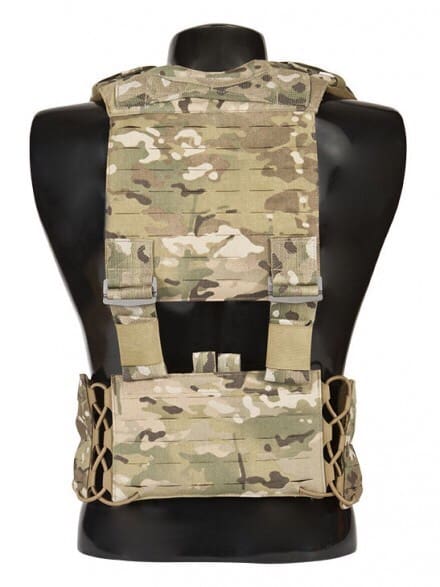
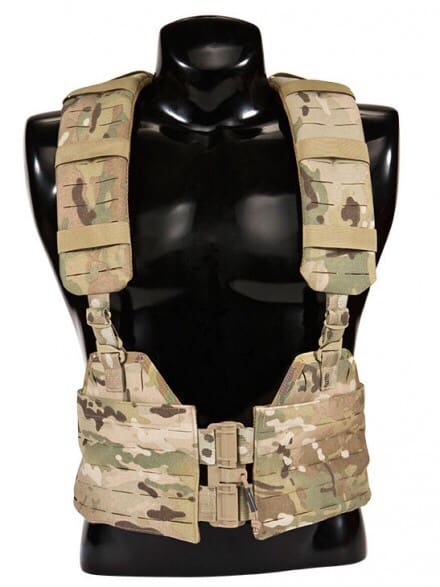
All new in the Non-Stocking Non-Standard section of the FirstSpear web store is the FirstSpear 6/12 Laser Cut, Tactical Patrolling harness. Classic patrolling harness design with modern construction techniques and materials including FirstSpear 6/12 and FirstSpear quick-relase Tubes technology. Large padded shoulder straps, drag handle and 6/12 back panel allow the user to mount 6/9, 6/12, and molle style pockets. Available in small/medium and large/ extra large. Limited colors and sizes available.

Non-Stocking Non-Standard items were built at the request of FirstSpear professional users and contract overruns. 100% 1st quality goods. Colors, sizes, and quantities are limited. When they are gone they are gone, No back-orders will be filled. No Returns No Exchanges.

www.first-spear.com

No More ‘Flight Suits,’ the Integrated Aircrew Ensemble Makes Debut

Thursday, August 1st, 2019

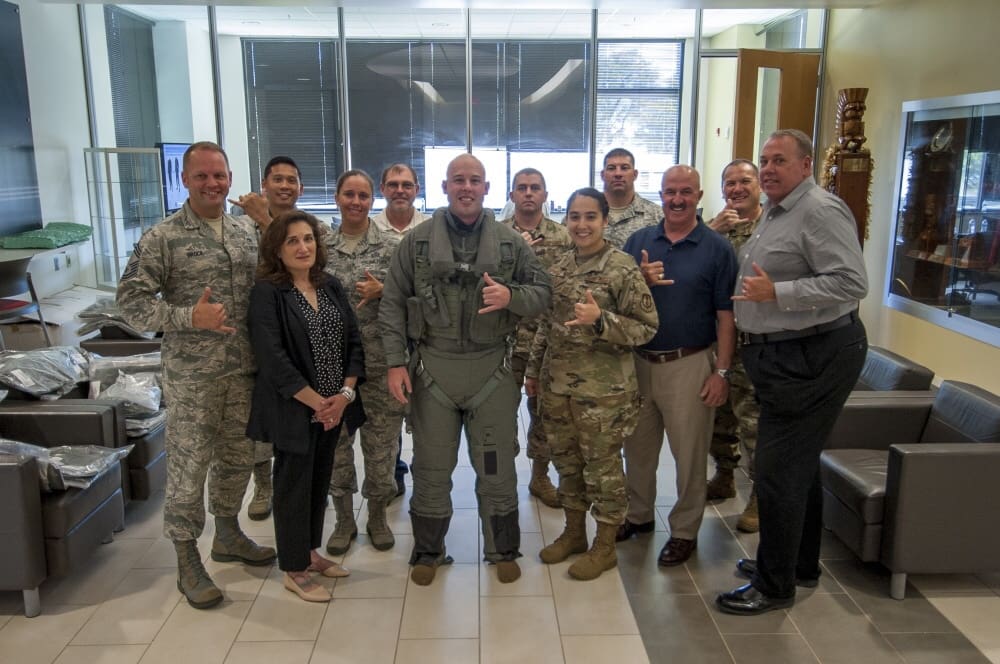
Representatives from Wright-Patterson Air Force Base, Ohio, visited Joint Base Pearl Harbor-Hickam July 8-12 to introduce fighter pilots and aircrew flight equipment professionals to some of the newest developments in flight-suit technology.

Team Hickam’s Hawaiian Raptors, comprised of members from the 199th and 19th Fighter Squadrons, have been selected to be the first aircraft operators to bring the gear, called the Integrated Aircrew Ensemble, into an operational capacity.

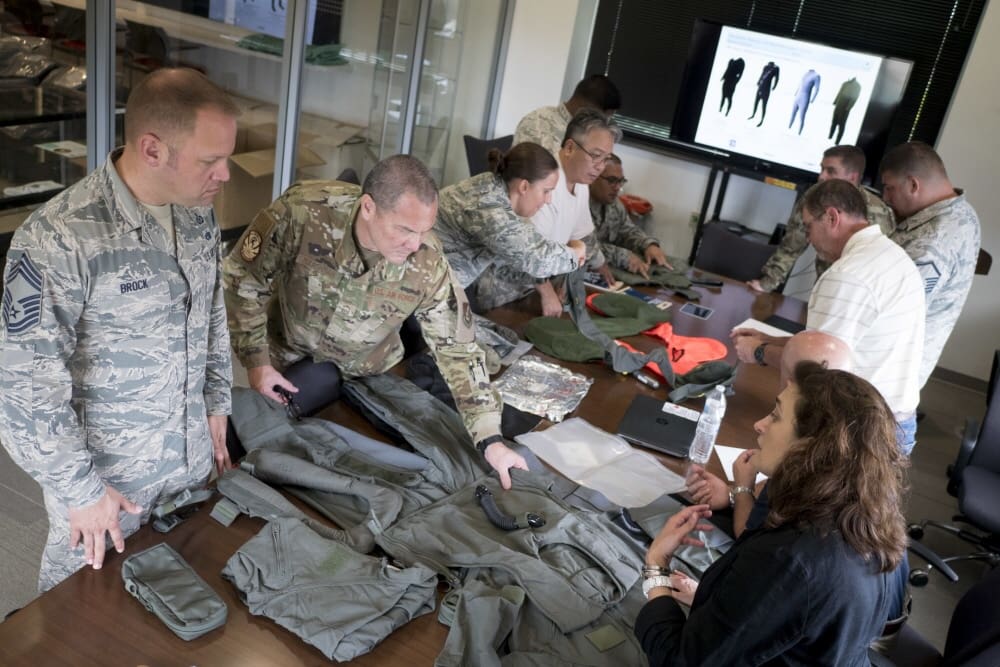
The visiting project managers from the Human Systems Program Office provided demonstrations, fittings and on-the-job training to F-22 Raptor pilots and the AFE Airmen who will maintain the state-of-the art ensemble.

“Being selected as the first unit, and also as the Air National Guard, over any other [major command] is definitely something to be proud of, said Senior Master Sgt. Michelle Davidson, 154th Operations Support Squadron AFE superintendent. “I think it says something about our work ethic and our integrity down here; that we’re willing to take on the challenge and be a part of this new process.”

Hawaii Air National Guard and Active Duty pilots were provided demonstrations and were individually measured for custom-fit equipment.

Unlike the currently used ‘legacy’ equipment, which had been piecemealed with additional support items over several decades, each component of the IAE has been designed to complement all other items. The IAE is built to support aircrew in all ejection-seat aircraft, to include fighters, trainers and bomb carriers. Its material has been influenced by recent advancements in sports technology to aid aviators who endure harsh flight conditions.

“It’s all strategically placed so items are not on top of each other; it minimizes the occurrence of friction, hotspots or wear-down on the system,” said Carl Medeiros, IAE program manager. “The material is also moisture-wicking, so it pulls moisture away from the body, removing and reducing thermal burden, while increasing mobility and comfort levels. When it all comes together, there’s a direct correlation and improvement to the physiological effects on the pilot.”

A combination of four layers can be used to support pilots in the face of natural elements and a wide range of mission sets. This includes a thermal undergarment for cold weather protection, a water-resistant environmental protection layer, a chemical/biological/radiological resistant layer and the coverall, which provides heat and flame protection.

While the new system will require additional familiarize training events for AFE Airmen, less man hours will be required to sustain and service the equipment. Developments, such as the new floatation device, make this possible, as it does not require sensitive munitions to activate and can be transported and handled without risks of explosive reactions.

According to Medeiros, the Hawaiian Raptors are projected to receive the IAE during the first half of 2020.

“Initially I think the buildup process is going to be quite tedious,” said Davidson. “It’s a big task to take on, but I think once the supplies are delivered and we’re all set up it’s going to be an amazing product for us to use.”

Story by SrA John Linzmeier 

154th Wing Public Affairs

202 MPH $205,000 APR RS7 The World’s Fastest Armored Car?

Tuesday, July 30th, 2019

Pete Blaber led company uses advanced polycarbonate composites and ballistic glass and “world class” security features to creat a B-4 level safe room.

AddArmor, known as much for the pedigree of its leadership as for designing what they call sophisticated mobile safe rooms, recently announced its latest creation: the “world’s fastest armored car.” It’s an Audi RS7 built with a polycarbonate weave they say is 10x stronger than ballistic steel.

The new 202 mph APR-tuned RS7 was designed and built to showcase new developments in lightweight combat-proven polycarbonate armor paneling. Armored vehicles have long been associated with lumbering, heavy duty trucks. This was apparently the impetus that pushed AddArmor design. As they describe it, they decided to showcase a truly modernized armored car that could put lie to such impressions – and by doing so to highlight just how far modern armor technology has evolved. The result is a car they claim can perform at speeds of more than 200mph sporting an armor material weighing 60% less than ballistic steel.

AddArmor President Jeff Engen explains.

“With the new AddArmor APR RS7, we wanted to demonstrate how today’s armoring technology allows drivers to pick from a wide range of cars not normally associated with armored vehicles. The total armoring weight of the AddArmor APR RS7 is no more than 200 pounds. That small amount of weight allows for exotic sports cars and even electric vehicles to be nicely armored without compromising their performance or range. The key difference is AddArmor uses a polycarbonate composite instead of heavy steel plating. The weave offers a much stronger, lighter package that simultaneously allows the car to be much faster.”

Speed and maneuverability is frequently a critical element of safety, so AddArmor worked to ensure the vehicle’s “lightweight comprehensive 360-degree protection” would function without compromising acceleration or braking. They combined this ballistic protection with horsepower. As a result, the RS7’s 4.0L twin-turbo engine is complemented an APR Stage II system. AddArmor advises us this “special performance package” will produce 760 horsepower/800 lb-ft of torque with a manufacturer-clocked 0 – 60 mph time of 2.9 seconds.

AddArmor upfitted European B4-level armoring to the RS7; this package combines front-seat 360-degree polycarbonate body panels and ballistic glass to limit weight and protect the primary the occupants. Their ballistic glass is comprised of a multi-layer mixture of polycarbonate and ballistic glass, providing a transparent layer of armor that can withstand prolonged attacks from blunt objects like bricks and bats. Ballistically, the B4 armor can stop a .44 Magnum round, allowing drivers and passengers to evade attack – more important to EP/PSD work than overlanding, but nice to have nonetheless!

Vehicle armor is ballistically rated, much as individual body armor is categorized in II, III, and similar levels by the NIJ. The actual terminology used my vary, for instance from the US State Department Armored Vehicle Program to others from half a dozen or more different countries.

As described by the AddArmor release, the APR RS7 features “Delta Force-tested security throughout.”

The description continues:

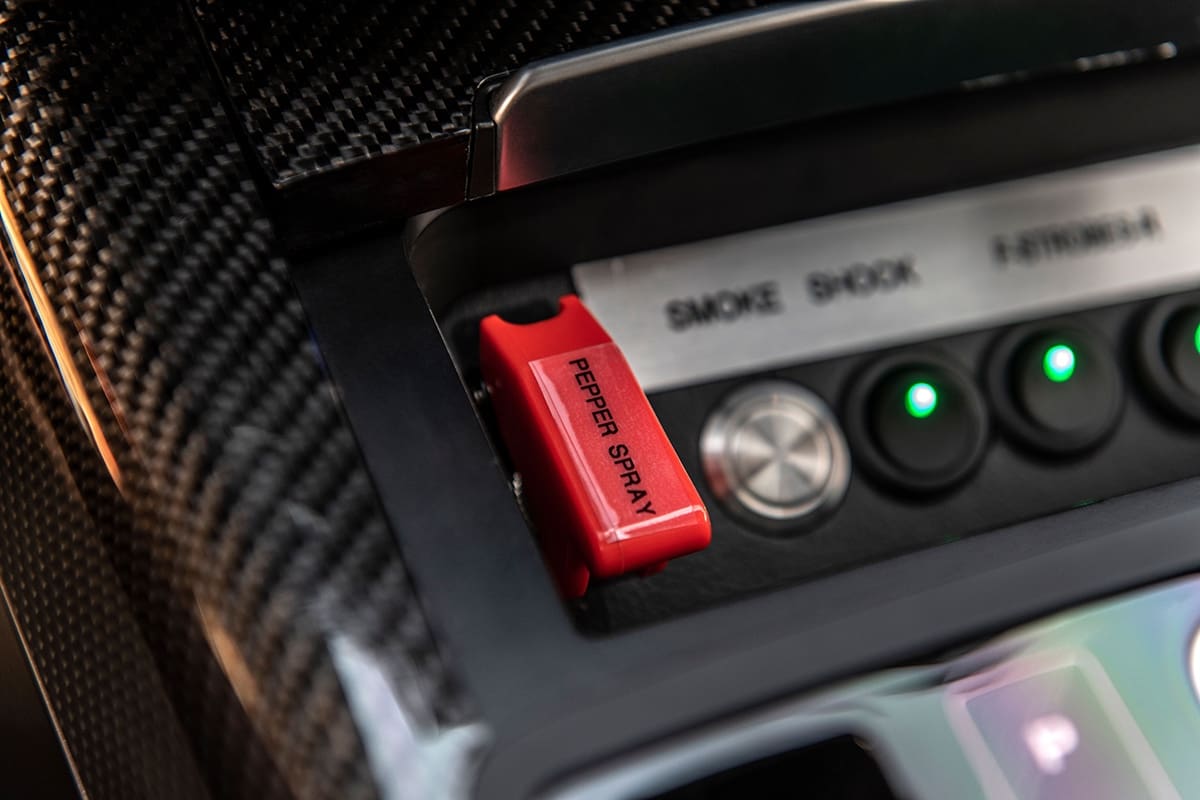
Hidden security countermeasures include a sonic sound cannon with a PA system and siren capable of 120 dB. Other security items include electric-shock door handles equivalent to a high-powered taser gun and pepper spray dispensers. For ramming, AddArmor installed a front barrier bumper that protects the car’s radiator while also allowing the automobile to comfortably drive through most ambush situations. The AddArmor APR RS7 also includes a specially developed rear blinding light system that uses aircraft landing technology to temporarily blind assailants. The new vehicle also features a custom smokescreen system. For added security, the AddArmor APR RS7 includes biometric gun racks hidden in the trunk that can accommodate assault rifles and handguns.
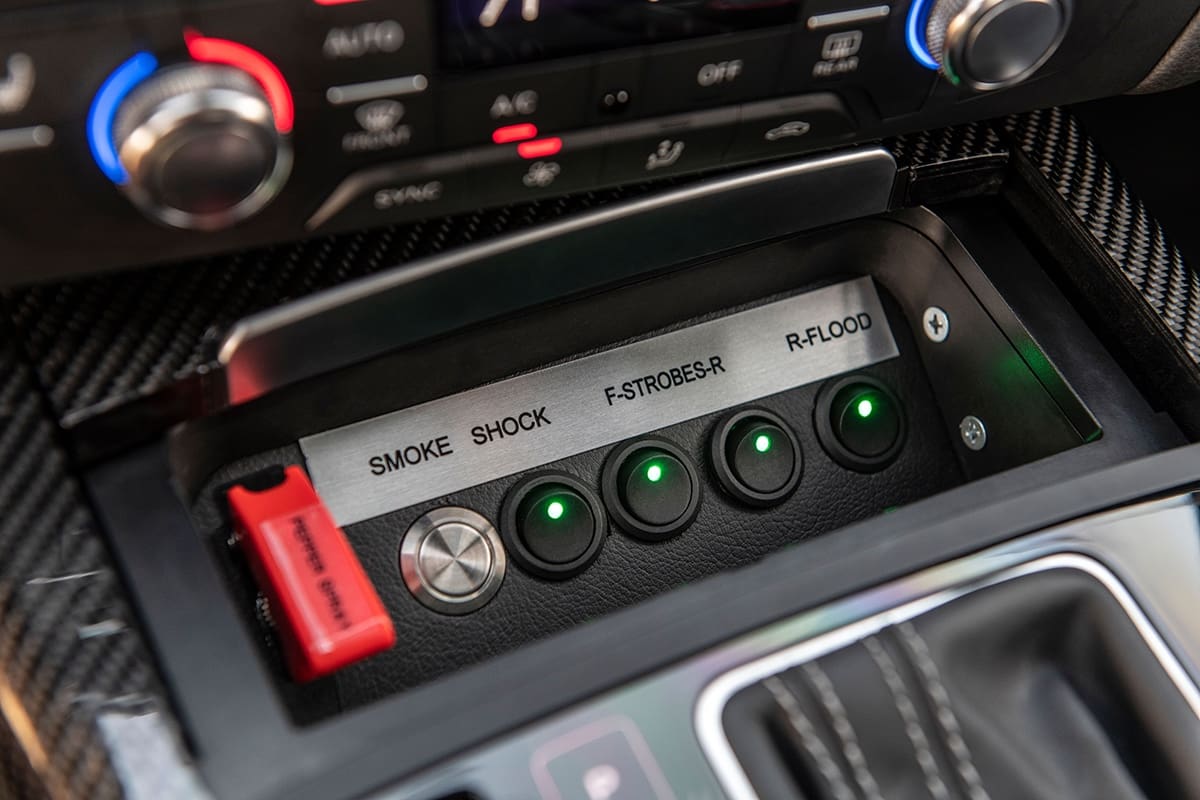
Another unique security measure included on the AddArmor APR RS7 is a special Global 911 concierge service. This satellite-activated 24/7 system monitors the vehicle’s occupants via their cell phones and an array of beacons. Any sign of trouble automatically sets off a siren in a command center staffed by highly trained security staff with military and first-responder backgrounds. The Global 911 concierge service assesses all security situations as they arise and dispatches solutions in the case of any emergency. These systems allow AddArmor to protect their clients anywhere around the globe.

For added security, the new AddArmor APR RS7 includes a multitude of other on-board tactical electronics. An overseas-compliant drone-denial frequency-jamming satellite communications system has been installed alongside active mine/explosion detection, as well as a state-of-the-art 360-degree night-vision camera system. In the case of any airborne attacks, the AddArmor APR RS7 has an overpressure gas detection unit with onboard gas masks and air tanks to supply filtered fresh breathing air.
The RS7 runs on high-performance 275/30ZR21 Pirelli P Zero Run Flat tires capable of driving 30 miles after sustaining multiple high-powered rifle shots.

The AddArmor APR RS7 demonstrates how AddArmor provides custom protection packages to meet clients’ needs for either new or existing vehicles. Security packages for executive, work, personal, and family vehicles are available starting at $28,000. The new AddArmor APR RS7 is available for $205,000.

AddArmor (which offers training as well) can be found online at AddArmor.com.

DR can be contacted on IG via @reederwrites.

NSWC Crane Hosts First United Kingdom Light Weapon Design Course for Expeditionary Professionals

Tuesday, July 30th, 2019

CRANE, Ind. – Naval Surface Warfare Center, Crane Division (NSWC Crane) hosted Expeditionary professionals for its first Light Weapon Design Course led by Cranfield University, a postgraduate university based in the United Kingdom that specializes in defense technology.

“This is the first time the Light Weapon Design has been brought to Crane,” says Adam Parsley, a Division Manager at NSWC Crane. “The Small Arms Weapon Systems Division was able to really enhance the learning experience for all the students with the access we have to weapons, ammunition, and the firing range.”

Parsley says the Light Weapon Design Course teaches the fundamentals of weapon operation and design.

“It focuses on the development of light weapons, or small arms, and their design and operation today,” says Parsley. “Through this course, our Expeditionary employees will better understand the reasoning behind design parameters – heat dissipation, durability, signature, recoil – and will have better concepts of how to design and test weapons.”

Chris Shaffer, an engineer at NSWC Crane, took part in Cranfield’s Light Weapon Design Course. Shaffer says these highly specialized courses from Cranfield help with workforce development.

“These courses offer Expeditionary professionals the opportunity to gain unique, hands-on experience,” says Shaffer. “They can take the engineering concepts, ideas, and skills they learned in undergrad and apply them to military devices. For these jobs in Expeditionary Warfare, the workforce needs specialized knowledge.”

Students from other commands traveled to NSWC Crane to participate in the course.

“The Light Weapon Design Course was fantastic,” says Erin Thompson, a Weapons Team Engineer at Marine Corps Systems Command. “I learned so much that will be directly applicable to my job and make me more effective for the Marine Corps. Chris Shaffer and the Crane team were great and the access we were afforded to the weapons was incredibly beneficial.”

“I thought the class was really well done,” says Elizabeth Palm, a Test Officer at US Army Cold Regions Test Center. “Adam and Chris did a great job coordinating with Cranfield to be able to offer so much hands-on time with a variety of weapons, especially the foreign ones. And of course any chance to get out on the range is always a good day!”


Cranfield University is in its second year of offering Masters of Science courses at Crane. The Light Weapon Design Course is the seventh Cranfield course since its inception.

“Cranfield offers courses in weaponry, munitions, sensors, and communications that most colleges and universities just don’t have,” says Parsley. “They also have packaged these courses in this condensed, one-week format that is optimal for the working professional who wants to pursue an advanced degree.”

NSWC Crane is a naval laboratory and a field activity of Naval Sea Systems Command (NAVSEA) with mission areas in Expeditionary Warfare, Strategic Missions and Electronic Warfare. The warfare center is responsible for multi-domain, multi- spectral, full life cycle support of technologies and systems enhancing capability to today’s Warfighter.

By NSWC Crane Corporate Communications

Max Talk 31: The Combat Reload

Monday, July 29th, 2019

This is the thirty first installment of ‘Max Talk Monday’ which shares select episodes from a series of instructional videos. Max Velocity Tactical (MVT) has established a reputation on the leading edge of tactical live fire and force on force training. MVT is dedicated to developing and training tactical excellence at the individual and team level.


The Combat Reload is essential to manipulating your rifle in a firefight. This video explains the context, tactical considerations, and options when it comes to the Combat Reload. Solid weapon manipulation skills are important in a tactical context, allowing you to focus on situational awareness, rather than being sucked into trying to keep your rifle running. Do not confuse ‘tactical’ cool-guy shooting with real tactical context. Train to win the fight!

Detailed explanations can be found in the MVT Tactical Manual: Small Unit Tactics.

Max is a tactical trainer and author, a lifelong professional soldier with extensive military experience. He served with British Special Operations Forces, both enlisted and as a commissioned officer; a graduate of the Royal Military Academy Sandhurst. Max served on numerous operational deployments, and also served as a recruit instructor. Max spent five years serving as a paramilitary contractor in both Iraq and Afghanistan; the latter two years working for the British Government in Helmand Province, Afghanistan.

Website: Max Velocity Tactical

YouTube: Max Velocity Tactical

SCUBAPRO Sunday – Compasses

Sunday, July 28th, 2019

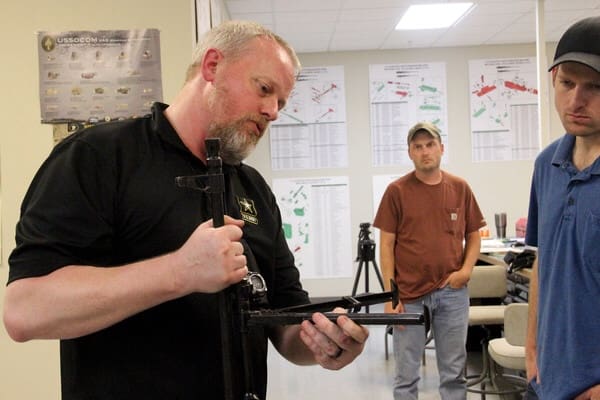
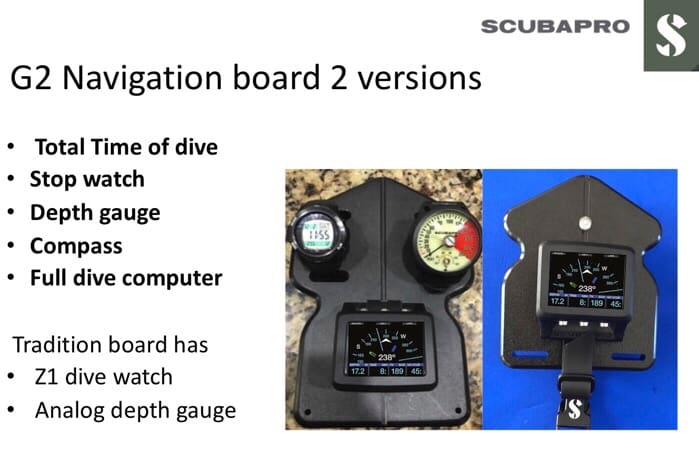
Using a Compass on your wrist or on a Navigation/attack board is something that is taught when you first start diving in the military. But how much time have you really spent honing your navigational skills? Using an underwater compass can keep your dive on track, optimizing your bottom time as well as getting you to and from the target safely. I am going to walk thru a handheld compass as it has more parts than most compasses that are on Nav Boards.   

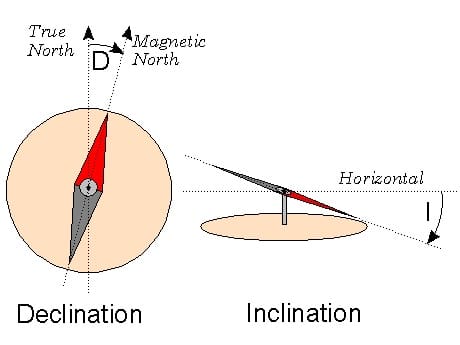
Knowing about your compass what it can and can’t do. Everyone knows that a compass points north. The part that handles that task is called the card. This is the spinning face of the compass that has N, E, S, and W printed on it. The edges of the cards are angled at 45 degrees. Around the perimeter of the compass is a movable ring called a bezel. The bezel has a line (sometimes a double line) running through the center called the lubber line. This line is your directional marker. One of the most important things to remember is to keep the compass as level as posable. Depending on where you are in the world, your compass hand will “dip.” That is caused by the different magnetic fields in the Earth pulling on the arm of the compass. This is different than setting your declination. Declination is where the arrow points. The inclination is the pull on the arm of the compass. All compasses are made for different parts of the world. If you buy a compass in the U.S., it was made for use in the U.S. Some companies produce what are called global compass. Those are made to be used worldwide. They have the least amount of dip of any other compasses. Truly the dip is really only a factor if you are covering long distances.  Most of that info was for a handheld compass. But as far as keeping a compass level, that is true no matter whether if you are on Sea, Air or Land. ( see what I did there) SEAL.


If you are using a compass on your wrist you will use the side window to aim the compass where you want to go or see at what bearing something is at. Once you orient the lubber line, with the side window of the compass, you will see a number on the card through that window. This is where the angled design of the card comes into play. As long as you are seeing this same number through the window, you are heading in the desired direction. If you see a different number, make small adjustments until your number comes back into the window.


You can also use landmarks, like piers, sandbars, rocks, whatever will not move to check your position. You can set these as waypoints or reset points. Look at your heading and then use that to reference a visible landmark that is on a straight line visually. When you arrive at this waypoint, you can look ahead to find the next one. These visual cues will work in conjunction with using an underwater compass and allow you to get where you want to be. It is just like doing it on the land so keep in mind that metal objects can interfere with your compass’s magnet, causing what is known as “deviation,” so if your compass starts to move around a lot, try and stay on heading and your compass will settle down once you pass it. Moving away from the object, either laterally or vertically should correct the problem. Recheck your headings, and you can get back on track.


A lot of younger diver like using a digital compass on Navigation boards. The same priceable apply for using a digital compass. Digital compasses should be calibrated for the area you are diving. Each calibration is basically taking a sample of the magnetic that surrounding the compass. A particular calibration is only valid for that location of the compass. Ferrous materials can cause heading inaccuracy. So, make sure when you do calibrate your compass you are away from metal. Ferrous material can also affect your compass on a dive. Since heading is based on the direction of the Earth’s horizontal field, a digital compass must be able to measure this field with lesser influence from other nearby magnetic sources or movement. A digital compass is like a traditional one. Both compasses use the Earth’s magnetic field to determine which way is North. The difference is that a standard compass can dip because of movement and may encounter interference from strong magnetic sources, so inaccuracy can be a problem. A digital compass is much more accurate because it will only use magnetic North. So, using an excellent waterproof compass can help make you a better combat swimmer.  


Kit Badger – The Date Night Drill

Saturday, July 27th, 2019

What do you think of this drill Ivan picked up from Bill at AMTAC Shooting?

kitbadger.com/the-date-night-drill

FirstSpear Friday Focus – TORN Warriors

Friday, July 26th, 2019

Stay tuned with FirstSpear TV this weekend as they make there way to Nevada for the inaugural kick off fundraiser for TORN Warriors, a nonprofit developed for disabled veterans and wounded service members that helps empower them through off-road driving, racing, and shooting events.

The two day shooting and riding event will be held this weekend with a raffle on Saturday the 27th with proceeds going to offset costs for future events including the first professional race in August – Best in the Desert’s Vegas to Reno. Driven by Curt Caruso 25-year veteran of the USMC and the navigator will be double amputee Clint Trial who you may have seen recently receiving the Purple Heart from POTUS.

The raffle will include hand crafted knives and firearms built by veterans along with more awesome industry kit.

There are multiple ways to donate / purchase raffle tickets ($100/ per ticket):

-Rough Neck Raffle July 27: go.rallyup.com/tornwarriors

-PayPal: info@tornwarriors.org

-Mail: TORN Warriors

HC 67 Box 30

Wells, NV 89835

Be sure to include your full name, email address, and annotate “TORN WARRIORS RAFFLE”