FirstSpear TV

Archive for the ‘Helmets’ Category

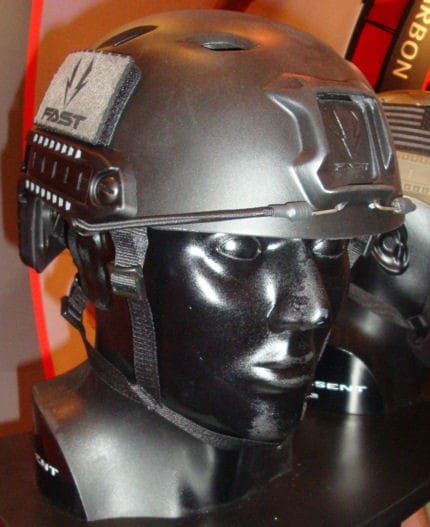
Basejump Helmet from Ops-Core

Wednesday, January 20th, 2010

In order to satisfy users who don’t need all of the capability of the FAST Bump helmet, Ops-Core has developed the Basejump. Manufactured from glass filled nylon the Basejump has the Night Vision mount molded directly into the helmet. Retail is said to be around $180.

Ops Core Basejump

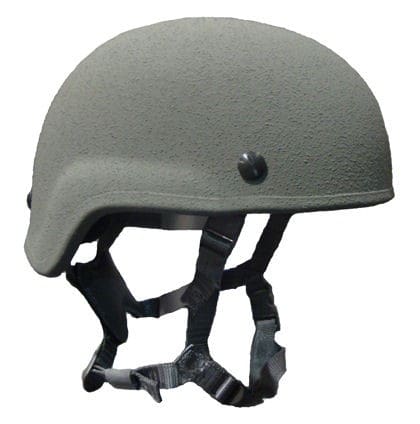
New Lightweight Helmet Option from Gentex

Saturday, October 31st, 2009

Gentex recently unveiled a new lightweight version of their popular Tactical Ballistic Helmet series. This new TBH III is crafted from a polyethylene product rather than the aramid normally found in the TBH. Inspired by the requirements for the Enhanced Combat Helmet requirements, Gentex decided to offer an alternative helmet. In addition to the new ECH, Gentex also developed a helmet that offers the same ballistic protection as a current ACH, but with a weight savings of over 30% due to the use of PE material.

Gentex TBH-III

Additionally, as you can see from the photo, Gentex is experimenting with new cuts to further balance protection with the ability to utilize active hearing protection and communications headsets. Rather than the popular “Gunfighter” cut (still offered by Gentex) step-style cut, this sample has more of a scoop cut around teh front portion of the ears and retains more coverage in the rear.

The new helmet is so new there is no information available on their website yet. Please contact Gentex.

Canada to Develop Urban Camo Pattern

Tuesday, October 27th, 2009

Canada has decided to develop a unique urban camo pattern called Canadian Urban Environment Pattern (CUEPAT). Ok, makes sense. But not the why and where. That is where it gets weird. We had to take this straight from the tender:

The Department of National Defence, Defence Research and Development Canada – Suffield, (DRDC-S), AB, has a requirement to develop a Canadian Urban Environment Pattern (CUEPAT) based on the unique requirements of Canada’s three major metropolitan areas, Vancouver, Toronto and Montreal. The current CBR individual protective equipment (IPE) used by the Canadian military is provided in a woodland or desert camouflage. A camouflage suited to the Canadian urban environment is required when the milatary (sic) operates in urban terrain.

So essentially, Canada’s equivalent of DTRA is seeking a camo pattern based on domestic urban environments. What’s even more curious is that the pattern is specifically for chem-bio gear. One would think that for domestic CBR defense, one would want to blend in with the local population as much as possible, perhaps as first responders or in items that more closely resemble civilian clothing.

However, what makes this even more interesting is that the tender is the Public Works equivalent of a sole source solicitation. The work is being handed over to Guy Cramer and Co at HyperStealth Biotechnology Corp. So how did they get this sole source contract valued at $24,900.00 C$ (GST extra)? Once again we have to look at the tender.

The Contractor holds the proprietary right to the advanced fractal algorithms and feed back loop technology to develop non-repeating digital camouflage patterns. HyperStealth Biotechnology Corporation’s design team of Guy Cramer and Timothy R. O’Neill share copyright on approximately 8,000 digital camouflage patterns. Access to this extensive data base for the purposes of developing a new Canadian urban environment camouflage pattern is critical to the success of the project. All Intellectual Property Rights in the Foreground Information shall belong to the Contractor as soon as they come into existence. There are no alternative sources of supply for this requirement as no other Canadian source exists that has the capability to design and develop digital, non-repeating camouflage patterns using state-of-the-art fractal algorithms and feed back loop technology, with concomitant IP protected access to approximately 8,000 copyrighted patterns that can be used in full support of meeting the requirement.

That’s right, copyright on over 8,000 patterns! Some other nuggets from the solicitation include that the period of performance will be from contract award until March 31, 2010 but may include follow on work. Interestingly, HyperStealth will be allowed to retain the intellectual property developed under this contract.

So the way this is written, it looks like the Canadian government is paying HyperStealth almost 25 large to do work they have already accomplished and they are giving them six months to do it. In the end, the Canadian government will have an urban camo pattern fine tuned for use in their own major cities and applied only to chemical and biological warfare clothing. Like I said; interesting.


The Mk 7 Helmet, Up Close and Personal

Thursday, October 15th, 2009

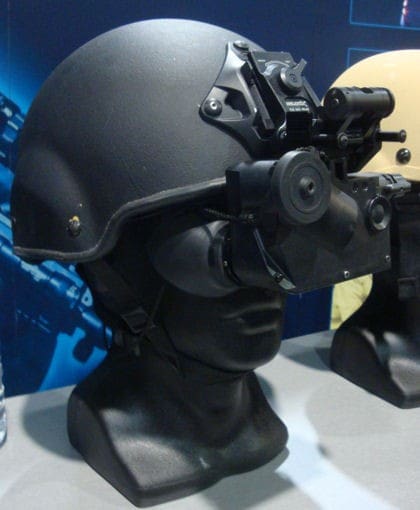
US manufacturer Wilcox Industries had a brand new British AC900/600 helmet on display at AUSA. The AC900/600 has been designated as the Mk 7 for use as an interim measure while PECOC refines development of an entirely new suite of individual equipment for the British Tommie. You can see from the display the full advantage of the scalloped brim when used with Night Vision Systems. This was one of the driving reasons behind the interim adoption of modified variant of the AC900/600 helmet worn by UKSF on CT role. Wilcox had the helmet due to a recent development effort in support of the MoD. This also demonstrates Wilcox’s excellent capability to integrate seemingly disparate systems into a cohesive capability in rapid order.


British Mark 7 Helmet

Enhanced Protection Individual Comfort

Thursday, October 8th, 2009

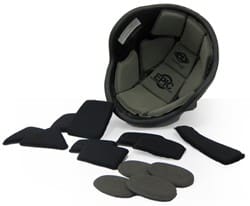
Team Wendy teased us at both Modern Day Marine and AUSA with their new EPIC technology. They have been keeping it under wraps because it is not yet approved for use by the military. However, Soldier Systems Daily was fortunate enough to be given a sneak peek at the new pad system.

Team Wendy's EPIC

Designed in response to an RFI for enhanced impact protection for the Enhanced Combat Helmet. The current ZAP pad system utilizes 7 pads but the new EPIC system offers 22 pads including a Impact Liner that cradles your noggin and is intended to be permanently attached to the inside of the helmet for enhanced performance. Additionally, there are sizing pads and four oval shaped Ultra Grip TM anti-slip pads to ensure a perfect fit. The comfort pads are provided in four shapes and two thicknesses: 3/16-inch “thin” and 3/8-inch “thick as well as two Sweat Bands (3/16-inch and 3/8-inch thick). The impact liner alone offers the 10 feet per second impact protection required. Testing indicates that the additional fitting pads only enhance the protection afforded to the wearer, up to 40% in hot conditions.

I had the opportunity to try it in an ACH and it definitely offers a great deal of adjustment. When I mounted the Ultra Grip TM pads it was going nowhere on my head. As with the current ZAP pad system, the pads feature wicking and anti-microbial treated fabric.

Team Wendy prepared this video to give you an idea of how the system works.

EPIC is available for sale to Law Enforcement customers but will not be offered to the military until it has been officially tested and approved for use. The ZAP system remains the sole approved helmet pad for use by the US military. We encourage the acquisition to take a serious look at such enhanced technologies as EPIC especially in light of the increased ballistic protection afforded by the developmental Enhanced Combat Helmet.

For more info visit Team Wendy.

Modern Day Marine Round Up

Monday, October 5th, 2009

There were a lot of great products at last week’s Modern Day Marine expo at Quantico, Virginia.

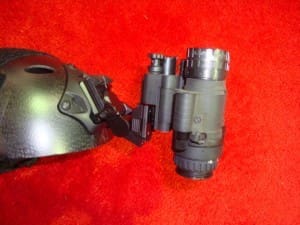
Wilcox Industries showed their new interface for the Ops-Core mount.

Wilcox Ops-Core Interface

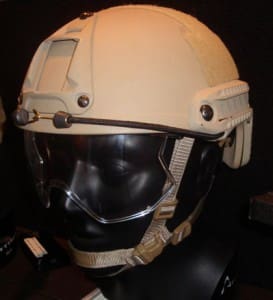
Speaking of Ops-Core, they debuted several new products available in early 2010. This eye shield was actually developed a couple of years ago but placed on hold while they refined the FAST technology for a military customer. The lens slides up and down on a track located inside the shell. It will replace the front brow pad inside the helmet as a unit and is ready to go awaiting production of the actual clear shield which will be manufactured by Oakley.

Ops-Core Shield

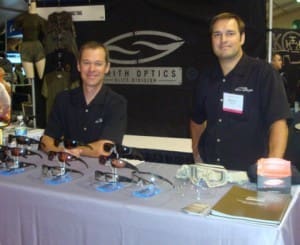
The Smith Optics Elite Division crew was on hand.

Smith Optics

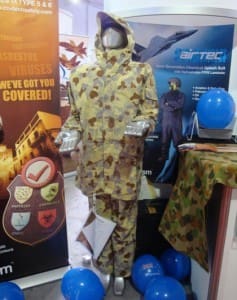
Australian firm Global Safety Solutions & Management PTY LTD exhibited their new wet weather laminate material. It is used in the current Australian issue foul weather clothing system.

GSSM Wet Weather Laminate

Inert Products, LLC displayed a wide variety of training aids including the M4 “rubber duck” as well as other inert training aids.

Inert Products LLC

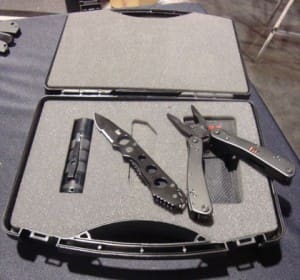
Benchmade Knives showed a set of their HK signature knives packed inside a pistol case. The combo pack includes a 20-Tools-in-One mutli-tool, LED light, and Ally knife.

HK Combo Pak

New British Helmet and Armor on Way to Afghanistan

Wednesday, September 23rd, 2009

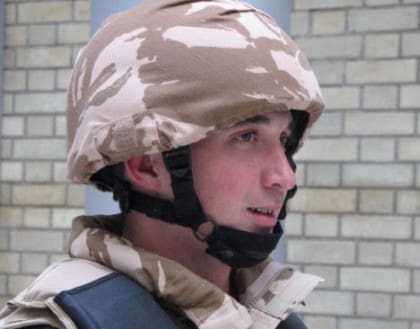
According to an article published in Sunday’s edition of the “Daily Mail”, the new Osprey assault armor and Mk 7 helmet have been shipped to Afghanistan for use by the 11th Brigade just beginning a six-month deployment.

Mk 7 Helmet

This photo published in the “Daily Mail” shows the new helmet’s camouflage cover. It will be interesting to see if this is just a prototype or will see general issue as it forgoes the sewn-in foliage bands found on the cover for the Mk 6 helmet.

News Flash – Military Helmet Designs Contribute To Brain Damage

Wednesday, September 16th, 2009

As if we needed a report to tell us that the current helmet design contributes to brain injuries. The current pattern is after all a compromise designed so that a Soldier can breath, smell, hear, and see. All pretty critical capabilities on a battlefield. Based on the cut, it isn’t any big surprise that blast waves enter the helmet. What is interesting is how one protective feature of modern helmets is protecting our troops, it is also putting them at risk to TBI.

The study entitled “Skull Flexure from Blast Waves: A Mechanism for Brain Injury with Implications for Helmet Design” discusses traumatic brain injury [TBI] and how it may be caused by skull flexure from even non-lethal blasts and without actual head impact.

Ultimately, what we are seeing is a similar phenomenon to what we have seen with body armor. Personal protection technology has developed to the point where they protect a Soldier from death in many attacks that would have killed them in previous conflicts. Consequently, we have seen a marked increase in burn, amputation, and brain injuries. These are effects that weren’t considered major requirements, if at all when the current family of PPE was under development.

In particular this report cites the air gap between the Soldier’s head and the inside of his helmet. Once again, with earlier technologies, the helmet shell’s material would not have been sufficient to protect the Soldier from most blasts and the accompanying shrapnel. Current and emerging shell technologies do a much better job at protecting from shrapnel injuries and so TBI is now being found in blast survivors. Unfortunately, the air gap in the helmet protects the wearer from blunt trauma injuries associated with back face deformation of the shell’s ballistic material. The ACH maintains a 1.3-cm gap between helmet and head; in simulations involving a 5-pound bomb exploding 15 feet from a Soldier’s head, blast waves washed into the helmet through this gap. “The helmet acts as a windscoop, so the pressure between the skull and helmet is larger than the blast wave by itself,” study co-author Michael King said. While the ACH’s pads mostly prevented this underwash, they also passed on forces to the skull.

King suggested that the pads’ stiffness could be optimized to “take the best of both worlds; it doesn’t allow the blast in there, and it doesn’t transfer [forces] from the helmet to the head.” He stressed that when making changes to the helmet, preserving its ability to reduce impacts and fend off bullets was paramount. “You’d have to be careful to make sure it doesn’t interfere with what the helmet does very well, which is stopping fragments and bullets,” he said. “The whole idea why there was a big gap between skull and helmet in the first place, is it makes it more likely for the soldier to survive if a bullet hits the helmet.”