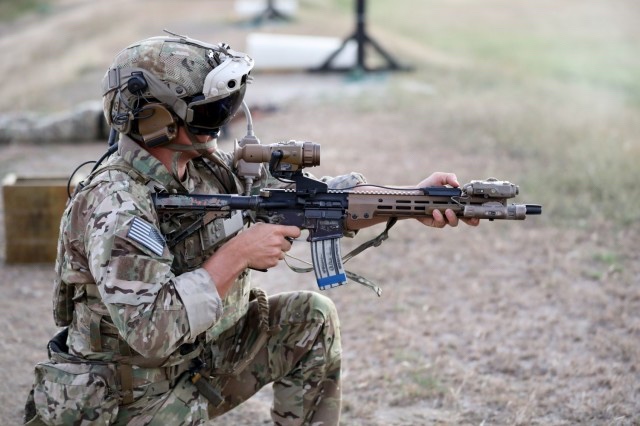
CAMP SANTIAGO, Puerto Rico — From minus 30 degrees Fahrenheit to over 90, the Integrated Visual Augmentation System was tested in back-to-back extreme weather test events led by Program Executive Office Soldier’s Project Manager IVAS this spring. After its time at the Cold Region Test Center in Alaska, the system was tested by 3rd Battalion, 75th Ranger Regiment at Camp Santiago’s Joint Readiness Training Center in Puerto Rico.

This was the first time that a platoon from a Ranger regiment had put IVAS military form factor through its paces and tested how the goggle increases situational awareness during land navigation, rapid target acquisition and full mission exercises.
“In my opinion, no one in the Army trains harder than we do,” said Brian Hayman, platoon sergeant for the 3rd Battalion, 75th Ranger Regiment. “If a unit is going to fully put this system to test, whether it’s good or bad, it’s going to be the guys out here.”
Hayman explained why his Soldiers were selected for this task. “The Ranger Regiment has a unique mission mindset where our guys, from skill level one all the way up to our senior enlisted, have been trained by the best of the best,” he said. “Our squad leaders have countless deployments overseas and they were trained by guys who have countless deployments overseas, and all that wealth of knowledge trickles down.”

LAND NAVIGATION
The Rangers tested land navigation, rapid target acquisition and after action review capabilities in progressive exercises that culminated in a movement-to-contact event and a platoon raid. The land navigation feature stood out as a favorite capability among the group.
“Traditionally, you have five points and you’re taking the time to hand-plot them on a map,” said Hayman. “A lot of guys make mistakes plotting on a map. With IVAS, the mistakes are taken away by just inputting the 10-digit grid into the system and then the programmed route populates in front of you. You never have to stop to do a map check or anything like that because, with just the push of a button, you have an arrow that’s in the bottom of your screen and you walk the arrow to your point, so there’s no accidentally drifting left or right. You never use a compass, and even if you need one, you look up and it’s in the top of the band. That’s what helped me a lot, overall.”
With intuitive access to navigation tools preventing the need to stop and fumble with a compass to discreetly reevaluate their location in the dark, the Rangers executed the land navigation course significantly faster than the Army requirement for a traditional five point course.
“The Army standard is to find four out of five points in five hours,” said Hayman. “I believe last night almost 90 percent of the guys had five points within an hour, hour and 15 minutes max.”
“The land navigation last night was too easy,” said squad leader Staff Sgt. Jake Croxdale. “It was super intuitive to navigate with the guide arrow, because I would just click where I wanted to go, the arrow popped up and I moved out. Being able to access a map by hitting just one button instead of having to look down at a phone or paper allowed me to not stop as much as I normally would, and ultimately execute faster.”
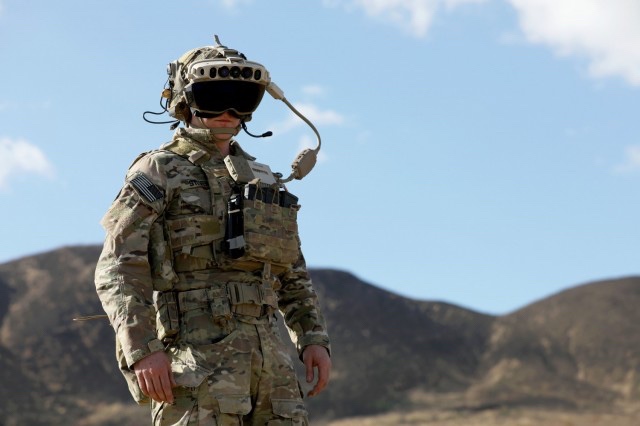
The IVAS heads-up display provides map, compass and navigation tools at the click of a button, not only for individual Soldiers, but it also enables the interconnected communication necessary to plan, build, share and execute routes across team, squad and platoon level elements.
“Land navigation was easy, but so was making the route and sharing it with my guys,” said Croxdale. “I created a route and blasted it out and it worked super quickly. We’ve had problems with other products where the connectivity was not as good, but as soon as I sent it to them they had it and we were able to move out.”
While executing the shared route, each Soldier could also see where the others were within their selected element. The ability to see the location of other Soldiers during the land navigation was a benefit praised by every level of leadership on the ground executing test operations, from the platoon leader to the platoon sergeant to squad leaders.
“I have command and control aspects in my job as platoon leader, so the icons on the map of where everyone’s located on the battlefield at any given point in time is super beneficial for me,” said 1st Lt. Luke Huen. “Instead of having to relay to a person to get their exact location, which might change in a matter of seconds, I can just hit a button and I know exactly where they are. It takes away all the guesswork. I think that’s by far the best feature.”
Huen recognized the information visibility as an advantage at his operational level, and the platoon sergeant and squad leaders echoed his sentiment as well.
“The good thing about being able to see where everybody is located is that you know where your front line trace is,” said Hayman. “If I’m running a support by fire berm and maneuvering two assault squads, especially in thick vegetation like we were last night, I can look on my map and see and then give more accurate commands off of that. I always know where all my guys are.”
Croxdale added that the situational awareness provided by IVAS allowed him to track accurately all eight members of his squad in real time so he knew exactly where each member of his formation was, with just the scroll of a cursor. He explained that their current tools are not carried by everyone in the squad, so the increased visibility allowed him to make more informed tactical decisions as a leader.
AFTER ACTION REVIEW
The Rangers were also briefly shown the after action review feature of the IVAS suite of capabilities. It gives a detailed virtual “play back” of the executed scenario to use as a review tool during both training drills and missions.
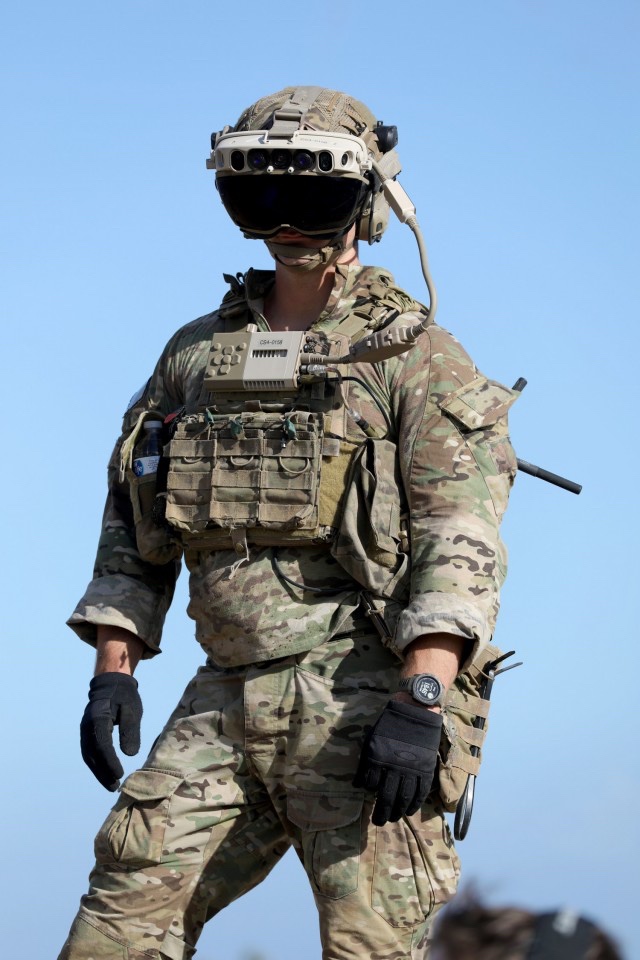
“It’s just like watching tape, growing up playing football,” said Croxdale. “You can see where the mistakes were made. I can replay it, see what everyone was doing and be like, ‘Hey, your dispersion wasn’t very good at this point in this situation,’ and if they come back and question it, I have the tapes to back it up.”
“It could be useful, especially if you get into something where there was literal fire and maneuver,” added Croxdale. “Not even just looking at walking and dispersion, but to [review] a fire and maneuver, that is definitely value added.”

TEAM & NATIONAL GUARD SUPPORT
The 75th Rangers provided thorough and honest feedback on the fourth IVAS capability set, but the test could not have been executed without support from the Army test community and Army National Guard.
“IVAS is an important system for the Army,” said Col. Ben Patrick McFall, commander of Yuma Proving Ground, Arizona. “But what I think is really important is the relationships between the PEOs, [program managers] and [Army Test and Evaluation Command] test community.”
“What is really important is the partnership that we have that allows us all to work together with the sole interest of supporting the warfighter, so we find any failure points before they do downrange,” McFall added. “We are also incredibly thankful to the Puerto Rico National Guard for support to this effort.”
The 191st Regional Support Group of the Puerto Rico Army National Guard stepped up to provide logistical and installation support to the IVAS test event at Joint Readiness Training Center. The Guard team, led by Capt. Noelia Roldan of the 292nd Combat Sustainment Support Battalion, remained flexible and accommodated changes, proving the team and the installation to be an ideally located asset to the Army test community.
Sgt. 1st Class Joshua Braly, who currently serves on the Soldier Lethality Cross-Functional Team, said he helped to facilitate ARNG support because he has personal ties to the Guard.
“I am also a Georgia Guardsman,” said Braly. “IVAS is being designed for the close combat force and the Army National Guard is a large part of that, which is why I am involved.”
Because of his connection to the Guard, Braly knew that they could deliver flexible and invaluable support that other locations could not.
“Given challenges we faced with COVID restrictions of movement, our usual avenues of approach for assessing this type of equipment in Panama, Suriname, Hawaii, Guam and other tropics region test centers were more challenging,” said Braly. “We reached out to the Puerto Rico National Guard and they eagerly accepted. Not only that, but they put Soldiers on orders to provide dedicated training area, range and logistical support to our effort.”
In fact, IVAS has leveraged National Guard installation and personnel support throughout many of its previous test events as well. Besides the tropics testing event in Puerto Rico, the Guard supported multiple large IVAS Soldier touchpoint events at Fort Pickett, Virginia, over the past two years; the aviation platform integration held at Redstone Testing Center in Huntsville, Alabama, using National Guard aircraft; and Vehicle User Study 3 held at Camp Roberts, California, in September 2021. Each of these events assess key areas necessary to further the development of IVAS for future testing, integration and fielding.
“The National Guard has been instrumental in support of the assessment and testing phase for this Army signature effort,” said Braly. “The flexibility of ARNG facilities and support of personnel and equipment will continue to enable timely and constructive testing necessary to further the development of IVAS, as well as other Army modernization efforts.”
The IVAS tropics weather test was executed by 3rd Battalion, 75th Ranger Regiment and supported by the Puerto Rico National Guard. Without the involvement of either IVAS team partner, the test would not have been as impactful.
“The IVAS test team has been beyond impressed with the professionalism and quality of feedback provided [by] the Rangers,” said Susan Fung, deputy technology director for Project Manager IVAS. She assured them, “Your feedback has been invaluable. We’ve been providing daily updates to the team back at the office and are definitely taking the details of your feedback and are working to incorporate them.”
The Rangers provided honest and realistic feedback based on their years of operational experience and deployments and can see the overall potential for the IVAS technology.
“The potential for this is unbounded, the ceiling is super high for it,” said Huen. “All these guys know that like in the next five, 10, 15 years we can see that this could be extremely useful, especially in what we do.”
“The thought process behind the IVAS system is incredible,” said Hayman. “It blows my mind that we’re in a day and age where the system even exists.”
By Courtney Bacon