GORE-TEX Professional

Next Level Arms Launches the NLS 22 Varmint Kit in Jenison, MI – Under $150, Built to Be Beaten

June 23rd, 2025

Available now. Keep your eyes peeled for content from Range Day at GunCon on June 27.

Jenison, MI — June 18, 2025 — Next Level Arms is shaking up the rimfire suppressor market with the NLS 22 Varmint Kit, a lightweight, serviceable .22LR suppressor built for real-world shooters. Priced at just $149.99, it’s designed for plinkers and varmint hunters who are tired of overpriced cans that clog up fast and cost more than their rifle.

“We built the can we wanted to buy,” said Dave Warner, Owner of Next Level Arms. “Rimfires are dirty and hard on suppressors. The NLS 22 Varmint Kit is designed to take that abuse and keep going, without costing half your paycheck.”

Key Features:

  • $149.99 MSRP
  • Includes 3 baffle stacks (1 installed, 2 spares)
  • Quick and simple maintenance—swap stacks and get back to shooting
  • Optional service available to restore the kit after all 3 stacks are used
  • Aluminum mount/blast chamber (hard coat anodized)
  • Carbon fiber baffle stacks
  • 6 inches long, 1.18 inches diameter, 3.2 ounces
  • Threaded 1/2-28 for standard rimfire compatibility

Most rimfire cans aren’t built to survive the long haul. This one is. When your baffles start to gum up, just swap them out and keep going. Blow through all three? No problem. Send it back for a rebuild and get back to work.

See It in Action

Keep an eye out for footage and feedback from GunCon’s Range Day on June 27. We’ll be running the NLS 22 Varmint hard so you can see how it holds up.

Want to Join the Affiliate Program?
 Are you on AvantLink? Want to become an affiliate and promote Next Level Arms products?
Reach out to zack@nextlevelarms.com to get started.

Available now:

NLS 22 Varmint Kit – $149.99

nextlevelarms.com

SIG NEXT 25 – ZULU-DMR Tripod

June 23rd, 2025

The ZULU-DMR carbon Fiber Tripod Kit was another item that wasn’t the focus of SIG NEXT, but new nonetheless.

The tripod extends to a height of 69″ and includes the following features:

  • 52mm Dual Tension Ball Head
  • ARCA-SWISS Compatible
  • 3 Section Carbon Fiber Legs, with Vented Tubes
  • 3 Position Detent Tabs for Adjusting the Angle of the Tripod Legs
  • Rubber Over Molded Twist Locks
  • Foot spikes are coming

Seen here, it is fitted with the new OSCAR6 HDX PRO Spotting Scope we previewed at Modern Day Marine which uses a digital accelerometer to stabilize the image even while moving. Powered by 2 x AA batteries, it features a 16-32x magnification along with a 60mm objective lens and is 11.5” long and weighs just over 55 oz.

While some items like the ZULU-DMR are currently made in China, SIG has been working to move production to TAA compliant countries or when possible, the US. The tripod is already planned to be moved to a TAA listed country.

SIG NEXT 25 – ZULU6 HDX PRO

June 23rd, 2025

SIG has been showing the update to their stabilized binoculars at trade shows for several now SIG NEXT was actually the first time I had gotten a chance to try them out in the wild, observing targets on the SIG Academy’s long range shooting range.

Available in 14x, 16x, and 18x 50mm variants, the ZULU6 HDX PRO feature SIG’s OmniScan OIS image stabilization which uses a digital accelerometer to optimize the level of stabilization applied based off your movement and vibration. This makes moving from one item of interest to another much smoother.

Powered by two common AA batteries, expect 40+ hours of constant runtime. System feature a 10-minute auto shutoff feature and IPX-7 waterproof rating.

These are made in Japan and SIG is working on adding a Mil reticle for ranging.

SIG NEXT 25 – P365-FLUX

June 23rd, 2025

The P365-FLUX is another collaboration between Flux Defense and SIG SAUER. Together they have created a polymer version of the aluminum Flux 365 Raider. The result is a slightly lighter version which will come as a complete gun. However, Flux Defense plans on offering the Raider for sale as a chassis.

The Raider is a chassis which transforms the SIG P320 of P365 FCU, barrel, and Slide into a PDW. It can serve as pistol or incorporate a stabilizing brace or fitted with a stock and converted to an SBR. The brace and stock fold to the right side of the pistol and can be configured to automatically deploy when the PDW is drawn from the holster. It’s important to note, the P320 and P365 require different Raider chassis.

The P365-FLUX comes with a 6″ barrel which is the longest P365 barrel but is only intended for use with the FLUX variant. It is also outfitted with a polymer barrel shroud, front Picatinny rail beneath the barrel, and X-RAY3 day / night sights.

SIG is going to offer a couple of versions. The full-on Sentry model will introduce the 25-round P365 magazine to the market and will come fitted with a 21 round and 25 round mag. Additionally, the PDW comes with a concealable (yes, this thing can be worn inside the waistbelt) holster.


We are still unsure when precisely the P365-FLUX will be available. Right now it looks like late Summer.

Air Force DASH Pioneers Human-Machine Teaming for Faster Battle Management Decisions

June 23rd, 2025

LAS VEGAS (AFNS) —  

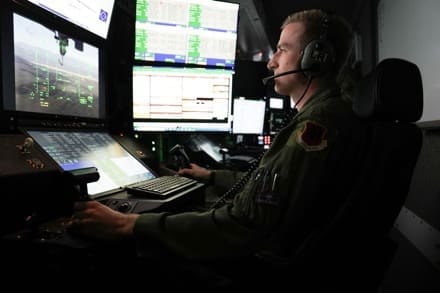
The Department of the Air Force took a bold step toward future command and control capabilities with the successful completion of its first Decision Advantage Sprint for Human-Machine Teaming, or DASH, experiment, recently held at the Howard Hughes Operations Center, or H2O, in Las Vegas, Nevada.

“The DASH experiment showed how machine support can dramatically reduce decision time and improve decision quality for air battle managers working in complex operational environments,” said Col. Christopher Cannon, Advanced Battle Management Cross-Functional Team lead. “Battle management teams were exercising command and control decision advantage.”

This two-week event brought together operational U.S. and Canadian warfighters, industry and Shadow Operations Center-Nellis software developers, to prototype microservices aimed at accelerating and improving decision-making in high-tempo battle management scenarios framed by the Transformational Model for Decision Advantage developed by the ABMS CFT.

“To deliver meaningful capability to the joint force, we must co-develop with industry partners who can iterate rapidly and help us operationalize software to meet urgent warfighter needs for today’s challenges and tomorrow’s fights. DASH experiments accelerate delivery of C2 and intelligence microservices that go beyond user interfaces and dashboards to directly address the (Combined Joint All-Domain Command and Control) imperative for decision advantage,” said Col. Jonathan Zall, ABMS Capability Integration chief.

Led by the ABMS CFT in partnership with the 711th Human Performance Wing, the Air Force Research Laboratory, the Integrated Capabilities Command and the 805th Combat Training Squadron, also known as the ShOC-N, the event focused on a critical subfunction of the Transformational Model – Battle Management: Perceive Actionable Entity.

“This is not just about accelerating data,” Cannon said. “It’s about accelerating decisions. DASH lets us move beyond buzzwords and into real-world prototyping, software built around the actual decisions our warfighters must make under pressure.”

The Transformational Model – Battle Management: Perceive Actionable Entity function determines which actions are possible, permissible and desirable against an operational entity, from targeting to rescue to resupply. Four selected industry teams and a ShOC-N coding team partnered with Total Force and Royal Canadian Air Force air battle managers in a simulated, high-pressure combat environment, building and testing code designed to help warfighters make faster and more effective decisions.

“Our C2 systems are still putting the burden of complex decision-making entirely on the human; this sprint starts to change that by giving our Airmen digital teammates that help them perceive, decide and act faster,” said Lt. Col. Shawn Finney, 805th CTS/ShOC-N commander, Nellis Air Force Base, Nevada. “The ShOC’s H2O center serves as an unclassified software development and vendor engagement hub allowing the DASH teams to rapidly code.”

From concept to capability: DASH in action
DASH participants were challenged to develop working software that output “Battle Effects,” battlefield-changing recommendations bounded by operational constraints like rules of engagement and time sensitivity. The tools were not pre-prescribed in format or interface, allowing developers flexibility in how their software performed decision-making and delivered information.

“What set the DASH experiment apart was its deliberate depth, driven by a focus on the end-user’s specific challenge. Instead of a generalized showcase, concentrating intensely on the PAE function allowed a rigorous evaluation of how advanced tools integrate into the operator’s critical workflow. This targeted, user-centric approach is key to genuinely operationalize agentic AI where it matters most, yielding concrete insights for the warfighter,” said an industry participant.

To measure the impact of human-machine teaming, the experiment was conducted in two phases. First, battle managers executed a combat scenario using only their existing tools and training—without any machine assistance. This established a performance baseline. In the second phase, they faced similar but not identical scenarios, this time with prototype decision-support tools developed during the sprint. By comparing performance across both scenarios, the assessment team measured how much the software improved decision speed and accuracy.

“The DASH experiment isn’t just a coding sprint—it’s a learning environment. Industry teams bring diverse perspectives and technical approaches that push us to think differently about C2. That collaboration accelerates our ability to deliver functional software and refine requirements for the entire enterprise,” said Lt. Col. Wesley Schultz, 805th CTS/ShOC-N director of operations.

The TM-BM DASH approach allowed for rapid development of machine teammates with clear, testable goals.

“DASH is the start of a new model for C2 software acquisition — one that begins with the decision, not the platform,” Cannon said. “We’re not buying software to display more data. Coders are building software that actively helps operators transform that data into measurably better battle management.”

Battle managers participating in the experiment responded positively, with anecdotal evidence suggesting the tools helped them process information more effectively and improve confidence in their decisions. Importantly, the tools required minimal training, reflecting the DASH experiment’s emphasis on lightweight, adaptable integration. Operators engaged directly with developers to refine the tools in real time, offering interface feedback that improved usability during the sprint itself.

“It was an incredible opportunity to be part of the inaugural DASH human-machine interface effort in battle management. I’m always looking for new ways to help make our force more expeditionary, more precise, and ultimately, more lethal,” said 1st Lt. Bennie Crawford, Georgia Air National Guard, 116th Air Control Wing, Robins AFB, Georgia.

ShOC-N: The engine behind DASH
The ShOC-N staff and facility played a critical role in the DASH by crafting the combat-representative scenario, using modeling and simulation technology presenting this simulated battlespace using an unclassified environment, reducing the barrier to entry for industry.

“At ShOC-N, we don’t just simulate conflict, we simulate decision pressure. The DASH experiment gave us a chance to immerse software developers in the reality our warfighters face, so the tools they build are operational from day one,” Finney said.

ShOC faculty also provided operator instruction and facilitated final outbriefs to senior stakeholders from Advanced Battle Management System Cross-Functional Team, Air Force Research Laboratory, Integrated Capabilities Command and 711th HPW.

“Our initial analysis illustrates that when the software developers’ tools were applied, not only did the human-machine team’s average decision-making time decrease seven-fold, but software ‘machines’ responded to more than twice as many dilemmas as the humans alone, and microservices generated three times the number of valid solutions, what we call ‘Battle Effects’,” Cannon said. “Machine answer errors were on par with human error, not bad for a week’s worth of coding. We demonstrated that machines absolutely helped, software services helped, but we also demonstrated that we can in fact build a software microservice that allows this to happen and gives us a more capable human-machine team.”

Each DASH enriches valuable software requirements that will find their way into future C2 requirements and gives participating industry early insight and practice in crafting their answers to those requirements. The experiment validated a repeatable, scalable methodology: design, develop, deploy and evaluate. This approach will guide future sprints across a growing catalog of decision functions. All findings, including technical and functional requirements, will inform future C2 software strategies and investments across the DAF’s C2 enterprise.

Beyond the sprint: The future of human-machine teaming
The DASH experiments translate abstract concepts like “decision advantage” into tangible, testable software capabilities. It marks a shift in Air Force capability development culture, developing functional and technical requirements alongside warfighters, with code in hand.

“Decision advantage is the capability gap that underwrites all others,” Finney said. “With DASH, we’re not just closing that gap, we’re coding directly into it.”

The ABMS CFT, in partnership with the 711th HPW, AFRL Information Directorate, ICC, and the 805th Combat Training Squadron, will host two additional DASH events later this year, each focusing on a different decision function within the TM-BM model.

“This is where theory meets execution,” Zall said. “We’ve spent years defining what decision advantage looks like. DASH is about delivering it by building software that helps our operators act faster and smarter than our adversaries. As the Air Force continues to iterate, experiment and evolve, the human-machine team will remain at the heart of the Department’s push for decision advantage.”

By Deb Henley

505th Command and Control Wing Public Affairs

Agilite Launches the New WIDE Admin Pouch

June 22nd, 2025

Agilite just launched the new WIDE admin pouch which is optimized for MOLLE second layers to give extra low profile real estate.

See all the features here:

agilitegear.com/products/wide-admin-pouch

Remembering Frank R. Brownell III (1939 – 2025)

June 22nd, 2025

GRINNELL, Iowa (June 18, 2025) – Brownells sadly announces the death of long-time family patriarch Frank Brownell, who successively held the positions of President, CEO, and Chairman of the Board at Brownells.

Frank passed away in Grinnell, Iowa on June 18, 2025, after a lengthy illness. He was six days shy of his 86th birthday.

For nearly six decades, Frank’s passion, vision, and generosity shaped not only Brownells, but the entire firearms community. Friends and customers alike remember him greeting “long lines of friends” at SHOT Show and the NRA Annual Meetings, championing gunsmithing, and driving industry innovation.

“Frank was the kind of person who made you better just by being around him.” Pete Brownell, CEO of Brownells and Frank’s son.

A Life of Service and Contribution

Born June 24, 1939, in Montezuma, Iowa, the second child and only son of Brownells founder Bob and his wife Lois, Frank grew up in Iowa and became involved in both the family business and the American gun industry at an early age. Frank graduated magna-cum-laude with a degree in Advertising from the University of Iowa in 1961 before serving aboard the USS Caliente (AO-53) as a U.S. Navy reservist.

In 1965, he joined Brownells full-time, laying out Big Book Catalog #18, and soon helped publish the first Gunsmith Kinks book in 1969 under the name F. Brownell and Son.

Frank became President in 1983, CEO in 2007, and Chairman of the Board in 2012, guiding Brownells for more than 40 years.

From marketing the now-iconic Latigo Sling at the 1964 NRA convention to elevating gunsmithing as a respected profession, his influence can be seen in countless shops, ranges, and workbenches across America.

A Legacy of Character

Beyond titles and accolades, Frank was cherished for his kindness, integrity, and infectious enthusiasm. Frank Brownell was a Navy veteran, a business leader, and a stalwart supporter of our unique American rights guaranteed by the 2nd Amendment.

An industry innovator, he helped establish Brownells as a nationwide legacy retailer in the gunsmithing, gun parts, and firearms space. He helped advance the best model for working with and developing endemic industry media. He advocated for elevating gunsmithing to a respected profession and created new ways to support and develop the growth of gunsmithing, gun ownership, and gun culture.

A Life Remembered

Frank is survived by his three sons, Bob, Pete, and Matt Brownell, and their families. Service details will be shared once arrangements are finalized.

Friends, colleagues, and customers are encouraged to honor Frank by sharing memories, supporting aspiring gunsmiths, or simply spending time at the bench, just as he loved to do.

Vintage Combat Control Team Action

June 22nd, 2025