FirstSpear TV

Blast from the Past – “It’s what we in the business call a mixed-fruit pudding.”

August 17th, 2024

“…fragmentation, grenades…tactical, antitank, antipersonnel…It`s what we in the business call a mixed-fruit pudding.”

The MM-1 Manville Gun made its film debut in 1980s “Dog of War” where it appeared as the XM18E1R. The quote above is from the arms dealer explaining how the weapon should be loaded for combat even though he avoids the question of whether or not he had ever served in combat. Interestingly, the weapon used in the movie looks to be the 12 ga variant which offers several more cylinders than the 26.5mm and 37mm models. Only manufactured from 1935-1943, the Manville Gun never saw widespread use.

National Guard Rifle Team Clinches Dogs of War Trophy

August 17th, 2024

CAMP PERRY, Ohio – The All National Guard six-person marksman team won the National Trophy, also known as the Dogs of War Trophy, at the National Matches in August. It was only the third time the National Guard has won this prestigious award, with previous wins in 1986 and 1977.

The National Trophy, a revered symbol of excellence in marksmanship, represents more than individual prowess; it embodies the collective discipline, skill and dedication of a team working in harmony.

“The greatest thing about it is that we are all from different states and at some point in time, every state has been part of the all-Guard rifle team,” said Sgt. 1st Class Amanda Elsenboss of the Pennsylvania Army National Guard, a shooter and coach on the team. “Those Soldiers and Airmen are taking back to their units the knowledge that they’ve gained from these national matches, and they’re sharing that wealth of knowledge with those Soldiers and Airmen back at their bases.”

The atmosphere at Camp Perry, steeped in history and tradition, was charged with patriotism and honor, reflecting the connection between military service and the art of marksmanship.

Maj. Kirk Freeman, a shooter and coach from the South Carolina National Guard, emphasized the impact and difficulty of the achievement.

“This is demonstrating the lethality that we are gaining here, being able to engage a target at 600 yards,” Freeman said. “We were able to make the correct wind call to get a hit 119 out of 120 times with six different shooters, shooting off a sling, not off a bi-pod, not off a bag, this was off elbows and a sling.”

Individual achievements and another team award further highlighted the team’s success.

During the award ceremony, Freeman presented Sgt. Jonathan Wood of the Louisiana National Guard with the U.S. Army Distinguished Rifleman Badge. Elsenboss was awarded the Women’s Rifle Trophy. The team also won the Hilton Trophy given to the highest scoring reserve component team in the National Trophy Rifle Team Match, adding to the National Guard’s legacy in the competition.


“To win this is really a big achievement,” said Master Sgt. Michael Hester, an Arkansas National Guard gunsmith and machinist for the team. “The shooters did exactly what they were supposed to do and the coaches were absolutely on point this year. It’s almost a 40-year try for this match, and this year we secured it.”


As the team members return to their respective units, they carry not just the trophy but the pride of having contributed to a tradition that spans generations. Their achievement at Camp Perry is a reminder of the National Guard’s enduring role in both national defense and the preservation of America’s marksmanship heritage.

By Shawn Monk, 171st Air Refueling Wing

By The Way, Happy National Airborne Day

August 16th, 2024

The first official US military parachute jump was on 16 August, 1940. Seen above are members of the Parachute Test Platoon.

Tasmanian Tiger to Exhibit at TacOps South

August 16th, 2024

Tasmanian Tiger® will attend this law enforcement tactical training conference and expo in Nashville, Tennessee, Aug. 21 – 22, 2024 at Table 3.

Knoxville, Tenn. (August 2024) – Tasmanian Tiger®, a tactical nylon line of products distributed exclusively for the US market by Proforce Equipment, Inc., will be exhibiting at TacOps South this Aug. 21 – 22, 2024 at Sheraton Music City in Nashville, Tennessee. Tasmanian Tiger will exhibit its line of Medic Packs and the recent NTOA Member Tested and Recommended TT Plate Carrier QR LC at Table 3. For two days, over 150 industry vendors will showcase the latest technologies and products aimed at patrol officers, SWAT, tactical teams, corrections, narcotics units, detectives, and TEMS.

Attendees can expect to see a comprehensive display featuring Tasmanian Tiger’s renowned Medic Packs, designed for optimal organization and rapid access in critical situations. Additionally, its versatile bags will be on exhibit, demonstrating their durability and functionality for a wide range of missions. Furthermore, attendees will have the opportunity to explore TT’s advanced plate carriers, engineered to provide superior comfort in demanding environments.

The TT Plate Carrier QR LC recently received an overall score of 3.95 out of five from the National Tactical Officers Association (NTOA) Member Tested and Recommended Program. This lightweight plate carrier is designed to offer a sleek and modern look, with a MOLLE system in laser-cut technology. The TT Plate Carrier QR LC is designed to fit SAPI plates of 12 x 10 in. (30 x 25 cm). It features a quick-release system with ROC buckle, which allows the wearer to quickly and easily remove the plate carrier in case of an emergency. The shoulder straps are adjustable, ranging from a minimum of 11 in. (28 cm) to a maximum of 20 in. (52 cm), providing a comfortable and customized fit for all users.

?2024 is Tasmanian Tiger’s 25th anniversary in business. For a quarter-century, Tasmanian Tiger has been at the forefront of innovation, providing top-quality products for military operators, medics, law enforcement professionals, and enthusiasts alike. The company owes its success to the tireless efforts of its dedicated team, the support of valued dealers, and the trust of customers who have been an integral part of its extraordinary journey.

Interested in Becoming Editor of “Special Warfare” Magazine?

August 16th, 2024

Applications are currently being accepted for one of the Army’s newest broadening opportunity programs – The Major General Edwin “Forrest” Harding Fellowship.

The Harding Fellowship is a competitive 36-month program consisting of a one-year accelerated master’s degree program at the William Allen White School of Journalism and Mass Communications at the University of Kansas for active component captains, non-commissioned officers in the grade of E-8, and warrant officers in the grade of CW4. Upon completion, Fellows will then serve as editors-in-chief for the branch journals at their respective center of excellence for a two-year term.

The Harding Fellowship produces leaders who strengthen the Army profession with their deep expertise in branch matters and superior communications skills. Given the two-year editor term, the Harding Fellowship alternates eligible branches by year.

In FY25, Special Forces, Psychological Operations and Civil Affairs branch personnel may apply for utilization as editor-in-chief of “Special Warfare” at Fort Liberty, NC.

They are now accepting applications for the second group of fellows. Army University recently published an article regarding the application window for the fellowship — Harding Fellowship application window now open | Article | The United States Army

Harding Fellowship application window now open

Meet requirements in chapter 2-2 of the Broadening Opportunities Catalog available at www.hrc.army.mil/content/BOP.

Mustang Survival Launches the All-New Quadra Dry Suit

August 16th, 2024

Minimalist and multi-purpose – it’s sure to ring bells, without the whistles
Burnaby, 2024 — Mustang Survival, the Canadian brand known for innovative solutions for the most demanding marine environments, announces today the launch of the Quadra Dry Suit. This brand-new minimalist, multi-purpose dry suit is designed for those who enjoy shorter-duration water activities and is available in men’s and women’s versions.

The Quadra Dry Suit is an excellent introduction to Mustang Survival’s high-quality standards. It features the same tough and durable three-layer Marine Spec BP fabric used in their other dry suits, with a design inspired by the gear they’ve innovated for military and public safety agencies and subjected to the same comprehensive testing.

Key Features of the Quadra Dry Suit:

• Durable Fabric: Waterproof and abrasion-resistant 3-layer Marine Spec BP fabric holds up in challenging saltwater environments.

• Custom Fit: Trimmable latex neck and wrist seals for maximum protection and comfort.

• Easy Maintenance: Collar and cuffs design make repair and replacement straightforward.

• Adjustable Waist Belt: Ensures a snug fit, accommodating various body types.

• Heavy-Duty Reinforcements: 500D Cordura® panels on the seat and knees add durability.

• Convenient Drying: External hanging loop simplifies the drying process.

• User-Friendly Zipper: Waterproof YKK® AQUASEAL® zipper for easy donning and doffing.

• Leak-Proof Assurance: Every suit undergoes comprehensive leak testing, ensuring superior performance and reliability.

“Dry Suits often come with a hefty price tag, and understandably so as a lot of engineering and materials go into a specialized garment that keeps you completely dry,” says Anja Mueller, Head of Marketing at Mustang Survival. “With the Quadra, we offer people new to cold water marine activities the same quality materials at a budget- friendlier price.”

Product Availability and Pricing:

• Men’s Version: Ocean Blue/Admiral Grey and Red/Admiral Grey, sizes small to 2XL.

• Women’s Version: Bluefin Blue/Admiral Grey, sizes X-small to X-large.

• Retail Price: $849.99 USD / $999.99 CAD

For more information about the Quadra Dry Suit, and to explore Mustang Survival’s full range of products, visit mustangsurvival.com

FirstSpear Friday Focus – NEW ACM 150 Short-Sleeve Field Shirt

August 16th, 2024

• American sourced Wool
• Made in the USA
• Antimicrobial
Don’t be fooled by its lightweight feel – the ACM Base 150 wool fabric offers unparalleled performance and durability. Updated with 55% Lenzing, 33% wool and 12% nylon, the new Field Shirts offers the perfect blend of synthetic and wool.

Use it as a base layer or standalone, no matter which way you choose, it will be a year-round go-to. The moisture-wicking properties of wool, means it’s perfect in all seasons. Whether its protection from the sun or a base layer in inclement weather, the ACM 150 Weight Short Sleeve Field Shirts get it done. Available sizes are S-2XL and colors include Midnight Blue, Black, Charcoal, Commando Green and not in stock, but coming soon is Stone Grey.

FirstSpear is proud to partner with Texollini in the creation of the Field Shirt. They are a fully vertically integrated company who specializes in yarn and fabric capabilities, and have a long-standing history of quality fabrics, specifically in their wool offerings. They have been in the military industry for decades and are well versed with Berry Compliant offerings such as the Field Shirt. Check them out here: www.texollini.com.

For more information, check out www.first-spear.com.

Soldiers Test Drive Autonomous Equipment Decontamination System at MSPIX 24

August 16th, 2024

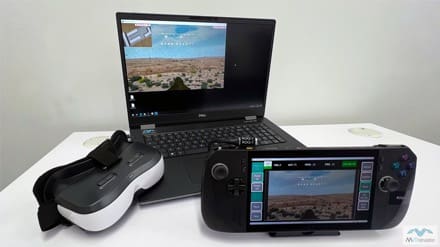
Aberdeen Proving Ground, MD — The best way to find out if a new car is right for you is to take it for a spin. When it comes to a new way to decontaminate military vehicles using mobile robotic technology, the same holds true. Take a seat at the computer, operate the system’s remote controls and see what feels right and what doesn’t.

That is exactly what four Soldiers from the U.S. Army’s 1st Armored Division did at this year’s Maneuver Support and Protection Integration eXperiments event, or MSPIX, held at Fort Leonard Wood, Missouri, May 6 to 23. The robotic system they were operating was the U.S. Army Combat Capabilities Development Command Chemical Biological Center’s (DEVCOM CBC) Autonomous Equipment Decontamination System.

The Soldiers were excited. “This system takes us away from the threat completely, and its buttons and controls are easy to use,” said Spc. Yaleidi Escalera. “We are the ones who will be using it in the fight, so it feels good to be able to tell the technology developers exactly what we need now.”

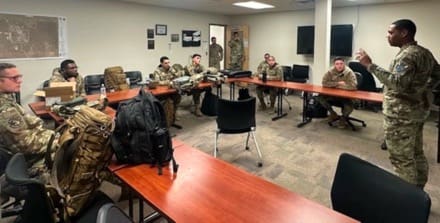
Escalera and three other CBRN Soldiers spent four days operating the system, followed by face-to-face feedback with the technology development team on what they liked about it and what parts of it can be improved.

“We usually never get a chance to meet the people designing the instruments we’re using as Soldiers,” said Sgt. First Class Joseph Bennett, also of First Armored. “So getting to experience the brain behind the equipment was exciting. They’re coming to us and asking, ‘Is this what you really want,’ and we get to tell them what we think.”

The Autonomous Equipment Decontamination System consists of a camera mounted on an unmanned ground vehicle (UGV). The camera scans the entire vehicle surface as it circles around it, transmitting the contamination data back to the system operators seated at a computer safely in the rear. A robotic manipulator arm then uses that data to spray a decontamination slurry developed by DEVCOM CBC on only those chemical agent hotspots, conserving decontaminant and saving time.

The Autonomous Equipment Decontamination System team received valuable feedback that they will use to refine the technology. The Soldiers pointed out the challenges encountered by the robotic platform while navigating around and manipulating the odd shapes and hard to reach surfaces of some military vehicles. The Soldiers also noticed simple things, such as adding right click functionality to the mouse on the computer interface to add more user capability. Finally, the Soldiers wanted to have a manual override for the applicator arm in case they find that not all the hot spots are being reached in autonomous mode.

Autonomous Equipment Decontamination is a multi-year cooperative project led by DEVCOM CBC. In addition to DEVCOM Army Research Laboratory support in designing the system’s robotic arm, DEVCOM Ground Vehicle Systems Center supports the computer interface and UGV operations. Industry partner Teledyne FLIR supports the development of software for the system’s camera.

Currently, it takes a team of 20 to 30 Soldiers in full protective gear 45 to 60 minutes to decontaminate each vehicle exposed to chemical or biological hazards. Soldiers must perform this task close to the point of exposure and may be vulnerable to enemy fire. The process takes more than 500 gallons of water and 50 gallons of decontaminant per vehicle.

Warfighter feedback is the acid test for a technology initiative according to Maj. Paul Austin, a CBRN experimental officer with the Maneuver Support Battle Lab who coordinates and runs MSPIX. “I know from my experience as a CBRN officer during my time in the Special Operations Command the value of fast, efficient decontamination in the field,” said Austin. “Chemical and biological agents are a weapon that can severely disrupt an operation, so being able to quickly address it is essential to completing the mission.”

Story by Brian Feeney, U.S. Army Combat Capabilities Development Command Chemical Biological Center