Colt

Soldiers Build Fort Sill Readiness with Future Machine Gun Range

June 8th, 2026

FORT SILL, Okla. – Soldiers who need to qualify on machine guns at Fort Sill will soon have a centralized, upgraded range built by Soldiers who know exactly why that training matters.
By applying critical thinking and looking beyond the standard path, leaders and engineers at Fort Sill are demonstrating how “getting to yes” can save time and taxpayer dollars while significantly improving the quality of training facilities.

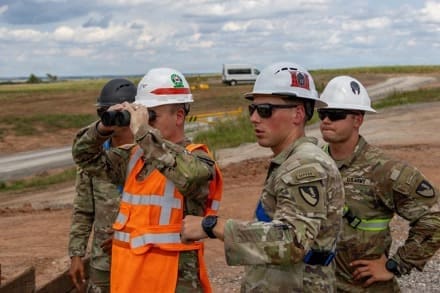
The 104th Engineer Construction Company, 62nd Engineer Battalion, 36th Engineer Brigade, is converting Fire and Movement Range 2 into a Multi-Purpose Machine Gun Range to support machine gun qualification for Fort Sill units and external training units. The project is designed to restore a critical training capability, increase throughput and provide Soldiers with a more efficient place to train on machine gun systems.

Col. John Morgan, U.S. Army Garrison Fort Sill commander, toured the construction site May 20 with Glenn Waters, acting deputy to the garrison commander, and Michael Spears, acting director of the Directorate of Plans, Training, Mobilization and Security.

Brig. Gen. Patrick Costello, Fires Center of Excellence and Fort Sill commanding general, visited the range May 28 to observe the work firsthand and speak with 104th ECC Soldiers about their role in building the new training capability.

Solving a training gap

The need for the range grew after the Joint Counter-small Unmanned Aircraft System University was stationed at Fort Sill in 2022 and occupied the installation’s primary Kerr Hill Machine Gun Range. That pushed units onto three geographically separated, nonstandard temporary ranges, which reduced training efficiency and created a qualification bottleneck for units that need to train machine gun crews.

Fire and Movement Range 2 was identified as the solution: an underused range that could be converted into a centralized facility for machine gun qualification.

Waters said the project directly supports readiness.

“This range is all about readiness,” Waters said. “We need modern, top-tier facilities to train our Soldiers, and this MPMG range gives them exactly what they need to master their weapons systems and build lethality right here at Fort Sill.”

When complete, the range will support the M249 squad automatic weapon, M240B machine gun, M2A1 .50-caliber machine gun and MK19 grenade machine gun. Soldiers will be able to train on those systems mounted on vehicles, fired through common remotely operated weapon stations, or used dismounted from tripods and bipods.

The range footprint includes six firing points, 75 infantry and armor target points from 100 to 1,300 meters, two maintenance access roads totaling about 2,600 meters, drainage improvements and supporting range infrastructure.

Faster and less expensive

A traditional military construction project had been projected for fiscal year 2036 at about $25 million. Through troop construction, Army engineers building a real-world project as part of their training, Fort Sill and the 104th ECC are delivering the capability about 10 years early for roughly $500,000.

Morgan said seeing the project early in his command showed what can happen when leaders think beyond traditional timelines and focus on what Soldiers need now.

“We can’t wait 10 years down the road to have a better range,” Morgan said. “We need a better range for the Soldiers today.”

Morgan said the project also shows how Fort Sill can solve problems across the garrison: identify the stakeholders, bring the right people together and find a practical answer that supports Soldiers.

“It’s proof of concept that we can build things faster and cheaper on behalf of our Soldiers,” Morgan said.

Waters said the project is an example of what happens when the installation focuses on solutions instead of barriers.

“It’s a perfect example of what happens when everyone leans in together,” Waters said. “We identified a critical training requirement, and by partnering with the garrison and utilizing the in-house talent of the 104th Engineers, we’re saving time and maximizing our resources. It proves that when the installation and the engineers work hand-in-hand, we deliver a better, faster product for the force.”

Soldiers building for Soldiers

For the 104th ECC, the project is more than construction. It is mission-essential training with a lasting purpose.

Capt. Jacob Sroka, commander of the 104th ECC, said his Soldiers are building a range that will outlast their time at Fort Sill and serve future units for decades.

“Our Soldiers understand this range will stand for the next 50 years units, and Soldiers will qualify and build their lethality on this range for generations to come,” Sroka said.

The work requires horizontal construction engineers, vertical construction engineers, surveyors, equipment maintainers and support Soldiers to work together. Soldiers are building firing points, placing target infrastructure, shaping access roads, improving drainage and ensuring the range is built to standard. Waters said the Soldier-to-Soldier impact is one of the most powerful parts of the project.

“Seeing Soldiers building infrastructure for other Soldiers is a powerful thing to witness, they know exactly how important this range is, and they are getting after it,” Waters said.

More than moving dirt

Warrant Officer 1 Ignacio N. Re, construction engineering technician for the 104th ECC, said the work requires more than moving material across a range.

Firing points must be placed precisely. Drainage must prevent erosion and flooding. Access roads must allow range personnel to service target systems. Surveyors and equipment operators must get the grade right the first time.

“Turning an existing range into a functional training asset requires far more than equipment operators moving material,” Re said. “It takes coordinated engineering expertise in surveying, design interpretation, drainage, earthwork, quality assurance and construction management.”

Re said proper grade, drainage and soil stability determine whether the range will hold up under years of training use.

“Proper elevations, drainage flow and soil stability are foundational to every structure and roadway built afterward,” Re said.

Fort Sill’s terrain and weather have given the engineers real-world challenges. Soldiers have had to adjust drainage plans, stabilize low areas and account for Oklahoma clay soil that holds water and affects construction. Re said those challenges are part of what makes the project valuable training because Soldiers must adapt, communicate and solve problems as conditions change.

Garrison support behind the scenes

The project also highlights the garrison support behind the scenes. DPTMS, Range Operations, Directorate of Public Works partners and other Fort Sill agencies helped move the project from concept to construction through site surveys, environmental and cultural reviews, unexploded ordnance assessments, design coordination, material procurement and daily support to the engineer company.

Sroka said that support allowed the 104th ECC to focus on the mission.

“Working with the various Fort Sill agencies supporting our project up here has been an incredible experience,” Sroka said. “They’ve accommodated us with every requirement and enabled us to focus on the project.”

Spears said the effort matched a Fort Sill capability gap with an engineer unit’s training requirement. Fort Sill needed a better machine gun range, and the 104th ECC needed realistic construction training tied to its mission-essential tasks.

During Costello’s May 28 visit, Soldiers and leaders explained the construction process, the scale of the project and how the completed range will improve machine gun qualifications at Fort Sill. At the end of the tour, Costello presented commanding general coins to Staff Sgt. Carola Chavez, Spc. Evan Floyd, Spc. Sato Mongkeya, Spc. Guillermo Jimenez, and Spc. Joshua Farias for their contributions to the project. Costello also told the Soldiers their work is important to Fort Sill’s mission.

For Morgan, the project also reflects the work done every day by Soldiers and civilians whose efforts may not always be visible but directly support the Army mission.

“What they do is important, and what they do is absolutely value added to the team,” Morgan said. “They should be proud of planting the seeds of the trees they might not see grow.”

When complete, the Multi-Purpose Machine Gun Range will give Fort Sill a centralized training capability that improves scheduling, increases throughput and supports units preparing for real-world missions. For the Soldiers building the range, the project is more than a construction mission. It is a chance to leave behind a capability that will help future crews qualify, train and prepare to deploy.

Waters said the work being done now will have a lasting impact.

“The hard work they are putting in today is going to pay dividends for every Soldier who trains on that range for years to come,” Waters said. “I couldn’t be prouder of what they are accomplishing.”

Story by Chris Gardner 

Fort Sill Public Affairs
Sangin Instruments and Spiritus Systems Announce Limited Edition “Titan” Collaboration

June 7th, 2026

Aberdeen, NC – May 27, 2026 – Sangin Instruments, manufacturers of American-made, purpose-built timepieces that are simple, functional and reliable, and Spiritus Systems®, one of the leading manufacturers of nylon equipment designed with intent for military and law enforcement professionals, are proud to announce a limited-edition collaboration featuring a custom version of the Sangin Titan.  

This partnership brings together two American-made brands defined by a shared commitment to functional excellence, merging precision mechanics with the mission-driven aesthetic of high-end tactical equipment. 

The Sangin Titan has long been a staple for those who require a timepiece capable of withstanding the anomalies of professional use. This limited-run Titan wasn’t just logical; it was inevitable, representing more than just a business partnership; “It’s the convergence of shared values, heritage, and a commitment to domestic craftsmanship,” stated Spiritus Co-Founder and CEO Zane Vogel. “This kind of collaboration combines specialized expertise from two different fields into a single, cohesive offering.” 

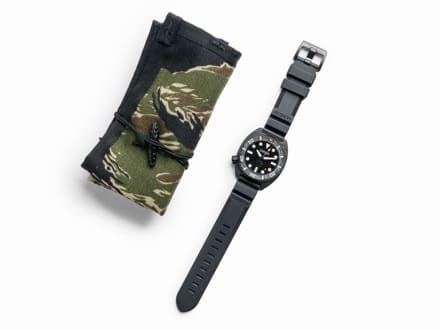
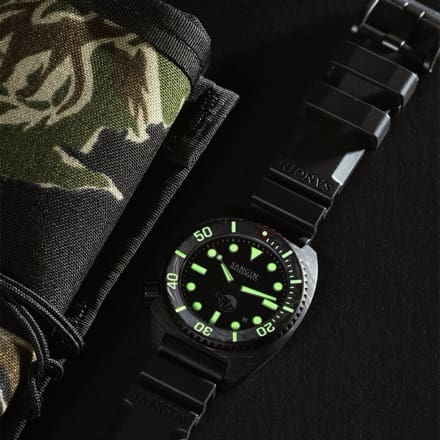
The Spiritus x Sangin Titan features a brushed titanium, 48MM case with a stadium-style slope with luminous insert bezel. The dial has been refined with high-visibility Super-LumiNova® markings and a Spiritus Systems Alpha Wolf logo. 

Equipped with the rubber black OTH Strap, WOE-ZA Commando Strap and is presented in a Spiritus Systems custom Jungle Tiger Stripe watch roll.  

Key Technical Specifications

Case Material: Forged Carbon with Titanium Core 

Case Length: 42MM / 48MM  

Movement: SW300 Automatic 

Water Resistance: 500M / 50ATM 

Crystal: Double-domed sapphire crystal with internal anti-reflective coating  

Strap: Black Rubber OTH Strap + WOE-ZA Commando Strap  

Luminous: Super-Luminova C3 

“Spiritus Systems represents the pinnacle of modern gear design, and their approach to problem-solving mirrors our own,” said Jake, Founder of Sangin Instruments. “The Titan was the perfect canvas for this project—a tool that doesn’t just look the part but performs under the exact conditions Spiritus gear is built for.” 

The Sangin Instruments x Spiritus Systems Titan is a one-time limited production run (Qty 40). To maintain exclusivity, the release will be conducted on the Sangin Instruments website. 

For specific release dates, times, and pricing, follow the official social media channels for both brands. 

New Veteran Education Initiative Launched In Houston As Many Eligible Borrowers Continue To Underutilize VA Home Loan Benefits

June 7th, 2026

Program Offers Educational Consultations Focused on Home Financing Options Available to Veterans

HOUSTON, June 4, 2026 — New Era Lending today announced the launch of its New Era Hero Care Promise, a veteran-focused educational initiative designed to help current and former service members better understand available home financing options and benefits, including those offered through the U.S. Department of Veterans Affairs.

The announcement comes as industry data continues to indicate that many eligible veterans have not utilized their VA home loan benefit. According to the U.S. Department of Veterans Affairs, approximately 36 percent of eligible veterans had used their VA home loan benefit as of 2022, leaving a significant portion of the veteran population who may not fully understand the homeownership resources available to them.

Texas is home to one of the nation’s largest veteran populations, with hundreds of thousands of veterans residing throughout the Greater Houston region. Mortgage professionals and housing advocates note that misconceptions surrounding eligibility requirements, entitlement restoration, refinancing opportunities, and down payment requirements continue to create confusion for some prospective veteran homebuyers.

Through the New Era Hero Care Promise, veterans may schedule a complimentary educational consultation to discuss homeownership goals, review available mortgage programs, and receive information regarding potential eligibility for VA and other home financing options.

“Many veterans are familiar with the existence of VA home loans, but fewer understand how the program may apply to their individual circumstances,” said Omar Said, Chief Executive Officer of New Era Lending. “Questions surrounding eligibility, entitlement usage, refinancing opportunities, and other program features can often create uncertainty. We developed this initiative to provide veterans with access to information that may help them make more informed home financing decisions.”

According to the Department of Veterans Affairs, VA-backed loans have helped millions of veterans and service members achieve homeownership since the program’s creation in 1944. Industry research has also shown that many veterans remain unaware that certain VA loan benefits may be reused under qualifying circumstances, while others mistakenly believe a down payment is required to access VA financing.

New Era Lending representatives say the educational consultations are intended to provide veterans with a clearer understanding of available mortgage options and the questions they may wish to consider when evaluating future homeownership decisions.

“Veterans have earned access to a unique set of home financing benefits through their service,” added Said. “Our objective is to help ensure they have access to accurate information and understand the resources that may be available to them.”

Veterans interested in learning more about the program may schedule a no-obligation consultation through New Era Lending’s Veteran Resource Center.

**This is not a commitment to lend. All loans subject to underwriting approval. New Era Lending LLC (NMLS 2424293) is not affiliated with nor endorsed by the Department of Veterans Affairs or the federal government.

Air Force Veteran Launches Memor App to Digitize Cemetery Records and Honor the Fallen

June 7th, 2026

New mobile app empowers families, veterans organizations, and cemetery managers to geo-locate gravesites and preserve the memories of loved ones — before they are lost forever




SCHENEVUS, N.Y., June 4, 2026 — Memor Cemetery Management, a mobile application designed to bring cemetery record-keeping into the digital age, is now available on iOS and Android. Founded by Jason Knapp, a 22-year United States Air Force veteran, Memor was born out of years of frustration placing Memorial Day flags using faded handwritten lists — and a growing urgency to preserve gravesites before deteriorating headstones make them unreadable forever.

From Handwritten Lists to GPS-Enabled Grave Records

For Jason Knapp, the problem was deeply personal. After two decades of Air Force service — during which he lost many friends and fellow servicemembers along the way — Knapp became active on a local cemetery board, a role he took to heart given his family’s roots in the death care profession. His father was both a funeral home director and a coroner.

Each Memorial Day, Knapp would head out to place flags on veterans’ graves, armed only with worn handwritten lists or decades-old typed records annotated in pen and pencil over the years. Without photographs or GPS coordinates for each grave, finding older gravesites became an increasingly difficult task.

“The stones were deteriorating year by year. I realized we needed to electronically catalogue them before they were lost forever,” said Knapp. Existing platforms like Find-a-Grave fell short of what he envisioned. So he built Memor.

What Memor Does

Memor is a simple, family-friendly app that allows individuals, businesses, and organizations to honor their loved ones by creating digital records of gravesites. Core features include:

Geo-location of gravesites – users can pin the exact GPS coordinates of a grave, making it easy to locate on any future visit.

Photo and documentation storage – capture gravesites with photographs while the stones are still legible, creating a permanent digital record.

Sharing and storytelling – families can share stories, moments, and pictures tied to a gravesite, preserving personal history alongside location data.

Growing accessibility – as more cemeteries adopt the platform, individuals gain easy digital access to their loved ones’ records.

Memor is built for families, veterans organizations, funeral homes, cemetery associations, and local historical organizations, anyone with a stake in preserving the lives of those who came before.

A Vision to Become a Household Name

Knapp envisions Memor growing beyond a management tool into a full-service platform for remembrance. “I’d like this to become a household name,” he said. “When someone wants to buy flowers and have them sent to the cemetery, they use Memor to do it.”

The app’s spring 2025 launch is well-timed. “It was a long winter, and half the country is just now able to feel spring and get outside again,” Knapp noted. “The season for visiting graves, placing flags, and honoring the people we’ve lost is just beginning.”

“We want Memor to be the place that everyone uses to honor, remember, tell stories, gather to celebrate, share pictures, and talk about their friends and family who have passed while digitally preserving their final resting place for all to share.”

— Jason Knapp, Founder, Memor Cemetery Management

Download Memor
Memor Cemetery Management is available now on:

iOS: apps.apple.com/us/app/memor-cemetery-management/id6756589530

Android: play.google.com/store/apps/details?id=com.memor.binate

Leveraging Artificial Intelligence to Ensure Secure Army Communications

June 7th, 2026

FORT HUACHUCA, Ariz. — In today’s rapidly evolving digital landscape, the convergence of large datasets and AI is transforming the way the Army secures and operates its networks. The U.S. Army Information Systems Engineering Command, a major subordinate command of the Communications-Electronics Command, stands at the forefront of this transformation by harnessing the power of AI to enable advanced data analytics and drive Army operational readiness and resilience across the force.

As Army networks expand and the volume of data grows, the attack surface for our adversaries also expands. Recognizing this, USAISEC is leading an effort to leverage large datasets with AI-driven insights to enhance operations and harden critical infrastructure for secure Army communications.

Supporting communications security

USAISEC is the home of the Army’s COMSEC experts. Tasked with supporting COMSEC across the Army, USAISEC ensures the proper safeguarding and handling of cryptographic materiel for hundreds of Army units worldwide. These units are engaged in missions ranging from training and humanitarian assistance to real-world military operations around the globe that require 24-hour support.

The USAISEC Communications Security Directorate provides critical support across three primary focus areas:

COMSEC accounts and keys: CSD operates the Tier 1 system that generates and distributes cryptographic keys to Key Management Infrastructure workstations. To maintain strict accountability, personnel serve as the Service Authority and Central Office of Record, providing oversight and assistance for all Army COMSEC account management.

COMSEC operations: Warfighters require continuous support to maintain secure networks in contested environments. To assist account managers with daily operations, CSD strategically positions regional COMSEC Information Security Representatives at geographic locations worldwide. Additionally, personnel staff dedicated help desks to guide soldiers through the complex operation of Key Management Infrastructure workstations, cryptographic hardware, and associated software.

COMSEC policies and compliance: Security is effective only when standards are strictly enforced. To enforce policies, CSD acts as a COMSEC Incident Monitoring Activity, actively assessing and mitigating reported security incidents across the Army. Additionally, personnel develop modernized procedures and conduct thorough audits of Army COMSEC accounts to guarantee absolute compliance with stringent national security policies.

Using AI to drive predictive analytics

This immense responsibility generates vast amounts of data, which historically required manual review and management. Today, USAISEC is leveraging AI-driven data analytics to assess these large datasets, enabling predictive analytics that allow for proactive engagement with Army units before challenges arise. This not only heightens Army readiness but also empowers commanders and decision-makers with data-driven insights to better manage COMSEC programs within their force structures.

One of the most significant advancements in this modernization effort is the development of the Communications Security Operations Center. Rather than altering the current mission, the CSOC strengthens and streamlines core COMSEC services by centralizing operations, improving readiness visibility and enabling a more integrated, data-driven support model. For the first time ever, data previously available only to CSD personnel is now available to commanders at all levels.

When fully implemented, the CSOC will support improved Army readiness by allowing detailed analysis of COMSEC account health, compliance and risk, while enabling proactive mitigation and forecasting of cryptographic materiel requirements. Powered by continuous data integration from across CSD’s mission areas, these enhancements ensure Army networks remain resilient and secure.

USAISEC is deploying AI to proactively monitor the Army’s COMSEC posture. By leveraging data-driven insights and establishing a centralized CSOC, USAISEC is shifting COMSEC management from a reactive to a predictive model. These advancements enable the Army to maintain continuous, secure communications for our warfighters worldwide. The resulting Army resilience ensures Army networks remain ready for complex operations across all domains.

By Steven Downer and Sandra Rosario, USAISEC

TacJobs – Emissary Development Seeks Independent Sales Reps

June 6th, 2026

WORK WITH EMISSARY: We’re looking for independent sales representatives focused on Law Enforcement, Military, and Government sales.

This is a fully remote, commission-only 1099 contractor opportunity. No salary, no quotas, and no set schedule.

We’re looking for professionals with existing relationships and experience in the LE/MIL/GOV space who can help introduce Emissary products to agencies, units, distributors, and procurement channels.

We’ll provide product training, quoting support, CRM tools, and direct access to our team. If you’re interested, apply at emissarydevelopment.com/salesrep

Thank You For Your Support

June 6th, 2026

We heard the Defenders at Fairchild AFB follow SSD. That’s a family homebase and we appreciate your readership and your service!

‘Project Bullfrog’ Sees Army Air Defenders in Europe Assess Skyhammer Effector

June 6th, 2026

SEMBACH, Germany – The ‘Project Bullfrog’ series of exercises, driven by the 52nd Air Defense Artillery Brigade (52d ADA BDE), brings together servicemembers and innovative air defense solutions from industry. During a recent iteration, the Skyhammer effector, produced by Cambridge Aerospace, underwent testing, marking another step in the brigade’s ongoing effort to accelerate the development of layered air and missile defense solutions for the U.S. Army.

The developmental tests focused on evaluating Skyhammer’s potential contribution to the Eastern Flank Deterrence Initiative (EFDI), the transformational warfighting concept that leverages unmanned and minimally manned systems, backed by an integrated mission command network that uses live data to accelerate decision-making and offset forward posture and adversary advantages in mass and momentum. The EFDI is spearheaded by the vision of the United States Army Europe and Africa (USAREUR-AF) and NATO Allied Land Command (LANDCOM).

The events provided Soldiers, engineers, and operational planners with an opportunity to assess the system’s performance, integration potential, employment considerations, and suitability for further operational evaluation. Following the developmental test series, the U.S. Army’s Global Tactical Edge Acquisition Directorate (G-TEAD) is expected to invite Cambridge Aerospace for an Operational Assessment and potential fielding consideration.

“The threat is adapting quickly, and our formations must move with the same urgency,” said Capt. Kurt Blumeyer, 52d ADA BDE’s Weapons Evaluation Test Cell Officer. “These tests allowed Soldiers and developers to work side by side, identify operational requirements, and evaluate whether emerging technology can help close real gaps in the current defense design,” Blumeyer continued.

The 52d ADA BDE remains committed to rapidly identifying, testing, and integrating capabilities that strengthen air defense in depth, protect critical assets, and give commanders more options to counter evolving aerial threats. Expanding its portfolio, the brigade is also working to defeat the cost curve for counter-cruise-missile capabilities, collaborating with Cambridge Aerospace on the Starhammer, a low-cost cruise missile with defeat capability.

“Along with increasing magazine depth amongst c-UAS capabilities, we are looking to do the same in the counter cruise missile space, at a low cost, to augment our exquisite interceptors,” said Maj. Cody Davis, the 52d ADA BDE Operations Officer. “Currently, we are planning to integrate the StarHammer into existing joint-force and European multinational exercises,” Davis continued.

These efforts reflect the brigade’s broader approach to air defense modernization: identifying operational problems from forward-deployed units, pairing them with promising industry solutions, and using Soldier-informed testing to determine whether systems are ready for further evaluation, refinement, or fielding.

The Skyhammer effector is designed as a lower-cost interceptor option to support layered defense against various aerial threats. During the test series, 52d ADA BDE personnel examined how the system could enhance depth, magazine capacity and engagement options within a broader integrated air and missile defense architecture.

“This partnership with the 52nd Air Defense Artillery Brigade allowed us to put Skyhammer in front of Soldiers who understand the threat and the mission,” said Chris Sylvan, Chief Commercial Officer and co-founder of Cambridge Aerospace. “Their feedback was direct, operationally grounded, and invaluable as we continue refining the system for real-world use,” Sylvan added.

The brigade emphasized that developmental testing does not constitute a final procurement or fielding decision. Instead, it provides commanders and technical stakeholders with the data needed to determine whether a system should proceed to operational assessment.

The planned operational assessment will take place this summer and provide a more rigorous venue for evaluating Skyhammer in an environment relevant to current and future ground-based air defense operations. The assessment is expected to inform future decisions on potential employment, integration, and fielding pathways.

The 52d ADA BDE provides air and missile defense capabilities in support of USAEUR-AF. The brigade focuses on defending critical assets, protecting maneuver forces, and advancing integrated air defense capabilities across the European and African theaters.

By CPT Zemas Andargachew