X-PAC

Archive for the ‘Guest Post’ Category

NEXCOM Participates in Virtual Textile and Clothing Technology Workshop

Monday, September 6th, 2021

The Navy Exchange Service Command (NEXCOM), its business line Navy Clothing and Textile Research Facility (NCTRF) and its parent command, Naval Supply Systems Command (NAVSUP) executed its first virtual webinar from Aug. 25-26, highlighting textile and uniform technology area. The workshop encompassed over 100 participants within industry and academia.


A number of NEXCOM leaders participated in a variety of information sessions and a panel discussion titled, ‘Demystify doing Business with Clothing and Textiles for NAVSUP, NEXCOM and NCTRF.’ NEXCOM leadership who participated in the two-day webinar included Laurra Winters, Director, NCTRF; Navy Cdr. Terri Gabriel, Deputy Commander Uniform Programs; Rich Honiball, Executive Vice President, Global Merchandising and Marketing Officer; and serving as keynote speaker, retired Navy Rear Adm. Robert J. Bianchi, CEO, NEXCOM.

Serving for nearly 30 years in uniform as a Navy Supply Corps Officer, Bianchi shared with the group his sentiment and the importance of a safe, comfortable and functional uniform. “One can say that the readiness of our Navy warfighters intrinsically starts with the uniform that’s on their back and the gear they carry,” stated Bianchi. “There is plenty of ongoing research and development being accomplished in the areas of seamless knitting, cold weather gear experimentation and NWU Type III design refinement—just to name a few. But make no mistake, all of the advancements in uniforms and protective gear has at its foundation a strong partnership with industry, in particular the clothing and textile industrial base.”

The two-day webinar featured discussions on new and emerging technologies, as well as concepts and the importance of the textile industrial base to military uniforms and gear. The workshop was hosted by the Naval-X Northeast Tech Bridge, 401 Tech Bridge, the Rhode Island Textile Innovation Network and the North Carolina Military Business Center. The group discussed opportunities for small business development, to address current capability gaps in textiles for uniform and protective clothing, and collaboration areas with industry and academia. NEXCOM’s participating leadership emphasized their commitment to establishing and maintaining close relationships with industry leaders and explained that such forums can help accelerate the connection.

Bianchi described two recent examples of successes where industry and NCTRF partnered to improve the safety and function of uniform and organizational components for the Navy fleet— the steam suit for submariners resulting in a new design and materials currently transitioning and the I Boot-5 for Navy warfighters which will meet the requirements to be worn in a variety of Navy environments.

“Events like this collaborative workshop serve an important role in highlighting the importance of building military/industry partnerships,” explained Bianchi. “I am optimistic about the future of clothing and textiles…whether research, design, testing, commercial manufacturing, or academia, all play a very important role to ensure our Navy warfighters never enter a fair fight—we always want the advantage, and are truly the world’s best Naval fighting force because of everyone’s contributions!”

Quick Facts

The Navy Exchange Service Command (NEXCOM), its business line Navy Clothing and Textile Research Facility (NCTRF) and its parent command, Naval Supply Systems Command (NAVSUP) executed its first virtual webinar from Aug. 25-26, highlighting textile and uniform technology area. The workshop encompassed over 100 participants within industry and academia.
SCUBAPRO Sunday – The Navy SeaBees

Sunday, September 5th, 2021

On September 1, 1942, the first Seabee unit to serve in a combat area, the Sixth Naval Construction Battalion (SeaBees), arrives on Guadalcanal.

I will not tell the story as there is a movie (with John Wayne, one of the seven he dies in), and I am posting a link at the bottom of an excellent article about them. I am going to say that Navy Seabees are some of the hardest working people you will ever find. I would rather have 1 Seabee than ten other people. They have built almost all the camps I have lived in since the first gulf war in Saudi Araba in 91 thru Iraq in the 2000s, and they never stop working on them to making them better. They build, they fight; you can ask them for something, and they will find it, they may be borrowing it, or they will make it. Indeed, some of the unsung heroes of the military.

Happy Birthday!

www.seabeesmuseum.com/seabee-history

archive.org/details/FightingSeabees44

Turning Thermal Energy into Electricity Could Help Soldiers

Sunday, September 5th, 2021

RESEARCH TRIANGLE PARK, N.C. — With the addition of sensors and enhanced communication tools, providing lightweight, portable power has become even more challenging. Army-funded research demonstrated a new approach to turning thermal energy into electricity that could provide compact and efficient power for Soldiers on future battlefields.

Hot objects radiate light in the form of photons into their surroundings. The emitted photons can be captured by a photovoltaic cell and converted to useful electric energy. This approach to energy conversion is called far-field thermophotovoltaics, or FF-TPVs, and has been under development for many years; however, it suffers from low power density and therefore requires high operating temperatures of the emitter.

The research, conducted at the University of Michigan and published in Nature Communications, demonstrates a new approach, where the separation between the emitter and the photovoltaic cell is reduced to the nanoscale, enabling much greater power output than what is possible with FF-TPVs for the same emitter temperature.

This approach, which enables capture of energy that is otherwise trapped in the near-field of the emitter is called near-field thermophotovoltaics or NF-TPV and uses custom-built photovoltaic cells and emitter designs ideal for near-field operating conditions.

This technique exhibited a power density almost an order of magnitude higher than that for the best-reported near-field-TPV systems, while also operating at six-times higher efficiency, paving the way for future near-field-TPV applications, according to Dr. Edgar Meyhofer, professor of mechanical engineering, University of Michigan.

“The Army uses large amounts of power during deployments and battlefield operations and must be carried by the Soldier or a weight constrained system,” said Dr. Mike Waits, U.S. Army Combat Capabilities Development Command’s Army Research Laboratory. “If successful, in the future near-field-TPVs could serve as more compact and higher efficiency power sources for Soldiers as these devices can function at lower operating temperatures than conventional TPVs.”

The efficiency of a TPV device is characterized by how much of the total energy transfer between the emitter and the photovoltaic cell is used to excite the electron-hole pairs in the photovoltaic cell. While increasing the temperature of the emitter increases the number of photons above the band-gap of the cell, the number of sub band-gap photons that can heat up the photovoltaic cell need to be minimized.

“This was achieved by fabricating thin-film TPV cells with ultra-flat surfaces, and with a metal back reflector,” said Dr. Stephen Forrest, professor of electrical and computer engineering, University of Michigan. “The photons above the band-gap of the cell are efficiently absorbed in the micron-thick semiconductor, while those below the band-gap are reflected back to the silicon emitter and recycled.”

The team grew thin-film indium gallium arsenide photovoltaic cells on thick semiconductor substrates, and then peeled off the very thin semiconductor active region of the cell and transferred it to a silicon substrate.

All these innovations in device design and experimental approach resulted in a novel near-field TPV system.

“The team has achieved a record ~5 kW/m2 power output, which is an order of magnitude larger than systems previously reported in the literature,” said Dr. Pramod Reddy, professor of mechanical engineering, University of Michigan.

Researchers also performed state-of-the-art theoretical calculations to estimate the performance of the photovoltaic cell at each temperature and gap size and showed good agreement between the experiments and computational predictions.

“This current demonstration meets theoretical predictions of radiative heat transfer at the nanoscale, and directly shows the potential for developing future near-field TPV devices for Army applications in power and energy, communication and sensors,” said Dr. Pani Varanasi, program manager, DEVCOM ARL that funded this work.

By U.S. Army DEVCOM Army Research Laboratory Public Affairs

Marines 3D Print a Rocket Headcap for Mine-Clearing Missions

Saturday, September 4th, 2021

QUANTICO, VA —

The Marine Corps continues to leverage additive manufacturing to benefit the warfighter.

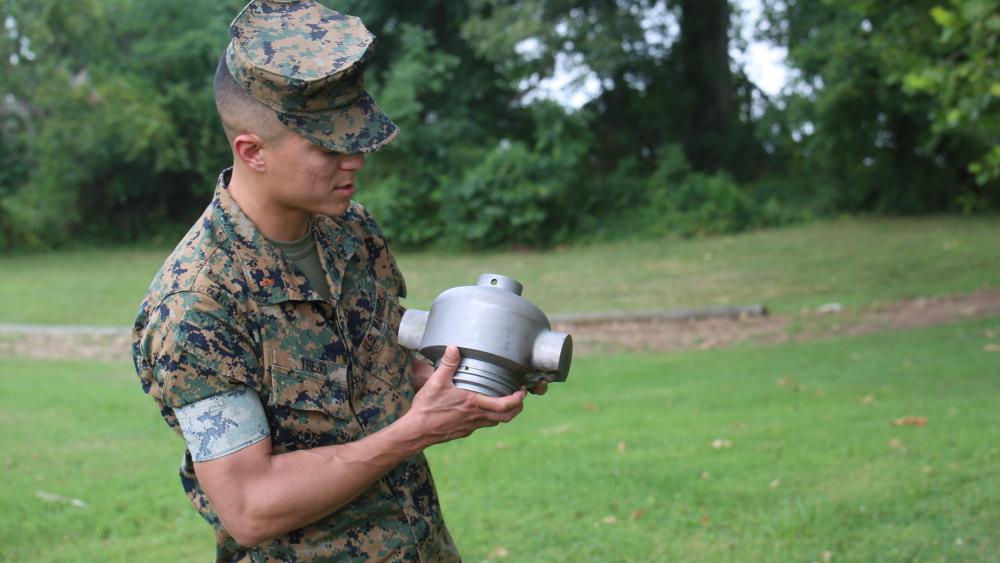
This summer, the Program Manager for Ammunition at Marine Corps Systems Command 3D printed a headcap for a rocket motor used to detonate a M58 Mine Clearing Line Charge. The MICLIC is a rocket-projected explosive line charge that provides a demining capability for Marines.

“The process of 3D printing allows Marines to create a physical object from a digital design,” said CWO2 Justin Trejo, a project officer with PM Ammo at MCSC. “We essentially created a 3D-printed product and incorporated it into a highly explosive system.”

Marines use the MICLIC to clear paths through minefields and other obstacles on the battlefield. However, traditional manufacturing methods for creating the headcap can be both timely and costly, said Trejo. MCSC wanted to identify a more efficient method for producing the part.

PM Ammo found the answer to this dilemma in additive manufacturing.

In 2019, PM Ammo began exploring alternative solutions for manufacturing the headcap. After many hours of research as well as developing and testing a prototype headcap, the team collaborated with Naval Surface Warfare Center Corona Division to produce a 3D-printed version.

Earlier this year, NSWC Corona produced the 3D-printed, stainless steel solution. The next month, PM Ammo representatives assessed the 3D product during a test event at Yuma Proving Ground in Yuma, Arizona. The evaluation involved launching the rocket motor to detonate the mine-clearing line charge.


Trejo said the event went flawlessly.

“The rocket motor fired off just as intended and the line charge detonated as it is supposed to, which was a significant moment for us.”

-CWO2 Justin Trejo, Project officer with PM Ammo at MCSC

“In the future, we’d like to attempt to 3D print the headcap with its nozzles attached,” said Trejo.

He stressed the significance of the successful test event because it further confirmed the effectiveness of 3D printing, which has been growing in popularity within the Department of Defense.

Additive manufacturing provides Marines with a streamlined solution to meet their needs. In 2019, MCSC established its Advanced Manufacturing Operations Cell to serve as a 24/7 help desk for Marines who need assistance with 3D printing, and other sustainment and manufacturing solutions.

AMOC is available to answer questions, field requests for prints and fully vet any part that requires fabrication by a Marine organization. The team of skilled Marines and civilians has employed additive manufacturing to develop everything from innovative maintenance tools to a reinforced concrete bridge.

Caleb Hughes, an engineer with MCSC’s PM Ammo who supported the Yuma testing event, said 3D printing saves the Marine Corps time and money.

“The previous process of traditional manufacturing is outdated, while 3D printing is a more modern manufacturing technique,” said Hughes. “I truly believe 3D printing is the next generation of the Marine Corps.”

Trejo believes additive manufacturing aligns with Commandant of the Marine Corps Gen. David Berger’s vision in that 3D printing helps increase Marines’ battlefield efficiency. Trejo said the manufacturing method enables the warfighter to be “lighter and faster,” critical attributes when supporting various missions.

“We’re able to create equipment parts and other assets for whatever particular mission we’re engaged in,” said Trejo. “This 3D-printed headcap represents the Marine Corps going above and beyond to support our Marines.”

By Matt Gonzales, Marine Corps Systems Command

FirstSpear Friday Focus: New Tubes X-Strap

Friday, September 3rd, 2021

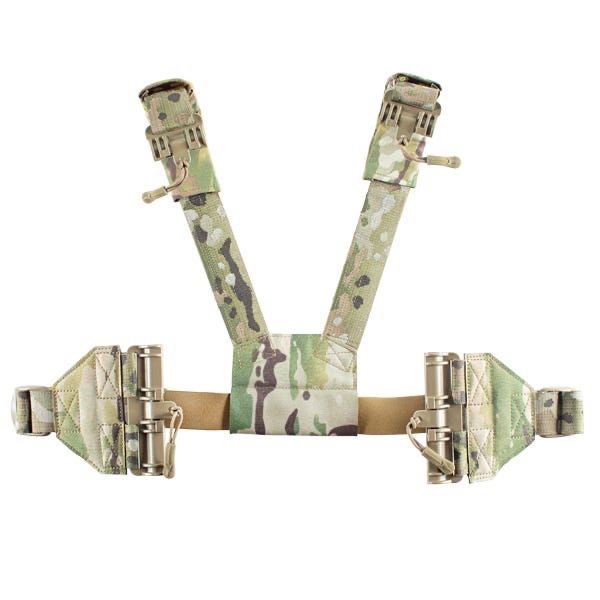
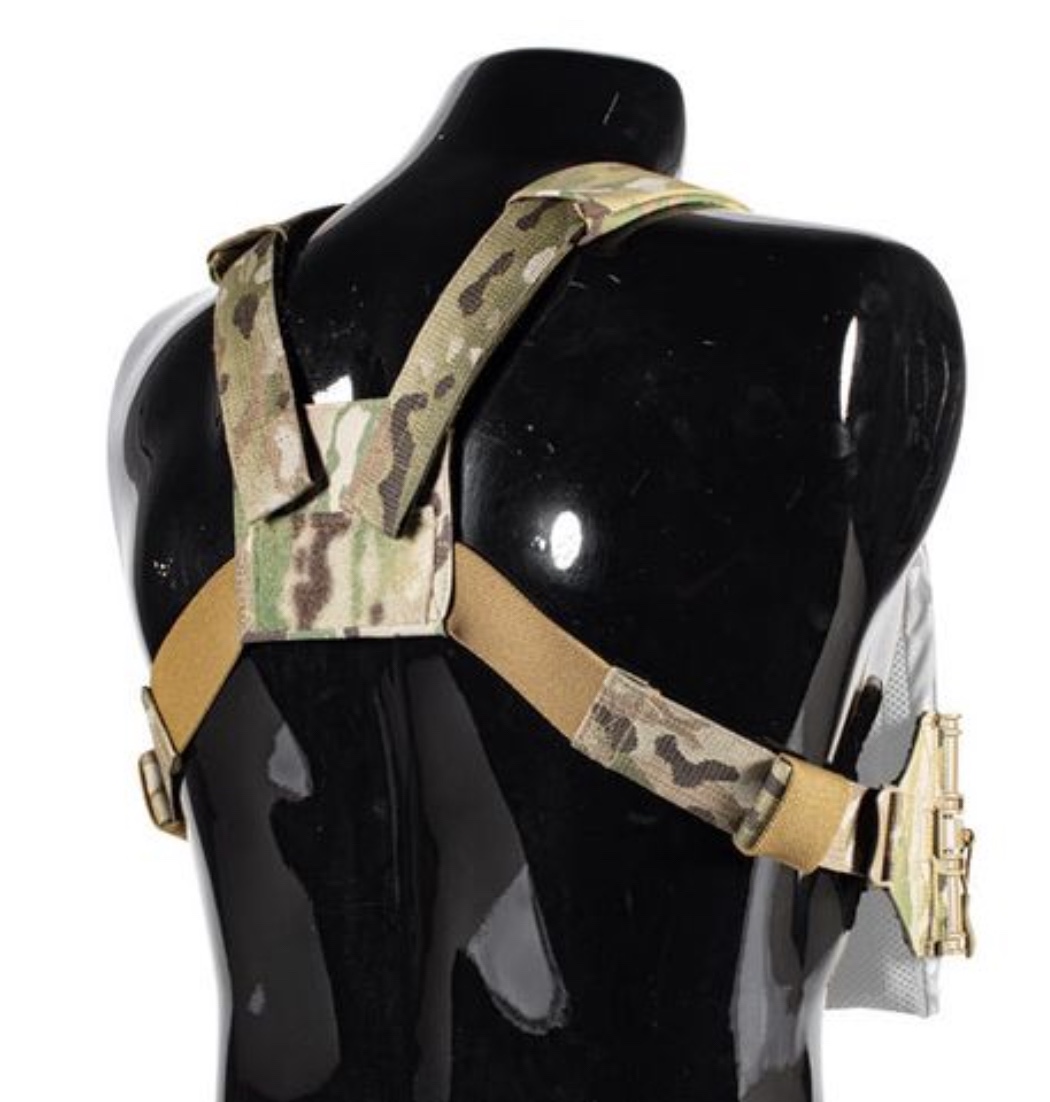
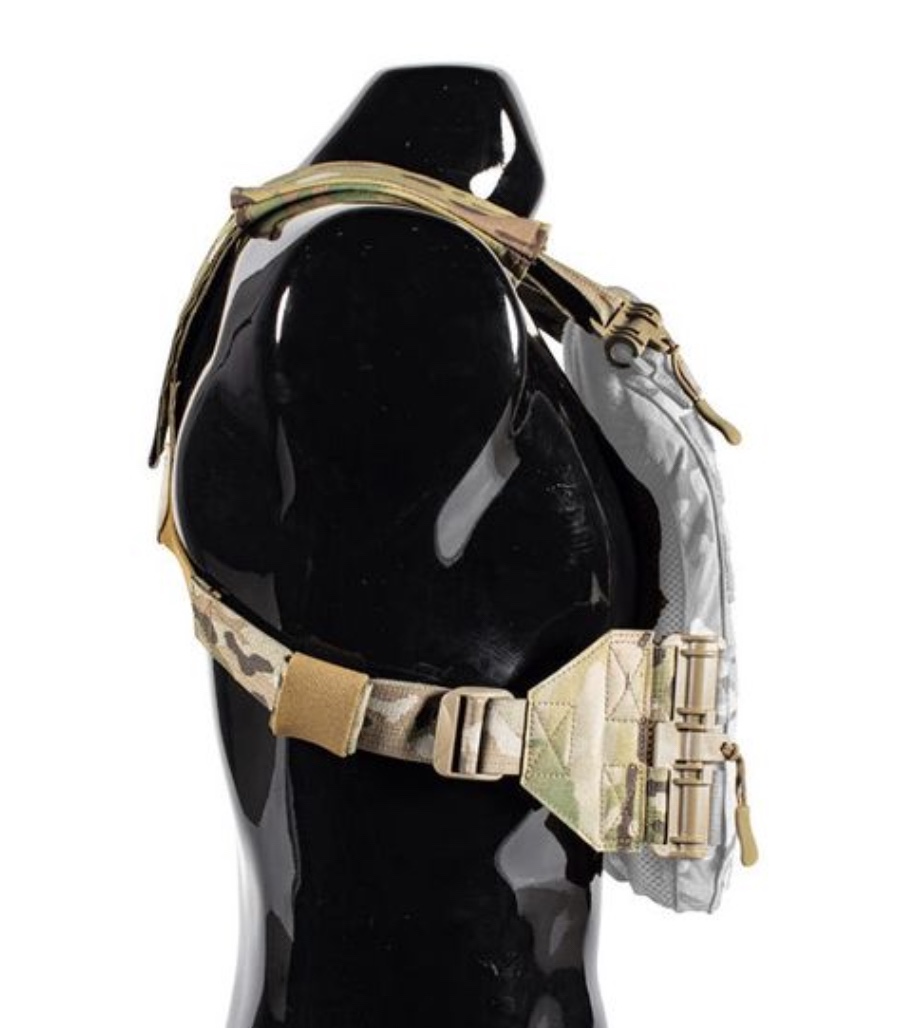
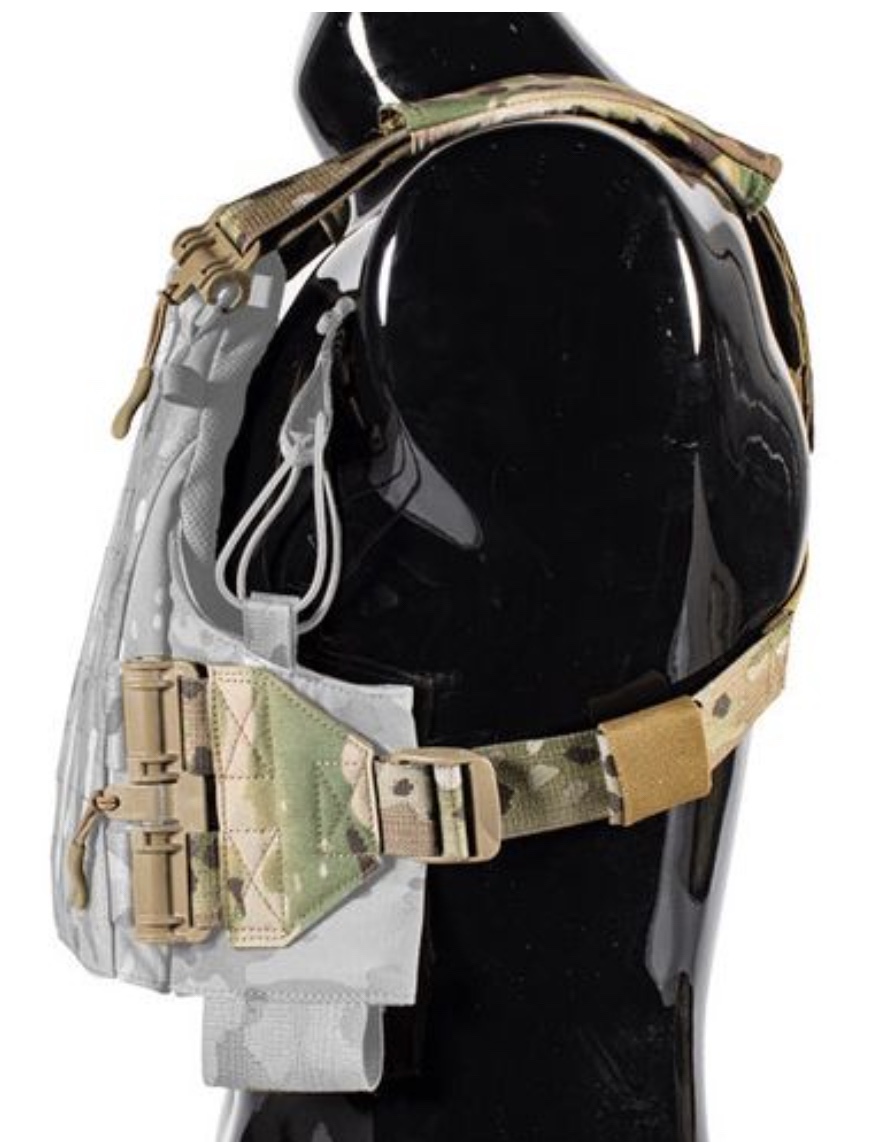
This Friday we’re looking at a new product, the Tubes X-Strap. Some mission sets call for unique approaches to load carriage. Some of our Users at the Tip of the Spear need compatibility with a Free Fall Harness, others are spending a lot of time in an Armored Seat and still others are carrying a back plate in a Pack that they cannot take off or risk mission compromise.

The X-Strap is designed to work with either the FS AAC family of plate carriers or Strandhogg this harness quickly Tubes into place and allows you to work with the front of your plate carrier in place without a back panel or cummerbund. The X-Strap system has enough adjustment to go on over the top of a Soft Armor Carrier or Cold Weather Clothing. A small amount of stretch is provided on each side and the Back Panel provides for attachment of FS Cell Tags.

• Integrates with plate carrier front
• Tubes technology
• One size fits all

This Harness in conjunction with a Front Panel is optimized for use with the FS AR, NBBP or UC Plates, hard armor that is heavier than those designs may not carry well.

For more information check out, https://www.first-spear.com/x-strap

38 RQS Trains to Support SpaceX, Boeing

Friday, September 3rd, 2021

PATRICK SPACE FORCE BASE, Fla. (AFNS) —

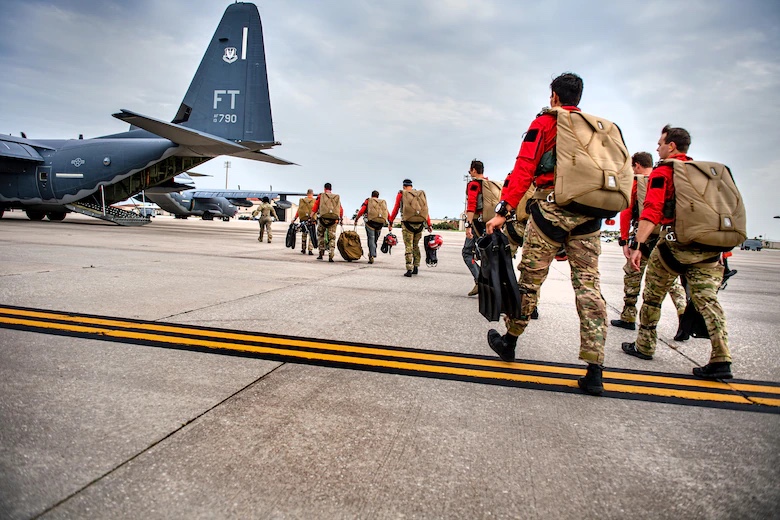
Pararescuemen, aircrew flight equipment Airmen and maritime operations specialists assigned to the 38th Rescue Squadron, Moody Air Force Base, Georgia, conducted rescue training in the Banana River and Atlantic Ocean near Patrick Space Force Base, Aug. 23-27.

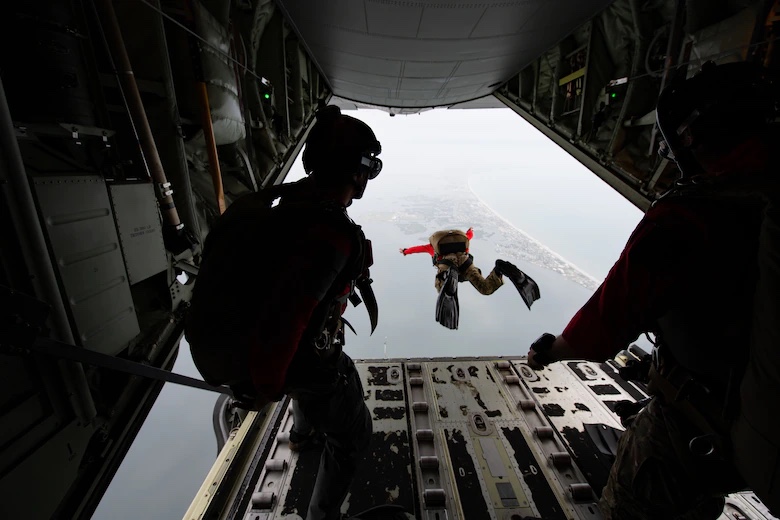
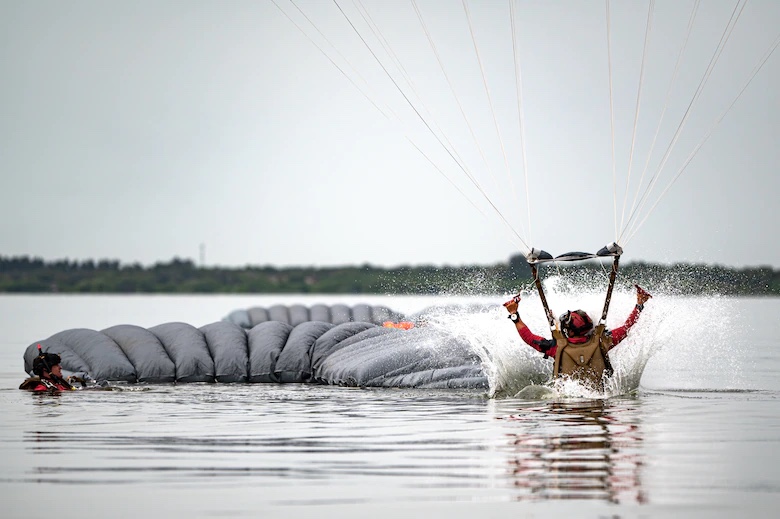
The 38th RQS Blue Team performed free fall jumps and equipment drops into water to prepare for potential operations supporting the SpaceX human spaceflight program and Boeing’s spaceflight program as well as other immediate response-force operations.

“When astronauts are doing their launches, we cover down in the Pacific or Atlantic Ocean,” said Tech. Sgt. Michael Galindo, 38th RQS pararescueman and Blue Team section chief. “That way, if they have an emergency and they need a bailout, we’re the rescue team on-site who would recover them from their capsule.”

In the event of a malfunction during launch, the capsule will detach itself from the rocket and jettison away from potential explosions or other hazards. The goal is for the capsule to land in an ocean where pararescue jumpers can go in and extract anyone on board.

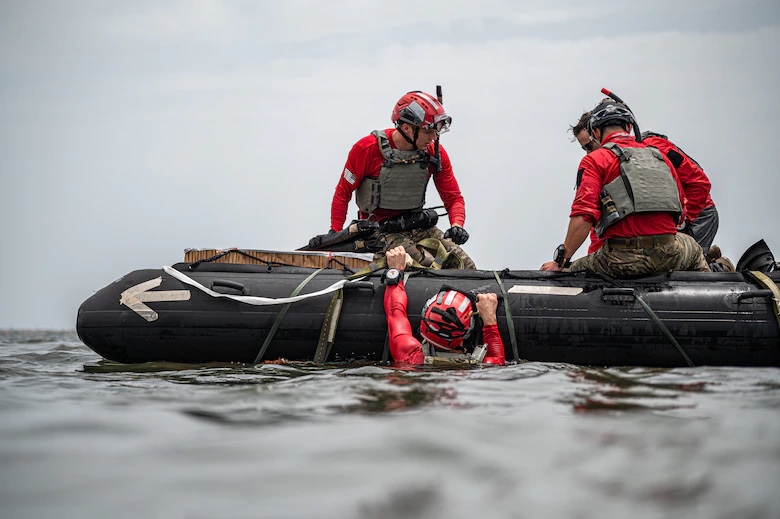
In order to execute this type of rescue operation, the team needs to be proficient in several areas. For starters, they need to know how to safely land in the ocean with their water gear. Additionally, there are two different boat packages they need to be familiar with: a Rigging Alternate Method Boat, or RAMB, which is a deflated Combat Rubber Raiding Craft that can be dropped by parachute into the water and then inflated upon landing; and a hard duck, which is an inflated CRRC fixed to a wooden base and dropped by parachute as well.

Using these packages, Galindo said their team can load the boats with medical supplies, paddles, boat engines and anything else they would need for their rescue operations. Then, the team can drop them from cargo aircraft and jump into the drop zone immediately after to conduct their rescue mission.

“In October, we’re actually doing two weeks of additional training at Cape Canaveral to learn how to access the SpaceX and Boeing capsules … and then make sure we can get access to the astronauts,” said Capt. Trent Vonich, 38th RQS Blue Team flight commander.

Conducting these training exercises on a routine basis ensures the teams are ready to go at a moment’s notice. This level of proficiency offers a layer of comfort for the astronauts conducting launches off the coast.

“It reassures them that if they do have an emergency, they know there’s a team who is highly trained in these types of rescues,” Galindo said. “It’s important for us to constantly keep current on this type of jump because there’s a lot that goes into it.”

While this training was specifically tailored to support the human spaceflight programs, it doubles as preparation for potential rescue operations in contingency locations.

“The top two locations in which that would occur would be the Arabian Gulf and the South China Sea,” Vonich said. “Adversaries have a number of capabilities that could potentially put one of our aircraft in the water, and we would have to go jump into the gulf or sea and do exactly what we did in today’s training.”

Whether rescuing downed pilots off foreign coasts or supporting rocket launches in the U.S., the 38th RQS could not execute their mission without trusted teamwork.

“It’s a lot of work being a pararescueman,” Galindo said. “I’m surrounded by a bunch of great people who are constantly challenging me. We have those who are always trying to improve themselves, whether mentally or physically, and it just drives me to be a better person and reach my potential.”

SpaceX plans to launch a crew of three Oct. 31, and the team will be prepared to respond if needed.

“Heaven forbid anything goes wrong, we’ll be ready if it does,” Vonich said.

Story and photos by SSgt Devin Boyer, 23rd Wing Public Affairs

Additional photos by SSgt Melanie A. Bulow-Gonterman

Navy Updates Hairstyles and Policies in Extensive Uniform Update

Thursday, September 2nd, 2021

The Navy has authorized new hairstyles for men and women in a just-released uniform policy and grooming standards update.  Also announced are changes to wear rules for watches, prescription glasses and sunglasses while in uniform, medically prescribed head coverings and earrings for men in civvies and changes to name tape policies, just to name a few.  

The Navy has authorized new hairstyles for men and women in a just-released uniform policy and grooming standards update.  Also announced are changes to wear rules for watches, prescription glasses and sunglasses while in uniform, medically prescribed head coverings and earrings for men in civvies and changes to name tape policies, just to name a few.  

The complete list of what’s new in uniform policy comes in NAVADMIN 183/21 released on Aug. 31. Effective date of changes vary pending the policy change, so please read NAVADMIN 183/21.

“Navy uniform policy updates are the result of Fleet feedback, uniform working group discussions, command sponsored requests and direction from Navy leadership,” wrote Vice Adm. John B. Nowell, Jr., chief of naval personnel, in the message.

“Navy uniform policy updates directly support Sailor 2025 objectives to attract and retain the very best Sailors by finding greater flexibility in our policies and practices, including uniforms.”

What all Sailors need to know is that if something isn’t spelled out in the uniform regulations, it’s not authorized, said Rob Carroll, head of uniform matters on the staff of the chief of naval personnel. This applies to everything from uniforms and grooming standards to rules on appropriate civilian attire.

“These changes are aligned with the efforts to eliminate inconsistency in the application of policy standards and provide clearer guidance that will facilitate compliance and enforcement,” Carroll added.

“Also, they will expand options for our Sailors in grooming standards while eliminating policies considered by most as outdated.”

Many of the changes came from Sailor feedback during uniform and grooming standards focus and working groups held in the fleet. According to Carroll, some came up during Task Force One Navy listening sessions held in 2020 and 21.

“We review commonly asked questions submitted by Sailors from around the fleet, we look at trends, and discuss policy considerations,” Carroll said.  “TF1N did not drive the policy changes, but it can be noted that some of the changes align with the Navy’s Diversity, Equity and Inclusion initiatives.”

Here are some highlights of what’s new; consult the NAVADMIN for even more changes.

Hairstyles

Navy Uniform Regulations spell out how all Sailors can and cannot wear their hair, but periodically the Navy updates these rules as practices become mainstream.

“These changes recognize hairstyles that are now pretty standard in society and is also aligned with presenting a professional military appearance while in uniform,” Carroll said. 

For men, this means officially sanctioned styles now include bald, flat tops, faded and high and tight hairstyles.  All styles include allowing squared or rounded gradual tapers in the back of the head.  Sideburns are authorized but cannot exceed the hair length of the haircut where the sideburns and side of the head intersect.  Sideburns with bald hairstyles are not allowed.

For women, the rules now allow very short hair styles to include showing the scalp. This includes tapered back and sides of the head. Razor-cut bald styles are not authorized except when prescribed for treating medical conditions.

When wearing very short hairstyles, female Sailors are allowed one hard part that may be cut, shaved, clipped or naturally placed into the scalp.  The hard part must be above the temple and no higher than the crown, where the side and top of the head meet. One hard part can be on either the right or left side of the head and must run straight “fore and aft,” the rules say. They can be no longer than four inches nor broader than one-eighth of an inch.

“This gives women more options for greater ease on hair care, especially while on deployment when longer styles can be tougher to maintain,” Carroll said. “Female Sailors have been asking for this flexibility.”

Earrings for Men

Earrings still can’t be worn by male Sailors in uniform but now are authorized while wearing civilian clothes in a leave or liberty status both on and off military installations or while using government transportation. Earrings are not allowed when performing official duties in civilian attire, the rules say.

Accented Names

For Sailors whose legal names contain accents, punctuation marks can now be used in name tags, name patches, or name tapes on Navy uniforms. 

Higher Heels for Women

For female Sailors wanting a bit more lift in their high-heels, uniform pumps up to 3-inches in height are now authorized, up from the previously approved height of two and 5/8 inches. Carroll said this is now considered the standard heel height for females in civilian business attire. Sailors can wear commercially procured shoes if they also comply with all other rules for uniform shoes (color, design and fabric).         

Sun and Prescription Eyeglass Options and rules

Prescription glasses and sunglasses frames worn in uniform must now conform to new rules. 

Frame colors can only be silver, gray, black, navy blue, brown or gold. They can, however, be transparent or translucent.  Sunglasses can also be green and sport small logos.

“There are just so many options available today for glasses and we needed to get some standardization of appearance in uniform,” Carroll said. “This change allows for a wide variety of options, ease of compliance and enforcement as well as maintaining a professional military appearance.”

Retainer straps can be worn only for foreign object debris prevention and safety. Only black straps are authorized and must be worn snugly against the head.  When not in use, eyeglasses cannot be worn on top of the head or hanging around the neck.  

More details and the rest of the uniform changes are available in NAVADMIN 183/21. More uniform information is available on the Navy Uniform Matters Website at www.mynavyhr.navy.mil/References/US-Navy-Uniforms.

From MC1 Mark D. Faram, Chief of Naval Personnel Public Affairs

Stealth Armor Systems Wants Industry Feedback On NIJ 0101.07 Armor Standard

Wednesday, September 1st, 2021

NIJ 0101.07 Standard

Letter from the CEO…. Hello everyone, I am not sure if the various agencies on our list are aware of this, but the NIJ standard is changing, and I wouldn’t say for the better.

I have been in this industry for 33 years now and the NIJ 0101.07 standard makes the 6th edition I have personally participated in as a manufacturer of armor, and as a laboratory technician. The prior standards have never really been that great and lag times from passing of a model to listing date is usually 6 months. Here are the issues with the new standard I want to make everyone aware of:

~ In the rifle threats they haven’t definitively distinguished a viable threat level, they have RF1 and RF 2 with the same rounds and velocities with really only the M855 as the upgraded level.

~ The Fit audit is just a paper pushing firm that charges a lot of money to do what the NIJ should be doing.

~ The ubiquitous use of clay as a medium that is supposed to be a constant in the test and resemble the body during a ballistic event on body armor. Factually it never has.

Over the coming weeks I have decided as one of my final tasks in this industry prior to retiring probably in 2027 is outline the issues with the NIJ standard, and offer a more common sense approach to testing body armor that serves law enforcement better.

In order to do this I need your help, and specifically I would like to invite questions and comments about the standard, as to what you think it does, or any ideas that might help with this task. I think everyone wants the same thing here, the question is do we just go with the new standard, or do we say enough of bad practices and let’s do something about it. One thing I will say is that NIJ standard is heavily integrated into specifying practices that favor those who have a vested interest in money, such is the case in many areas of the commercial market, but that shouldn’t be a practice when it comes to officer safety, and part of officer safety is testing armor in a way that can be repeated, which has never been the case.

Interested participants can contact me at a.bain@stealtharmorsystems.com or 346-212-6318 (cell)

Allan D. Bain
CEO/CTO