Pirata Series from OTB Boots - Coming March 2026!

Archive for the ‘Guest Post’ Category

Soldiers Test New Army System to Increase Command Post Mobility

Sunday, August 8th, 2021

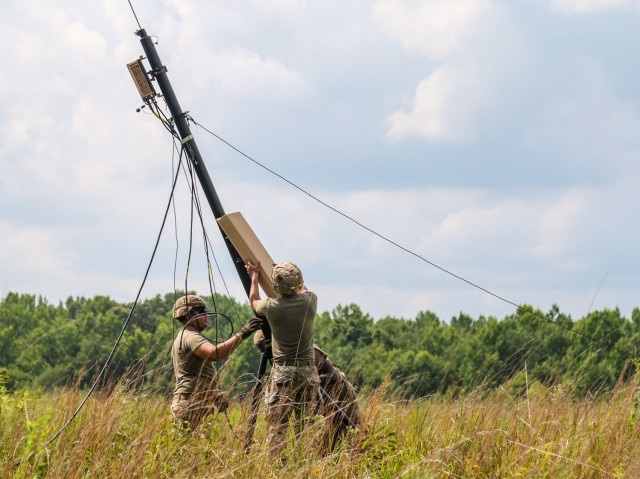
FORT CAMPBELL, Ky. — Soldiers from Headquarters and Headquarters Company, 3rd Brigade Combat Team, 101st Airborne Division (Air Assault), conducted a Command Post Modernization Operational Assessment July 22-26, at the Kinnard Mission Training Complex on post.

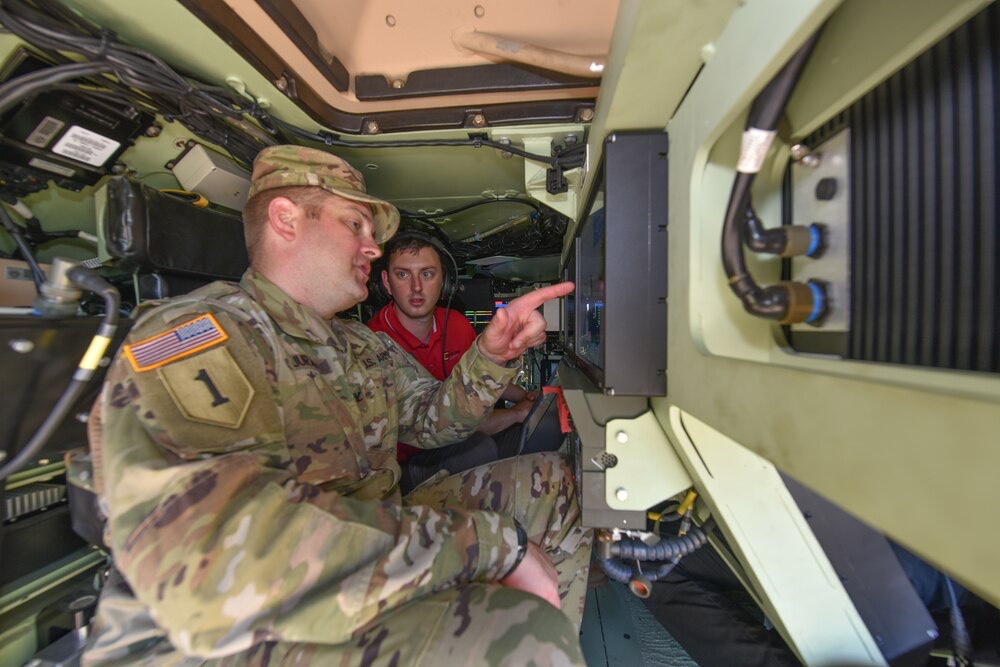
Command Post Integrated Infrastructure, better known as CPI2, is a major modernization line of effort. It integrates emerging technologies and capabilities with mobile mission command platforms and command post support vehicles as a means of increasing agility and improving survivability on the battlefield.

“CIP2 will help units succeed in combat by providing mobility of the command post and getting after the signature aspects, like the electromagnetic and physical signature by reducing the number of vehicles and providing the workspace for units to be successful in their mission set,” said Lt. Col. Jeremy Rogers, product manager for CPI2.
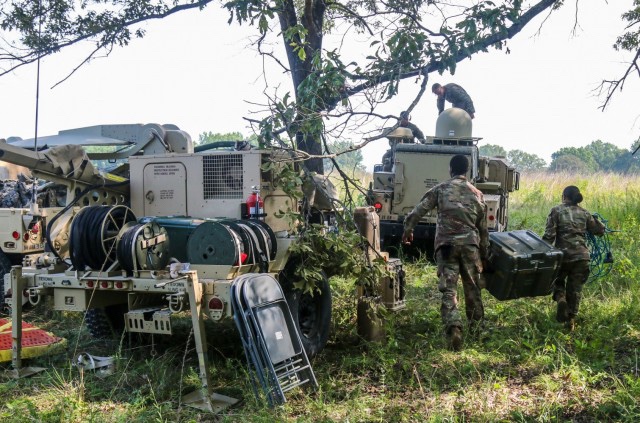
The previous program that CPI2 is attempting to replace typically took between four and eight hours to set up and displace, says Rogers. The goal is to reduce this time down to approximately 30 minutes.

Utilizing this program has knocked placement and displacement times down to between an hour and an hour and a half, approximately 80% faster than before. This is done by reducing the footprint that the tactical command post, or TOC, normally creates.

“The TOC tents that we were used to in the past were a large footprint,” said Staff Sergeant Michael Prater, an operations and plans Noncommissioned officer for 3 BCT and battle NCO for the operation. “This is a more mobile, smaller, diverse footprint that creates a better way of getting into the fight and getting out of the fight.”
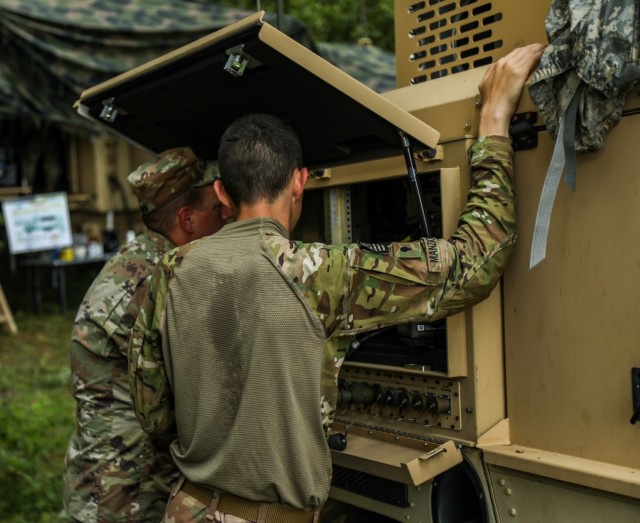
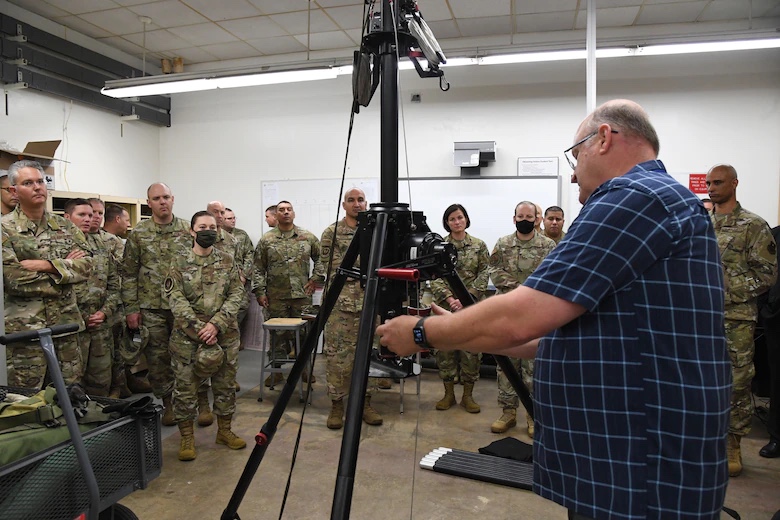
Prater’s focus, as the operational NCO, has been teaching the Soldiers, officers and other NCOs of his unit how to use, set up and tear down the equipment, focusing on increasing efficiency over time.

Being more mobile enables Soldiers to move, shoot and communicate with the efficiency they need to accomplish the mission. So far, other units that have tested this innovative system include, 2nd Stryker BCT, 2nd Infantry Division; and Headquarters, 4th Infantry Division, each with different command post configurations.

“As we take the unit feedback from both of our operational assessments, it will help inform not only our future requirements, but the baseline of the command post moving forward,” said Rogers.
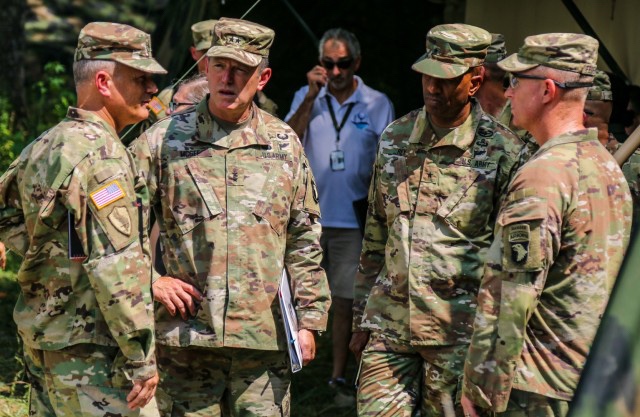
Spc. Lance Lee, brigade air defense valve management systems operator for HHC, 3 BCT, says that CPI2 makes his life a lot easier because he is able to fall in on a pre-made shelter with network connectivity ports already allotted to him, eliminating time previously spent searching for a spot on the switch.

“CPI2 is a valuable asset for us because we’re able to fall in on an experimental software location where we can try new ideas, and essentially game plan to create new ways for us to affect the fight for the brigade commander,” said Lee. “I serve in the Army to make a difference, to innovate, and to get out there and try to find a new solution to currently existing problems. If I can be at the forefront of finding something that can affect the fight for the future, then I will be.”

By SPC Andrea Notter, 40th Public Affairs Detachment
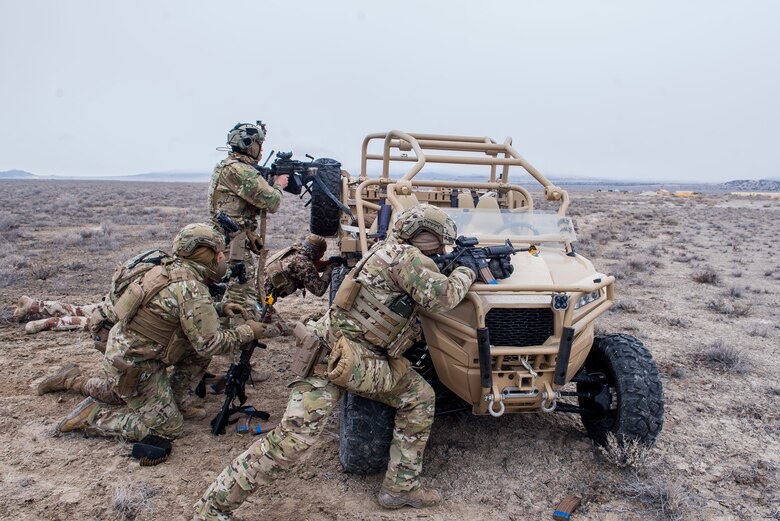
AFSOC Stands Up New Mission Sustainment Team at Cannon AFB

Saturday, August 7th, 2021

CANNON AIR FORCE BASE, N.M. —

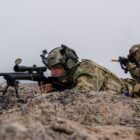
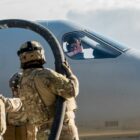
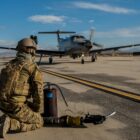
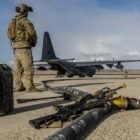
A new unit has been generated on base in support of mission readiness and efficiency. Mission Sustainment Team 1 is a group of individuals with diverse skill sets selected from the 27th Special Operations Mission Support Group, with the intent that they will cover and provide every asset required to sustain livable conditions in austere locations for an extended period of time.

The Mission Sustainment Team concept provides a way forward in building small, scattered teams capable of operating independent of main operating bases – a focus area highlighted by Lt. Gen. Jim Slife, Air Force Special Operations Command commander, during his 2021 Special Operations Forces Imperatives Forum earlier this year.

“This idea is not new or unique to the Air Force as a whole, but it is to the Air Force Special Operations Command,” said Senior Master Sgt. John Spencer, 27 SOMSG, Detachment 1 MST 1 team lead. “AFSOC is used to providing for the operators for a short duration, but something like this has never been done before in this Major Command.”
AFSOC currently does not have an on-demand capability to provide and sustain a livable environment in areas without pre-established facilities. To fix this issue, the MST consists of Airmen from different MSG specialties, and trains them all on necessary expeditionary functions.
“We are taking roughly 60 people from different shops in the MSG and making them work together to create livable conditions for a base worth of personnel,” Spencer said. “We have to try these things, see where they fail, then learn from our failures and do it better the next time.”
There are many unknowns surrounding the MST, as with any new unit. The team hopes to benefit from these unknowns however, documenting their experiences and applying the lessons learned to ultimately teach and train those who follow in the future.

The team had the opportunity to test themselves recently in an Operational Readiness Exercise. Select individuals from Cannon AFB were involved in a mock deployment to an austere location and required support from MST 1. This entirely new scenario helped participants as it was an ideal testing ground for the capabilities of sustained support for multiple personnel.

Within a limited resourcing environment, MST 1 gives AFSOC the ability to enable the larger joint force with unique capabilities; things that no one else can do.

The opportunities to blaze new trails are plentiful for MST 1. As the first of its kind in AFSOC, there is no manual or guidebook to follow. Instead, the team will take the knowledge and practices of similar groups in other MAJCOM’s and tailor them to their needs.

During the 2021 SOF Imperatives Forum, Slife spoke on the necessity for the development and continuous acceleration of SOF and AFSOC forces, including those a part of MST 1.

“The standards of yesterday were applicable to yesterday,” Slife said. “The question is, what are the standards of tomorrow and how do we build the force we need, to be most effective in the future? Our competitive advantage will continue to be the men and women who make up our formation, but the challenge for leadership is ensuring… those men and women in AFSOC know that they are relevant to the nation.”

Not many in support roles have the opportunity to see how their work directly affects the mission downrange. The work of this new unit provides Airmen a tangible link between their efforts and the final product, something that boosts morale while transforming them into a team of lethal, multi-faceted Airmen.

“It brings me real joy to see how folks who, before joining this group, had never worked with a services Airman, and then see them training on a field kitchen three days later,” Spencer said. “This is what I like to do. I like building teams, being out in the field, and doing what the Air Force trained me to do in defending airfields. Seeing all this [come together] from my personal perspective is unique and amazing. It also helps the Air Force as a whole as it takes someone from their regular unit for a while, and then returns them 100% better than when they left because they got to learn all the things they would normally never do.”

MST 1 may be new, but they have their work cut out for them. Providing support for active personnel at austere and un-furnished locations is no easy feat, but it means the work done by MST 1 will be vital in helping similar units in AFSOC for years to come.

Story by Senior Airman Christopher Storer, 27th Special Operations Wing Public Affairs

Photos by Senior Airman Vernon R. Walter III

USMC PFT Update for Calendar Year 2022

Friday, August 6th, 2021

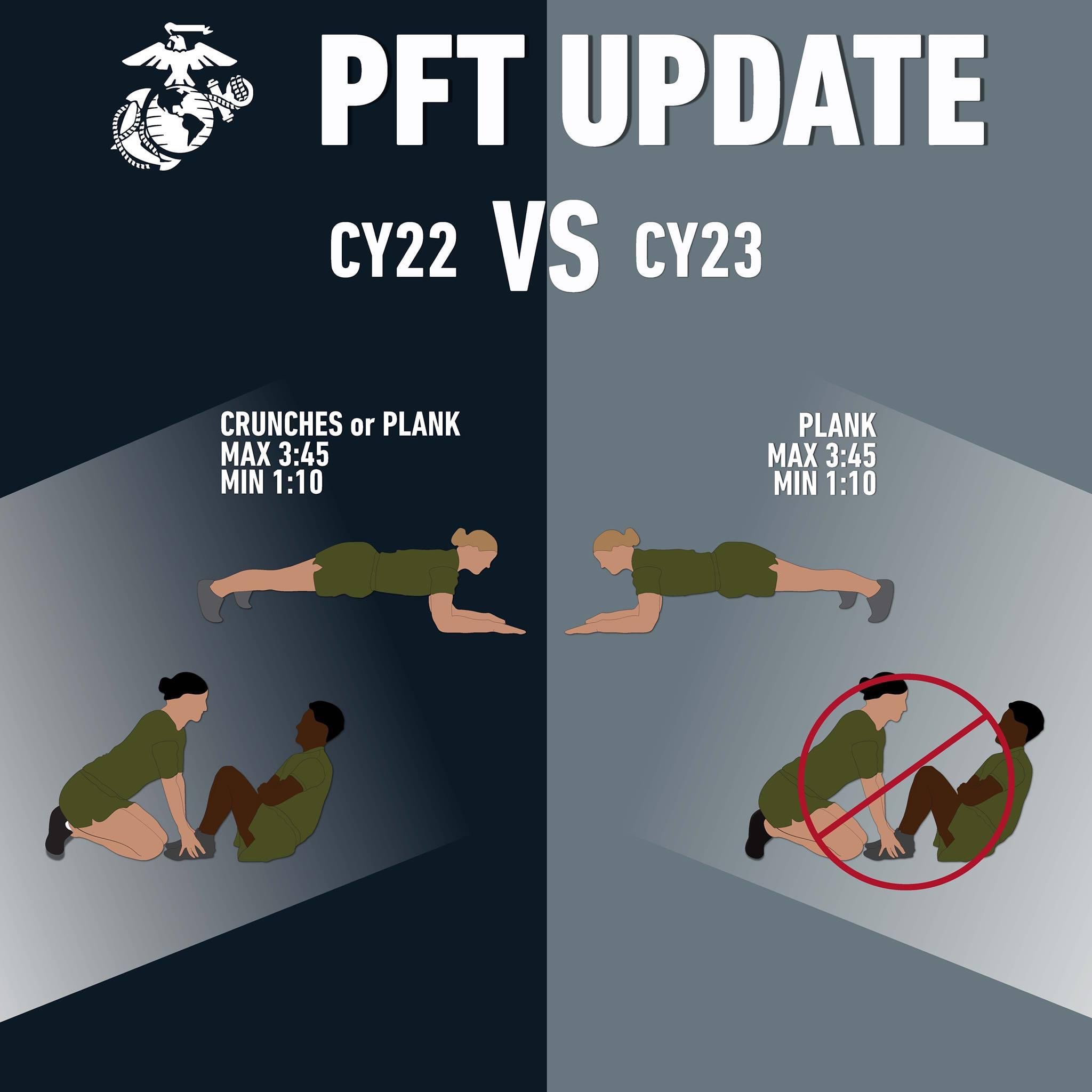
In 2020, the Marine Corps adopted the plank as an alternative to crunches for the annual Physical Fitness Test (PFT) as a means to measure core stability, strength, and endurance while reducing risk of injury. For PFTs conducted in 2022, Marines will still have the option to conduct the plank or the crunch just as in 2021, with slight scoring adjustments. The plank will be mandatory in 2023, replacing the crunches as an authorized PFT exercise.

For decades, the Marine Corps has used sit-ups and crunches to both improve and assess abdominal endurance. However, research has shown that sit-ups and crunches with the feet restrained require significant hip flexor activation. This has been linked to an increased risk of injury, including lower back pain due to increased lumbar lordosis.

The plank presents numerous advantages as an abdominal exercise. The plank’s isometric hold requires constant muscle activation, activates almost twice as many muscles as the crunch, and has been proven to be most reliable in measuring the true endurance required for daily activity function. With increased core strength, Marines are less likely to experience injury or fatigue during functional tasks like hiking, lifting and low crawling.

The new time for the maximum score will 3:45, reduced from 4:20. The time for the minimum score has also been adjusted, increasing from 1:03 to 1:10.

For more information and resources, including a four-week core strength training plan, visit www.fitness.marines.mil and reference MARADMIN 404/21 at www.marines.mil/News/Messages/Messages-Display/Article/2719680/forthcoming-changes-to-the-physical-fitness-test.

Direct link to the Plank Progression Program: www.fitness.marines.mil/Portals/211/Cache/Plank%20Progression_Wk1-Wk4

FirstSpear Friday Focus: Rash Guards Back In Stock

Friday, August 6th, 2021

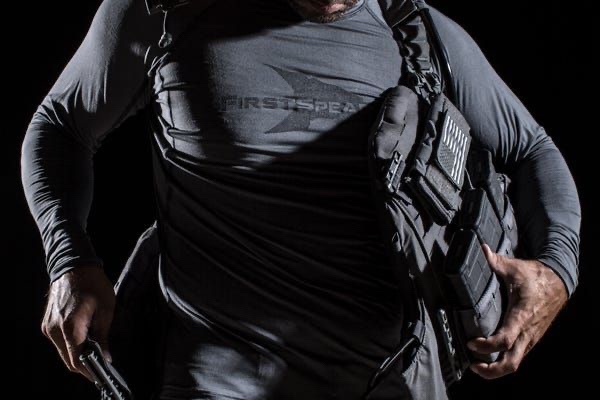
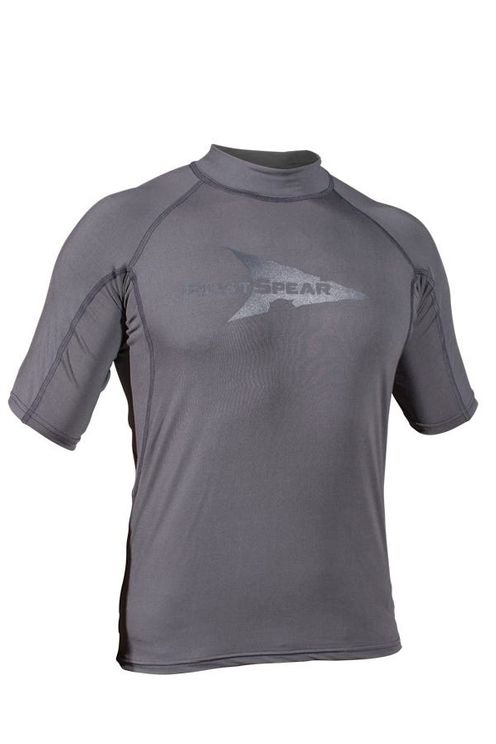
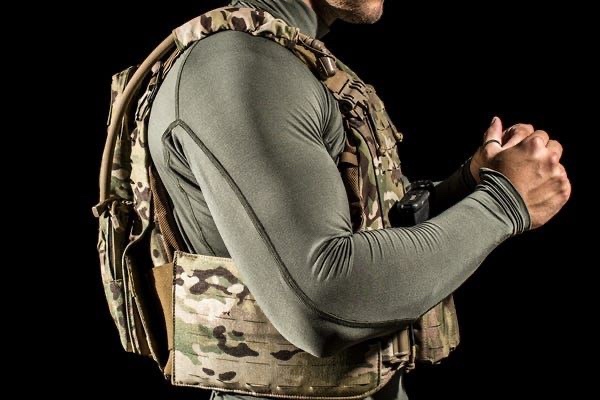
Take a look at FirstSpear’s all American made short and long sleeve Rash Guards that are now back in stock!

Built from a premium poly/spandex blend the FS Rash Guard is an ultralight compression fit garment that helps to protect against abrasion and rub commonly found in a maritime environment.

• Ultralight compression fit
• Protects against rubbing and abrasion while wet
• Natural sun / UV protection
• Dries quickly
• Made in the USA

Quick to dry with natural sun / UV protection. Smooth flat seams, medium high collar, and integrated low profile thumb holes keep the sleeves in places when putting on equipment and other garments. Available and shipping now in short and long sleeve in charcoal and ranger green. Order your standard t-shirt size for a compressed fit and consider stepping up 1-2 sizes for a more relaxed fit. 100% Made in America.

For more information, check out www.first-spear.com/technical-apparel/rash-guard-7228.

Airless Tires Undergo Punishing Evaluation at Army’s Tropic Regions Test Center

Friday, August 6th, 2021

YUMA PROVING GROUND, Ariz. — U.S. Army Yuma Proving Ground and its constituent test centers test virtually every piece of equipment in the ground combat arsenal in extreme environments to ensure it will work wherever in the world American forces are serving.

To ensure gear can survive the unforgiving rigors of jungle warfare, the Army relies on Tropic Regions Test Center (TRTC), which conducts realistic evaluations in a variety of tropical locales.

Though the deserts of Southwest Asia have been the most common location of American military involvement for nearly twenty years, the majority of the world’s conflicts have occurred in tropical areas, which have ground conditions from dense jungles to savannas with 20-foot tall grasses. Testing equipment under inhospitable tropic conditions provides insights that may never be discovered in an environmental chamber. Will muddy, biomass-laden jungle terrain destroy the integrity of wheels and tires on a combat vehicle, for instance?

One recent TRTC test involved the Polaris MRZR, a military version of the popular off-road vehicle that American forces have used in places like Afghanistan in recent years.

“It is not as comfortable, but it is sturdier and heavier with a rolling cage,” said Carlos Mora, TRTC test officer. “It is more mission-oriented.”

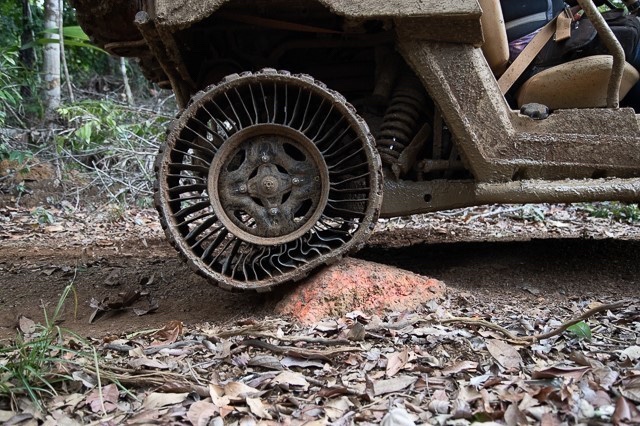
The MRZR under test was outfitted with Tweels instead of standard tires. The Tweel, produced by Michelin, is an airless radial tire designed to work like an ordinary pneumatic tire. In addition to the obvious advantage of never having to worry about flat tires, utilizing Tweels has second order effects that are useful for Soldiers.

“One reason for this technology is to reduce weight on those small vehicles so you don’t have to carry a spare tire, jacks, or materials to fix a puncture,” said Mora.

The Tweels also have the ability to conform to multiple different terrain types, and can last three times as long as standard tires. Putting the Tweels through their paces on land deep within the jungle of the nation of Suriname that TRTC have utilized in previous vehicle tests gave the evaluation a particularly realistic operational flavor.

“All of these old mining roads and logging roads were the perfect scenario for the vehicle,” said Mora. “The customer also liked the composition of the soils.”

There was also the added benefit of microclimates and terrain features that are only sometimes associated with the tropics.

“We added a portion of savanna, which is a sandy terrain with small brushes,” said Mora. “It turned out to be very demanding.”

Tweels are also designed to power through serious damage for far longer than even run-flat pneumatic tires. Using a drill bit, testers damaged the Tweels to simulate as if they had been shot prior to some of the evaluations.

By necessity, TRTC provides substantially more assistance to its customers than other test centers, which are located in the United States and do not require complicated visa and country clearances from various embassies and the military for American visitors.

“We always have the support of the embassy and the national police, so everything we do is sanctioned and approved by the foreign minister and the U.S. embassy,” said Ernest Hugh, TRTC director. “That’s part of the process we take care of to ensure the visit is seamless for the customer.”

The American embassies and associated military groups within each delegation assist TRTC in securing the necessary permissions to conduct testing in a variety of countries.

“We work closely with the United States embassies in all of the host nations in which we conduct tests,” said Hugh.

Army’s GVSC, Picatinny Arsenal Test Robotic Combat Vehicle Prototype at Fort Dix

Thursday, August 5th, 2021

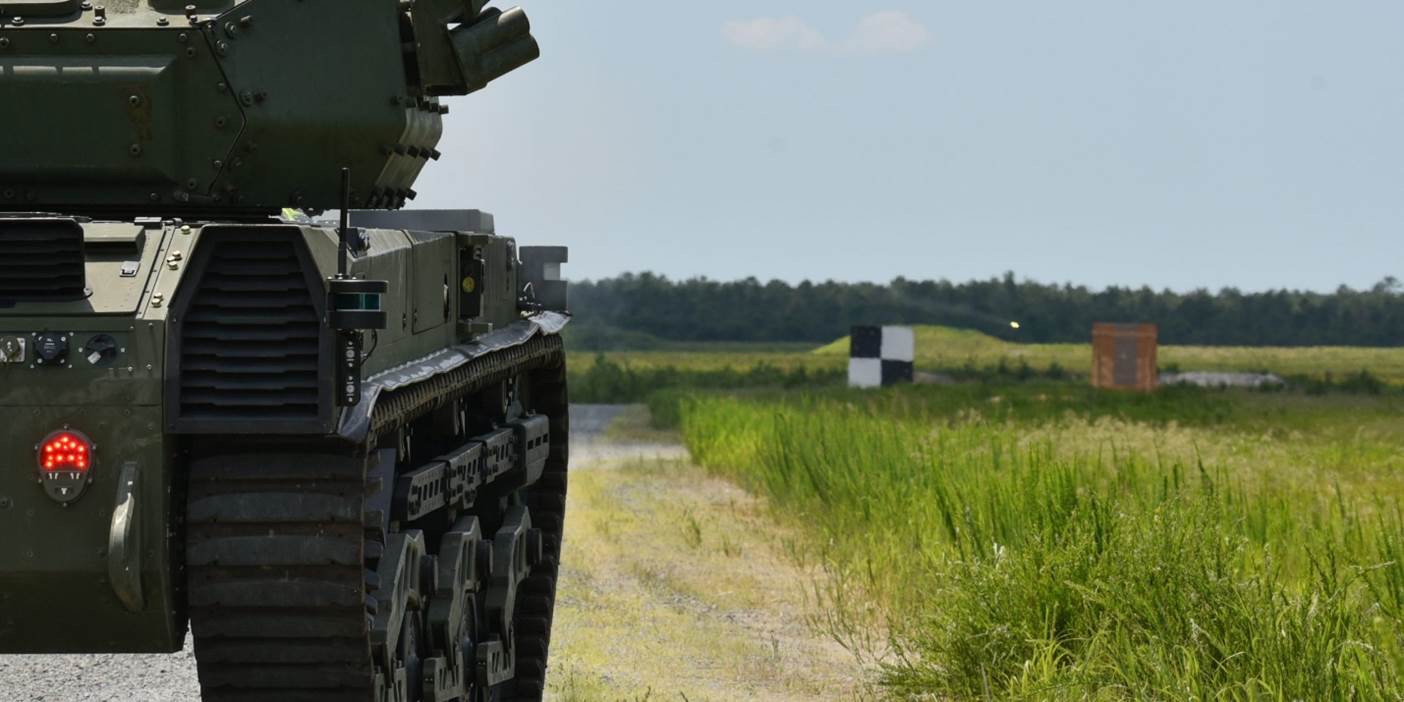
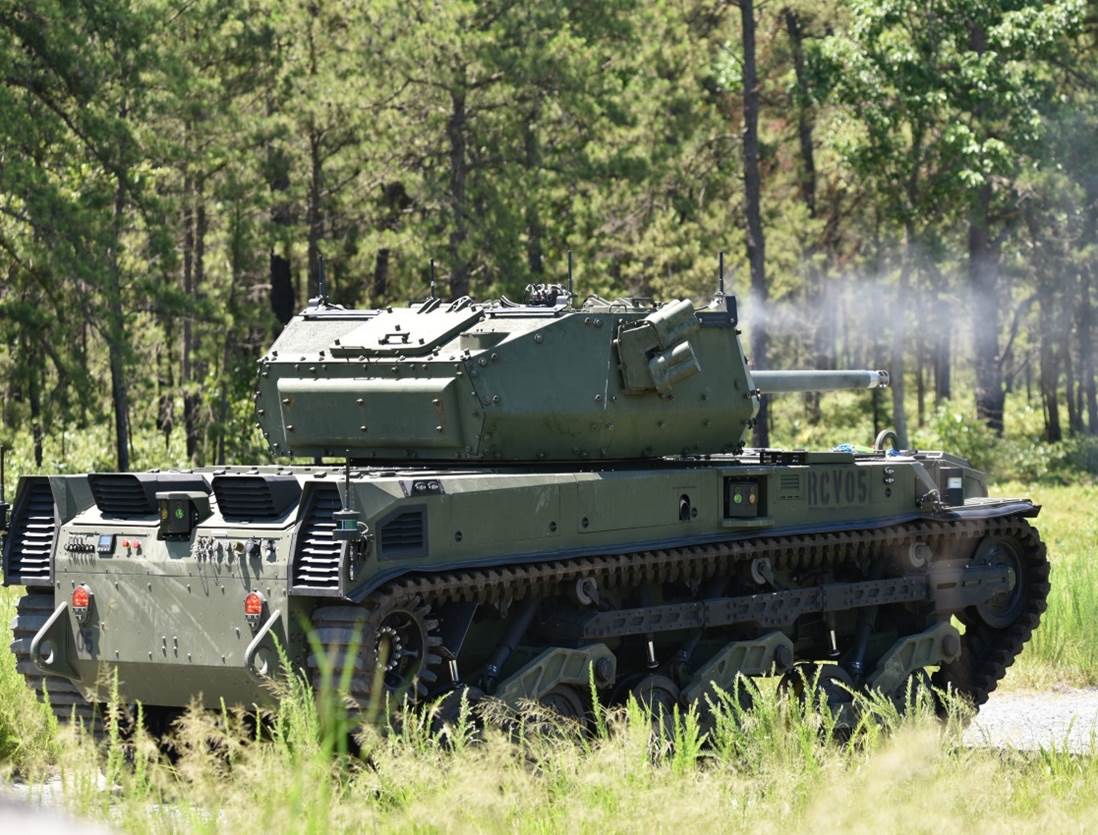
JOINT BASE MCGUIRE-DIX-LAKEHURST, New Jersey– Members of the U.S. Army Combat Capabilities Development Command (DEVCOM) Armaments Center at Picatinny Arsenal, New Jersey, and Ground Vehicle Systems Center (GVSC) located in Detroit Arsenal, Michigan, joined together on a range at Fort Dix June 30 to perform a live-fire test of a Robotic Combat Vehicle-Medium (RCV-M), an experimental prototype under the Next Generation Combat Vehicle Cross-Functional Team (NGCV CFT).

The tests focused on firing the RCV-M’s XM813 main gun, as well as its M240 machine gun, from an unmanned and wirelessly-operated weapon station.

“We want to look at the integration of a turret, which was provided as government furnished equipment to the effort, onto the platform,” said Mike Mera, an engineer in the Remote Weapons Branch at Picatinny Arsenal.

The RCV-M program is a joint collaboration among the NGCV CFT, Product Manager Maneuver Combat Systems (PM MCS), Product Manager Soldier Lethality (PM SL), and Combat Capabilities Development Command. The RCV-M platform includes products from Textron, Howe and Howe Technologies, FLIR, and Kongsberg Defence & Aerospace (KDA).

“We’re using high speed cameras to look at the platform, cannon, and turret dynamics,” Mera said. “We’ve got data collection systems downrange to collect the dispersion information, and we’ll evaluate both the performance and quality of the overall integration to make sure expectations are being met.”

The verification exercise ensured the stringent requirements for the turret and host platform were not only met by design, but also in reality.

“Here, we’re evaluating the armaments integration, but the overall expectation is to get these into the Soldiers’ hands and perform some experimentation as part of a regular training regimen down at Fort Hood, Texas, next summer,” Mera said.

Although this system has been in the works for approximately 18 months, this was its first live-fire test.


A Robotic Combat Vehicle-Medium fires a around at a target during the vehicle’s live fire testing at Fort Dix, N.J., June 30, 2021. The testing prepares the vehicle’s systems and the engineers who design and operate it the opportunity to exercise its capabilities before the 2022 Soldier Operational Experiment at Fort Hood, Texas. (U.S. Army photo by Angelique N. Smythe/Released)

“To date, there hasn’t been any testing other than in the lab,” Mera said.

The RCV-M armament system’s control station was housed in a Mission Enabling Technologies Demonstrator (MET-D). From there, crewmembers were able to move, shoot and communicate through a mixture of touchscreen panels and physical controls.

“We’ve got personnel from the Armaments Center – both government employees as well as employees of Booz Allen Hamilton,” Mera said. “The Booz Allen folks perform the energetic operations. They’re our gunners and loaders. The government personnel serve in the capacity of the officer in charge of the range – that’s myself, and the range safety officer, as well as other support. We’ve also got folks from the Ground Vehicle Systems Center. They’re supporting the platform, monitoring the overall test, providing a lot of logistic support.”

Several GVSC and Armaments Center officials also visited the range to observe the demonstration, such as Michael Cadieux, director of GVSC, and Mark Ford, Director of the DEVCOM Armaments Center Weapon Systems and Technology Directorate, among others.

Cristian Bara, a GVSC test engineer for the RCV-M and MET-D, said he also came from Michigan to observe how the guns performed from the test plan perspective and to ensure the quality of the systems were where they needed to be.

“These are all prototypes,” Bara said. “This is the first system that we’ve developed where we have a gun of this caliber mounted on the robot, a completely unmanned robot, and that is also controlled from a different location or within the manned combat vehicle; it’s certainly unique.”

The functional check ensures the MET-D and RCV systems communicate properly, messages and data are received on both ends, and the hardware and software also perform as intended.

“The overall goal is to ensure that the systems, technologies and capabilities work as we design them and are being used as intended,” Bara said. “We want to make sure we deliver a solid product to Soldiers because we’re trying to save lives.”

Another observer from Detroit Arsenal, Col. Jeffrey Jurand, Project Manager, Maneuver Combat Systems at PEO Ground Combat Systems, said a robotic platform allows the ability to fight wars without risking the lives of Soldiers.


Engineers and program officers from the U.S. Army DEVCOM Ground Vehicle Systems Center and DEVCOM Armaments Center operate a robotic vehicle crew station from inside a Mission Enabling Technologies-Demonstrator vehicle at Fort Dix, N.J., June 30, 2021. The crew station allows Soldiers to provide waypoints or remotely operate Robotic Combat Vehicles from a distance. (U.S. Army Photo by Angelique N. Smythe/Released)

“We’re taking humans out of harm’s way,” he said. “Although it’s something we’d want to avoid, if the vehicle were to be lost, we’re not losing Soldiers. We can build new vehicles.”

The RCV-M live-fire demonstration took place at Fort Dix on ranges formerly used to train Abrams and Bradley crews in gunnery from manned combat vehicles.

“It is fitting this range is now being used to test and develop the robots that will one day fight alongside them,” said Mera.

“We wanted to do it at Camp Grayling [Michigan] because it’s closer to home, but there are a lot of active units training out there,” Bara said. “Fort Dix was available, and also Picatinny is close. Picatinny is our partner in weapons integration.”

Fort Dix is the common name for the Army Support Activity located at Joint Base McGuire-Dix-Lakehurst. It is located less than two hours south of Picatinny Arsenal. The partnership between the two installations allowed for flexibility in scheduling the range for testing of experimental systems in relevant environmental and training conditions.

By Angelique N. Smythe, Picatinny Arsenal Public Affairs

USAF Cyber Careerfield Discusses New Training Baseline

Wednesday, August 4th, 2021

KEESLER AIR FORCE BASE, Miss. (AFNS) —

The 81st Training Support Squadron hosted the Cyber Operations Specialty Training and Requirements Team conference at Keesler Air Force Base, July 19-23.

“The conference was held to ensure the upcoming evolution from cyberspace support to cyberspace operations is a smooth transition, eliminate training deficiencies and maintain the health and welfare of the entire career field at the highest standard,” said Staff Sgt. Matthew Storer, 81st TRSS cyberspace support force development noncommissioned officer in charge. “It impacts the entirety of the cyberspace support career field by creating baseline requirements for training.”

The conference included cyberspace support career field managers, functional managers from each of the 10 major commands, including Guard and Reserve, representation from Space Force Cyber, technical training school houses and qualifications flight to determine the training requirements for the most elite cyber operations troops going forward.

“The STRT and Training Planning Team meetings are an essential part of the Air Force, and encompasses each career field, major command and learning program’s representatives,” said Chief Master Sgt. Victor Cordero Jr., Air Force cyberspace support career field manager. “This is a historic conference, advancing the Career Field Education and Training Plan, future training requirements and establishing formal training requirements for Air Education and Training Command aligned to the new transition.”

As a result of the conference, a partnership was formed between Air Combat Command and AETC to reimagine training that works the way Airmen work in order to develop the 30,000 total force cyber Airman capable of conducting the build, secure, protect and defend mission on the Air Force network enterprise.

“Future conflicts will be fought and won in cyber, and we need to develop and deliver a mission-ready cyber force armed for tomorrow’s fight,” said Chief Master Sgt. Patricia Ford, ACC support functional manager. “The capability of our cyber Airmen will be the deciding factor between mission success and mission failure.”

By SrA Kimberly L. Mueller, 81st Training Wing Public Affairs

82nd Airborne, 3rd SF Troops Test New Parachutist Life Preserver at Ft Bragg

Tuesday, August 3rd, 2021

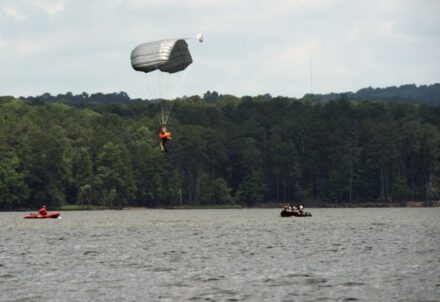
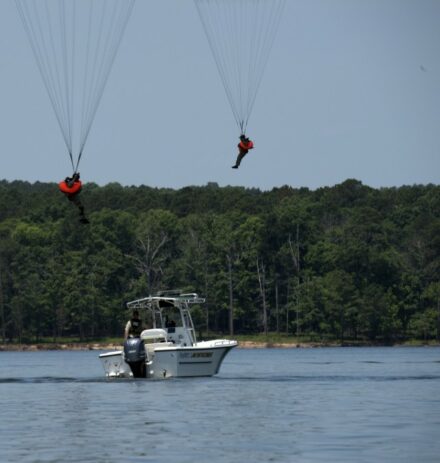
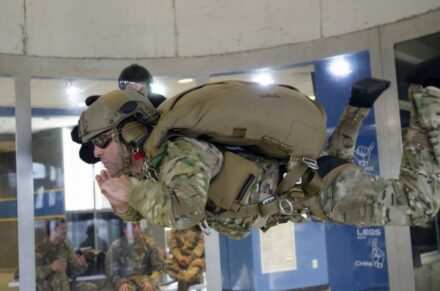
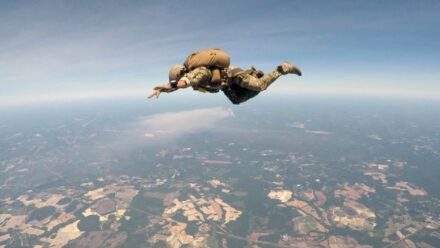
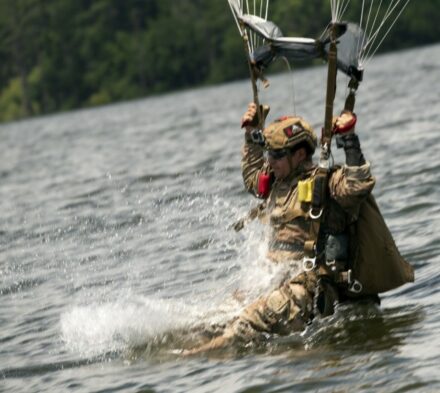
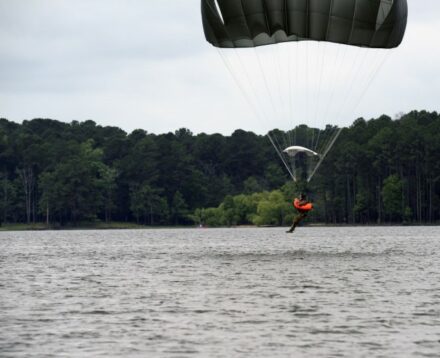
FORT BRAGG, North Carolina – Some of the nation’s elite Soldiers with the 82nd Airborne Division and 3rd Special Forces Group have finalized testing the Army’s new Parachutist Flotation Device (PFD).

Preparation for the PFD test started in mid-April 2021 with the Airborne and Special Operations Test Directorate performing intentional water landings in Jordan Lake, North Carolina, according to Maj. Camden S. Jordan, ABNSOTD’s executive officer.

“Planners synchronized early with local emergency management, law enforcement and state wildlife agencies to help support the Army’s water operations on Jordan Lake,” said Jordan said.

Jordan went on to say rehearsals took place for the multi-tiered and complex infiltration technique before final testing in June.

“Located just West of Raleigh, North Carolina, Jordan Lake is one of North Carolina’s most pristine waterways, so these agencies provided swift water rescue teams, emergency medical technicians, small boat support and assisted in routing boaters away from the water drop zone while airborne operations are underway,” he said.

“We relied heavily upon the support of the community to execute this test. Local emergency services were the lynchpin to this entire test and could not have been executed without their outstanding support,” said Sgt. 1st Class John Reed, ABNSOTD’s Operations NCOIC.

According to Dan Shedd, Senior Mechanical Engineer Developmental Command at Natick, Massachusetts, military planners try real hard to keep airborne operations away from bodies of water.

He said on occasion, though, paratroopers can engage high value targets near large bodies of water so they must be equipped accordingly for safety.

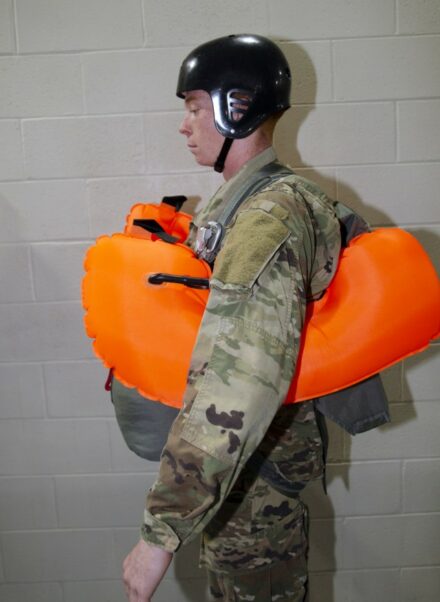
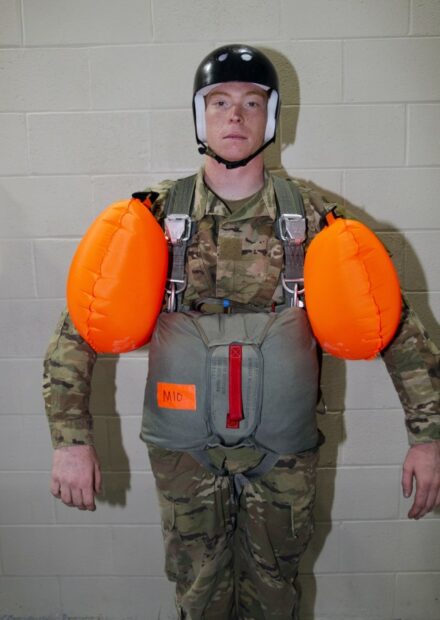
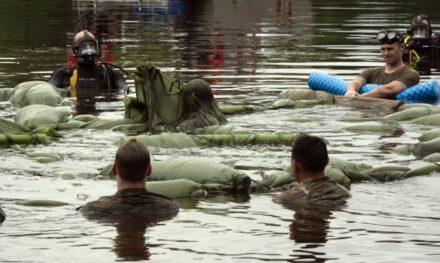
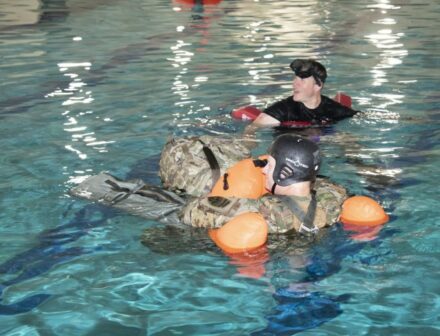
With flotation bladders that can be inflated using an internal carbon dioxide (CO2) gas cylinder or an oral inflation tube, once employed in the water, the PFD becomes critical in saving lives.

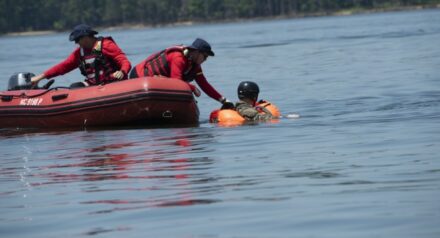
Shedd explained how the PFD must suspend a combat-equipped jumper in a “lifesaving” posture for an extended period following an airborne infiltration.

“In real-world scenarios,” he said, “this critical time allows recovery teams time to locate and extract jumpers in the event of a water landing.”

Reed said operational testing with Soldiers during early June saw participating paratroopers undergoing intensive training cycles geared toward preparing for deliberate water operations.

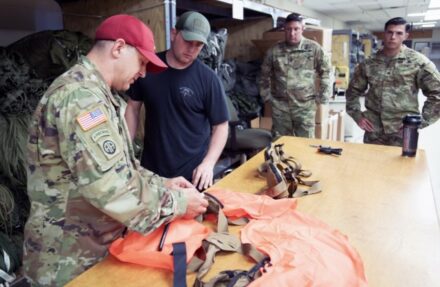
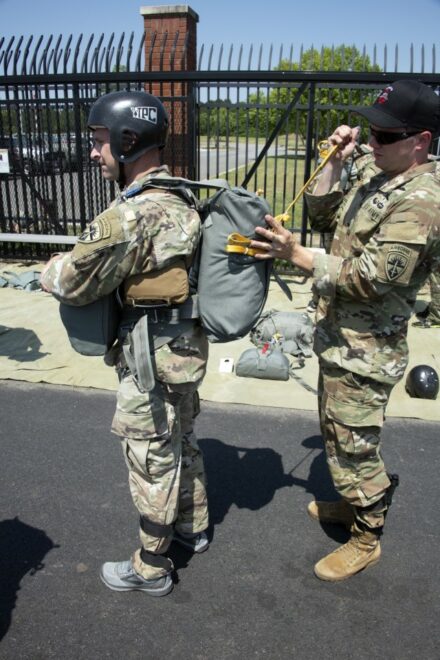
That training began with new equipment training (NET) so the Soldiers could practice the proper rigging techniques and activation procedures required using the PFD.

“Anytime two lifesaving devices are being employed by one Soldier, intense attention to detail is required for both proper fit and wear as well as how these systems interact during airborne infiltration,” said Staff Sgt. Jonathan R. Copley an ABNSOTD Military Freefall Master Jumpmaster.

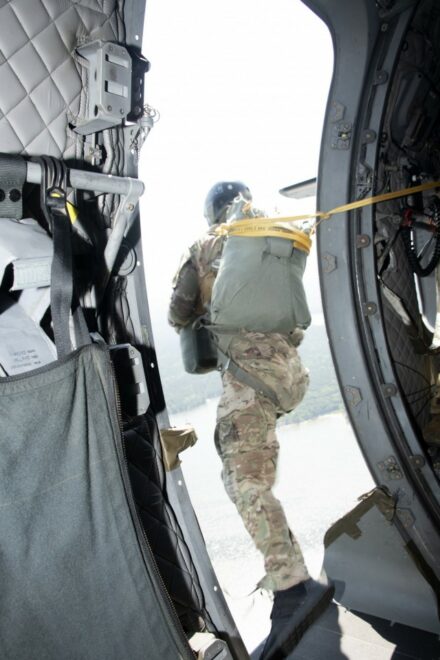
The rigorous NET training test jumps required the test Soldiers of 82nd Airborne Division and 3rd Special Forces Group to complete a full combat water survival test (CWST) conducted in Fort Bragg’s Mott Lake.

Sgt. 1st Class Steven Branch, a platoon Sergeant and Jumpmaster assigned to C Company 2nd Battalion 501st Parachute Infantry Regiment, gave the PFD a thumbs-up.

“The PFD is much easier to rig for static line operations,” he said. “We barely noticed having it on, and it can easily suspend a Soldier with combat equipment for a long time if needed.

“Overall I was very impressed with every aspect of the PFD.”

ABNSOTD used the PFD test to train parachute riggers from across the airborne and special operations community in the proper maintenance and care of the new life-saving apparatus once they return to home station.

This “maintainer” training included system maintenance, repacking, repair, proper storage, handling, as well as rigging and employment during water landings.

Sgt. Issa Yi, a parachute rigger with the 151st Quarter Master Company said, “The PFD was easy to pack and required no special tools or materials to maintain.”

Story by Mr. Mike Shelton, Airborne and Special Operations Test Directorate, U.S. Army Operational Test Command

Photos by Mr. James L. Finney, Mr. Barry W. Fisher, and Mr. Chris O’Leary, U.S. Army Operational Test Command, and SFC Timothy D. Nephew, Airborne and Special Operations Video Flyer