FirstSpear TV

Archive for the ‘Guest Post’ Category

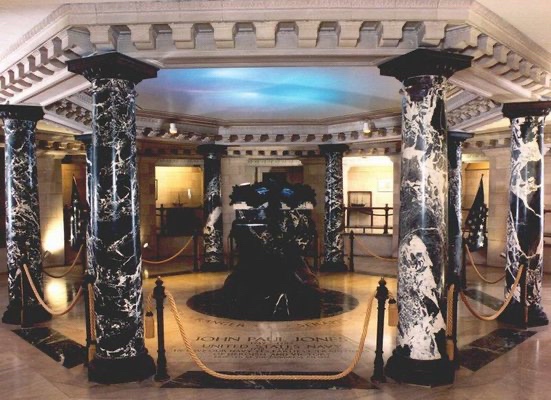
SCUBAPRO Sunday – John Paul Jones, Father of the U.S. Navy

Sunday, July 4th, 2021

Happy Independent Day. This is indeed one of my favorite holidays. For all my British brothers out there, I have attached a video for you. There is also a bonus one at the end.

For his actions and the way he led his man during the Revolutionary War, John Paul Jones is considered the father of the U.S. Navy.

John Paul was born in Kirkcudbright, Scotland on July 6, 1747. He joined the British merchant marine at the age of 12 and went to sea for the first time as a cabin boy.

In 1766, he was appointed the first mate on a slaver brigantine, but he quickly abandoned the trade due to dissatisfaction. In 1769, he was appointed master. In Tobago, West Indies, he killed the leader of his mutinous crew in self-defense in 1773. He then went to Virginia to avoid justice and was labeled a fugitive by the British. By adding the surname Jones, he was able to hide his true identity.

Now going by John Paul Jones, he moved to Philadelphia and joined the Continental Navy when the American Revolution broke out in 1775. On the first American flagship, the Alfred, he was commissioned a lieutenant. In 1776, Jones was promoted to captain and assigned command of the sloop Providence. On his first time at sea as a captain, he went north to Nova Scotia, wrecked British fisheries, and seized sixteen British prize ships.

In 1777 and 1778, he commanded the Ranger, and he had two definite objectives in mind for this deployment. He wanted to carry out hit-and-run operations against opposing coastal fleets first. Aside from the apparent harm to local shipping, it would cause civilian terror along the English, Scottish, and Irish coastlines, forcing British war planners to redirect some of their marine resources from protecting American ports to defending their own.  Second, he sought to kidnap a high-ranking British official and keep him for ransom until imprisoned Americans were released from British prisons or were released from impressment. For his actions, he was given command of five French and American ships. Jones led his squadron off the Scottish coast to capture seven merchantmen. His most famous battle was on September 23, 1779 against the 44-gun Royal Navy ship, Serapis, and one of the bloodiest naval battles in history. That day, even though his ship was burning and sinking, Jones refused to surrender to the British, saying “I have not yet begun to battle”. Serapis surrendered after more than three hours, and Jones assumed charge.

Even being a sailor, he was very well-dressed, wielded a sword, and behaved in a manner of studied decorum, unlike most merchant seafarers. He spoke with a faint Celtic dialect and had a Scottish brogue. He was a severe military master who was obsessive about his honor and obligations, yet surprisingly pleasant. He was a prolific poet and letter writer, knew some French, and was involved in numerous romances while never marrying. No one, above all, questioned his audacity. His maritime operations against the mother country earned him a reputation as a pirate in Britain.

Jones was named rear admiral in the Russian Navy by Russian Empress Catherine the Great in 1788. He participated in the Liman campaign in the Black Sea. Then, in 1789, he quit the Russian service and relocated to Paris. He was then appointed as the United States Consul in Algiers, but he died before his commission arrived. His body was buried in Paris, but after a long search, his perfectly preserved body was recovered and sent to the United States in 1905. Jones’ remains were reinterred in an elegant mausoleum at the Naval Academy Chapel in Annapolis, Maryland, in 1913, thanks to President Theodore Roosevelt’s intervention.

Air Force Releases Cardio and Strength Fitness Assessment Alternatives, New Online Capabilities

Saturday, July 3rd, 2021

WASHINGTON (AFNS) —

The Air Force will provide Airmen five physical fitness assessment alternatives—three for the cardio portion and sit-up components and two for the push-up component of the physical fitness assessment beginning in early 2022.

Airmen will select from the traditional 1.5-mile run, 1-mile walk or the High Aerobic Multi-shuttle Run (20M HAMR) to meet the cardio requirement. Then select from traditional push-ups or hand release push-ups for one strength component; and from sit-ups, the cross-leg reverse crunch or plank for the other strength component to complete the comprehensive fitness assessment.

Finalized fitness assessment scoring charts, with alternative components broken out by gender and age, will be provided at a later date.

“We are moving away from a one-size-fits-all model,” said Air Force Chief of Staff Gen. CQ Brown, Jr. in the initial change announced May 2021. “More testing options will put flexibility in the hands of our Airmen – where it belongs. We know not all Airmen maintain their fitness the same way and may excel in different areas. Alternate components provide choices while still providing a mechanism to determine overall fitness.”

This initiative is the result of Airmen providing feedback to Air Force leaders through the physical fitness working group in conjunction with looking at the way other services complete their physical fitness programs. From the data collected, the Air Force fitness working group conducted research and testing on the health benefits of the current fitness components and various other components to come up with the alternative options.

Each new component has been developed to be an equivalent measure of fitness regardless of methodology. For example, the 1-mile walk alternative is a scientifically-valid estimation of the member’s aerobic capacity (also referred to as VO2 max), which measures fitness and aerobic power. Test scores incorporate time to complete the 1-mile test along with the member’s age, weight, and heart rate at the time of walk completion. Based on the rigorous scoring to pass this test based on age, weight, speed, and heart rate, there is no significant difference of scores between the walk and run tests.

“What we care about is measuring and testing aerobic fitness. The ‘walk’ is not a stroll in the park and both the pace required and method for computing aerobic fitness make it 100% equivalent to the run,” said Lt. Gen. Brian Kelly, deputy chief of staff for Manpower, Personnel, and Services. “In fact, I think we’ll find fewer people will prefer that option over the more traditional mile-and-half run.”

Air Force members and fitness monitors will have approximately six months for a break-in period to familiarize themselves with the use and execution of the alternative testing options prior to having them officially available in early 2022. The six-month timeline will help ensure fitness assessment cells are prepared to train physical training leaders to administer tests using the new options. During the six-month break-in period, units and Airmen will also be able to provide feedback on the new components that will allow any adjustments as necessary prior to live use.

Other exercise options such as swim, row, and bike tests were reviewed but are not being implemented at this time. “It’s important for our testing options to be available and executable for all Airmen at all locations,” Kelly said. “If you are at a remote location or a location that does not have a pool or other needed equipment, those options become less equitable.  We want our Airmen to have the same options no matter where they are testing.”

These changes align under the Air Force’s Action Order Airmen, people-first approach.

“If we are truly going to get after building a culture that embraces fitness as a lifestyle, then we have to grow beyond the mentality of a one-size-fits-all PT test,” said Chief Master Sgt. of the Air Force JoAnne S. Bass. “Providing our Airmen with these options is a step in the right direction toward developing an Air Force that is fit to fight, anytime, anywhere.”

The waist measurement is no longer a scored part of the physical fitness test. A separate assessment of body composition, as required by DoD Instruction 1308.3, will continue starting in October 2021. Further details on the body composition program will be released at a later date.

In addition to the fitness component changes, the Department of the Air Force also released the myFitness capability on July 1. The new feature will replace the Air Force Fitness Management Site II and serve as a single location for all total force Airmen and Guardians’ fitness needs.

The capabilities that exist today allow Unit Fitness Program Managers and Fitness Assessment Cells to manage fitness assessments, documentation and scheduling, to include walk-in, same-day fitness testing in myFitness. Additionally, users are able to view past scores, individual fitness reports, dashboards showing completed or updated fitness assessments scores and allow for the download of Fitness Screening Questionnaire as well as medical forms. Users can also access a calculator for estimating fitness results and composite scores.

myFitness will eventually allow users to schedule fitness assessments, receive automated notifications for scheduled testing or cancelations, access and submit fitness assessments, upload medical documents for review.

myFitness is hosted on the myFSS platform and a part of the department’s initiative to improve Airmen and Guardian’s experience with technology by making applications user-friendly and more easily accessible. Active duty, Guard and Reserve personnel will be able to access and use myFitness worldwide.

To access myFitness, go to myfss.us.af.mil.

For additional information on Physical Fitness, Airmen can visit myPers or the Air Force’s Personnel Center’s fitness program page. Draft fitness score charts are available on MyPers to use until final score charts are provided. 

The Space Force will follow these fitness standards until service-specific guidance is developed and published.

Secretary of the Air Force Public Affairs

7th Group Conducts Foreign Internal Defense Maneuver Live Fire Exercise

Saturday, July 3rd, 2021

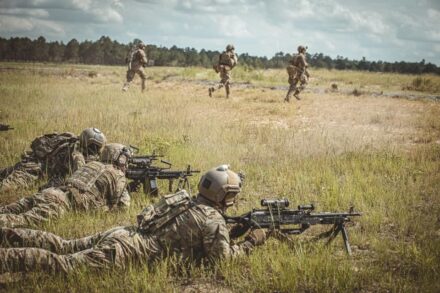
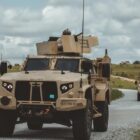
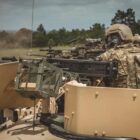
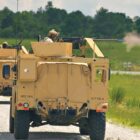
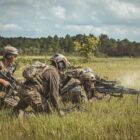
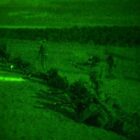
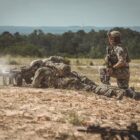
The 2nd BN, 7th SFG(A) Level 1 Dive Team completed its Foreign Internal Defense Mounted Maneuver Live Fire Exercise (LFX) at Ft. Benning, GA with SOT-A enablers, attachments, and SFAB support. This LFX was designed to increase interoperability and expand partnerships in preparation for armed conflict in an increasingly complex environment that is contested in all domains.

U.S. Army photos by SPC Christopher Sanchez

FirstSpear Friday Focus: Battle of San Juan 123rd Anniversary and Rough Rider T-Shirt

Friday, July 2nd, 2021

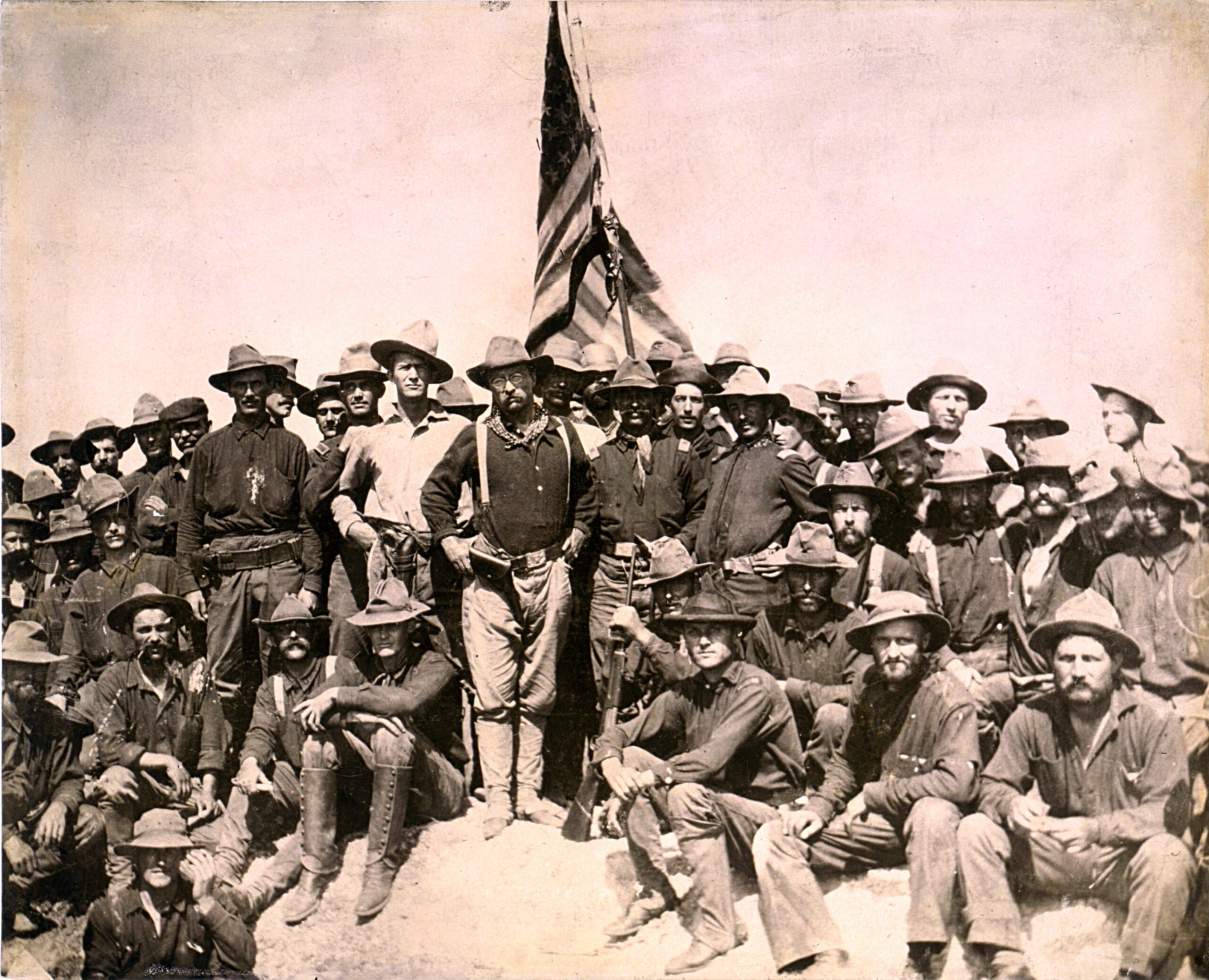
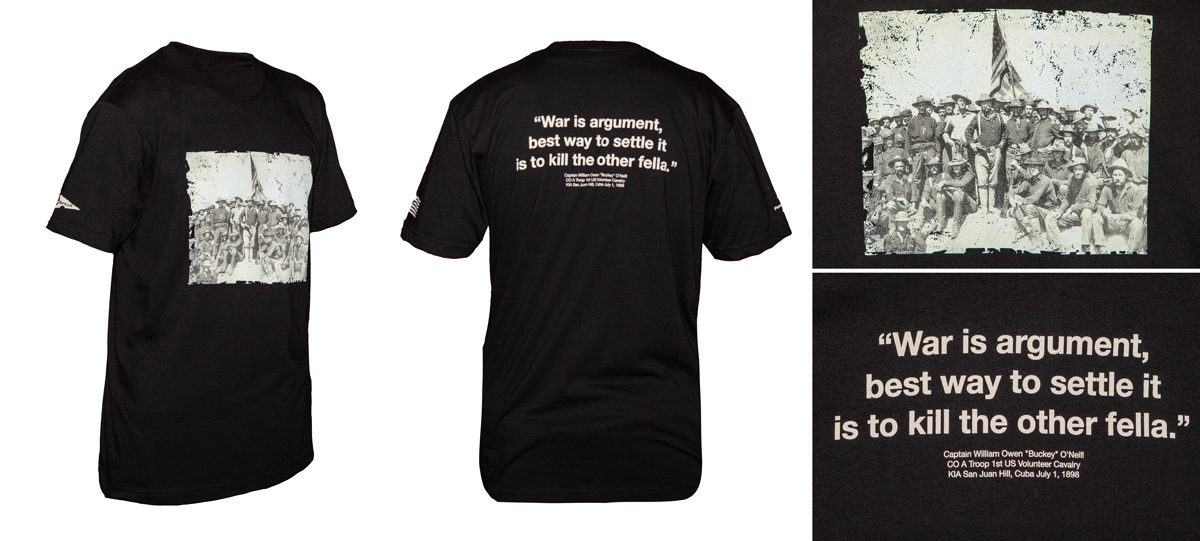
On July 1, 2021, the 123rd anniversary of the epic battle of San Juan Hill, Cuba. FirstSpear pays tribute the Rough Riders and the gallant charge made that day to secure the critical heights. This charge ultimately led to freeing the oppressed peoples of Cuba to pursue their own destiny.

This iconic photo was taken that day after the successful charge. Legendary famous Law Man and Troop CO “Buckey” O’Neil once said, “War is argument, best way to settle it is to kill the other fella.” This emboldened the Rough Riders to continue forward to victory even though he was killed in the assault.

FirstSpear has created an iconic, limited edition commemorative T-shirt with this photo and quote.

For more information, check out: www.first-spear.com/rough-rider.

USAMTEAC Test Rapid Opioid Countermeasure System at Camp Bullis

Friday, July 2nd, 2021

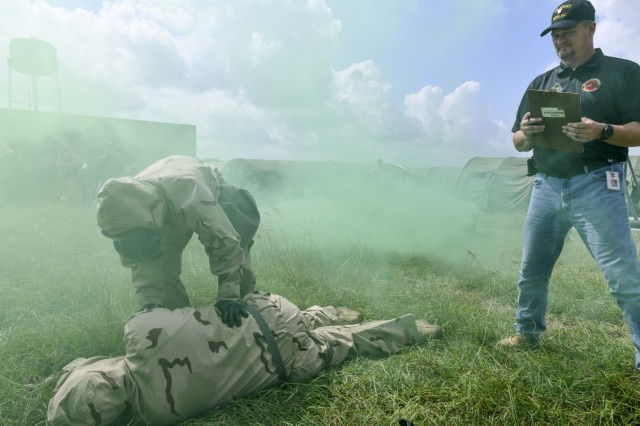
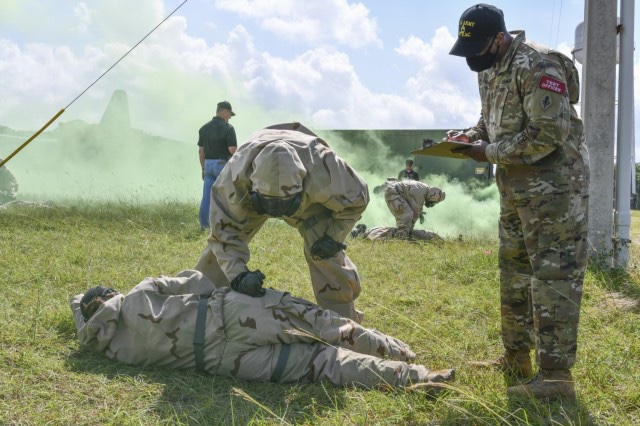
JOINT BASE SAN ANTONIO, TX – The U.S. Army Medical Test and Evaluation Activity (USAMTEAC) conducted a customer test for the Rapid Opioid Countermeasure System (ROCS) auto-injector at the Deployable Medical System Equipment for Training (DMSET) site in Camp Bullis, TX. USAMTEAC, formally called the Army Medical Department Board (USAMEDDBD), is part of the U.S. Army Medical Center of Excellence (MEDCoE), and provides independent operational testing and evaluation of medical and medical-related materiel and information technology products in support of the Army`s Department of Defense acquisition processes.

The ROCS test was requested by the product manager at the Joint Program Executive Office for Chemical Biological Defense (JPEO–CBD), Medical Countermeasures Systems (MCS) to assess the functionality and usability of the ROCS auto-injector within the operational environment. Soldiers who are the typical users of the ROCS served as test players for the event. The ROCS auto-injector report is relevant and provides JPEO–CBD MCS a report and data for their evaluation and possible future fielding throughout the Army.

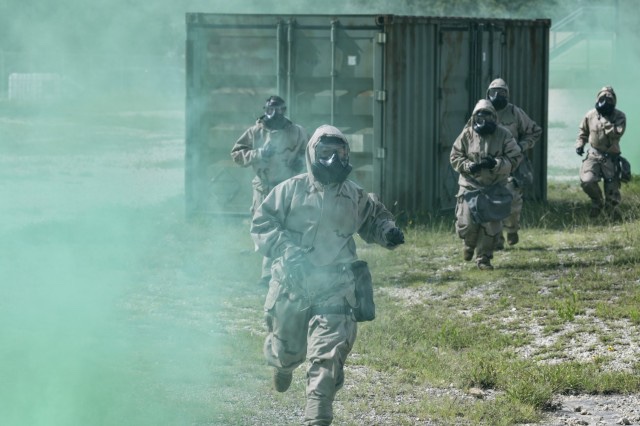
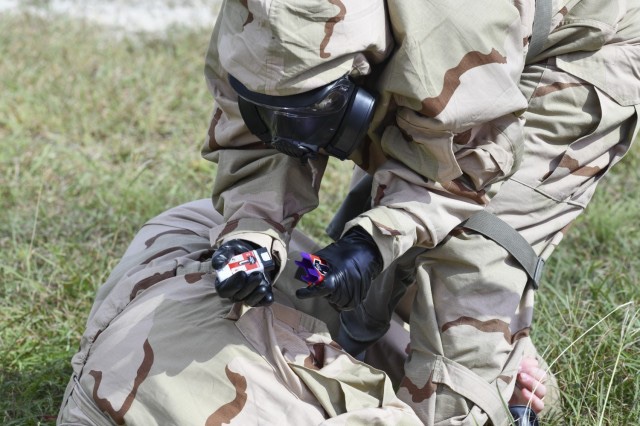
Army test players participated in self-aid and buddy-aid scenarios using the ROCS, a single-use auto-injector pre-filled with 10 mg of Naloxone. The ROCS auto-injector provides the capability to deliver an intramuscular injection with a 22-gauge needle and be used in a suspected opioid environment with Soldiers wearing Mission Oriented Protective Posture (MOPP) Level 4 protective gear. During the test at Camp Bullis, test players also donned MOPP Level 4 gear in a simulated field environment.

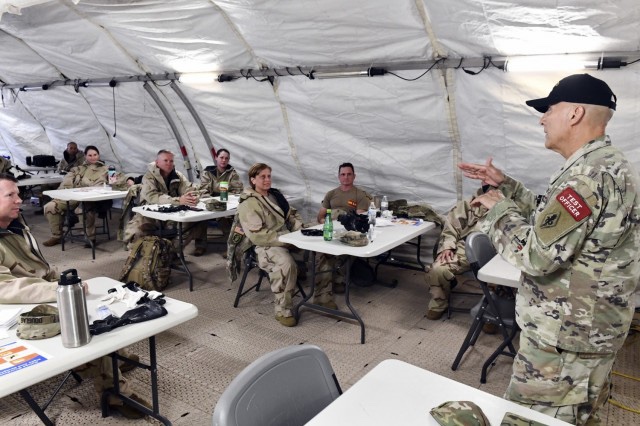
“With the humanitarian missions we’re supporting our Soldiers may walk into a hot spot and unknowingly get exposed. The ROCS auto-injector will help if they are experiencing symptoms of opioid exposure with better medical care for the front line troops,” said Charles Lohsandt, one of the USAMTEAC Test Officers. “It’s a very small single-use cartridge that can easily fit in a gas mask carrier or inside one of the protective suit pockets, for example.”

Col. Mark Plooster, Executive Director, USAMTEAC, discussed the collaboration with other organizations in conducting this test. “What we do is bring in a capability developer from CDID (Army Futures Command Capability Development Integration Directorate), people from the FFID (Field Force Integration Directorate), the MRDC (U.S. Army Medical Research and Development Command), and Weapons of Mass Destruction – Civil Support Teams to bring in the whole team to make sure that everybody who has a piece of the pie is involved,” said Plooster. “At the end of the day the real customer is the Soldier on the battlefield. We try to make this test as realistic as we can using Soldiers in the actual unit that will be using the equipment.”

“The test players are the most important and valuable part of the test,” said Col. Roberto Marin, Chief, Materiel Test and Evaluation Branch, USAMTEAC. “Although we have the capability developers, the material developers, and us, the USAMTEAC test team, as the lead test agency, test players, also known as the end users, they provide us with honest feedback that is required to provide better medical care for the warfighter, the ultimate customer.” Said Marin. “Test player data feedback includes an after action review detailing the ROCS auto-injector strengths and weaknesses, a survey, and recommendations. We analyze all the data points and send a report to the material developer for higher level decision authority.”

To learn more about the USAMTEAC mission, visit their website at medcoe.army.mil/usamteac.

By Jose E. Rodriguez, MEDCoE Public Affairs

ACC Activates 350th Spectrum Warfare Wing

Wednesday, June 30th, 2021

JOINT BASE LANGLEY-EUSTIS, Va. (AFNS) —

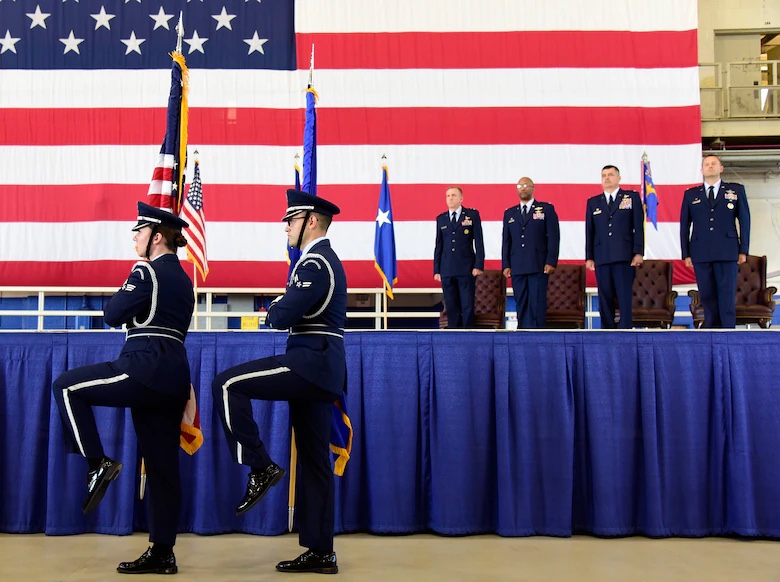
Recognizing an operational need to dominate the electromagnetic spectrum, Air Combat Command activated the 350th Spectrum Warfare Wing June 25, which is temporarily located at Eglin Air Force Base, Florida, while the Air Force conducts an environmental review for the permanent location.

A first of its kind, the 350th SWW will enable, equip and optimize fielding capabilities to give the U.S. and its allies a sustainable, competitive advantage over adversaries in the electromagnetic spectrum.

The new wing will provide maintenance, operational and technical expertise for electronic warfare in support of the Combat Air Forces.

“The competition in the electromagnetic spectrum is more important than ever before. The joint force is connected by and delivers effects in and through the EMS,” said Col. William Young, 350th Spectrum Warfare Wing commander. “If we lose the fight in the EMS, we will lose the fights in all other domains. We’re here to help make sure that doesn’t happen. Standing up this unit emphasizes the Air Force’s commitment to consolidating and modernizing our entire enterprise so that joint warfighters have freedom to attack, maneuver and protect themselves at the time, place and parameters of our choosing.”

The EMS is a sovereign national resource that exists as part of an intangible world, yet manifests itself through everyday items. The EMS includes everything from radio waves to visible light and affects almost every aspect of life from personal cellular phones and Wi-Fi to advanced technology used in military applications.

The EMS as a warfighting battlespace is not a new concept, but according to Young, advances in technology have created a critical need for Airmen to better understand their role within this intangible domain.

“The activation of the 350th Spectrum Warfare Wing is the latest step the Air Force has taken to maintain our competitive advantage in electromagnetic warfare,” said Maj. Gen. Case Cunningham, United States Air Force Warfare Center commander. “Placing this critical mission under a wing commander dedicated to this mission set is fundamental to accelerating needed change and ensuring our warfighters can continue to fight and win in the EMS.”

The standup also ensures all Air Force electronic warfare and EMS capabilities are consolidated at one location. The 53rd Electronic Warfare Group will move from the 53rd Wing to the 350th SWW.

In order to remain competitive and in line with the National Defense Strategy, the 350th SWW will help the Air Force rethink its EW capabilities and plan for future requirements. Over time, the wing will mature, evolve and expand its EMS capabilities to provide spectrum warfare capabilities.

The Air Force will conduct further environmental analysis before making a final basing decision for the wing’s permanent location, expected in spring 2022.

By TSgt Emili Koonce, Air Combat Command Public Affairs

Uniform Integrated Protective Ensemble Air 2 Piece Under Garment Completes Testing at Dyess AFB

Tuesday, June 29th, 2021

KIRTLAND AIR FORCE BASE, N.M. (AFNS) —

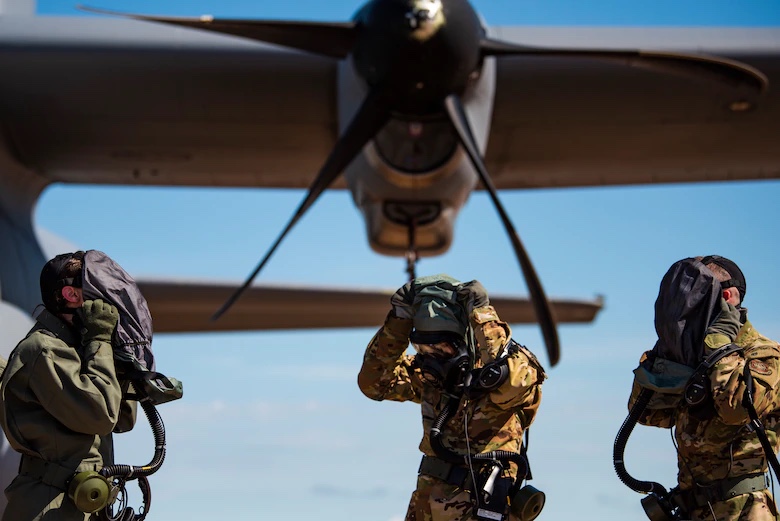
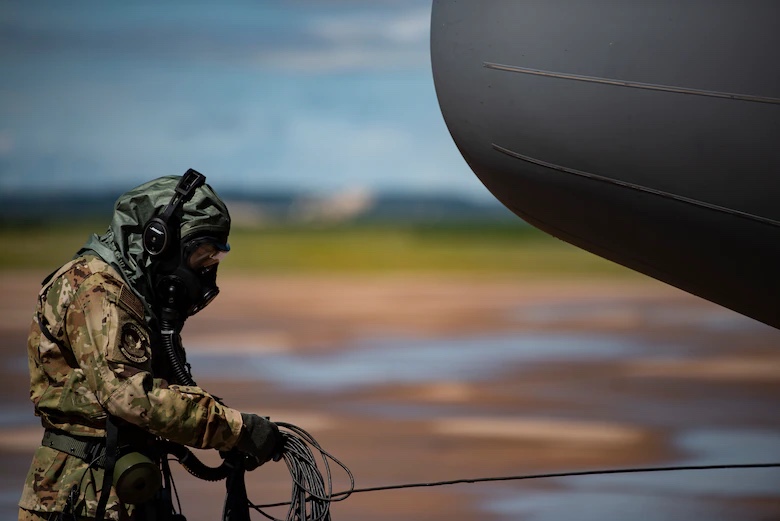
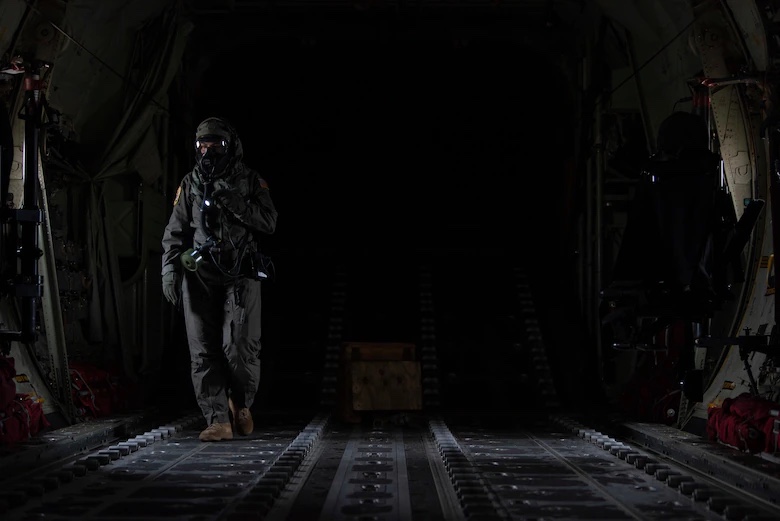
A joint military test team recently conducted ongoing developmental and operational testing of the Uniform Integrated Protective Ensemble Air 2 Piece Under Garment at Dyess Air Force Base, Texas.

UIPE Air 2PUG is a two-piece carbon-based protective undergarment designed to be worn underneath the CWU-27/P flight suit and is intended to provide chemical, biological, radiological and nuclear protection to aircrews in toxic environments.

The test team was made up of members from the Air Force Operational Test and Evaluation Center’s Detachment 2 and the 28th Test and Evaluation Squadron from Eglin AFB, Florida, the Navy’s Operational Test and Evaluation Force, and the Air Force Life Cycle Management Center’s Agile Combat Support Directorate Human Systems Division.

The new system is intended to offer better mobility, breathability, and a lower thermal burden on aircrews. UIPE Air 2PUG allows aircrews to stay in the suit longer and do their jobs with less heat burden or chances of heat casualties.

During this phase of testing, the UIPE Air 2PUG was tested on C-130J Super Hercules aircrews from the 39th and 40th Airlift Squadrons that are part of the 317th Airlift Wing at Dyess AFB. The aircrew simulated aircraft preflight checks and conducted a ground egress in order to field test the new UIPE Air 2PUG garment. The test event also focused upon the garment’s interoperability and compatibility with current equipment.

“The joint ground test provided critical feedback from the user to the engineering and testing team,” said Lt. Col. Brent Gaylord, 317th Operational Support Squadron commander. “The 317th Airlift Wing utilized a full aircrew complement to include female aircrew members representative of our diverse crew force and ensuring all ergonomic factors are considered. Updating decade’s old equipment is an exciting process to be a part of and is critical to maintaining our qualitative advantage over global competitors as we continually pursue full spectrum readiness.”

“This was the final ground compatibility test event,” said Tech. Sgt. Bryce Gardner, AFOTEC Det. 2 Aircrew Flight Equipment Program manager. “Previous test events were conducted with the KC-135 (Stratotanker) at McConnell AFB, Kansas; the HH-60 (Pave Hawk) at Nellis AFB, Nevada; and the F-15 (Eagle) at Eglin AFB. Multi-Service Operational Test and Evaluation will occur in the first quarter of fiscal year 2022.

“This test event went very well and the test team gathered all the required data because of the outstanding support received from the Dyess Aircrew Flight Equipment team and the participating C-130 aircrew,” Gardner said.

Once testing is completed and UIPE Air 2PUG is approved, it will be fielded to all Air Force, Navy, Marine Corps and Army aircrews across fixed wing, rotary wing, ejection seat and large frame aircrafts.

AFOTEC’s mission is to inform the warfighter and acquisition through operational tests. AFOTEC evaluates the capability of systems to meet warfighter needs by planning, executing, and reporting independent operational assessments, tests, and evaluations. From concept development to system fielding, AFOTEC evaluates a system’s overall operational mission capability under realistic conditions. AFOTEC’s mission requires lock-step efforts with acquisition partners focused on shortening the combat capability delivery timeline.

By Katherine C. Gandara, Public Affairs Advisor, Headquarters Air Force Operational Test and Evaluation Center

Alpha One Niner: A Brand You Should Know

Monday, June 28th, 2021

Just when you would think that the tactically-inspired realm of apparel and carry gear was saturated, an outfit comes around and kicks things up a notch. Alpha One Niner (A19er hereafter) is the brainchild of founder Helmie Ashiblie and leverages his experience in the shooting sports, grunt life, EDC product development and manufacturing disciplines. He has successfully merged this depth of knowledge with a creative energy that is hard to find these days and he’s been putting a shoulder to the wheel since day one.
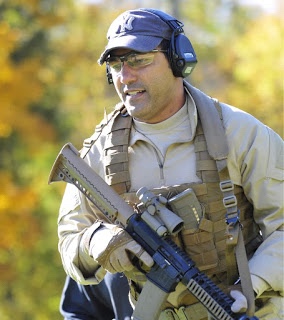
Ashiblie pushing the limits during a recent match.
The first product under the A19er flag was the “Recon One” tablet caddy, an iPad sleeve/organizer that allows an aircraft passenger to affix it to the seatback pocket, allowing for easy access to the device and other small items like earbuds, notebooks and pens during long-haul flights. Helmie first pitched it on Kickstarter and A19er grew from there.

Years of international travel influenced A19er’s first products, as Helmie had already spent a ton of time globetrotting for SERT, the LE/Mil company he founded that delivers equipment and training solutions to a wide spectrum of paramilitary, law enforcement and special operations customers. Its signature product line is a series of soft-sided AR-pattern and SBR cases currently in use with units around the world.

A wide range of pouches, packs, Dopp kits and admin organizers followed the Recon One, utilizing excess production capacity at SE Asian facilities where SERT products are stitched up. It is at these locations and design studios that Ashiblie maintains trusted relationships and oversees high quality-control standards (once found only in the domain of USA-based manufacturers) for mission-essential gear.
Three core elements of Ashiblie’s past form the bridge to the company’s future. First, the brand takes its name from the call-sign he used while leading a reconnaissance platoon during compulsory national service with the Singaporean Army. I’ve shared lunch with Helmie and you can tell that those years in uniform made an indelible mark on his perspective. When I asked him to point to the signature philosophy that sets A19er apart from the competition, his reply was quick and to the point: “The dogged determination not to suck.” This mindset is in line with other veterans who founded the likes of Down Range Gear, Tactical Tailor, Mayflower Research & Consulting, PocketUp and GORUCK. They all grew their reputation through innovation and a commitment to their products and customers.

We talked about all things tactical during that lunch, and Helmie described the countless hours spent—even in the dead of night—answering texts, emails and voicemails from customers and colleagues.  He chuckled when I asked him how he juggles it all, then explained his fairly rudimentary thought process. He just wants to make sure he does everything to get it right.

The second element comes from a little-known part of Helmie’s past life as a model who worked with fashion houses in Milan and New York City. He took a deep interest in the behind-the-scenes work of product development and marketing, then used the knowledge to get SERT off of the ground after he left NYC and moved to Virginia in the aftermath of 9/11.  He is the first to admit that he is not a professional gear designer, but asserts that he knows a hell of a lot about finding the right resources to bring cost-effective products to market.

The final area that Ashiblie draws inspiration from is his participation in the IDPA and 2 and 3-gun shooting sports. His accrued experience influences several products that comprise A19er’s lineup and they all get the job done while looking good doing it.

The “Recon Nine Evade” eventually followed the Recon One and A19er broke into the mainstream as Helmie crowdsourced the feature set of this pack over at EDCForums.com, where he excelled at tapping into a potential customer base for inspiration. He solicited detailed input and commentary on the final design, with an eye towards maintaining transparency over the process.
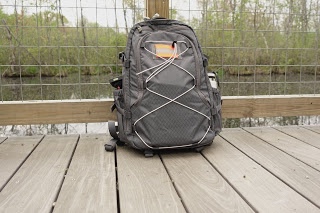
Evade 1.5 in 420 denier Wolf Gray diamond ripstop nylon
When suggested changes to the basic design could be incorporated and they meshed with the realities of production restraints, Helmie did his best to follow through. When they were outside the realm of the possible, he let the forum members know.

“As long as you make that very clear from the get-go and simply DO NOT beat around the bush when it comes to what can or cannot be done, the guys are smart and reasonable enough to understand. If you decide to make a change and it’s not based on any of the revisions requested, get straight to the point and let everyone know why. You’d be surprised how accommodating and supporting others can be, and more importantly all parties walk away learning something from it.”
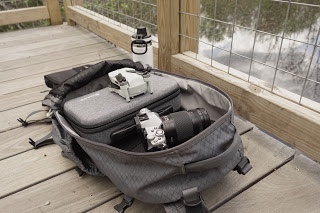
A year and dozens of prototypes later, the first commercial version of the Evade hit the streets and caused a stir. Because he is always on the path towards improvement, when comments started rolling in about the shoulder straps, main compartment volume or fabrics, Helmie listened carefully. The result was the Evade 2.0, a pack with larger volume and revisions to the carry system.

The final stop on the iteration train came about when members of various Facebook backpack groups began to get their hands on an earlier Evade, read a review, or watched a video of its features. These users and onlookers began to chime in and the 22 liter Evade 1.5 was developed as a slightly smaller pack that would make for a better EDC option. One gear reviewer spoke so highly of the final version that he felt the refinements left nothing else to critique; I wholeheartedly concur.

The Evade 1.5 is available in a “full” or “lite” version.  The “full” offers a dedicated laptop compartment while the latter version omits this feature. Both have a concealed/covert compartment between the main compartment and a user’s back, where a pistol can be secured on the full loop Velcro that lines the space. If a pistol is not holstered there, the compartment has enough room to secure an iPad, sensitive documents or other flat items like flex cuffs, evidence bags or laminated imagery.
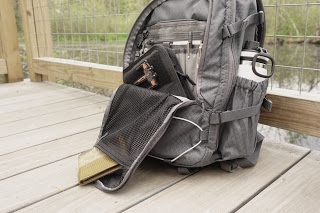
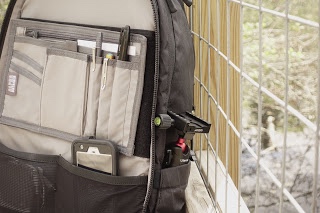
A19er products provide superb organization
A full panel of MOLLE-compatible, laser-cut loop Velcro lines the main compartment, allowing a user to configure an array of pouches, organizers and holsters. It is this modularity that allows the Evade to fill a wide range of roles, for a broad spectrum of users, and at a respectable price that won’t crush a wallet. Its slick, inconspicuous exterior makes it as well-suited for special reconnaissance tasks as it would for range bag duty. The name is a perfect fit.

Nine different fabric weights, textures and colors are available, ensuring that there is an Evade 1.5 for practically anyone who needs modularity in their load carriage.  I spent a lot of time reading reviews on the Evade series, so when I required a new pack that wasn’t covered in PALS webbing, it was an easy choice. The packs are in heavy demand these days, so don’t be surprised if A19er is in the middle of a restock phase.

My Evade 1.5 has lived up to all of its advertised capabilities and you quickly get a sense of the deliberate thought put into its design. It follows in the footsteps of other classic tactically-themed packs, but stands on its own merits and has the potential to become as much an icon as the classic Eagle Industries A-III or Lightfighter RAID.

It has already won a user-nominated award for “Best Everyday Bag”, beating out contenders from heavyweights Triple Aught Design and Mystery Ranch. I’ve travelled across several continents with it and just when I’d given up on convincing my wife to ditch her bucket purse for air travel, she used an Evade on a return trip to the USA and is now hooked. If there was ever a strong endorsement, that’s it right there.

The latest A19er product to hit the scene is a pack that actually predates the Evade in terms of its development timeline.  The 25 liter “Pathfinder” utilizes the same harness system as the Evade 1.5 and is built to the same degree of durability, but can be best described as styled for the urban commute.
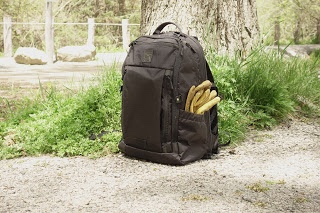
The A19er Pathfinder offers comparable organization capability to its smaller Evade cousin.
It is available with fewer fabric and color options, but the design still exhibits the clean lines you find in other A19er products. Dimension-Polyant X42 fabric forms the outer body and 210 denier ripstop nylon lines the interior compartments.
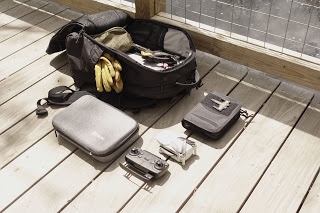
The padded laptop and tablet sleeves secure electronics while additional mesh compartments, admin organizers and water bottle pockets round out the feature list. It is definitely a stylish pack with a workhorse pedigree.
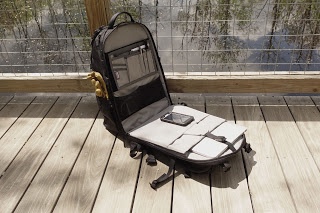
Got a lot of electronics and supporting cables? The Pathfinder can handle your carry requirement.
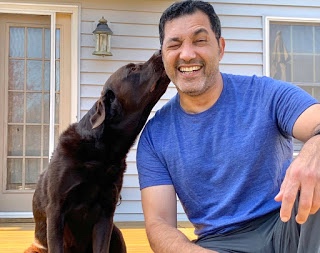
Alpha One Niner has been a personal project of Helmie Ashiblie since his first three-compartment caddy was used on a trans-Pacific flight.  His passion for producing hard-use gear has grown slowly but steadily, and if you operate in demanding environments downrange or around the corner, you should take a look at what the A19er brand has to offer.


Author Jon Custis is a veteran Marine infantryman who writes on a variety of tactical equipment, training, and leadership topics.