NELLIS AIR FORCE BASE, Nev. (AFNS) —
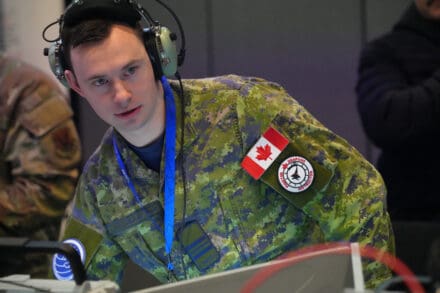
The 805th Combat Training Squadron, also known as the Shadow Operations Center – Nellis, or ShOC-N, executed its bi-annual capstone event at Nellis Air Force Base, Nevada.
The coalition integration experiments improved warfighters’ decision advantage and overall situational awareness. The AI can quickly learn theater decision makers’ preferences and provide upfront solutions within the constraints we provided for its automation. It has the potential to do that now, with the next step being to do it more accurately and see if it can learn in real-time throughout the experiment.”
-Capt. Edwardo Ramirez, 805th CTS/ ShOC-N Capstone 24B lead
Capstone 24B provided risk reduction opportunities for high-technology readiness-level prototype capabilities within a combat-representative scenario for integrated two-way kill chain automation between operational and tactical battle management command and control.

The Department of the Air Force, major commands, and Air Force centers use the ShOC-N’s Battle Lab capstone series to examine scenarios and technology to experiment with C2 and communications needed for battle management and tactical applications. These capabilities make up portions of the DAF BATTLE NETWORK, the integrated system-of-systems connecting sensor, effector, and logistics systems providing better situational awareness, faster operational decisions, and decisive direction to the force; they are directly relevant to the Department of Defense’s Combined Joint All Domain Command and Control warfighting approach.
The experiment’s primary focus was optimizing new data pathways and tactics, techniques and procedures to leverage technological advances to speed and scale the Fix to Target process for surface- and maritime-based, mobile, and deliberate on-call targets.
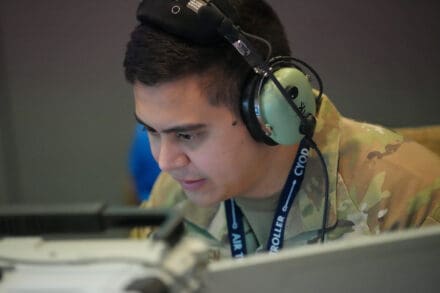
Capstone 24B also served as a risk reduction event for Bamboo Eagle 25-1 and informed three lines of effort: Human-Machine Teaming, or HMT, Coalition Integration, and Cloud-Based C2 Decision Advantage Integration. During the experiment, these technologies were incorporated into the Tactical Operations Center – Light Major Release 1, or TOC-L MR1, cell providing battle management teams the ability to act as Dynamic Targeting cell members.
Optimizing the Kill Chain through HMT LOE
The HMT LOE incorporated Palantir’s Maven Smart System, or MSS, and Maverick artificial intelligence into the dynamic targeting process to determine whether the technology could improve its speed, scale, and accuracy.
The ShOC-N executed constructive large-force employment scenarios with injected data generated organically by the ShOC-N’s Modeling and Simulation Flight, which will be used to improve dynamic targeting kill-chain automation through software integration and associated TTP development.
The HMT experiments provided a data-enforced conclusion of how automation has the potential to aid teams executing the targeting process. The ShOC-N’s goal with the experimentation was to assess the speed, scale, and accuracy of these systems against the challenges our forces would face within the Indo-Pacific area of responsibility.
“We expect that the data provided will ultimately show that having automation/AI applications integrated into current systems helps the HMT performance, with additional focus to ensure accuracy of recommendations for force packaging and matched weapons/effectors,” said Capt. Edwardo Ramirez, Capstone 24B lead.
During the experiment, Maven Smart Systems and Maverick AI applications allowed the tactical control, execution, and assigning of assets in an embedded common operating picture, while also receiving simulated track data, proving an HMT can ingest and display red and blue tracks within a tactical data link. Additionally, it showed it can auto ingest planning data, which gives battle managers critical insights allowing them to better handle complex and evolving areas of operation.
“Maven has the capability to integrate across domains, so if we can do space and cyber, it helps facilitate realistic, all-domain operations. I believe the next step to address the CJADC2 problem sets needs to be multi-domain and multi-service, outside the Air Force’s systems to employ with the Navy, Marines, and Army by having them integrate our instance to provide layered targeting solutions,” Ramirez said.
Coalition Integration LOE
The Coalition Integration LOE leveraged the Combined Federated Battle Laboratories Network and Five Eyes, or FVEY, partner teaming to improve coalition interoperability by making information accessible anywhere, anytime, for quick decision-making on the battlefield. Coalition members from the U.K. and Canada served in various roles during the experiment, including as battle managers on the TOC-L MR1 team and members of the DT cell. In addition, connections were established between the U.K. and Canadian CFBLNets and the ShOC-N, with Australian connections planned for 2025.
“We are partnering with Australia and New Zealand Battle Labs to connect to CFBLNet in 2025,” Ramirez said. “We are also pursuing additional connection possibilities with partners like Japan, after which we will reach out to our other INDOPACOM [Indo-Pacific Command] partners to gauge their interest in participation.”
The DOD’s CJADC2 concept has challenged U.S. joint and combined forces to prioritize achieving decision advantage over potential adversaries, to retain our warfighting advantage and enhance the deterrent effect of a powerful military.
For this reason, the DAF focused its efforts for the CFBLNet experiment on enhancing and refining the data-centric information exchange across disparate U.S. and coalition partners’ C2 systems.
U.K. and Canadian distributed participants connected to the CFBLNet could see the same data as the U.S. members in real-time, including red and blue force simulation and planning products, during the scenario.
“We can be more aggressive in our next experiment and have our partner forces share responsibilities within CFBLNet; that way, they can own a portion of the mission. If we can have them execute a mission using our simulation, I think they should employ their own C2 and intel team to go through their processes,” Ramirez said.
For the first time, the combined U.S. Air Force, Air National Guard, U.K., and Canadian TOC-L MR1 team was led by Royal Canadian Air Force Maj. Cody-Jean Carignan.
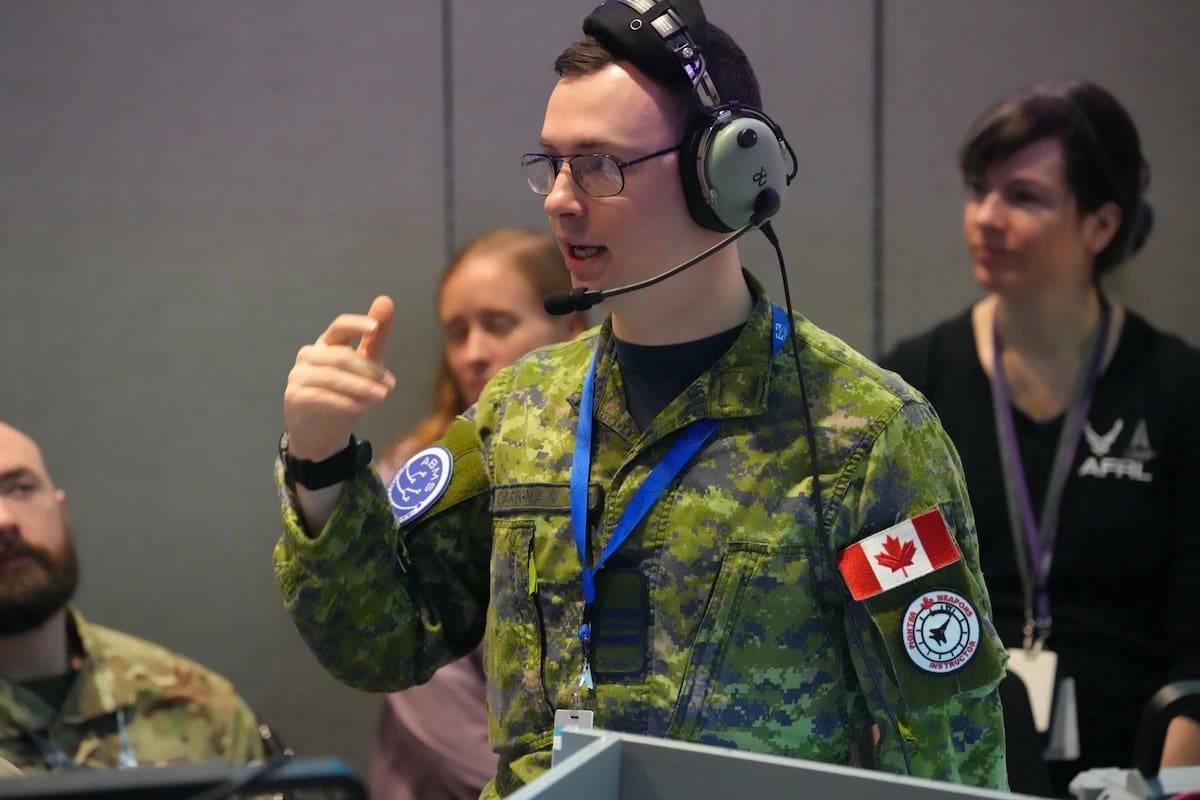
The ShOC-N team created new TTPs for coalition partner incorporation into the experiment and overcame system classification limitations during Capstone 2023 and 2024 experiments. This evolved into the coalition-led tactical C2 team executing within Maven.
“Our partner forces wanted to be more hands-on during the experiment, and quickly coalesced into a highly-functional, and well-executed team,” said Ramirez. “It was a discovery to find that they were able to merge and fuse together quickly and not have any kind of operating procedure conflicts or understanding of what they were trying to do.”
According to Ramirez, “the coalition integration experiments improved warfighters’ decision advantage and overall situational awareness. The AI can quickly learn theater decision makers’ preferences, and provide upfront solutions within the constraints we provided for its automation. It has the potential to do that now, with the next step being to do it more accurately and see if it can learn in real-time throughout the experiment.”
Cloud-Based C2 Decision Advantage Integration LOE
This LOE focused on incorporating Kessel Run’s All Domain Operations Suite, or KRADOS, into the experiment and ensuring proper functionality with systems used throughout, including MSS. The ShOC-N continues to incorporate more and more with Kessel Run and other air operations center tools as part of a comprehensive effort to improve the entire kill chain.
In addition to the Kessel Run incorporation, the ShOC-N is pursuing connection to and implementation of CBC2. This experiment served as a discovery opportunity for future expansion of CBC2 at the ShOC-N and potential for additional partnership on its development. C2 operators received limited training on the application and were able to see initial functionality and provide feedback to the vendor to inform future updates.
Industry/Distinguished Visitor Day
The ShOC-N, as part of the Advanced Battle Management System Battle Lab, has a unique role to play in integrating the efforts of the DAF and other services to speed warfighter advantages. In this capacity, they conduct experimentation on emerging and existing systems, processes, and connections that directly impact combat operations. During capstone, the ShOC-N hosted an Industry/DV Day to expose senior leaders and industry members to a visceral and experience-based understanding of the pain points and challenges standing in the way of improving warfighters’ decision advantage and optimizing the kill chain using HMT automation.
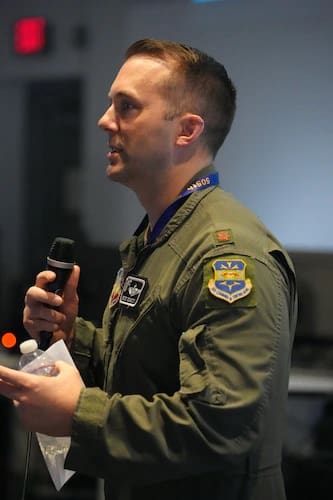
“By bringing industry partners and leaders from relevant Air Force, sister service, and coalition organizations into the ShOC-N environment simultaneously, Industry and DV Day affords experts from both areas the opportunity to interact and approach solutions to difficult problems facing our modern warfighters,” said Maj. Wesley Schultz, 805th CTS/ShOC-N director of operations.
The ShOC-N’s experimentation efforts inform acquisition decisions, allow warfighters to explore novel ways of operating that may not have been possible under existing doctrine, and inform and explore the conceptual limits of TTPs.
“Having strong industry partners who seek to help the DOD solve exceedingly complex issues is critical to maintaining the fighting edge of the U.S. military. The military has limited bandwidth to develop technical solutions to all its requirements; tapping into the immense technical and logistical capacity of industry allows warfighters to focus more on the ultimate goal of being prepared to engage in conflict at a moment’s notice,” Schultz said.
The Way Forward for ShOC-N Experimentation
In 2025, the ShOC-N will execute an “Experimentation Series” consisting of four experiments and a series ending capstone event. The series will follow a building block approach wherein hypotheses assessed in earlier events will serve as baselines for the experiments that follow. Three of these experiments will also be shadow events for exercise Bamboo Eagle and the Army-led Project Convergence Capstone 5. The fourth experiment will be a homegrown ShOC-N event in June.
In addition to the Experimentation Series, the ShOC-N will also serve as a host location for the ABMS Decision Advantage Sprints for HMT events. The intent of these sprints is to develop software solutions to specific challenges facing battle managers and inform future experimentation lines of effort. Teams of software developers will develop potential solutions over the two-week events, including a team of Airmen from the ShOC-N.
“Having an organic capacity within the ShOC-N to develop micro-services for warfighters that could potentially be incorporated in emerging technical solutions is amazing. The Airmen in this squadron are incredibly talented in their crafts and this gives them an opportunity to showcase their skills,” Schultz explains.
The ShOC-N’s execution of both experimentation lines of effort and these software “sprints” represents a unique opportunity to help the DAF make rapid acquisition decisions, provide data-driven requirements, and distribute warfighter feedback to drive information advantage and decision superiority against current DOD pacing challenges.
By Deb Henley, 505th Command and Control Wing Public Affairs