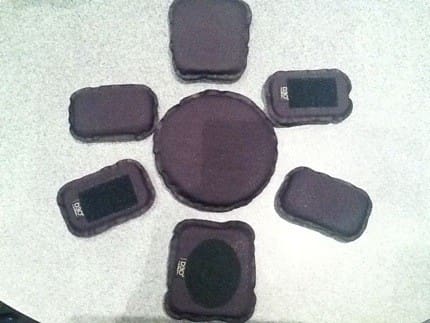
We caught up with D3O at OR and they gave us a quick glimpse of their new helmet pad system. Look for a full report soon on SSD soon.
The Army’s latest round of Small Business Innovative Research topics includes several from Natick Soldier Systems Center and PEO Soldier.
Natick Soldier RD&E Center
A11-126 Energy Reducing, Ruggedized, Solar Lighting System
A11-127 First Generation of Controlled-Release Bacteriocins/Anti-Microbials
A11-128 Lightweight Material for Full-Scale Parachutes
A11-129 Methodologies and Algorithms for Ground Soldier Load and Route Selection Decision Applications
A11-130 High-Efficiency Energy-Harvesting Battery Charger/Storage Unit
PEO Soldier
A11-134 Nanostructured High Performance, High Angle of Incidence Anti-Reflection Coatings
A11-135 Thermally Responsive Fibers for Environmentally Adaptive Textiles
Officially, the SBIR program:
“The goal of the dual-use SBIR program is to tap into the innovativeness and creativity of the small business community to help meet government R&D objectives. At the same time, these small companies develop technologies, products, and services which they can then commercialize through sales in the private sector or back to the government.”
SBIRs are a great, low-cost way for the Army to rapidly investigate technology development in industry. Broken up into phases, success is awarded with funding for further development. Several years ago, SOCOM’s Modular Glove System was developed by Outdoor Research through a SBIR.
This year’s solicitation is in pre-release with the solicitation opening on 29 August, 2011 and closing 28 September, 2011. Visit www.acq.osd.mil/osbp/sbir/solicitations/sbir113/army113.htm for additional information as well as full submission instructions.

It seems like just the other day that McNett announced the addition of two new camo patterns to their lineup of Camo Form® Protective Camouflage Wrap. No sooner than we tell you about it and they inform us that they will now also offer MultiCam. This is great news for guys using OCP downrange.
Miltner Adams Company has introduced the Incredible Self-Locking Clip. It’s simple to use and automatically locks on to most soft materials such as pockets, waistbands, or even nylon webbing, but unfortunately not leather. To release, simply press the clip. The SLCâ„¢ is made from a Carbon Fiber Composite. If there’s any weak point in the design at this point it is how you attach it to your stuff. While there is a key ring adapter, for pretty much anything else it attaches via 3M VHB Adhesive Tape. I’m not convinced this is teh right answer for every application. Hopefully, manufacturers will see this and contact Miltner Adams to discuss ways to better integrate it into their products.
Polish manufacturer SPECOPS has introduced zipper pulls in Black, Coyote and Olive which will not only blend with most any base color or pattern, but will also help to make the product even more distinct by incorporating their logo.
The most remarkable thing about this photo of Navy SEALs undergoing cold weather training at Det-Kodiak in Alaska is the expression on their faces. Or, better yet, their lack of expression. The reason is simple. In addition to training they are wearing garments insulated with PrimaLoft. In fact, PrimaLoft is used in cold weather loft layers used by all four services as well as SOCOM. If you’ve deployed in the past few years, chances are good you’ve relied on PrimaLoft.
Originally developed during the 1980s, the US Army commissioned Albany International to work on a water resistant synthetic alternative to down. What they came up with is PrimaLoft, used for military as well as commercial applications. However, in the meantime, they hardly been sitting around resting on their laurels. For instance, they’ve recently improved the performance of PrimaLoft Sport with their Convection Technology to offer 15% more loft than previous versions.


One of several things that PrimaLoft has going for it is a waterproof treatment that is cured into its fibers. This process results in PrimaLoft fibers adsorb only about 100 to 250% weight in water while many other polyester fibers will absorb up 400% to 1000% of their weight in water. Take a look at the diagram above. As you can see, PrimaLoft Sport does a pretty good job of retaining its CLO value* whether wet or dry. Additionally, PrimaLoft uses fibers that are less than one denier (a single strand of silk is essentially one denier) in thickness. This translates to increased compressibility.




If you’ve been using clothing insulated with PrimaLoft while deployed, you might want to know that numerous manufacturers also rely on it for their commercial products. For instance, you might be interested in this Spindrift Jacket from KUIU for use while hunting. You’d be amazed to see who’s using it. What’s more, you can even get bedding featuring PrimaLoft. To learn more, visit www.primaloft.com.
*One Clo represents the amount of insulation required to keep a resting person warm in an indoor room at 70°F (21.1°C). Clo ratings in oz/sq yd allow you to compare relative thermal performance of one insulation versus another.
Australian firm Mission Pac has added 100% Cotton Outer Garments to their line up of merino wool under garments.
Mission Pac has reminded me of these excellent properties of Cotton:
“This natural fibre, like merino wool, provides increased breathability, increased comfort levels , and improved flash-over properties compared to poly-cotton and other synthetic fibres.”
They are offering Patrol Shirts, Patrol Pants, Bush Hats, and a lightweight Smock designed loosely on the original SAS Smock in Auscam (DPCU), AustDesert (DPDU), Multi-Cam (MCP), Danish Desert, Tan and Navy Blue.
Editor’s Note: I LOVE 100% cotton ripstop! (remember jungle fatigues?) I LOATHE the craptastic 50/50 NYCO that the Army introduced in the early 90s for the “Enhanced” Hot Weather BDU. The NYCO was developed so that Soldiers could starch their uniforms and make them last longer. It was not introduced to enhance the comfort of the uniform in hot environments. But, just remember, cotton isn’t for EVERY environment. So, huzzah to Mission Pac for putting this together! You guys rock.