FirstSpear

Galvion Invests in Sentinel Photonics to Accelerate Frontline Laser Threat Protection

May 6th, 2026

Farnborough, UK, 6th May 2026Galvion, a leader in integrated soldier systems, has announced a strategic investment in Sentinel Photonics to accelerate the deployment of advanced laser detection and protection technologies to allied forces.

The partnership combines Sentinel’s operationally proven laser threat detection and protection technology with Galvion’s expertise in soldier system integration and its global defence relationships. 

The investment will support continued product development and the integration of laser defence capabilities into soldier systems and broader defence platforms. It is also expected to deepen North American engagement with laser defence as a critical capability for NATO and coalition forces operating in contested environments. 

Christoper Burgess, CEO at Sentinel Photonics, says, “Laser threats are already active across multiple theatres, and demand for effective detection and protection is increasing quickly. Partnering with Galvion allows us to speed up the integration of laser awareness into soldier systems and allied platforms, and get proven capability into the hands of warfighters faster.”




Jonathan Blanshay, Executive Chairman at Galvion, comments, “Galvion is focused on enhancing the performance and survivability of the world’s most demanding military and tactical teams. With Sentinel, we can give frontline operators earlier warning of hostile laser activity, protecting them and their equipment while maintaining mission effectiveness.”

Both Sentinel Photonics and Galvion have deployed systems in operational theatres across multiple allied nations, providing these capabilities to personnel and platforms operating in high-threat environments. 

Owl Cyber Defense Unveils XD Tyton, the First Secure Gateway for iPhone & iPad in Classified Networks

May 6th, 2026

XD Tyton™ helps agencies unlock the power of iOS and iPadOS inside classified networks — securely and compliantly. 

COLUMBIA, MD. May 5, 2026: Owl Cyber Defense (Owl), the leader in cross domain network security, today announced the launch of XD Tyton™, a breakthrough solution that provides an approved secure gateway for iOS and iPadOS into air-gapped networks for the first time. XD Tyton helps agencies leverage the full performance and productivity of iPhone and iPad devices in critical enclave networks, redefining what is possible for secure mobility. 

Built to work within the iOS and iPadOS secure update architecture, XD Tyton resolves one of the most persistent challenges in secure closed network mobility: enabling iOS and iPadOS devices to update securely within air-gapped environments. XD Tyton facilitates secure over-the-air (OTA) updates without a break in operational security to keep iPhones and iPads protected, compliant, and mission-ready. 

“XD Tyton is more than technology. It’s a decisive evolution in classified mobility. It enables our warfighters and government employees to leverage the intuitiveness and productivity of Apple devices at work that they rely on in their personal lives.” said Sco Orton, CEO of Owl Cyber Defense. “We’re empowering agencies to harness the full power of iOS and iPadOS, the most advanced, secure and user-friendly mobile operating systems available, inside classified environments. From secure field communications and real-me mission intelligence to advanced data analysis and situational awareness, this is mobility without barriers: faster, more intuitive and more capable than anything that’s come before.” 

When deployed alongside a compliant commercial High Threat Network (HTN) Cross Domain Solutions on (CDS), the integrated architecture meets the U.S. Government’s Raise the Bar (RTB) and Commercial Solutions for Classified (CSfC) program requirements. XD Tyton can also integrate with Mobile Device Management (MDM) solutions for centralized device provisioning, policy enforcement, and streamlined management. XD Tyton enables agencies to capitalize on the unmatched stability, security and user experience of iOS and iPadOS within air-gapped domains. Users can now use iPhones and iPads in the mission for secure data exchange, situational awareness, custom applications, and accelerated decision cycles to redefine mission mobility. Proprietary (Confiden al) and Trade Secret Information on — Do not Disclose Without the Written Permission of Owl Cyber Defense. 

XD Tyton, the first and only solution to secure classified and high risk networks, delivering connected and compliant mobility with iPhones and iPads performing critical missions spanning flight decks, field operations, and command centers. To learn more about XD Tyton, visit owlcyberdefense.com

iPhone, iPad, iOS, and iPadOS are trademarks of Apple Inc., registered in the U.S. and other countries. App Store is a service mark of Apple Inc. Owl Cyber Defense is not affiliated with or endorsed by Apple Inc. 

38 Sierra Introduces Drone Incident Response Training (DIRT): Counter-UAS Training for Grounded Drone Response

May 6th, 2026

Barboursville, VA — May 5, 2026 — 38 Sierra, a Virginia-based provider of specialized counter-UAS training, announces Drone Incident Response Training (DIRT), a specialized training program designed to prepare personnel to safely assess and manage grounded, crashed, suspicious, or potentially weaponized unmanned aircraft systems (UAS).

Most counter-UAS training focuses on detection, airspace monitoring, and drone interdiction. DIRT focuses on what happens after the drone is on the ground.

Whether a drone is abandoned, has crashed, is found near sensitive infrastructure, or is associated with suspicious activity, the operational challenge changes the moment it becomes a grounded aircraft. At that point, personnel must be prepared to assess the situation safely, manage the scene, preserve evidence, and support informed escalation.

DIRT was developed to address that operational gap.

A Practical Program for Grounded Drone Response

Drone Incident Response Training (DIRT) is a counter-UAS training program built specifically

around the operational challenges associated with grounded drone incidents. Rather than

focusing exclusively on aerial detection or interdiction, DIRT prepares personnel for the critical phase that begins once a drone is on the ground.

DIRT emphasizes:

  • Safe assessment of grounded, suspicious, or potentially hazardous drones
  • Hazard recognition and risk-informed decision-making
  • Reporting, scene control, and escalation procedures
  • Evidence preservation and support to follow-on response
  • Operational continuity during drone-related incidents

DIRT is designed to provide actionable, immediately applicable procedures for personnel responsible for managing drone incidents in real-world operational environments.Mission-Specific Training for Real-World Incidents

DIRT is structured as a mission-specific training program designed around the environments,

risks, and response requirements each organization is most likely to face.

38 Sierra currently delivers DIRT for:

  • Critical Infrastructure
  • Law Enforcement
  • Executive Protection
  • Aviation & Airport Security
  • Maritime & Port Security
  • Event & Stadium Security
  • Corrections
  • Military Facilities
  • Bomb Squads & EOD

Each course is built around the operational realities of that environment, ensuring personnel receive relevant, role-specific guidance aligned to the incidents they are most likely to encounter.

“When a drone is on the ground, the problem has just begun. DIRT was developed to ensure personnel can recognize hazards, assess risk, and respond safely during that critical phase of the incident,” said Patrick McCrone, Co-Founder of 38 Sierra.

Scenario-Based Training Built for Practical Application

To support DIRT delivery, 38 Sierra develops realistic inert UAS threat training aids and support tools that enhance hands-on instruction and scenario-based exercises.

These tools are used to support:

  • Hazard recognition training
  • Scenario-based practical exercises
  • Response evaluation and decision-making drills
  • Controlled simulation of grounded drone threat situations

These supporting tools are integrated to improve realism and reinforce functional application without introducing risk.

Built on Operational Experience

DIRT is informed by operational experience, real-world threat analysis, and direct contributions to the development of grounded drone response procedures.Co-Founder Patrick McCrone is an Explosive Ordnance Disposal (EOD) professional with over two decades of experience in counter-IED operations, weapons technical intelligence, and grounded unmanned aircraft system response. He previously served as a Technical Lead at the U.S. Army Combat Capabilities Development Command (DEVCOM) C5ISR Center, where he led work focused on UAS threats, radio-controlled improvised explosive devices, and grounded drone response procedures. He was responsible for developing the initial doctrine for U.S.

Military EOD response to grounded small unmanned aircraft systems, helping establish formal tactics, techniques, and procedures for a previously unaddressed operational gap.

Preparing Personnel Before the Incident Occurs

DIRT is built for the personnel most likely to encounter the drone first.

In many cases, that is not a specialized response unit. It is a patrol officer, facility security professional, corrections officer, military security element, or frontline employee expected to make immediate decisions in uncertain conditions. 38 Sierra provides practical training and the tools necessary to ensure those personnel are prepared to assess grounded drone incidents safely, maintain control of the scene, and support informed follow-on response.

To learn more about Drone Incident Response Training (DIRT), visit: www.38Sierra.co

Eerie Company: A New Threat at the Joint Multinational Readiness Center

May 6th, 2026

HOHENFELS, Germany — Soldiers assigned to the newly established Eerie Company, 1st Battalion, 4th Infantry Regiment, used first-person-view drone systems to enhance reconnaissance capabilities during Joint Multinational Readiness Center exercises in Hohenfels, Germany.

Acting as the opposing force during the exercise, the company replicated a modern battlefield threat by combining emerging drone technology and electronic warfare with traditional infantry tactics, creating a realistic training environment for rotational units.

Established in December, Eerie Company specializes in short-, mid- and long-range reconnaissance to provide timely, accurate battlefield intelligence. The unit was created to address the evolving demands of modern warfare and to increase situational awareness across the battalion.

“The rate at which modern warfare is moving, and due to current conflicts, this company was established to help bridge that gap and be the eyes and ears of the battalion,” said Army Capt. Luther Salmon, company commander.

One of the primary systems the company employs is the Archer, a first-person-view drone used to replicate emerging aerial threats observed in ongoing global conflicts, including the war in Ukraine.

Army Spc. Ryan Hatcher, an infantryman and subject matter expert on the system, emphasized its effectiveness during training.

“It’s pretty good for an FPV,” Hatcher said. “Other FPVs we’ve flown here in Hohenfels, Germany, we’ve only been able to max out at eight to 10 minutes of battery life.”

Hatcher added that operating first-person-view drone systems is not limited to a specific military occupational specialty, which allows Soldiers from across the formation to qualify as drone pilots and contribute to reconnaissance efforts.

He said the Archer can be configured for multiple roles, including intelligence, surveillance and reconnaissance. In some scenarios, similar systems may be equipped with munitions, allowing Soldiers to train on identifying the differences between armed and unarmed drones.

Due to its limited range, the system is primarily employed in defensive operations, providing units with a close-range aerial perspective of the battlefield and enhancing their ability to detect and respond to threats.

Through the use of drone technology and specialized reconnaissance elements, Eerie Company continues to adapt to the rapidly changing operational environment, ensuring the battalion remains prepared for modern combat scenarios.

By SSG Troy Wharton

Teledyne to Present United Ecosystem of Sensing Solutions at SPIE Defense + Security 2026

May 5th, 2026

Taking place on April 26-30, 2026, at the Gaylord National Resort & Convention Center in National Harbor, Maryland, visitors to Booth 703 will witness a powerful, integrated ecosystem of sensing solutions for government and security force projects.

Visitors to SPIE Defense + Security 2026 will discover how a collective of Teledyne business units and subsidiaries is advancing defense applications through high-performance sensing and imaging technologies.

Accelerating insight through advanced IR imaging Central to the showcase will be research and science cameras from Teledyne FLIR, developed to provide exceptional infrared (IR) imaging performance in demanding environments. Combining advanced detector technologies, high-speed data acquisition, calibrated radiometric measurement, precision optics, and flexible integration, the cameras enable precise visualization and quantification of complex thermal phenomena, even in fast-changing or low-signal conditions.

Integration with FLIR Research Studio software streamlines thermal image acquisition, processing, and analysis within a single, intuitive, research-focused workflow. By reducing set-up time, minimizing complexity, and accelerating the transition from data capture to actionable insight, users gain from faster, more reliable, and more confident thermal analysis.

Complementing these imaging systems, Teledyne FLIR Defense Optics solutions drive innovation in industrial, scientific, and defense technologies. From integrated laser systems to advanced crystals and optics, our products deliver the precision and reliability needed for the most demanding applications. Explore how our components enhance imaging, targeting, and performance across industries.

A full cooperative of sensing expertiseSharing Booth 703, numerous further Teledyne business units and subsidiaries will demonstrate complementary capabilities across the sensing spectrum.

Teledyne Scientific Cameras, for example, will highlight its cutting-edge innovations for quantitative imaging, including the new VIS-SWIR SCION camera platform. Designed for demanding applications such as defense, security, and space, VIS-SWIR SCION offers high sensitivity, speed, and flexibility to capture dynamic events with exceptional clarity across extended spectral ranges.

Teledyne Judson Technologies, meanwhile, is set to shine the spotlight on its portfolio of high-performance IR detectors and integrated solutions, supporting applications from military safety to surveillance and space missions. Another focus product will be the CESIUM integrated dewar cooler, a scalable, space-ready platform designed to enhance signal-to-noise performance while reducing size, weight, power, and cost in mission-critical systems.

Also on display will be Teledyne Scientific’s Chip Scale Atomic Clock (CSAC), delivering highly stable, low drift timing in a compact, low power form factor for defense and security applications operating in GPS challenged environments.

Elsewhere on the booth, Teledyne e2v will provide insight into its latest image sensor technologies, with a new product release set to be unveiled shortly before the event, reinforcing its reputation for high-speed, low-noise imaging solutions tailored to applications that include defense and aerospace.

Adding further to the visitor experience, Teledyne DALSA will highlight its decades of thermal imaging expertise, with uncooled LWIR microbolometer detectors that enable high performance, small, light, and low power camera solutions for an ever-expanding range of applications.

Beyond the booth

As a point of note, Teledyne FLIR OEM will host a dedicated demo suite and meeting room at the event, where highlights will include Prism C-UAS, an advanced AI-driven software platform for detecting and tracking unmanned aerial systems. Prism C-UAS supports earlier threat detection, higher situational awareness, and improved tracking in complex, dynamic environments.

Ultimately, Teledyne innovations are enabling faster insight, greater precision, and more informed decision-making across the defense sector. Learn how to turn complex data into decisive advantage by visiting Booth 703 and the demo suite (Monument Suite, 5th Floor, #5221) at SPIE Defense + Security 2026.

For more information, please visit www.flir.com or follow @flir.

AEVEX Joins Persistent Systems’ Wave Relay Ecosystem

May 5th, 2026

Wave Relay® MANET as preferred network for Atlas UAS, Mako and Mako Lite USVs

NEW YORK – May 5, 2026Persistent Systems, LLC (“Persistent”), a leader in advanced networking solutions, announced today that AEVEX, a defense technology company providing autonomous unmanned systems and mission solutions for U.S. and allied customers, has joined Persistent’s Wave Relay® Ecosystem. AEVEX is integrating the Wave Relay® MANET into its Atlas unmanned aerial system (UAS) and its Mako and Mako Lite unmanned surfaced vessels (USVs).  

• Atlas is a Group II UAS supporting ISR and precision-strike mission variants;  

• Mako and Mako Lite are modular unmanned surface vehicles equipped for ISR, maritime sensing, communications relay, and mission?tailorable payloads.

The Wave Relay® Ecosystem is an industry alliance of unmanned systems and sensor companies leveraging the Wave Relay network to unite warfighters and battlefield technology on a common fabric of connectivity.

“Prior to AEVEX joining the Ecosystem, our Wave Relay® MANET was integrated into their Atlas UAS, which was selected for the Army’s Launched Effects-Short Range program following successful testing,” said Ed Fahrenkrug, Director of Programs at Persistent Systems. “We are excited to be partnering with a leader in precision strike unmanned systems and build on the Army’s success to meet future operational needs.”

The addition of AEVEX extends the Wave Relay® Ecosystem across a broader set of unmanned platforms. Persistent believes autonomoussystems will soon outnumber warfighters on the battlefield, and networking systems, sensors, and warfighters into a common operating picture will require both resilience and high networkscalability. The Wave Relay® MANET provides that scalable communication fabric today.  

“We chose Persistent’s Wave Relay® MANET for communications because of its high scalability, resilience to Electronic Warfare (EW),collaborative behavior, targeting, and intelligence collection,” said Chris Robinson, Vice President of Business Development at AEVEX. “Additionally, Persistent’s Cloud Relay™ capability supports global connectivity in contested environments.”

With AEVEX as the 20th Wave Relay® Ecosystem partner, the Wave Relay® MANET has become the standard network uniting unmanned systems, sensors, devices, and warfighters on a global fabric of connectivity.  

DroneShield and Terma Sign Strategic MOU to Advance Layered Counter-UAS Capabilities

May 5th, 2026

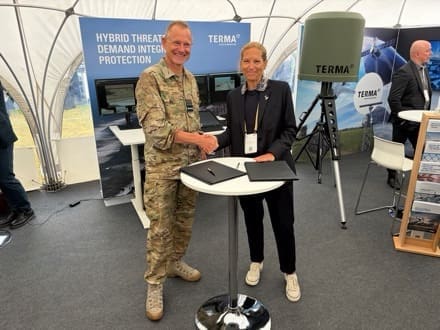
Amsterdam, The Netherlands – 4 May 2026 – DroneShield (ASX:DRO), a global leader in counter-drone technology solutions, along with Terma, a leading defence and aerospace company, announced the signing of a Memorandum of Understanding (MOU), to establish a strategic collaboration focused on advancing layered counter-UAS capabilities. Both companies bring complementary, mission proven counter-UxS technologies to the collaboration, including AI-enabled UAS detection, electronic warfare systems, and command?and?control software.

The MOU establishes a structured framework to validate, build interoperability, and operationalise complementary counter-UAS capabilities, with the objective of coordinated market engagement between DroneShield and Terma. This collaboration also provides a pathway for customers globally, including Denmark, the Middle East, and the Asia-Pacific, to strengthen existing long-term air defence frameworks as threat environments evolve.

The MOU reflects the growing importance of layered counter-UAS solutions, providing operators the flexibility to select sensing technologies best suited to their specific environment and threat profile. When underpinned by mature, AI-enabled sensor fusion, operators are supported by improved situational awareness and increased accuracy in UxS detection and classification, which are critical to enabling timely and decisive operational responses.

Image: DroneShield and Terma recently signed a Memorandum of Understanding to further cooperation on counter-UAS opportunities.

Louis Gamarra, Chief Commercial Officer at DroneShield said the collaboration strengthens the ability of both companies to address evolving air defence and counter-UAS requirements. “Counter-UAS operations increasingly demand interoperable, multi-sensor solutions that can be deployed rapidly and scaled across diverse operational environments. Partnering with Terma allows DroneShield to combine our battle proven counter-UAS and command-and-control capabilities with Terma’s advanced air defence technologies, creating a compelling pathway for customers seeking to enhance layered defence outcomes.”

Steen Trier, Vice President, Global Sales at Terma said the MOU supports customers seeking to strengthen counter-UAS capability within established frameworks. “Terma works closely with defence customers operating in complex and demanding environments. This collaboration with DroneShield enables us to complement existing capabilities with additional counter-UxS solutions, supporting customers as operational requirements continue to evolve.”

As defence and security customers across Europe and the Middle East continue to prioritise counter-UAS capabilities, this MOU provides a pathway for DroneShield and Terma to jointly pursue emerging opportunities and deliver coordinated, deployable solutions aligned with modern operational requirements.

US Army Selects AV’s Switchblade 400 for LASSO Program

May 5th, 2026

Award establishes Switchblade 400 as key component of Army’s enduring next-generation loitering munition program

ARLINGTON, Va.– AeroVironment, Inc. (“AV”) (NASDAQ: AVAV) today announced that it has been awarded a prototype agreement from the U.S. Army for the Low-Altitude Stalking and Strike Ordnance (LASSO) program to support the rapid development, delivery and testing of the Switchblade® 400 loitering munition.

The award establishes Switchblade 400, AV’s medium-range, man-portable, anti-armor loitering munition, as a key component of the Army’s LASSO program, supporting the service’s modernization priorities for rapidly deployable, precision strike capabilities that can operate effectively in contested environments.

“This award reflects the Army’s confidence not only in Switchblade 400, but in AV’s ability to deliver at scale,” said Trace Stevenson, President of Autonomous Systems at AV. “Being selected under the LASSO program positions AV as a long-term partner to the Army as it modernizes its loitering munition capabilities, from development and testing through production, fielding, and continuous capability evolution.”

The first loitering munition purpose-built to operate within AV_Halo™, AV’s modular command-and-control ecosystem, Switchblade 400 incorporates advanced aided target recognition (ATR) and autonomous capabilities to detect, classify, and engage targets, day or night, in denied and contested environments while delivering the same anti-armor performance comparable to larger systems, like the Switchblade 600 Blk 2.

Core to Switchblade 400 is the implementation of a Modular Open Systems Approach (MOSA) in system design to ensure long-term system resilience and relevance allowing for interoperability, upgradeability, and affordability as missions evolve.

Known as the “Lightweight Tank Destroyer,” and sized to fit common launch tubes, Switchblade 400 enables a sensor-to-shooter concept of operations that allows a single soldier to detect, identify, and engage targets through a unified, networked architecture – shortening decision timelines while increasing precision, speed, and operational flexibility at the tactical edge. The system features an all-up round (AUR) weighing under 40 pounds that provides the soldier with a lightweight, man-portable, anti-tank weapon system.

“Switchblade 400 is the product of continuous feedback from the field and the soldiers who rely on our systems in real-world operations,” said Brian Young, Senior Vice President of Loitering Munitions at AV. “We are constantly leaning forward, integrating new capabilities, enhancing performance, and reducing the burden on the warfighter. That soldier-driven approach is central to how we develop, test, and deliver capability for the Army.”

The new OTA award under LASSO follows a recent $186 million delivery order from the U.S. Army for Switchblade® 600 Block 2 and Switchblade® 300 Block 20 explosively formed penetrator (EFP) loitering munition systems, part of the Army’s existing five-year, $990 million Indefinite Delivery, Indefinite Quantity (IDIQ) contract under the Lethal Unmanned Systems (LUS) Directed Requirement (DR), which was awarded in August 2024. It was the Army’s first Switchblade order containing EFP payload, delivering enhanced lethality against armored threats.

“The Army’s trust in the Switchblade family has been earned through years of real-world use by soldiers who rely on these systems every day,” said Jimmy Jenkins, Executive Vice President of Precision Strike and Defense Systems at AV. “That trust reflects a clear operational need for precision, speed, and adaptability at the tactical edge—capabilities the Switchblade family is designed to deliver as missions and threats continue to change.”