FirstSpear TV

AUSA 22 – Danner Resurgent

October 11th, 2022

Currently exclusive to US Patriot, the Danner Resurgent is a lightweight tropical-style boot which features Italian Perspair fabric which is highly breathable and abrasion resistant.

It also features an energy return comfort insole and a Vibram outsole.

AUSA 22 – DNS Alpha

October 11th, 2022

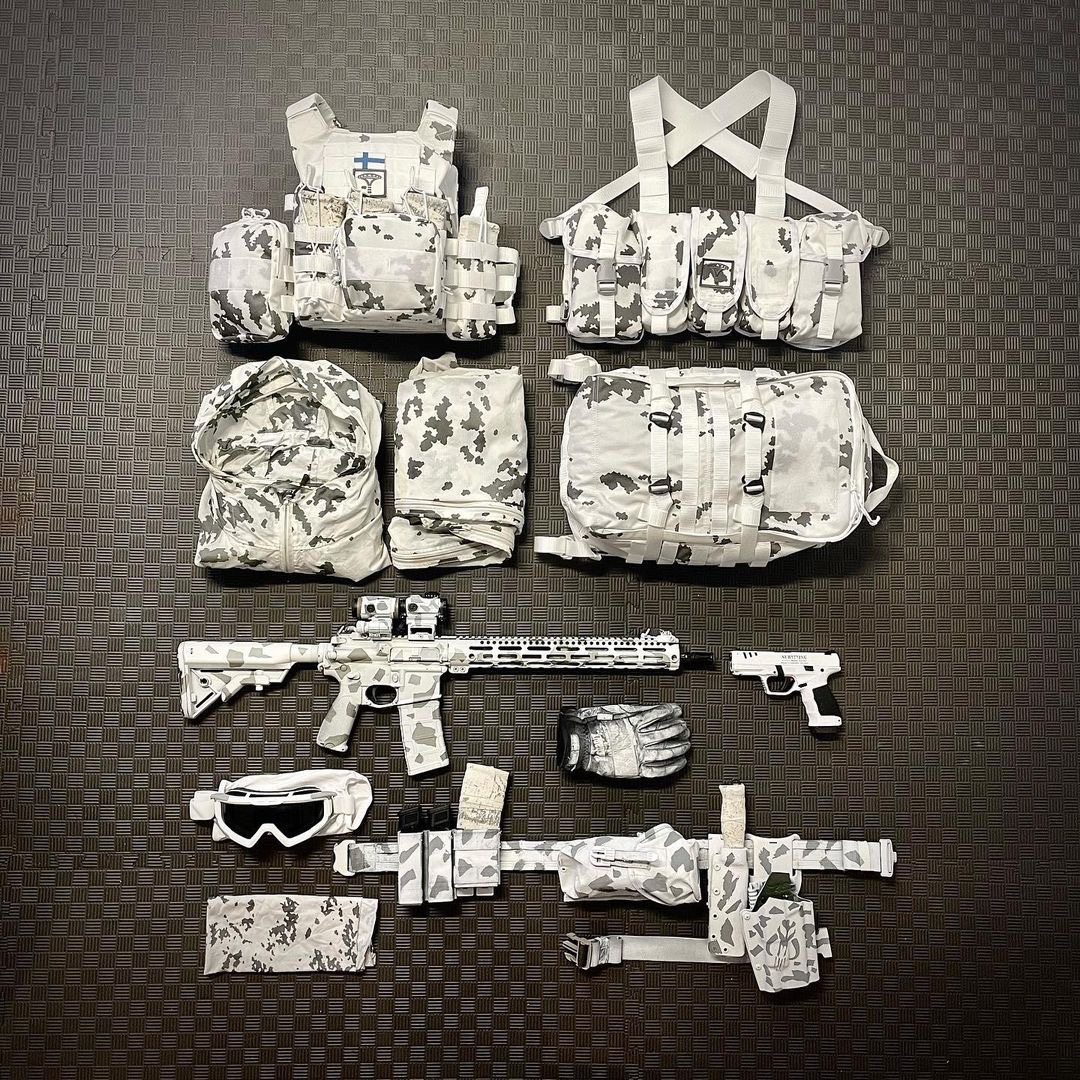
DNS Alpha is exhibiting in the Mountain Horse Solutions booth. They showed me their new Over Whites which are based on a design they did for a European SOF unit.

They have a version made from a 3 layer GORE-TEX fabric as well as a version in a 40D material printed in MultiCam Alpine.

AUSA 22 – Camelbak Arctic Canteen Parka

October 11th, 2022

Developed for use with the Ability One produced one quart arctic canteen and canteen cup, the new Arctic Canteen Parka from Camelbak is an issue item. It is MOLLE compatible and will keep water in liquid form for up to 10 hours in temperatures down to -60 F. Although not the intended use, it will also keep water cool for up to four hours in temperatures up to 95 F.

Former NATO Afghanistan Commander General Scott Miller Joins SIG SAUER

October 11th, 2022

NEWINGTON, N.H., (October 11, 2022) – SIG SAUER is pleased to announce former JSOC Commander General (Scott) Miller has joined SIG SAUER as Defense Advisor.

General Miller served in the United States Army and most recently served as the commander of NATO’s Resolute Support Mission and U.S. Forces in Afghanistan.  Prior to this he was the commander of the Joint Special Operations Command (JSOC), in addition to participating in numerous combat operations including the Battle of Mogadishu and the wars in Iraq and Afghanistan.

“General Miller is an exceptional addition to our team and comes at one of the most exciting times for our company as we begin the historic process of fielding the Next Generation Squad Weapons with the U.S. Army,” said Ron Cohen, President and CEO, SIG SAUER, Inc.  “General Miller knows the complexities of the battlefield, what’s necessary to achieve overmatch, and most importantly how to succeed. His experience in close quarters combat combined with his proven leadership ability will be invaluable to us.”


General Miller is a graduate of the United States Military Academy and was commissioned as an infantry officer in the U.S. Army. After completing Ranger school, he was assigned to a platoon in 3rd Battalion, 325th Infantry (Airborne), 82nd Airborne Division. After multiple assignments he completed the Delta selection course and was assigned to the Delta Special Operations Detachment (1st SFOD-D) at Fort Bragg, North Carolina. Miller continued to hold prestigious leadership positions in special operations commands throughout his forty-year career with the U.S. Army and retiring as a decorated four star General.

“It is an honor to join the team at SIG SAUER. While I served on active duty I’ve always been a proponent of ensuring that our service members had the right lethal capabilities available to them in order to safeguard our national interests, and I note the relentless focus from the SIG SAUER team in ensuring their requirements are met,” added Miller.

2022 AUSA Annual Meeting & Exposition

October 11th, 2022

Rheinmetall at AUSA 2022 – American Rheinmetall Brings Next-Generation Technologies that meet the U.S. Army’s Highest Priority Modernization Challenges, Now

October 11th, 2022

The AUSA Annual Meeting & Exposition takes place in Washington, DC from 10-12 October. This year’s motto is “Building the Army of 2030”. The American Rheinmetall family of companies along with key partners from Rheinmetall’s global enterprise will be on-site (booth #1439) showcasing some of its most recent activities, achievements and innovative solutions aimed at providing the U.S. Army with the critical, next-generation technologies it needs and deserves.

The OMFV Concept Demonstrator

American Rheinmetall Vehicles and the exceptional U.S. defense companies of Team Lynx – Textron Systems, Raytheon Technologies, L3Harris Technologies, Allison Transmission, and Anduril Industries, are designing a transformational next-gen infantry fighting vehicle – The Lynx OMFV – for the Army’s Optionally Manned Fighting Vehicle (OMFV) Program. Featuring a US-designed new, lethal, unmanned 50mm turret with 3rd GEN FLIR, a highly maneuverable and powerful right-sized chassis, advanced on-board protection systems including active protection, and an open systems architecture, ensuring overmatch today and overmatch tomorrow.

On the Rheinmetall booth, visitors can see American Rheinmetall Vehicles’ OMFV Concept Demonstrator, a life-size display that represents the physical appearance of the Lynx OMFV’s design, complimented with augmented reality highlighting technologies for the OMFV program. Visitors can learn more about the Lynx OMFV’s transformational capabilities at Rheinmetall booth #1439. Additional information on next-gen technologies that are part of the Lynx OMFV delivered by Team Lynx is available on their individual exhibition booths: Textron (#3024), Raytheon (#2304), L3Harris (#6627), Allison (#8409), and Anduril (#4443).

The HX3-CTT – The Next-Gen Tactical Truck that Delivers

The HX3-CTT, offered to the Army for its Common Tactical Truck (CTT) program by American Rheinmetall Vehicles and GM Defense features proven commercial technology alongside impressive tactical capabilities. Delivering exceptional commonality across a family of tactical trucks, the HX3-CTT brings the benefits of common parts and high commerciality that enable rapid, efficient incorporation of advanced technology insertions in the future, including those developed by the commercial marketplace with clear benefit to the military vehicle segment. The next-generation tactical truck offers modern capabilities, such as advances in safety (including extensive ADAS features), demand reduction with improved fuel efficiency and reduced carbon emissions, and leverages commercial content to maximize the benefits of a streamlined, validated global supply chain.

American Rheinmetall Vehicles and GM Defense formed a strategic collaboration to bring together two powerhouse companies that can leverage commercial technologies, robust engineering, and world-class manufacturing to answer the Army’s call for the next-generation CTT program. The HX3-CTT is a derivative of Rheinmetall MAN Military Vehicles’ globally successful and fielded HX family of military off-the-shelf tactical trucks already in service with 8 allied countries. See the HX3-CTT at the GM Defense booth #7901!

Airburst Lethality – Fight. Survive. Win.

On display at AUSA, visitors will see a range of world-class, medium caliber airburst munitions, a field of technology in which Rheinmetall specializes. The airburst munitions produce lethal effects against personnel in open and defilade positions, defeat unarmored/lightly armored vehicles and provide layered counter-UAS defense. The improved MK93 heavy weapon mount – designed and produced by American Rheinmetall Systems – will also be on display. The improved mount reduces recoil and improves accuracy of medium caliber weapon systems, to enable the integration of Rheinmetall’s airburst munition and lethality capabilities that require high precision. Rheinmetall is also leveraging its extensive systems expertise to provide high performance programmers that increase first round hit probability for airburst systems. American Rheinmetall Munitions coordinates Rheinmetall’s work to ensure these systems deliver optimal interoperability and game-changing combat performance for the Army.

The 155mm L52 Howitzer Cannon Barrel and Advanced Artillery Technologies

Rheinmetall‘s expertise as an Artillery Systems House will be on full display, starting with the combat proven, in-service 155mm L52 howitzer cannon barrel – JBMOU compliant and NATO compatible. Also featured is Rheinmetall’s most advanced artillery technologies including Extended Range Charge (ERC) propellant, providing significant range increase across operational temparature profiles, the precision Velocity-enhanced Long-Range Artillery Projectile (V-LAP) 155mm ammunition which have recently set world-records, and SMArt®155, the intelligent and autonomous sensor-fused, fire-and-forget artillery projectile. ERC is protoyping a L58 ERCA charge for the Army and V-LAP recently demonstrated extremely high accuracy with course-correcting fuzes in a live fire in Yuma. The technology combination of 155mm L52 with ERC and either V-LAP or SMArt®155 provide game-changing lethality and range dominance desired for the Army’s tactical fires.

Rheinmetall’s Mission Master CXT Autonomous Unmanned Ground Vehicle

Rheinmetall is proud to introduce the Mission Master CXT, the latest member of its successful Mission Master family of Autonomous Unmanned Ground Vehicles (A-UGV), at this year’s AUSA exhibition. The Mission Master CXT is a new autonomous ground vehicle capable of tackling extreme terrain with a world-class weapon, the M134D, providing rapid suppression of any target and putting friendly military forces in positions of advantage. Stay tuned for more info!

Electronic Mission Systems Including Unmatched EO/IR 360° Vehicle Situational Awareness Technology

Rheinmetall’s U.S. electronics division, American Rheinmetall Systems, will display its broadened product portfolio at this year’s AUSA exhibition. In addition to soldier lethality systems such as laser aiming, pointing and illuminating devices and fire control systems, the company offers world-class vehicle electronic mission systems to the U.S. market. On display at AUSA will be an interactive commander’s and gunner’s display of a TRL 9, fully integrated, modular and scalable combat vehicle system for EO/IR 360° Situational Awareness and Drivers Vision Enhancement. 

StrikeShield Active Protection System: Modular Protection with Lower Risk of Detection

Rheinmetall will demonstrate its expertise in vehicle survivability with an exhibit of StrikeShield, a next-generation Hardkill Active Protection System that integrates APS components within a modular armor package. StrikeShield’s hybrid design provides optimal performance while minimizing system weight and power consumption. In addition, StrikeShield offers superior protection when engaged by multiple or simultaneous threats, even from very close range. The system emits a very low electronic signature that significantly reduces the risk of detection by adversaries, and its defeat of threats in close proximity to the platform make StrikeShield much safer for dismounts.

Visitors to Rheinmetall’s booth will also learn about the company’s Rapid Obscuring System (ROSY), a 40mm non-lethal grenade launcher that is currently fielded on both vehicle and naval platforms.  ROSY produces an instantaneous smokescreen for effective obscuration across the visual and IR spectrum, and the system’s lightweight modular design is suitable for virtually all ground vehicles.

Rheinmetall welcomes visitors to AUSA booth #1439 to experience the Group’s offerings fitted for the Army’s future fighting force.

Tardigrade Tactical – Introducing the MBACS – Base Line XMPC – Plate Carrier

October 11th, 2022

The Base Line XMPC is a part of the new MBACS system of armor carrier components, that will expand in option over time, including plate pockets, cummerbunds, accessories hard- and soft armor.

The Base Line XMPC is a simple, yet versatile plate carrier, with features such as:

– Fully MOLLE/PALS compatible.

– Market leading cable routing options on front- and rear plate pocket. 

– Ergonomically curved and reinforced cummerbund

– Compatible with many types and sizes of rifle plates from LVL III ICW 10″x12″ to LVL IV SA, SAPI, size M and even LVL III++ SA, size Large (from Protection Group Danmark).

– Industry standard plackart compatible (side release buckles + g-hooks).

– Optimized for compatibility with aftermarket liners, like the TacVent, BodyArmorVent, etc.

Included with the Base Line XMPC, Size M, is the:

MBACS – Reinforced, Curved Cummerbund, Size M, that can be ordered separately:

The MBACS – Reinforced, Curved Cummerbund is designed for optimal offset between rear- and front plate pocket as well as elevation of the cummerbund to support optimally positioned side plates.

Side plate pouches can be mounted to the “MOLLE/PALS” on the inside or on the outside of the cummerbund, or over the cummerbund, stabilized with Velcro loop material attached the reinforcement, made from the very sturdy CURV material. 

The 20% launch-/ pre-order discount will be applied when the product is added to the shopping cart. 

Link to the MBACS system:

www.tardigradetactical.com/collections/mbacs-modular-ballistic-armor-carrier-system/MBACS

Stay safe!

Army of 2030

October 11th, 2022

WASHINGTON — As the Army comes out of the conflicts in Iraq and Afghanistan and refocuses on the pacing challenge of China and the acute threat posed by Russia, Army leaders are directing the most significant reorganization and technical innovation since the end of the Cold War — ensuring our adversaries cannot outrange or outpace us on traditional battlefields, or the new frontiers of space and cyberspace. The world is changing, and the Army is changing with it. On the battlefields of the future, the Army of 2030 must:

Acquire sensors to see more, farther and more persistently than our enemies.

Concentrate highly lethal, low-signature combat forces rapidly from dispersed locations to overwhelm adversaries at a place and time of our choosing.

Deliver precise, longer-range fires as part of the Joint Force to strike deep targets and massing enemy forces.

Protect our forces from air, missile and drone attacks.

Be secure from enemy cyber and electronic attacks in order to reliably communicate and share data with ourselves, sister services and coalition partners.

Ensure we can sustain the fight across contested terrain and over time.

To meet the evolving threat, the Army is undergoing a once-in-a-generation transformation to develop the capability to converge effects on land, in the air, sea, space and cyberspace. This transformation includes investment in our people, reorganization of our forces, the development of new equipment, and the adoption of new concepts on how to fight that allow the Army to maintain superiority over any potential adversary.

People: The U.S. Army’s Military Advantage

More than any other area, the U.S. Army relies on cohesive teams that are highly trained, disciplined and fit to fight and win. To maintain a quality force, we must transform the way we recruit, train, educate and prepare America’s sons and daughters for an increasingly complex battlefield. The Army is building a 21st century, data-driven personnel management system to transform how we identify, develop and manage the talent that is the bedrock of our military advantage. Instead of the industrial age system of assigning people to jobs based on a few factors, the Army of 2030 will look at skills, education, experiences and personal attributes to match individuals with positions to which they can best contribute.[1] The Army is also investing in programs and education to improve how leaders identify their own strengths and weaknesses and to allow their organizations and their people to thrive.[2] The Army of 2030 will harness advances in virtual reality and simulations technology to train in more realistic environments at lower cost and with reduced risk to our forces. With the investments we are making, the Army will train Soldiers in simulated environments, where they can interact with and prevail against limitless threats and scenarios, enhancing preparedness from the smallest unit to the largest formation. The Army of 2030 will improve upon our longstanding commitment to the Soldiers who serve, not only with gratitude for their sacrifices, but with investments in their future. In addition to investments in advanced education, comprehensive health and fitness, and development of skills that will benefit them for life, the Army is transforming the way we protect Soldiers, civilians and families from harmful behaviors. The Army is leading the charge to develop prevention efforts for suicide, sexual crimes and extremism while strengthening our support systems to care for those affected.

Transforming How We Organize

To remain the dominant land force on battlefields of 2030, the Army is changing the way it organizes, equips and fights. After two decades of focusing on brigades rotating in and out of Iraq and Afghanistan, the Army is shifting its organizational focus to larger formations that are more capable of working with our sister services, allies and partners around the globe. Theater armies, corps and divisions will gain the personnel, organizations and equipment they need to disrupt and defeat an adversary’s ability to achieve their objectives. These organizational investments are multiplied by leveraging advances in commercial data analytics to improve the speed and accuracy of leader decision-making. Our study and analysis of recent conflicts, exercises, simulations and training indicate that brigade commanders must fully focus on winning the close fight. To allow front-line leaders to concentrate on the close fight, division and corps commanders will have the responsibility and capability to visualize the larger picture. Divisions and corps must be able to employ and allocate the growing array of lethal and non-lethal weapons to attack an enemy across all domains.

Evolving How We Fight

As the Army refocuses from conflict in the Middle East to focus on near-peer challenges, we must adapt to changes in technology and enemy capability and rethink how we deter our adversaries from using force to achieve their objectives. We know that forward positioned ground forces — able to converge effects from land, air, sea, space and cyberspace — complicate our adversaries’ decision-making, disrupt their actions, and assure our allies and partners. Whether in the Pacific or Europe, control of key nodes in the land domain will be required to win in large-scale combat.

The Army of 2030 must equip its forces with new and different capabilities. Many current systems are enduring capabilities developed during the Cold War. To defeat our adversaries on the modern battlefield, the Army is developing newer and more-advanced equipment, and is incorporating cutting-edge technologies to enable us to win on the battlefields of the future.

We are developing a network of connected unmanned and manned sensors that will enable us to see more, farther and more persistently than our enemies.[3]

We will deliver faster, more-survivable fighting vehicles, including unmanned robotic systems able to deliver more firepower.[4]

We will deploy new missiles that are able to travel at hypersonic speeds, increasing the range and ability to avoid traditional air-defense systems.[5]

We will harness the potential of high-energy lasers and microwaves for mobile short-range air-defense systems.[6]

We are innovating, through experiments like Project Convergence, to transform the Army into a data-centric force where commanders at all levels have the information they need to make decisions.

Finally, we are transforming how we sustain the fight by rethinking how the Army provides logistics and sustainment support with lighter and more climate-resilient vehicles and headquarters.[7]

Modernizing for an Uncertain Future

As we transform for the future fight, we are also setting the Army on a sustainable strategic path — one that balances the generational investments we are making to prepare for the future fight with the realities of our fiscal environment. The nation depends on the U.S. Army to respond to a broad range of missions at home and abroad. We must modernize sustainably, maintaining readiness now, while transforming at a pace informed by available resources. This will require hard choices about the pace of modernization and the risk we assume in order to chart a long-term course to integrate new capabilities while maintaining our ability to respond to crises.

Rarely in the Army’s history have we seen changes this significant. As we transform to meet an uncertain future, we must adapt how we recruit and retain talent, how we organize and how we fight to ensure that the Army of 2030 is ready to win when the nation calls. Winning matters.

DOWNLOAD: Army of 2030 Information Paper

DOWNLOAD: Army of 2030 Infographic

By U.S. Army
???????????????

[1] The Integrated Personnel and Pay System – Army (IPPS-A) will become the Army’s total personnel management system. The update pending release in early FY23 will provide the capability for all components of the Army to manage talent and career development.

[2] The Commander Assessment Program (CAP) assesses senior leaders’ ability to lead the Army’s most important organizations. The program was initiated in 2019 and has steadily expanded each year, with an anticipated permanent facility and staff stationed at Fort Knox in FY24. Project Athena provides junior leaders feedback about the skills, capabilities and tendencies they possess as they progress through their careers. The assessment tool is used for officers, warrant officers and noncommissioned officers at each step of their professional military education.

[3] Unmanned Aerial Vehicles have demonstrated in Ukraine the importance of persistent sensors. The Army is investing in systems like the Future Tactical Unmanned Aircraft System (FTUAS), Future Unmanned Aircraft System (FUAS)-Air Launched Effects (ALE), and High Accuracy Detection and Exploitation System (HADES).

[4] The Army will start fielding Armored Multi-Purpose Vehicles (AMPV) in early 2023. The Army recently awarded a contract to field Mobile Protected Firepower (MPF), which will provide infantry units with armored firepower. We are experimenting with Robotic Combat Vehicle technology, with the goal of delivering initial capability by 2030.

[5] The Army is developing four long-range fires systems: Precision Strike Missile (PrSM), Extended Range Cannon (ERCA), Long-Range Hypersonic Weapon (LRHW), and Mid-Range Capability (MRC).

[6] The Army is developing 50-kW high-energy lasers for Maneuver-Short Range Air Defense (M-SHORAD DE) and Indirect Fire Protection Capability (IFPC-DE). The Army Rapid Capabilities and Critical Technologies Office is experimenting with a 300-kW high-energy laser.

[7] The Army is modernizing our watercraft fleet to provide heavy and light versions to enable the execution of contested logistics in the Pacific. The Army is experimenting with hybrid combat vehicles and alternative power for deployed forces to reduce the demand for fuel.