XC3 Weaponlight

For The Ladies – Velocity Systems Introduces Women’s BOSS Rugby

Monday, December 5th, 2016

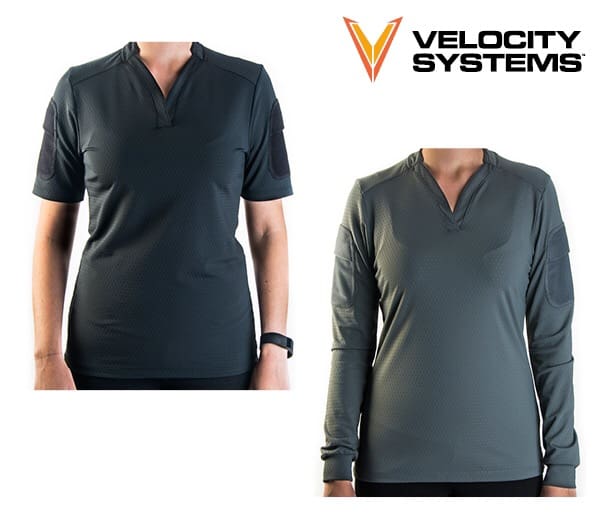
Velocity Systems’ BOSS Rugby has been super popular, both as Range attire as well as a uniform item. They’ve just released a Women’s version of this shirt.

The Velocity Systems Women’s BOSS Rugby is lightweight and can be utilized as a hot weather range shirt, or a moisture managing base layer under armor. The rugby style collar keeps a weapon sling off the base of neck. The active cut is athletic and mobile; the material is comfortable and quick to dry. The two envelope pockets on the sleeve accept hook backed patches. 83% Nylon 17% Spandex. All materials and workmanship are 100% made in the USA. The new Women’s BOSS Rugby comes in Black, Ranger Green and Wolf Grey in sizes, S through XL.

Available now at www.velsyst.com.

The Baldwin Articles – Cargo Pockets

Monday, December 5th, 2016

There is one functional element that is found on the field uniform of practically all the militaries in the world today. It is some version of the simple but effective thigh mounted cargo pocket. Surprisingly, the genesis of that now ubiquitous feature dates only back to WWII. And it is very much an American innovation. Most militaries, including the US Armed Forces saw no need for anything other than small patch pockets on field uniforms prior to 1940. And most of those were located on issued jackets or shirts and not trousers. If you have a set of Dress Blues or Greens in your closet you can see what most truly old school combat uniforms looked like. But with global war imminent in the late 1930s new and previously untried clothing ideas found some traction and urgency.

During WWII the US Army fielded three types of field trousers each with different cargo pockets. The first and most widely issued was the Herringbone Twill (HBT) uniform (not shown). The HBT trousers had a relatively small unpleated pocket mounted high on the thigh that was secured by one button and a flap. This is the trouser worn by the Ranger characters in Saving Private Ryan (also seen in The Dirty Dozen and more recently The Great Raid). This uniform remained in service until the late 1950s generally only for summer wear. The second type of field trousers saw much more limited use. Those are the Trousers, Mountain, which were issued only to the 10th Mountain Division and the First Special Service Force (FSSF). These pants had a good sized cargo pocket with flap and two buttons for closure. Side note: even though they were also parachute qualified the plank holders of the FSSF preferred the mountain trousers to those developed exclusively for paratroopers.

But it was the development and eventual combat employment of mission specific paratrooper uniforms that rightly validated the utility of cargo pockets. By necessity the Army Airborne Command was a hotbed of invention. The leadership quickly recognized the critical need for a paratrooper to carry considerably more gear on his person than the typical soldier. Early on they produced two limited issue experimental uniforms that never saw combat: the paratrooper coveralls and the M1941 uniform. The coveralls had fair sized thigh pockets with a metal zipper across the top and no flap. The M1941 uniform had single snap closed pockets that were deemed too small but was hurriedly reengineered and fielded as the iconic M1942 Parachutist Uniform.

But by the time the American Airborne had a couple of combat jumps worth of experience it was obvious that the cotton twill of the M1942 uniform – especially the pockets – needed to be reinforced. To be fair, the troopers routinely overloaded the pockets with hard edged objects that would wear holes in almost any clothing material available at the time. Fortunately the Airborne units had a secret weapon not available to “leg” outfits. That is the Parachute Rigger. The Rigger was not only charged with packing parachutes but also with repairing them. So all were trained to use industrial grade sewing machines and had a steady supply of web material and high strength thread. Riggers were the first custom gear industry. They produced countless enlarged ammo pouches, specialized rigs for engineers and medics and anything else needed by Airborne units that was not in the normal Army supply channels.

So when time and mission permitted paratroopers turned in their uniforms to have canvas or cotton webbing reinforcements applied by the Riggers. This included leg ties, rectangular canvas patches for the elbows and knees (see photo) and webbing around all of the pockets. The leg ties were needed to stabilize and cinch the load to the troopers’ thighs during and after a drop. By the Normandy Invasion jump most of the troopers in the 82nd and 101st were wearing uniforms with these improvements. Again as widely seen on the Airborne characters of Saving Private Ryan and the first couple of episodes of Band of Brothers. I mention the movies in part because I don’t have a M1942 uniform to display. What I do have at the top of the visual aid is a set of “Rigger Pockets” that are of the same dimensions – and nearly identical design. With the aforementioned canvas leg ties and knee patches. These are well made replicas that come from a place called WWII Impressions that caters to Reenactors.
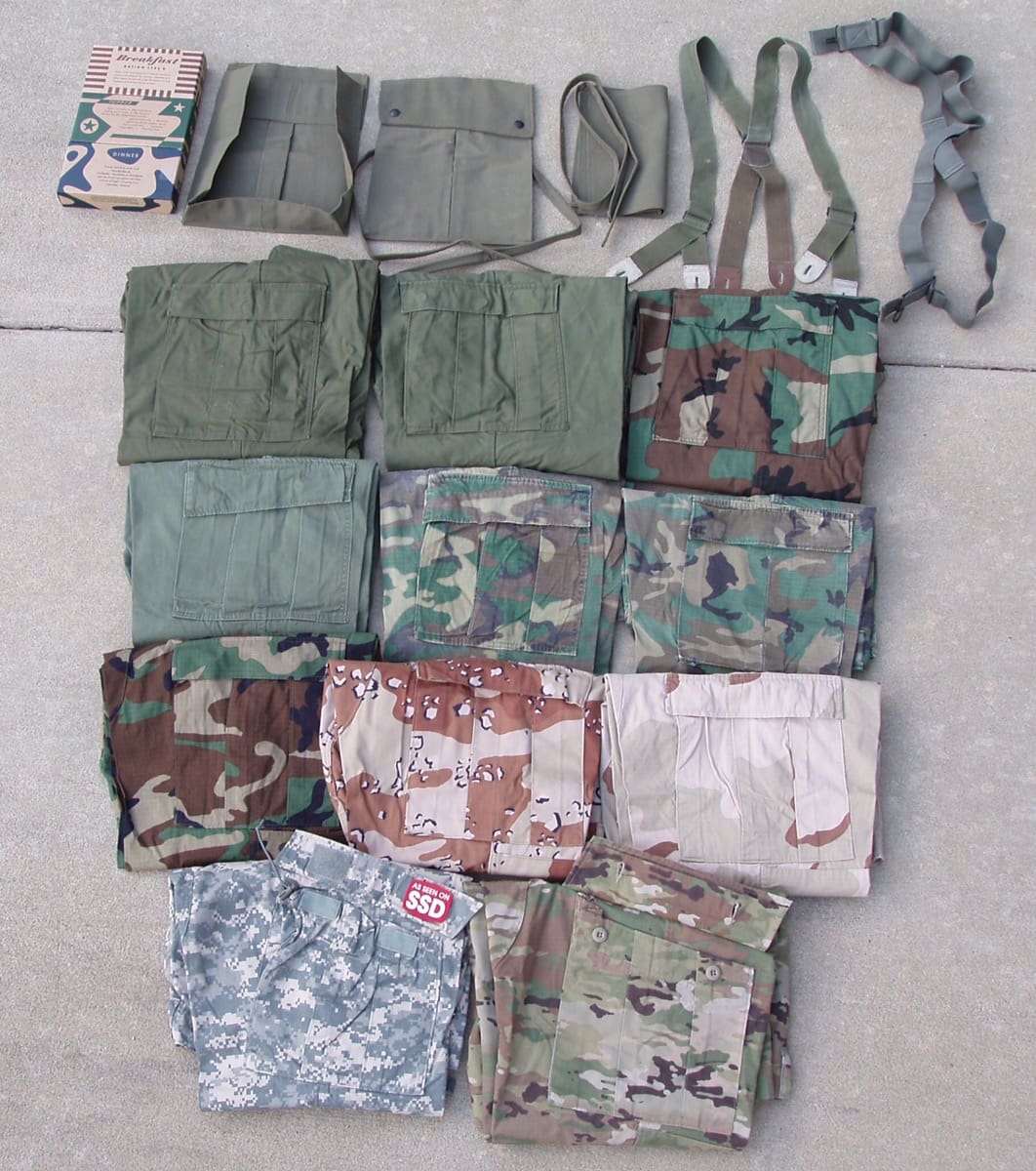

1st Row: Replica K Rations, Canvas Rigger Pockets (back and Front), M1945 and M1950 Suspenders. 2nd Row: M1965 Field Trousers (OD and Woodland). 3rd Row: OG 107 Jungle Fatigues, ERDL Green Dominant, ERDL Brown Dominant. 4th Row: BDU Woodland, DCU 6-Color, DCU 3-Color. 5th Row: ACU UCP, ACU OCP.

The M1942 uniform really was the archetype from which all subsequent US Military cargo pockets evolved. When then Captain Yarborough designed the parachutist uniform he sized each pocket based on purpose. The thigh cargo pockets specifically were intended to hold 3 K-Ration meal components (see photo). The pockets for every paratrooper were the same size to hold the same load. Not sized to look esthetically pleasing on the individual as is common today. During the upgrades mentioned above, two other design shortcomings were deemed less critical and were not immediately addressed. The pocket had bellows along all three sides. This provided for maximum usable volume. But also allowed the pockets to bulge out significantly and become a snagging hazard especially in wooded terrain. The pocket also had an “inverted box (2 sided) pleat” in the center to allow expansion (yes, I looked it up). Inverted simply means that the fold that forms the pleat is on the inside of the pocket rather than the outside (see photo). That pleat also tended to get easily caught by underbrush. But it was still the best uniform with the best pockets available into the late summer of 44.

Stateside, the Army had already been working on a replacement common combat uniform for the entire force. Experimentation was conducted on the proposed M1943 uniform beginning in 42. Early combat lessons learned by Airborne units were incorporated into the test up front. For the Trouser component six different cargo pocket configurations were tested. On some of the test pants there was actually a different pocket on either side of the sample. However, when the official type classified “M1943 Uniform” was fielded it had no cargo pockets. There were a couple of reasons for this. One, the Armor community and Air Corps did not want cargo pockets. They saw them as nothing more than an annoyance in a tank or plane. There was also some institutional resistance to cargo pockets because they made soldiers look “sloppy and unprofessional”. And, after all, the Great War had been won without cargo pockets. But I think the final decision came down to nothing more than simplifying the design so that the trousers could be easier to produce in mass quantities rapidly.

However, the Airborne still wanted cargo pockets. So even before the M1943 uniform was shipped into the European Theater the Riggers were hard at work fabricating those Rigger Pockets. Using the M1942 pockets as the best available template. They chose canvas because it was the toughest fabric they had on hand. Then as the M1943 trousers arrived the Riggers sewed those pockets to the pants just in time for Operation Market Garden and all subsequent jumps. On the plus side, the unmodified M1943 Jacket, Field was well received by the paratroopers. The new ensemble was made of sturdy cotton sateen and was more durable than the M1942. It is important to note that the M1943 Uniform was envisioned to be a 3-season temperate zone uniform. It was supposed to supplant all the specialized uniforms including HBTs. But soldiers quickly found that while the M1943 was a great improvement it was simply too hot for summer wear even in Central Europe. So by default the HBT uniform soldiered on despite the Army’s original intentions.

Rigger Pockets themselves actually have a much longer history too. Post WWII the Army continued to issue the slick M1943 trousers. But Airborne units still wanted pockets. So it became something of a rite of passage for graduates of Jump School to receive a set of canvas Rigger Pockets and leg ties. Which the cherry jumper would then have sewn on at a local tailor shop. When the Rangers and the 187th RCT made the two large scale combat jumps in Korea almost all were wearing M1943 uniforms with canvas Rigger Pockets. The M1951 Uniform was eventually fielded with built in cargo pockets but did not get to Korea in any quantity till after 53 and the Armistice. But even after the M1951 uniform was available the Rigger Pockets remained the mark of a seasoned paratrooper and continued to be worn in the back woods of places like Fort Bragg and Germany. In one book I have there are a couple of pictures of an ODA doing mountaineering training in 1961. And it appears the older NCOs still have them on their trousers.

But as already mentioned some changes were definitely warranted in the cargo pocket design despite the mystique and longevity of the originals. So when the Army developed the M1951 Uniform they created an improved version that utilized the now familiar tri-panel “knife (1 sided) pleat” configuration. Additionally the leading and bottom seams were sewn down. The new pocket therefore only expanded in the rear. Both revisions served to greatly reduce snagging issues. Moreover, the bottom front corner of the flap was bartacked down for the same reason. This now classic design, with some occasional minor tweaks, remains the standard even today some 65 years later.

I don’t have any M1951 trousers anymore but I do have three of the follow on M1965 Field Trousers* on display. The only real difference between the 51s and 65s is in the buttons. The 51s had flat plastic buttons and the 65s have the oval plastic buttons we are still using today. The 51s also had buttons on the outside of the waist so that they would be reverse compatible with the M1945 Suspenders (see photo). I have also laid out the long serving M1950 Suspenders that many of you will recognize. The M1950s are apparently still in the system and being produced today in foliage green. Paratroopers learned in WWII that if you put heavy things in your cargo pockets suspenders were practically mandatory.

I was issued M1951s and those very M1945 suspenders in Germany in 1975. In those days you used serviceable gear until you literally wore it out. I put an asterisk next to “Field Trousers” above because there is one difference between the two OD examples I have. The earlier manufactured one is labeled “Trousers, Field”. The one produced later is labeled “Trousers, Cold Weather” as is the woodland set. As I recall we almost always just called them “field pants”. Like their predecessors, the M1951 and M1965 cargo pockets have the very useful leg tie downs hidden inside. I still remember enlightening soldiers and even NCOs in the early 80s who didn’t know the ties were there or didn’t understand what they were for. I used my tie downs just about every time I wore field pants. They definitely help keep the pocket’s contents from bouncing around.

The OG107 Jungle Fatigues and the first set of ERDLs are cut in the same pattern. They have the tri-panel knife pleat but a slightly larger flap that is obviously reminiscent of the Rigger Pocket or M1942 flap. Both of these uniforms were extremely functional and popular and have been discussed many times here on SSD. The last generation ERDLs (late 70s/early 80s) had a very different pocket arrangement. The jacket pockets were square and level rather than rounded and canted. And all had the inverted box pleat including, inexplicably, the thigh cargo pocket. I was issued this pair in 83 at Fort Bragg. On my first field problem the pleat caught on brush and was ripped. When I got back to garrison I had the pleat sewn shut. Problem solved. I can only assume that somebody had not bothered to capture why that feature had been abandoned in the first place and recycled it out of ignorance. Uniforms in this straight pocket configuration were also produced and issued in OG107 Jungles and in experimental 6-Color Desert.

The early BDUs circa 1982-83 had a myriad of problems. They had a goofy big collar, turned blue after one or two washings and shrank like crazy. But there was nothing wrong with the cargo pockets. The Army wisely reverted back to the knife pleats and a relatively narrow flap with a two button closure. Another side note. Some of you may remember that the original BDUs in NYCO Twill were intended as an all-purpose 3-season temperate zone uniform. Sound familiar? They were too hot and soon “Light Weight” Ripstop BDUs were produced to fix that problem. OG107 Jungle Fatigues were also authorized Army wide as an interim fix until the lighter uniforms could be fielded. Many soldiers, unaware of the history, often erroneously refer to the heavier originals as “winter weight” BDUs. As far as I know, USGI Desert Storm era 6-Color DCUs were only issued in Twill and later 3-Color DCUs only in Ripstop.

Today the USMC MARPAT uniforms and the Air Force ABU still use the same well refined and combat tested BDU pocket design described above. But the Army decided it needed to make some changes when it fielded the ACU in 2005. They kept the tri-panel pocket body. But they traded buttons for Velcro and shock cord. I’m not anti-Velcro. I believe in some applications it is a suitable closure device. Chest pockets under body armor for instance. But it is the wrong option for cargo pockets for a number of reasons which have been discussed here many times. The flap was also canted and was no longer bartacked down. These changes were all intended to make it easier to access the pocket when seated. Maybe so. I just personally don’t recall that accessing the older cargo pockets was a problem prior to 2005.

In any case, the Army has transitioned back to a button closure on the last generation of UCP ACUs and the newer Multicam and OCP ACUs. But for some reason someone decided that there was a need for a third “expansion” button. If that works for you then by all means drive on. But after some unscientific experimentation here on the homestead, I saw no use for it and removed the superfluous third button. When I was wearing the UCP ACUs in the 2005-07 timeframe I also had the bottom front corner of the flaps bartacked down. I experienced no adverse issues with pocket access. And I felt more secure in that the flap could no longer come completely undone and dump the contents (say in a vehicle roll over).

There are a number of newer and IMHO tactically questionable cargo pockets designs out there today. The Navy just adopted the NWU Type III that according to pictures I’ve seen has cargo pockets segmented by two inverted box pleats. I’m sure that will work fine aboard ship. But this style will never travel well through a jungle. Other popular commercial examples have internal elastic to accommodate rifle magazines. I can tell you that unless there is some provision to cinch that pocket to the thigh (or you like wearing really tight pants) those loaded magazines will beat your leg to death when you run. And one last thing. The flap on the OCP ACUs is noticeably larger than previous cargo pocket flaps. I thought of early BDU/DCU Elvis Collars when I saw it. It just seems bigger than reasonably necessary for the task. For those wearing them in the field today I would be curious to hear if the pocket flap is the snag monster I suspect it can be. TLB

LTC Terry Baldwin, US Army (RET) served on active duty from 1975-2011 in various Infantry and Special Forces assignments.

Next: Load Carriage – The Road to ALICE

US Army Patents New Blast Debris Protective Harness

Sunday, December 4th, 2016

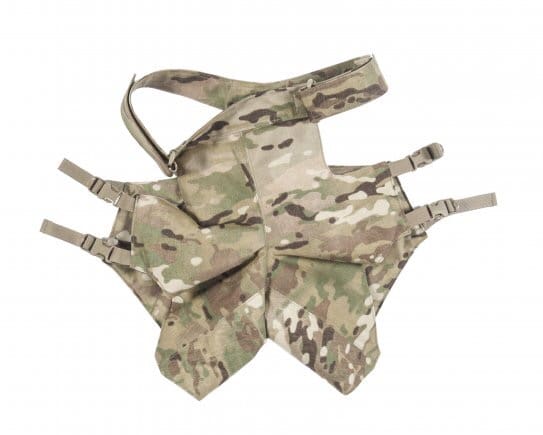
This press release from the Army discusses a new take on the Protective Over Garment or POG program.  The commercial items they issued in the past, would be displaced by the negative pressure wave preceding the blast and frag wave.  Consequently, they weren’t as effective as they could have been.  I’m told this new system is a much closer fit, so it won’t move during a blast.


Engineers and designers at the Natick Soldier Research, Development and Engineering Center, or NSRDEC, have patented a blast debris protective harness. The harness is worn outside the pants and hugs the body without hindering movement. (Photo Credit: David Kamm)

Granted, it looks complicated in this photo, but it will make sense once you see it actually being worn in the next photo.

Below is the full Army story.

NATICK, Mass. — Engineers and designers at the Army Natick Soldier Research, Development and Engineering Center have patented a new design for a harness that protects its wearer from blast debris.

Worn outside the pants, the harness is designed to protect the groin and femoral artery and prevent debris from embedding in and around the groin. Such injuries can be so severe that repeated surgeries are often needed to remove the debris, leading to extreme discomfort as well as health and hygiene issues. The harness has also been adapted to provide fragmentation protection.

Project lead Kristine Isherwood said NSRDEC began designing the piece of equipment after a joint urgent operational needs statement was issued for blast debris protection, while the Product Manager Soldier Protective Equipment looked for commercial off-the-shelf solutions.

“The protection that existed before was letting debris in because it wasn’t fitted close enough to the body,” said Cara Tuttle, an NSRDEC clothing designer and design lead. “Soldiers weren’t wearing it often enough, and it didn’t come down inside of the leg to protect the femoral artery.”

Before arriving at the harness design, NSRDEC considered several others, including under-trouser, within-trouser, and over-trouser designs. The ultimate design for the harness uses multiple layers of Kevlar that alternate as they overlap.

“A layer overlaps in one direction, then the next layer overlaps in the opposite direction, and it keeps alternating,” Tuttle said. “This creates a better barrier for small [debris fragments], which would have to zig zag through all these layers to get through.”

The resulting design hugs the body without hindering movement or range of motion. Project engineers partnered with NSRDEC’s Human Factors and Anthropology teams to achieve the snug fit. The design makes use of adjustable straps and buckles that allow for easy doffing and donning.

“It was challenging to add layers and area of coverage without impacting movement,” said Isherwood. “Whether you had to climb in a window or kneel, [the harness] needed to stay in place, but also allow full range of motion. The uniqueness of this design is that it’s stable but moves with you.”

Tuttle, who worked in the apparel industry for a number of years before coming to Natick, and Isherwood say they are dedicated to improving the quality of life and safety of the warfighter.

“There is nothing in the [apparel] industry quite like what we do here at Natick,” Tuttle said. “We are helping to protect the men and women who are protecting our country. Our work … has the potential to save lives.”

“[Our Soldiers] are volunteering to be put in harm’s way,” Isherwood said. “So anything I can do to protect them without compromising their effectiveness is the goal. That’s what we are trying to do every day.”

As with many protective items developed by NSRDEC, the innovation is expected to benefit the not just the warfighter, but also may, in the future, be licensed for use by first responders.

TacJobs – Manager, TAG Regional Account

Saturday, December 3rd, 2016

TAG is looking for highly experienced and qualified people to begin filling our team as our military sales division rapidly expands over the next year to meet the ever growing demands from our customers.

TAG, has shifted its focus from solely offering its own products to a best in class tactical products distribution company. On Jan 17th 2017 our new website will be live with not only an all new look and function but will feature these brands.

Benchmade, Darn Tough, Armor Express, ESS Eyewear, Sig Sauer, Predator War Paint, Mechanix Wear Gloves, Hesco, Multimat, Streamlight, XGO, Proforce, Snugpak, Gerber, Ops Core, Fifty-Fifty, Rite in the Rain, Magpul, SOG Knives, Petzl, Crye Precision, Wiley X, Aimpoint, Maglite, Suunto, S&S Precision, ArcTeryx, LED Lenser, Leatherman, Soloman, Revision Eyewear, Kysek Coolers, Pelican, Goal Zero, Source Hydration, Smart Wool, Under Armour, Oakley, Smith and Wesson, Danner, Gripod and Camelbak.

We have seen tremendous success within our Base Supply Centers and ecommerce sales channels in the past two years. So we are expanding our efforts with our direct to consumer business model that we first implemented in Jan. 2016. What this ultimately means is that TAG no longer has “dealers” or “distributors.” We will price these brands as aggressively as we can to provide not only best in quality but best in price for the end user.

This Regional Account Manager position is in Durham, North Carolina.

LC Industries, a multi-site manufacturing, distribution, retail and E-Commerce Company, is seeking a TAG Regional Account Manager to join our team.

DESCRIPTION: The TAG Regional Account Manager’s responsibility is to develop relationships with military units, customers, supply officers and contracting officers (end users at all levels) within their defined sales territory to grow LCI tactical business by accessing current and future requirements, by being a solutions provider on behalf of the customer. The TAG Regional Account Manager should also educate all customers regarding LCI’s/TAG’s capabilities to be their supplier of choice. Establish and maintain rapport with all co-workers, customers and vendors. Must be an extremely effective communicator both written and in person. Strong phone skills required. Ability to log in and work remotely. Working knowledge of MS Office Suite especially Word® and Excel®. Reports to the Director of TAG. Bi-weekly meetings, day to day supervision is limited. Updated weekly sales pipeline will be required to be submitted bi-weekly for review. Be available for all requested meetings and phone calls from co-workers and direct supervisor.

Strong working knowledge of all tactical products to include but limited to Tactical nylon products such as pouches, packs, plate carriers, slings, belts and harnesses. Hard and soft armor systems. Experience with ballistic helmets, communications equipment to include hand held and man pack systems. Knowledge of Communications headsets, Boots and combat uniforms, Knives; fixed blades and folding. Understand Medical equipment and kitting systems, tactical and cold weather gloves, cold weather layer systems and sleeping systems. Working knowledge of ballistic eyewear systems, high level of understanding of military language, rank structure & acronyms. Must have basic understanding of US ground combat weapons platforms to include but not limited to pistols, combat rifles, sniper rifles, rockets and mortar systems. Exemplify understanding of individual optic and aiming systems as it relates to their weapons platforms. Great knowledge all contract vehicles/funding methods customers can and do use for procurement at all levels. Extensive experience in responding to Requests for Information (RFI) and Request for Quote (RFQ) directly from customers as well as government contracting officers. Detailed knowledge of the Berry Amendment and its rules

QUALIFICATIONS: Bachelor’s degree or 5 years minimum industry experience as an outside sales representative in the tactical industry and experience, knowledge and training with government procurement vehicles such as but not limited to: Defense Logistics Agency’s (DLA) Special Operations Equipment (SOE) and the Fire & Emergency Services Equipment (FESE) contracts as part of the Tailored Logistics Support Program (TLSP). General Services Administration (GSA) schedule 84 products. Federal Business Opportunities (FEDBIZOPS). May substitute or combine up to 2 years’ experience as an Inside Sales Representative to achieve this requirement.

Apply online at: www.lc-ind.com

NO Phone Calls Please

LC Industries is an Equal Opportunity / Affirmative Action employer. All qualified applicants will receive consideration for employment without regard to race, color, religion, sex, national origin, disability, or protected Veteran status.

A Quick Nap

Saturday, December 3rd, 2016

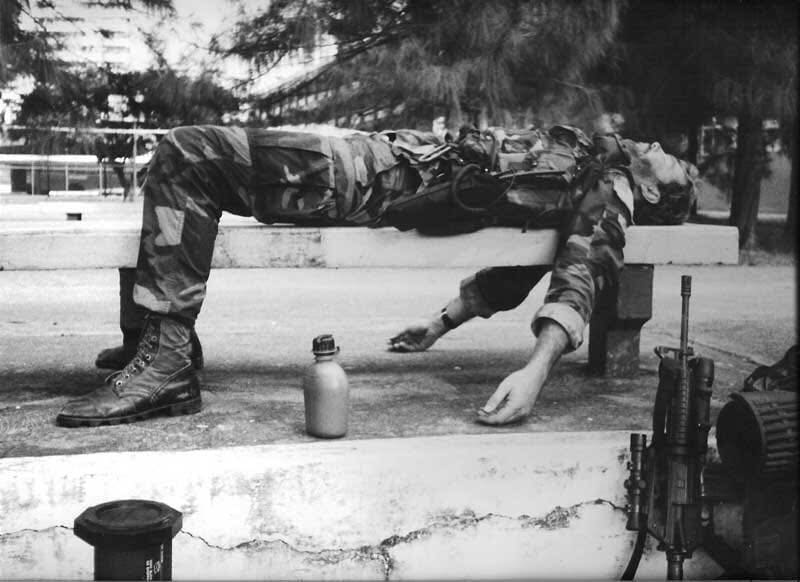
This photo from the Panama invasion depicts a US SOF Soldier getting some rest during a lull in the fighting. Love the Colt carbine with the massive flashlight attached to the handguard and the optic mounted to the carrying handle.

Triple Aught Design – Azimuth Transport Pack Now Available For Pre-Order

Friday, December 2nd, 2016

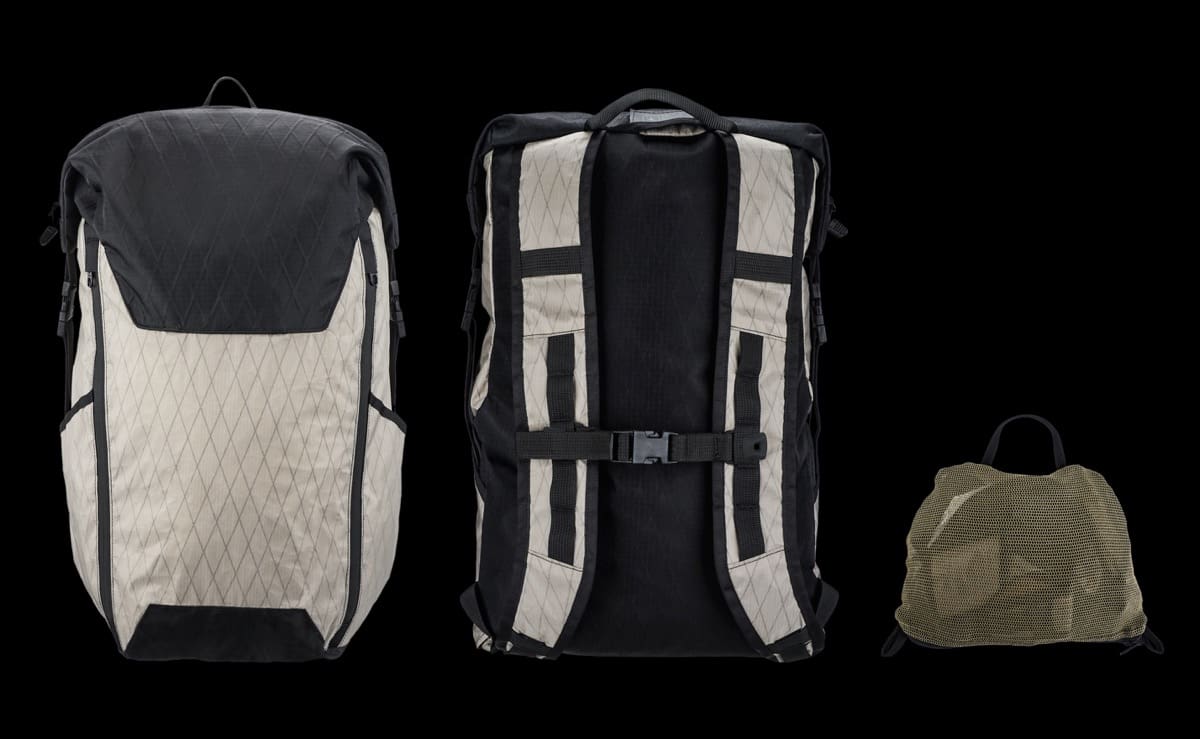
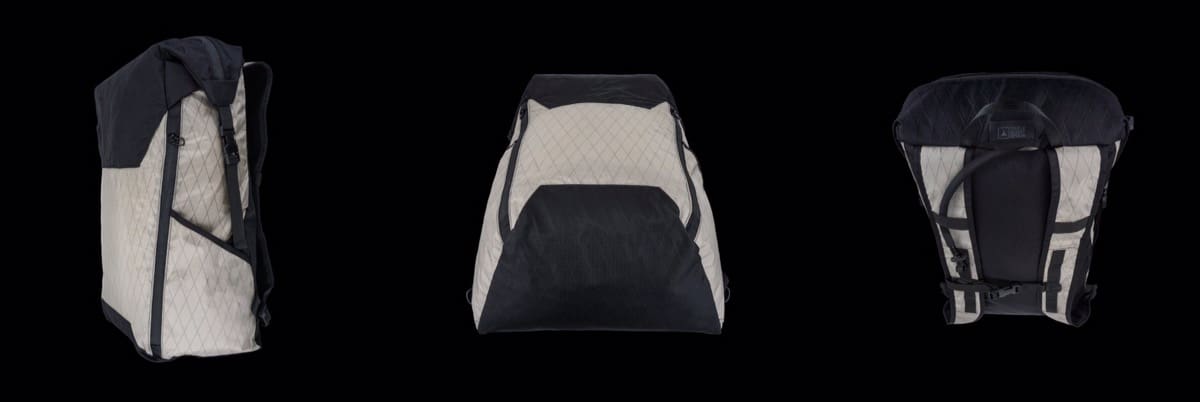
I was first exposed to the Azimuth Transport Pack from Triple Aught Design during Destination: Granite. TAD gave each of the attendees a prototype of this lightweight daypack. I used it during the experience and now keep it with me for travel. As you’ll notice, it compacts into an internal pocket for storage or transport. The idea is that you can take it with you in your main luggage and then pull it out and use it as a daypack once you get to your destination. It weighs .8 lbs and offers 19 liters of carrying capacity.  I really like the top zipper opening which secures via two side release buckles. The pack also offers a handy side zip for panel access as well as dual water bottle pockets.  However, the real exciting thing about this pack is that it is super durable thanks to the VX-21 Ripstop and VX-07 Shell materials which are essentially modern sail cloth.

Features:
Easy Access: Primarily loaded via the large, water resistant zipper at the top of the pack, the Azimuth Pack also has zippers running along both sides of the front panel. One zipper leads to the main compartment, allowing the user to quickly and easily access items at any layer of the pack, and the other zipper leads to a separate, flat storage compartment that keeps small items readily accessible.

Internal Organization: Two Helix (HX) attachment points inside of the Azimuth Pack allow the user to attach Transport Cubes, our soon-to-be-released Transport Sleeve, select Control Panels, or any other compatible storage system securely inside the pack. An internal mesh pocket keeps small items accessible at the top of the pack, and also acts as the carrying pouch when stowing the Azimuth for transport.

External Organization: The Azimuth Pack has two quickly accessible external side pockets with attachment loops to help retain essential tools such as a water bottle, compass, GPS, or map. These pockets are ported to allow small debris or loose liquid to escape.

Capable Companion: Unstructured and minimalist, the Azimuth can be packed into its own internal mesh pocket, rolled up, or packed flat. Made in the USA from premium lightweight and durable weather-resistant materials, the Azimuth packs features above its weight class into a package you’ll forget is there until you need it.

Hydration Compatible: A hydration bladder attachment strap rests inside the top of the Azimuth Pack to allow common sizes and shapes of hydrations bladders to be suspended. The top of the pack is ported to allow hydration hoses to be routed to either shoulder strap. Both straps contain a small elastic loop to secure the hose to the strap.

Colors are Black/Brindle. Pre-orders for the pilot production run will begin shipping on Wednesday, 12/7. All pre-orders will ship in time to arrive by 12/24. Not available for pickup in-store. However, there will be a limited number available at the annual prototype/sample/warehouse sale happening this weekend at their Dogpatch location. On a side note, this year TAD will be doing an online sale for the customers who can’t make it here for the sale. Online info: tripleaughtdesign.com/dogpatch-warehouse-sale

To pre-order the Azimuth Transport Pack, visit store.tripleaughtdesign.com/Azimuth-Pack.

TD Christmas Stocking

Friday, December 2nd, 2016

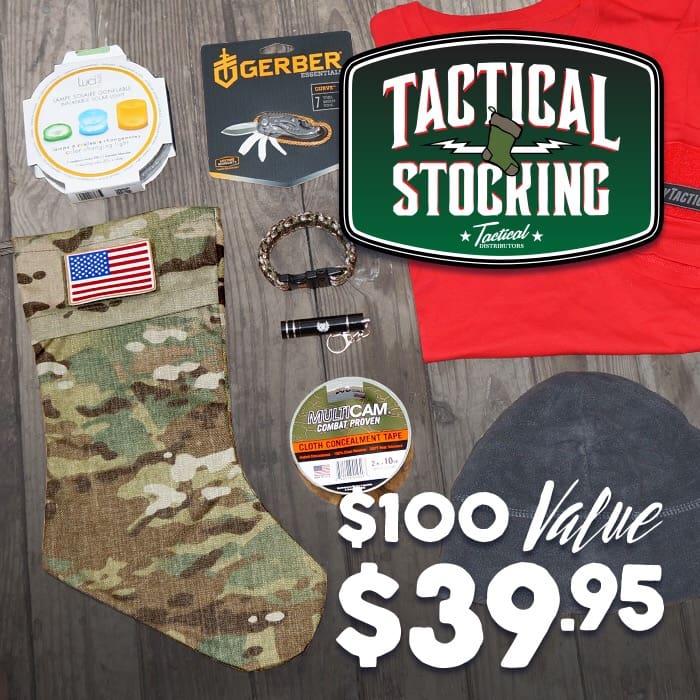
Looking for a tactical Christmas stocking? Tactical Distributors has got you covered. The Christmas stocking was made by LBT specifically for TD and it’s stuffed with over $100.00 worth of gear, for only $39.95.

Contents:
-LUCI Aura Solar lantern
-Gerber Curve Multitool
-TD Shooter Shirt
-Pro-Tape Multicam Grip Tape
-TD Para-cord Bracelet with whistle
-TD LED Key Light
-Condor Watch Cap
-US Flag Morale Patch

Limited quantities available.

www.tacticaldistributors.com/products/td-christmas-stocking

Nightforce Optics Designates Frederick Karl to Lead Marketing

Friday, December 2nd, 2016

Nightforce Optics, Inc., has named Frederick Karl as Strategic Marketing Manager. Fred brings with him extensive experience in product development and marketing in multiple categories of products within the outdoor, military and firearms markets.

“We are very pleased to have Fred join Nightforce to lead our marketing team,” said Gordon Myers, Director of Sales and Marketing. “With his experience as a marketer and developer of product ideas, he matches our capability as an organization in bringing innovative products to professionals and consumers alike. We are excited to have him help us build the next stage of Nightforce’s product brand.”

Fred commented, “Nightforce is known as the most dependable and rugged brand in optics; and to be able to bring that message to consumers is fantastic. I am thrilled to be a part of such a committed team that delivers premium product to loyal customers throughout the world.”

Recently with CRKT, as Brand Manager, Fred was instrumental in developing and launching the Ruger Knives program. His background also includes companies like Crimson Trace and Gerber Blades, where he honed his industry experience in marketing, product development, design and strategic planning. He has an excellent blend of experience of working with, and communicating to, military, tactical and hunting customers that are at the core of Nightforce’s brand.

Fred will have responsibility for the Nightforce brand and engaging Nightforce’s high-level consumers domestically and throughout the world. In addition to leading the marketing team he will be responsible for strategic planning, coordinating product launches and supporting the sales team and their customers. Fred commented, “I am looking forward to build on such a formidable product brand and reaching more shooting enthusiasts.”

A graduate of Rochester Institute of Technology in New York with a degree in product design, Fred joins the company with more than twenty years of product development and marketing experience.

www.nightforceoptics.com