Register Now for SOF Week

Author Archive

Ermine – Rheinmetall’s New Lightweight Hybrid Vehicle Family for Modern Armed Forces

Tuesday, March 4th, 2025

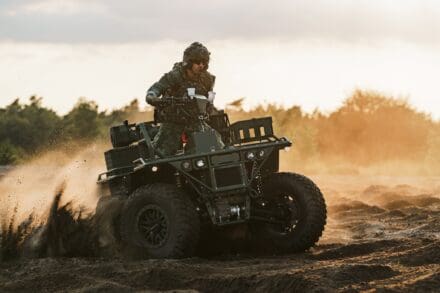
Rheinmetall is showing its tactical small vehicle family Ermine for the first time at the Enforce Tac. It represents a new generation of tactical mobility, combining tactical transport with a mobile energy source (microgrid). Operational creativity is at the core Ermine’s design. Its features enable it to act as an effective force multiplier. Ermine can operate remotely controlled and is prepared for autonomy.

The modular Ermine family currently consists of an Unmanned Ground Vehicle (UGV), a side-by-side buggy and a quad. Various 4×4 and 6×6 variants are available. All vehicles are based on the same diesel-electric hybrid drivetrain and base platform. This gives Ermine maximum modularity with unrivalled agility. Thanks to the hybrid technology, up to one ton of payload, a range of more than 1,000 kilometres and a top speed of 90 km/h are possible, depending on the vehicle’s configuration. Up to four Ermine vehicles can be transported by cargo helicopters such as the CH-47 or CH-53.
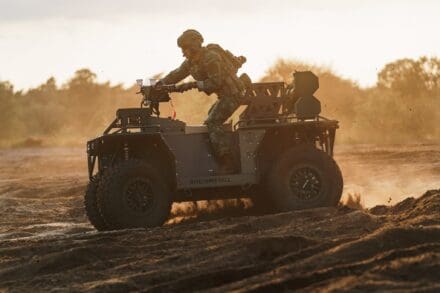
The Ermine vehicles can be configured for various purposes, including reconnaissance & liaison, special operations, anti-tank, weapon carriers,
MedEvac or generator function. At Enforce Tac 2025, Rheinmetall showcased a 4×4 quad with the ROSY smoke/obscurant system and special operation forces equipment. One element is the Mobile Mission Pod (MMP, which also made its debut at Enforce Tac.)

The MMP is designed to conduct standoff reconnaissance and engage enemy forces using small UAVs. Developed primarily for special operations forces, it enables maximum effectiveness behind enemy lines. Thanks to its long standby time and remote operability in conjunction with artificial intelligence (AI), the MMP is designed to be able to operate against enemy forces long after it has been deployed to the battlefield. The MMP combines the expertise of existing products as well as current technologies and experiences from current conflicts in a new product that is outstanding in its capabilities. Thanks to its high degree of automation, AI support and standalone design, it significantly expands the mission portfolio of armed forces, enabling missions that were previously considered impossible.

The Ermine vehicles are furthermore characterised by high mobility in almost any terrain and can also be driven completely silent thanks to their electric drive. If the vehicles are not used for tactical mobility, they can be used as a mobile energy source. The Ermine family can therefore significantly increase the operational value of armed forces.

The Ermine technology was developed in the Netherlands by the start-up company REEQ – a subsidiary of Rheinmetall Defence Nederland B.V. since March 2024 – and is being produced there. The acquisition of REEQ enables Rheinmetall to serve the Dutch and European market in the field of light tactical mobility, both manned and unmanned, in combination with a microgrid – and with short delivery times. Thereby Rheinmetall’s industrial strength and the innovative power of a start-up complement each other. Within the Rheinmetall Group, REEQ retains its status as a start-up in the field of development. The further development and serial production of these vehicles will also take place in the Netherlands.
Rheinmetall Squad Support Weapon – The 40mm Fire Support Weapon for Superior Infantry Firepower

Monday, March 3rd, 2025

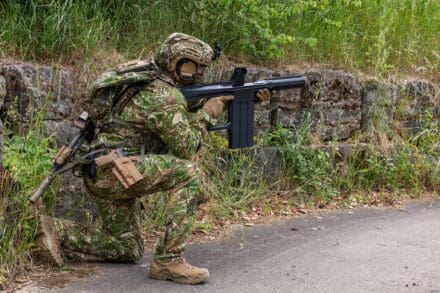
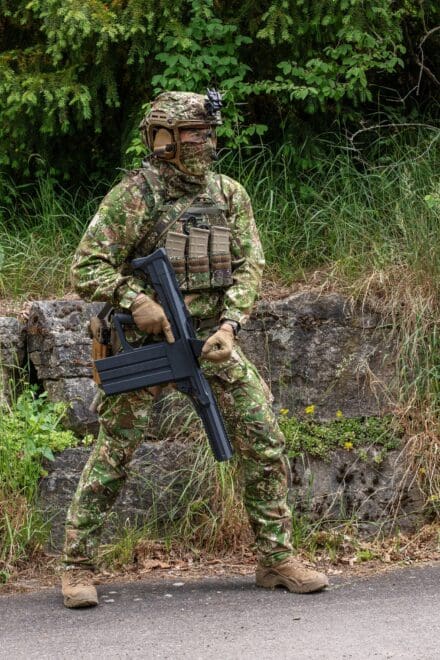
Rheinmetall is presenting the world’s first automatic, magazine-loaded, shoulder fired grenade launcher at Enforcetac 2025. Both weight, dimensions and handling of the SSW40 are similar to assault rifles. Thanks to a recoil-reducing and self-regulating recoil system, the SSW40 (Squad Support Weapon 40) can fire all available 40mm Low Velocity (LV) ammunition types as well as the new Rheinmetall 40mm Medium Velocity (MV) ammunition.

The new MV ammunition has a significantly increased velocity and a flat trajectory, allowing targets to be engaged more quickly and increasing the effective range of the system to 900m. Combined with the broad spectrum of Rheinmetall’s 40mm LV/MV ammunition portfolio, the infantry user achieves unprecedented flexibility and effectiveness on the battlefield of the future. The first test firings were successfully carried out at the beginning of 2024. The market launch with series production will start in 2025.

The 40mm MV ammunition family combines Rheinmetall’s experience in 40mm LV and High Velocity (HV) ammunition. Therefore, the SSW40 can be used with the following ammunition types:

HE Fragmentation (HEFRAG)
Anti-Tank (HEDP)
Door Breaching (HEBE)
Air Burst (HEAB)
Training (TPM, TPM-T)
Illumination / Fog
Sound & Flash and Irritation Ammunition (CS)

Via a quick magazine change, the SSW40 can be used in any near peer as well as asymmetric conflict scenario and offers superior firepower in any terrain, even against medium-weight armoured vehicles. The interfaces on the SSW40 also allow the inclusion of laser light modules, fire control sights as well as IR programmers for aerial explosive point ammunition. The SSW40 can also be integrated on vehicle mounts or field mounts.

Rheinmetall Gladius Light – Special Networking for Special Operations Forces

Sunday, March 2nd, 2025

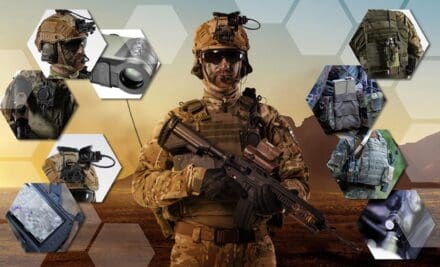
Soldier systems connect individual warriors on the battlefield with other actors, sensors, effectors and platforms, bringing them into the network-enabled operational loop. Rheinmetall has extensive experience in this area. Just in February 2025 the Federal Office for Equipment, Information Technology and In Service Support of the Bundeswehr (BAAINBw) has signed a framework contract with Rheinmetall Electronics GmbH for the follow-on procurement of soldiersystems ‘Infantry Soldier of the Future – Enhanced System’ (IdZES). The framework contract, with a maximum gross volume of €3.1bn, will run until the end of 2030. Overall, the German Armed Forces can thus initiate the proportional regeneration as well as the manufacturing and delivery of up to 368 IdZ-ES platoon systems and various options for the procurement of additional components and services. A platoon is a military sub-unit.

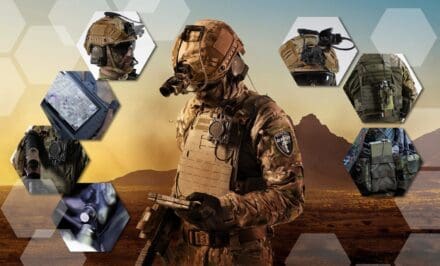
IdZ-ES is based on the soldier system Gladius 2.0. At Enforce Tac 2025, the Group will be presenting another version of its Gladius 2.0 soldier system, specifically designed to meet the needs of special operations forces. During development, the system’s designers kept a sharp focus on the need for lightweight, flexible systems that enable maximum mobility. The Gladius Light configuration has therefore been stripped down to its essentials. At the same time, however, care was taken to maximize flexibility, making it possible to include accessories needed for special operations. Moreover, the new configuration is specially designed to enable subsequent upgrades and extensions. The Gladius Light configuration is based on a lightweight tactical harness with scalable ballistic protection.

It includes:
-a radio for voice and data communication as well as GPS tracking for ‘blue force’ information;
-an advanced headset with various push-to-talk buttons (connected by cable or Bluetooth) for voice communication;
-an end user device (e.g. a tablet) for depicting tactical maps, assuring an uninterrupted exchange of information and improved situational awareness.

Spectra Group Announces the Award of a Contract to Supply Troposcatter COMET to the Irish Defence Force

Friday, February 21st, 2025

Spectra Group (UK) Ltd, the specialist provider of secure voice, data and satellite communications systems, has announced a contract award to supply the Irish Defence Force with Comtech’s Troposcatter Compact Over-the Horizon Mobile Expeditionary Terminals (COMET). Spectra Group acquired the global distribution rights to supply Comtech’s Troposcatter Family of Systems (FoS) in February 2024 (less USA, Canada and Mexico which Comtech retains). This procurement is the next in a series of overseas sales under this agreement. The Irish Defence Force has procured a number of COMET systems, with more systems and the associated training and support package in the pipeline, including aspirations to deploy the new Troposcatter on the Move (TOTM) enhancement; more news on this exciting new capability coming soon. Spectra Group is attending EnForce Tac in Booth 7-360 showcasing their specific communication capabilities, including GENSS. Troposcatter COMET will also be on display at the JK Defence booth (10-521).

Tropospheric scatter is a communications capability that uses the Troposphere (up to about 13km altitude) to provide high bandwidth communications. It is satellite independent and works in a GPS/GNSS denied environment, so is suitable for use in a Peer-on-Peer conflict/Multi Domain Integration. Troposcatter inherently has very low latency and can provide huge bandwidth, enabling analysis and manipulation of large data, which combined with its low operating cost makes it suitable for strategic and tactical headquarters. In the past, Troposcatter technology required large power-hungry equipment unsuitable for expeditionary or manoeuvre warfare. However, modern technology and significant development by Comtech has revolutionised the size, weight and power of the Troposcatter Family of Systems, of which, COMET is the smallest and most lightweight.

COMET is specifically designed for rapid deployments and mobile operations, delivering high bandwidth (5-60Mbps) and long-range connectivity (70km+) while operating efficiently with just 10 Watts of power—currently the only low-power Troposcatter system available. The COMET system uses a single 1-metre dish and the COMTECH CS67Plus Modem capable of up to 210Mbps, which takes the IP stream and directly converts to two RF outputs in the range 4.4-5Ghz to provide two frequencies, amplified by Dual 10W GaN amps (Dual LNA on the receive path). This allows for dual frequency/polarisation diversity that compensates for any fading/multi-path effects and ensures low latency (typically 9-20mS). In suitable conditions, the bandwidth, range and data transfer speeds can be much greater than specified. The COMET system is simple, intuitive, and easy to set up and does not require the use of vulnerable and expensive satellites. It has been developed to be man-portable and the whole system can be established and operational within 15 minutes. The COMET system comes packed in two small cases (25kg each) that can be transported on civilian aircraft if required.

Michael Davies, Business Development Manager at Spectra Group said: “This is a continuation of what we hope to be many procurements under our Troposcatter global distribution agreement with Comtech. We have been working closely with the Irish Defence Force for some time to find suitable solutions to their strategic communications challenges and help meet their national defence commitments. With many NATO countries already operating Troposcatter systems, COMET is the perfect solution for its reliability, capacity, deployability and interoperability both on the land and for maritime vessels.”

spectra-group.co.uk

KRDA Launches Capital Campaign to Fund Its Mission to Promote, Protect Fort Knox

Thursday, February 6th, 2025

ELIZABETHTOWN, Ky. – The Knox Regional Development Alliance (KRDA) launched its capital campaign to fund the organization through 2030 during its recent annual meeting of investors. The non-profit, funded through private and public sector investments, is the only organization dedicated to promoting and protecting Fort Knox and growing the defense sector economy in the region.

Luke Schmidt, a Hardin County native and CEO of L.B. Schmidt and Associates, is co-chairing the KRDA capital campaign with Marilyn Ford, KRDA’s outgoing board chair and City President of Kentucky’s Heartland Region for WesBanco. During the meeting, Schmidt encouraged the assembled investors to continue their support of KRDA.

According to Schmidt, the campaign’s goal is to secure $2.25 million in pledges to fund five years of operations beginning in 2026. Schmidt spoke of the importance of Fort Knox and having an organization like KRDA, proactively working to protect its tremendous impact on our regional economy.

“For more than a century, Fort Knox has fueled this region’s economy and helped us weather global economic downturns better than most,” Schmidt said. “Fort Knox’s $1.3 billion in annual payroll and $5.6 billion in annual economic impact are second to none in this region. It is imperative we do all we can as a community to promote it, protect it and grow defense-related business in the region. KRDA has been doing that now for almost a decade with great success.”

Schmidt pointed to several indicators of success since KRDA was established – most notably that Fort Knox’s annual payroll and annual economic impact have more than doubled.

In addition, the post has gained several new missions, including V Corps Headquarters, the Command Assessment Program (CAP), and a new three-star headquarters in Recruiting Command. These three missions alone have brought nearly 1,000 new jobs.

“The KRDA team always credits the leadership of Fort Knox and its dedicated workforce for putting the installation in a position to gain these missions, as they should. But we also know that KRDA’s advocacy, our community’s support, and the region’s overall quality of place make Fort Knox more competitive when these opportunities arise,” said Schmidt. “Competition for new missions is high and KRDA helps make sure we do all we can as a community to position the installation for continued growth.”

KRDA CEO retired Colonel Lance O’Bryan knows first-hand the importance of community support.  In his last assignment before retirement, O’Bryan was the Fort Knox Garrison Commander. This assignment is comparable to that of a mayor or city manager.

“This community helps set the installation apart from others,” O’Bryan said. “Whether it’s limiting encroachment, providing career opportunities to military spouses and transitioning service members, or fostering partnerships that are mutually beneficial to the community and the installation, we want to be the very best.”

O’Bryan also spoke about the potential for another round of Base Realignment and Closure (BRAC) or mission changes associated with the new federal administration’s government efficiency efforts. 

“Because of the installation’s capacity, energy resilience and security, we consider Fort Knox well-suited for growth,” said O’Bryan. “But it’s imperative we have the resources in place to mount a strong advocacy effort in the event the federal government decides to move in this direction. We also regularly share the Fort Knox story with stakeholders and decisionmakers at all levels of government to help keep Fort Knox top of mind. “

Schmidt called KRDA the go-to community organization for all things Fort Knox, emphasizing that its operations and grassroots funding model serves as a national example for defense community organizations. He also commended KRDA’s strong fiscal oversight.

“I have served on several boards and can honestly say I have never seen a level of financial stewardship like that of KRDA. They run a lean operation and it’s tremendous what they have accomplished,” said Schmidt. “I had the privilege of chairing their last capital campaign and am proud to co-chair this campaign with Marilyn.”

During the meeting, O’Bryan also thanked the current board and investors for their support. 

“Thanks to our investors, we are able to dedicate ourselves fully to our mission each and every day,” he said.

In closing the annual meeting, Marilyn Ford explained why Wesbanco supports KRDA.

“Investing in KRDA is an investment in the future of our community,” said Ford. “Their efforts ensure that Fort Knox remains a strong economic engine for our region, creating jobs and driving growth. The return on investment is clear—supporting KRDA means supporting economic stability and opportunity for businesses and families alike.”

To learn more about KRDA, their mission, and how to participate in the capital campaign, visit growknox.org.

MRIGlobal Awarded GSA OASIS+ Contract Provides Government Customers with Vetted Contractor Access

Thursday, February 6th, 2025

Kansas City, Mo.: (Feb. 5, 2025) – MRIGlobal is pleased to announce its award of the General Services Administration (GSA) One Acquisition Solution for Integrated Services Plus (OASIS+) Indefinite Delivery, Indefinite Quantity (IDIQ) contract under the Research & Development domain. With more than 80 years of experience supporting the United States government, MRIGlobal is well-positioned to continue delivering integrated and multi-disciplinary solutions in defense, health surveillance, and health diagnostics.

“For more than eight decades, our scientific researchers and engineers have created breakthroughs to meet the needs of our customers and contribute to national security. Our expertise in global health surveillance, disease diagnostics, chemical and biological threat detection, and emerging infectious disease response has served as a critical asset to the United States government,” said Dr. Ian. M. Colrain, President & CEO, MRIGlobal. “This GSA OASIS+ contract award ensures that we will continue providing innovative solutions to these and other important challenges, and we are now able to do so more efficiently and effectively than ever.”

Administered by the GSA, OASIS+ is a government-wide, multi-award, IDIQ contract vehicle that supports federal agencies’ procurement requirements for services-based solutions. This contract is available for use by all Federal agencies. The contract provides Federal agencies with vetted, highly qualified contractors; a flexible, expandable domain-based structure; a 10-year order period; no contract dollar ceiling and no cap on awards, and price evaluation at the contract level. Requirements can be included that are performed in CONUS and/or OCONUS locations, for complex commercial or non-commercial services, and for any contract type.

“Having been vetted by the GSA as a highly qualified contractor means that we’ve demonstrated our capabilities and experience in serving our government customers,” said Michelle Rodrigues, Vice President, Government Business Development. “Receiving this OASIS+ award contract is recognition of the quality of scientific and engineering research our teams have performed for those customers, and the positive impact our solutions have had on society.”

Administered by the General Services Administration (GSA), OASIS+ is a government-wide, multiple award, IDIQ contract vehicle that allows government customers to acquire a range of non-IT services from government vendors. For easy access to MRIGlobal’s OASIS+ contract vehicle, including awarded CLINS, visit www.mriglobal.org/contract-vehicles.

Sneak Peek – Safran DSI IronSnake Thermal Reflex Sight

Thursday, January 16th, 2025

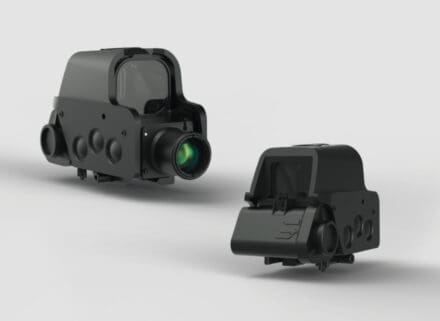
During next week’s SHOT Show in Las Vegas Safran Defense & Space Inc is going to officially unveil their new thermal Fused red dot sight, dubbed IronSnake.

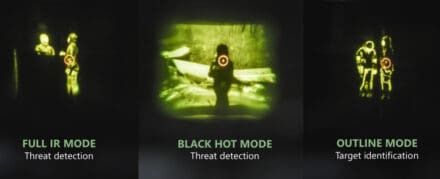
Designed for assault rifles and light ­machine guns, the IronSnake reflex sight offers a clear direct view channel ­ enhanced by high contrast thermal imagery and a configurable digital reticle.

Day or night, IronSnake can be used to identify and engage targets.

Developed in France in collaboration with BERTIN Technologies, IronSnake offers optimized ergonomics and compactness thanks to a combination of the latest technologies from France’s leading players in their field.

See IronSnake in the Safran booth #31108.

23 STS IDMT: ‘Knowing what to do and being ready can make all the difference’

Sunday, January 5th, 2025

HURLBURT FIELD, Fla. —

“Is there a doctor on board?”

Sitting in his aisle seat toward the back of a commercial flight, Air Force Staff Sgt. William Flaspoehler saw the flight attendants scrambling for help.

It was May 2023, and Flaspoehler was traveling to a deployed location in Southeast Asia.

He walked to the front of the cabin and found a 64-year-old woman, pale-faced, sweating and clutching her chest in pain.

After observing her symptoms, he checked the woman’s pulse and blood pressure.

“We need to divert and land as soon as possible,” he told the pilots, knowing the woman would soon go into cardiac arrest.

From there, Flaspoehler said he relied on both instinct and experience. He followed chest pain protocols, placed the passenger on oxygen and gave her aspirin and fluids. Next, he examined a bottle of nitroglycerin: a drug that could potentially stabilize the patient, but could also be lethal.

“I knew I had to do it,” he said. “It was stressful, but I knew she didn’t have much time.”

As the aircraft began its descent to the nearest airport, Flaspoehler worked to keep the woman alive.

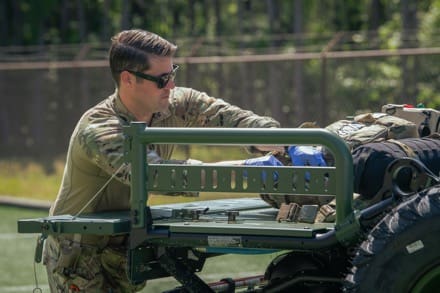
For Flaspoehler, an independent duty medical technician with the 23rd Special Tactics Squadron at Hurlburt Field, Florida, providing life-saving care is almost second nature.

His journey to that moment began years before he joined the military.

Before enlisting in the Air Force in 2016, Flaspoehler honed his medical skills as a civilian emergency medical technician in Los Angeles. Later, his career led him to a level-one pediatric trauma center at LA Children’s Hospital. There, he treated some of the most critically injured patients imaginable, he said.


“We responded to car accidents, fires, stabbings … pretty much everything imaginable,” he said. “As a whole, those jobs exposed me to a wide range of medical incidents.”

Flaspoehler said that one of those incidents in particular left him wanting something more in life.

One day, the former EMT found himself in the back of an ambulance, speeding through the streets of Los Angeles, treating a man bleeding heavily from a neck wound.

As he packed the wound to stem the bleeding, the same thought continued to flash through his mind: the injury was eerily similar to the one that had killed his friend, fallen Army Sgt. Michael Cable, who died in Afghanistan in 2013.

Flaspoehler said that in the moment, he tried not to think about Cable’s death. But afterward, he began to dwell on it. He couldn’t shake the feeling that he could be serving a greater purpose, he said.

“I wanted to be able to be there to see and treat my friends and brothers and sisters,” Flaspoehler said. “As a civilian, I was usually treating strangers. I wanted to be with a team and have the responsibility of taking care of them.”

That realization drove him to join the Air Force.

As part of the 23rd STS, Flaspoehler’s work is dynamic. His unit is tasked with missions involving austere airfield control, terminal attack control, personnel rescue and recovery, assault zone battlefield trauma care, and more.

In his role as an IDMT, he’s trained to establish medical treatment facilities in remote and hostile environments.

“I can run a 911 call, pick up an active duty patient, treat them as a paramedic, bring them to the emergency room and then treat them and discharge them,” Flaspoehler said. “This kind of position doesn’t really exist in the civilian world.”

He also provides medical support during high-risk activities like airborne jump operations and dives, and trains personnel on Tactical Combat Casualty Care to prepare them for potential life-and-death scenarios.

“One day, it could be their friend that needs help out there,” he said, referring to fallen Army Soldier Cable.

On the flight, the 64-year-old patient’s blood pressure and heart rate returned to healthier levels and the medicine reduced her pain.

Soon after, the flight landed in Kuching, Malaysia, where Flaspoehler helped first responders carry the woman off the plane and to an ambulance.

After arriving at his deployed location in Southeast Asia, Flaspoehler followed up on the patient’s status: the woman had survived after receiving additional care in Kuching.

“I felt relieved that I made the right call,” he said. “While it was something I had handled so many times before, I had never had to do something like this on a plane, in international waters.”

Ultimately, Flaspoehler said he credits the medical experience he gained as a civilian and in the Air Force.

“Knowing what to do and being ready can make all the difference.”

By SSgt Natalie Fiorilla
24th Special Operations Wing