BOSS-Xe from Wilcox Industries

Archive for the ‘Contracts’ Category

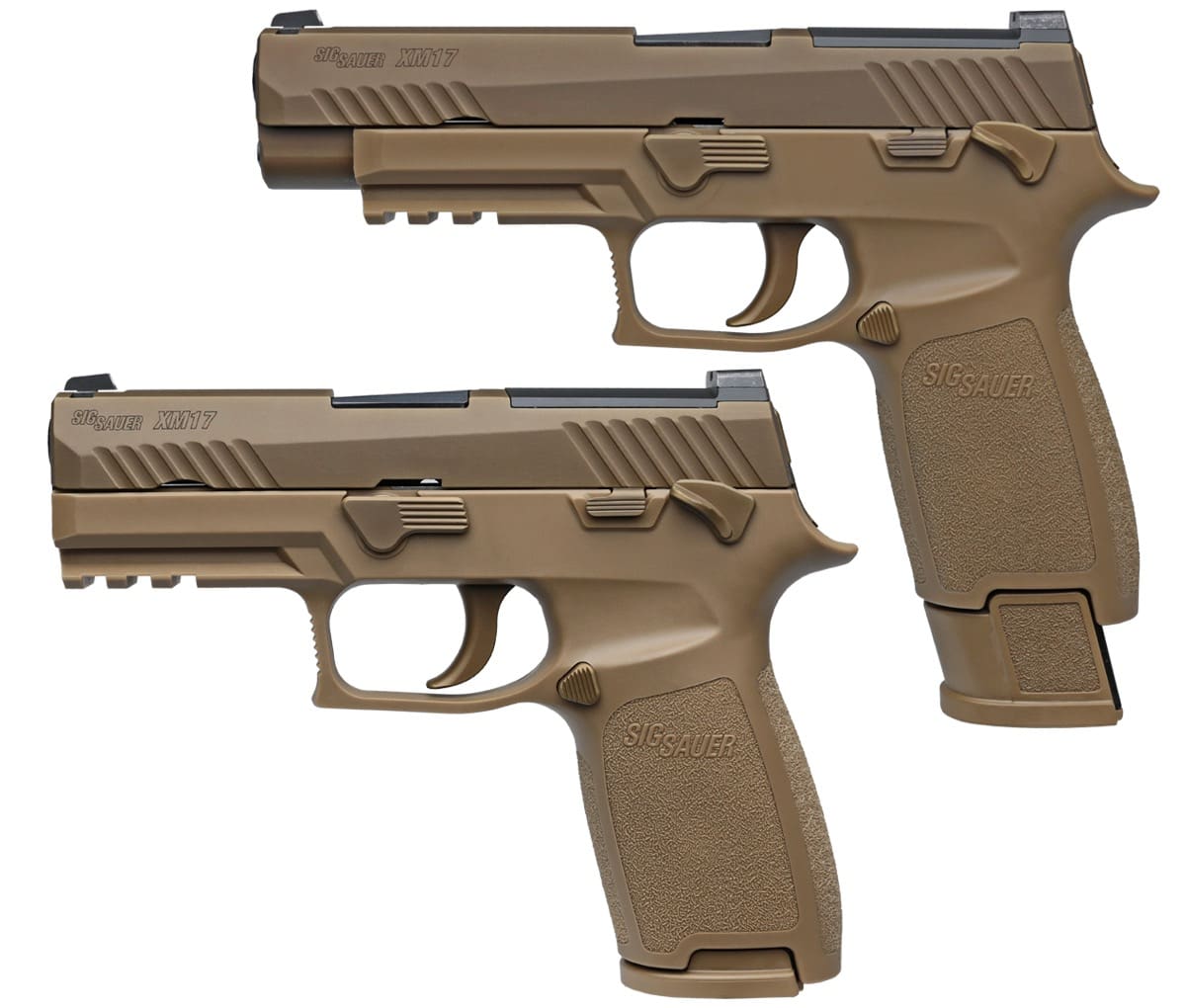
Army To Issue New M17 Modular Handgun To Ft Campbell Troops First

Wednesday, May 3rd, 2017

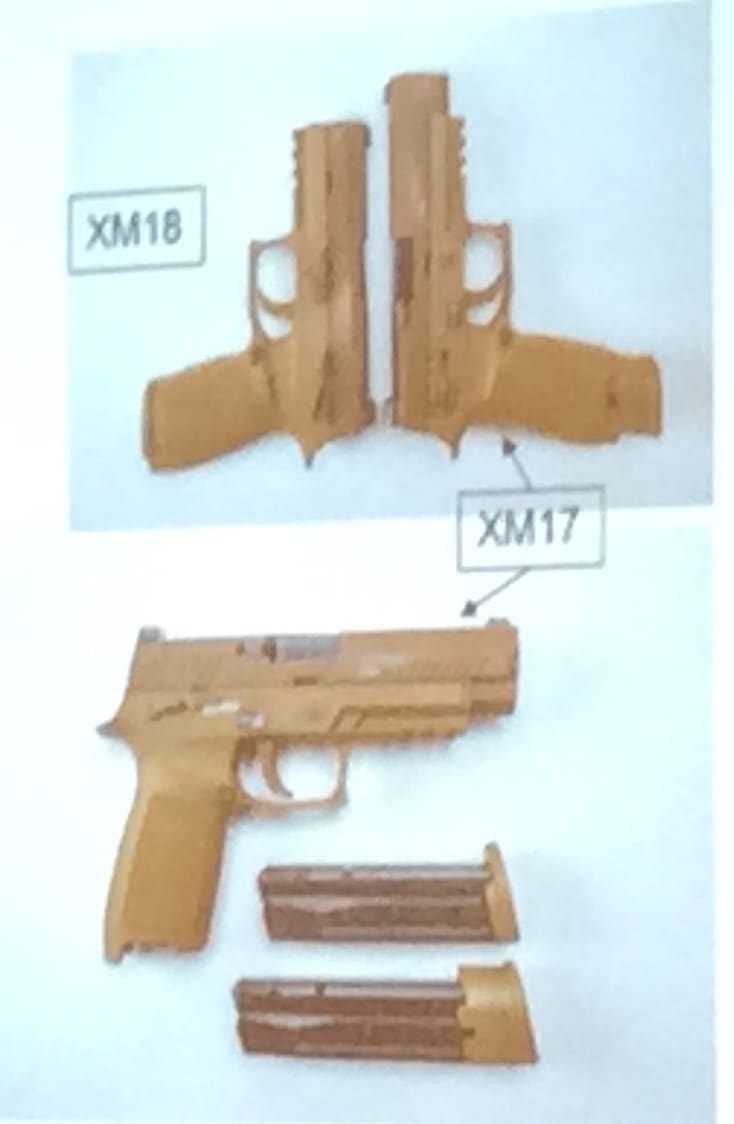
Earlier today at the NDIA Armaments Conference, PEO Soldier’s PM for Soldier Weapons, LTC Steven Power stated that the First Unit Equipped for the M17 Modular Handgun will be the 101st at Fort Campbell, Kentucky, during the first quarter of Fiscal Year 18. He also stated that other units on Fort Campbell would also receive the first of 190,000 Pistols the Army plans to buy.

In addition to multiple other Army units on the post, the 5th Special Forces Group ( Airborne) and elements of the 160th Special Operations Aviation Regiment are also there. Yesterday, USASOC Deputy Chief of Staff for Requirements (G8), COL Samuel Ashley stated that despite adoption of the GLOCK 19 by elements of the command, it was part of the Army’s fielding of the M17 as a replacement for their M9 pistols.

IMG_1388

In January during SHOT Show, the Army selected the SIG SAUER P320 as its new modular handgun. However, in Februrary, GLOCK protested the award. The GAO has until 5 June to make a decision on whether or not to sustain the protest. Despite this, the Army has developed a fielding plan for the new pistol, no matter who produces it.

USSOCOM Seeks Advanced Technologies

Tuesday, April 25th, 2017

USSOCOM Science and Technology Directorate’s (SOF AT&L-ST) has issued addendum J of their Broad Agency Announcement for advanced technologies. The directorate’s vision is to Discover, Enable, and Transition technologies to provide an asymmetric advantage for Special Operations Forces (SOF). SOF AT&L-ST has identified specific technology Areas of Interest to accelerate the delivery of innovative capabilities to the SOF warfighter.

Fires/Scalable Effects Weapons (SEW):
USSOCOM seeks to study, design, develop, and demonstrate advanced technologies associated with the application of fire from non-lethal through lethal. These technologies include, but are not limited to, weapons, munitions, and fire control, with the major development goals being lighter weight, lower cost of ownership throughout the entire lifecycle of the product, and increased effectiveness. Highly desired are:

Improved Effectiveness of Fragmentation Weapons. Alternatives to existing fragmentation weapons, or weapons where the casing is shattered upon detonation, and identifying munitions with greater effectiveness while applying the FBI standard for bullets (10-12 in penetration of tissue simulant) in the design of fragmentation munitions. The technology and approaches should assess what industries such as aerospace, automobile manufacturing and other non-ordnance suppliers have available or in development that applies to the needs. Specifically desired are:

Analysis of alternatives on potential of fragmentation weapons.

Enhanced 40mm x 46xx fragmentation grenade. USSOCOM is interested in an enhanced 40mm x 46mm cartridge propellant system that optimizes the acceleration curve enabling heavier payloads at current ranges or current payloads a longer range while remaining within current pressure and recoil limits. Peak chamber pressure is approximately 2320-3000 psi depending on barrel material and thickness. Recoil safety limit is 45 ft-lbs to 50 ft-lbs. USSOCOM is interested in increasing the lethal area of a 40mm x 46mm fragmentation projectile with enhanced energetics and optimize controlled fragmentation. USSOCOM defines lethal area as having a minimum of 2 fragments per square meter and 90% of those fragments penetrating 12 inches of 10% tissue simulant.

Payload Development. Technologies that can be employed as a payload to stop/disable maritime vessels and that can be delivered from an unmanned underwater vehicle (UUV). The payload can deliver a non-reversible effect, however, the effect should not betray hostile intent. Technologies/payloads that can be transported in a UUV compartment and can be exposed to a harsh, marine environment. Technologies/payloads should stop a vessel less than 50 meters long.

Human Performance
USSOCOM seeks to conduct research, design, development and demonstration of capabilities that enhance physiological, physical, psychological, and intellectual performance, and improve resistance to disease, stress, or injury caused by the demands of sustained operations in extreme environments. Highly desired are:

Performance Enhancements. Innovative solutions that will optimize human performance, reduce recovery time, and increase peak performance sustainability, including increased endurance, strength, energy, agility, enhanced senses, provide restorative effects of sleep, and enhance tolerance to environmental extremes. The technologies can be demonstrated through studies that provide proof of concepts or through solutions demonstrated in humans that quantify operational performance improvements. Technologies should not consist of new software applications, wearables, and additional studies on existing nutraceuticals that have been previously researched in depth. SOF AT&L-ST is specifically interested in:

Genomics, epigenetics, proteomics, and synthetic biology

Nutraceuticals and/or pharmaceuticals

Enhancing metabolic efficiency

Methods of improving oxygen delivery to muscles

Reducing the potential for musculoskeletal injury

Increasing tolerance to pain

Cognitive Enhancement

Sleep Restoration

Submissions should consider methods of demonstrating safety and efficacy, and a regulatory approval strategy if required. Proposed solutions do not have to be FDA cleared as a prerequisite, but nutraceuticals and/or pharmaceuticals must be US-sourced. Submitters should have access or partners with access to lab facilities.

Protection
USSOCOM seeks to conduct research, development and demonstration of advanced technologies associated with protecting the future dismounted SOF Operator. These technologies include, but are not limited to, ballistic body armor, helmets, and eye protection, with the major development goals being lighter weight and increased protection. SOF AT&L-ST is specifically interested in chemistry and microstructure improvements for advanced armor materials, including the following:

Mechanical property enhancements in existing armor ceramics through microstructure modifications

Development of new ceramic armor materials

Continued optimization of fiber-based armor materials, to include aramids, ultrahigh molecular weight polyethylene, and their associated resin systems

Investigations into additive manufacturing of armor materials (metals, polymers, and ceramics)

Thin, lightweight and low-cost transparent armor (polymer, glass and ceramic based solutions)

While the main focus of the research should be development of advanced armor materials, other considerations include projectiles of interest (7.62 x 39 mm MSC at 2400-2450 ft/s, 7.62 x 39 mm API BZ at 2400-2450 ft/s, 7.62 x 54R mm API B32 at 2850-2900 ft/s, and 7.62 x 51 mm AP M993 at 3050-3100 ft/s), a final system thickness of less than 1.0 inch, backface signature performance of less than 44.0 millimeters at the velocities listed above, and an ultimate goal of areal density reduction (with similar or improved ballistic performance).

Optical Electronics
USSOCOM seeks to conduct research, design, develop, and demonstrate advanced technologies associated with target engagement, intelligence, surveillance & reconnaissance, and neutralization of opposing force capabilities. These technologies include, but are not limited to, optics, lasers, sensors, and radar, with the major development goals being transition to the field within 5 years, backwards compatible with existing infrastructure, and do not require a significant cost investment to produce and sustain. SOF AT&L-ST is specifically interested in:

Observer to Point of Interest: Ground-to-Ground/Air-to-Ground

Man Portable Equipment and Turrets / Pods to Tower-Test

Characterization Abilities: Ability to identify and detect persons or objects of interest, identification of and thru material layers

Technologies that can be employed to effect long range enemy identification, to include laser vibrometry. Specific distances have yet to be determined, but should work outside the signature ranges of Intelligence, Surveillance and Reconnaissance (ISR) platforms to ensure surreptitious collection

Interested parties must submit whitepapers for this BAA Addendum which closes on June 5, 2017, at 11:59 p.m. EDT. USSOCOM may select some candidates which will then be funded up to $3m and given up to three years of development.

For full details, visit www.fbo.gov.

INVISIO Receives Additional Order from the UK Ministry of Defence Worth About SEK 15 Million

Monday, April 24th, 2017

INVISIO announced today that the initial order from the UK Ministry of Defence (MOD) worth about SEK 90 million was extended by an additional SEK 15 million order, which means that the contract value now amounts to approximately SEK 105 million. Deliveries will begin in the second quarter of 2017.

The contract with the British Ministry of Defence was announced on March 9, 2017, and comprises hearing protection and communication ancillaries for specialist land, maritime and air applications. The contract is for four years with options for a fifth year and a complete mid-life enhancement at two and a half years.

The contract follows previous MOD contract awards for hearing protection, THPS, announced in 2015.

The order was through INVISIO’s UK based partner Marlborough Communications Ltd (MCL).

USSOCOM Issues Presolicitation for SPEAR Family of Tactical Headborne Systems

Friday, April 14th, 2017

Recently, United States Special Operations Command (USSOCOM) issued a presolicitation notice to industry for a Commerical-Off-The-Shelf Special Operations Forces Personal Equipment Advanced Requirements (SPEAR) Family of Tactical Headborne Systems (FTHS)-Ballistic and Non-Ballistic Helmets. The FTHS-Ballistic and Non-Ballistic Helmets will consist of a ballistic helmet system as well as a non-ballistic helmet system.  

The government intends to award a five-year Indefinite Delivery Indefinite Quantity (IDIQ) Firm Fixed Price (FFP) production contract for a fully developed item to the offeror with the best value to the Government. This is not a R&D contract; the offeror must be the Original Equipment Manufacturer (OEM) and have an existing U.S. verifiable production line for any product proposed under this solicitation. All offerors must submit a proposal for both helmet systems; partial proposals will not be accepted. The helmet systems must meet the performance requirements as outlined in the Performance Specification and meet the requirements set forth in the Berry Amendment.

The acquisition will utilize full and open competition and the final solicitation is expected to be released this month. The minimum contract value will be $150K and the maximum contract value will be $95M.

Offerors will be required to submit Product Demonstration Models (PDMs) with proposal submission for evaluation. In addition, the Government may procure additional PDMs for testing purposes as part of this solicitation. These PDMs will be purchased from only those vendors remaining in the competitive range. Word is, the Government wants each offeror to submit in excess of 300 sample helmets, cost free. That’s a serious outlay to participate, considering the offeror may walk away empty handed.

It is important to note that these helmets are not the same as the Next Generatin SOF Helmet examples produced last year by Ops-Core and Revision.  Instead, these will be much more evolutionary in nature, bringing new materials and improved fit in packages much more like SOF currently use.  For example, this procurement is looking for solutions that include ballistic and bump shells, suspension systems including left and right eye dominant straps, accessory rails, exterior Velcro kits, 3M Peltor Accessory Rail Kit, and helmet covers.  Interestingly, SOCOM is said to be looking for a new hearing protection system soon making the interest in a 3M Pelton mount interesting.  Additionally, the offeror must propose a 3-Hole VAS shroud, provide the Wilcox G24 VAS mount, 4-Hole GSGM VAS Shroud, Wilcox GSGM VAS Mount, and the helmet itself must be compatible with currently fielded shrouds.  Kind of makes you think there should be a move to a more common VAS Shroud.  However,  another procurement is expected later this year for a separate SOF coxswain helmet which will likely include a bump helmet with ballistic appliqué upgrades as well as a mandible guard.

For additional details, visit www.fbo.gov.

USAF Standing Up MFF Parachutist Course For Battlefield Airmen

Thursday, April 13th, 2017


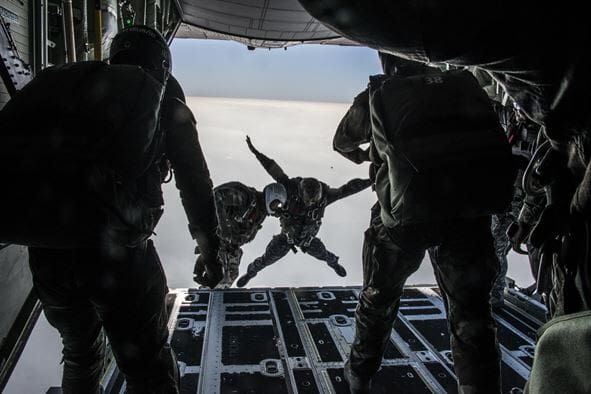
(USAF photo by Capt Jessica Tait)

Despite a couple of delays, the US Air Force is closing in on standing up a Military Free Fall Parachutist qualification course for its Battlefield Airmen. Like the US Navy’s course, it will be run by contractors, and the curriculum will be certified by USSOCOM and USASOC as well as AETC. Unlike the USN course, students will not earn their Static Line parachutist qualification, but will already be graduates of the Ft Benning course upon attendence of the AF MFF course. Students will meet all of the standards of the Army MFF course, but it will be conducted at a contractor facility, utilizing contract aircraft.

MFF training is an initial skills course that provides academic, ground, vertical wind tunnel/simulation, and military freefall training to first time jumpers that meets United States Special Operations Command/United States Army Special Operations Command (USSOCOM/USASOC) curriculum requirements.

Sister service parachute training has been stood up due to limited availability of course quotas for the Army MFF course. The Navy has been using a contractor run course for over a decade and added S/L training to their parachutist course because the Ft Benning curriculum lasts three weeks. While NSW primarily conducts MFF parachute ops, they certify their students in S/L procedures within the first few days of their training course.

Final contractor proposals are due on 2 May, 2017. Hopefully, we’ll see a pilot course before the end of the fiscal year.

Propper Awarded New Army Boot Contracts

Wednesday, April 12th, 2017


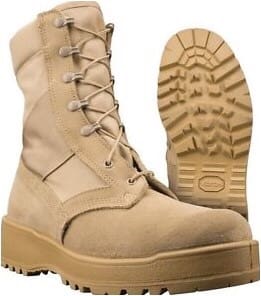
St. Charles, MO — Propper International has won two new contracts to supply hot weather boots to the United States Army and the Afghanistan military. The new three-year contract was awarded by the Defense Logistics Agency after an extensive bidding process.

The boots will come in two colors: tan for the US Army and black for the Afghanistan military. The contracts, totaling just over $48 million, will run through fiscal 2020. The boots will be manufactured in Propper’s Puerto Rico facilities.

“The new boot contract extends Propper’s five-decade commitment to those who serve,” said Anderson Ward, SVP of Global Supply Chain Operations for Propper. “We are proud to continue the long-standing tradition of supplying our fighting forces with dependable and rugged gear.”

Propper has proudly supplied the US military with uniforms and gear since 1967. Today Propper is the country’s largest supplier of ACUs and BDUs.

www.propper.com

US Secret Service Issues Pre-solicitation For New Carbine

Tuesday, April 11th, 2017

This week, the Department of Homeland Security’s United States Secret Service issued a pre-solicitation for a new rifle in 5.56x45mm. There are no set asides and they anticipate an open bid process with a contract award for a five year IDIQ.

The United States Secret Service has a requirement for 5.56 x 45mm rifle, equipped with full- and semi-automatic firing capability. USSS seeks to establish a single-award Indefinite-Delivery, Indefinite-Quantity (IDIQ) contract vehicle for a period of five (5) years. The Draft Statement of Requirements is attached as reference for potential offerors and is subject to change at the time of solicitation posting. This Presolicitation notice is associated with a Request for Information notice posted March 11, 2016. The anticipated award will be made in Fiscal Year 2018.

The weapon itself is pretty straight forward. They want an ambidextrous carbine. Interestingly, they will only accept Magpul PMAGs as magazines. Additionally, testing will be conducted while wearing Mechanix Wear Vent gloves.

According to the notice:
The weapon shall be operable, without modification or alteration, by a right or left-handed user, firing with the right or left hand, depending on handedness.

All external metal parts of the weapon shall have a dark subdued, rust/corrosion resistant finish. The finish shall be unaffected by commercially available gun cleaning solvents, such as Simple Green, used in heated ultrasonic cleaning tanks. Flaking, peeling, blotching, etc. of the finish is unacceptable.

The weapon shall be chambered in accordance with current U.S. Military specifications for 5.56 x 45mm, and function with assorted ammunition ranging in weight from 55 to 77 grains (to include all common SAAMI-spec and Mil-Spec ammunition) as well as frangible ammunition.

Dimensional Requirements:
Height (no taller than, sights folded, w/o accessories or magazine) 8.5 inches
Weight (no heavier than, w/o accessories) 7.5 pounds
O/A Length (no longer than, w/stock fully extended) 34 inches
Barrel length (min – max) 10-12 inches
Rifling (5.56) 1 turn 7” inch twist RH

Operating System.
The weapon shall utilize a direct-impingement gas-operated system or a short- stroke gas piston system.

Barrel.
The barrel shall have a minimum service life of 15,000 rounds.
Barrel service life is defined as a not exceeding 5 Minutes-of-Angle (MOA) and exhibiting no more than 125 ft/sec decrease in velocity (in accordance with USSS velocity testing procedures), with observance of offeror’s submitted maintenance protocols.
The barrel shall be free of cracks, seams, and other injurious defects and the bore and chamber shall be free of pockets, rings, bulges, and other deformations. The bore and chamber shall be chromium plated, or of equivalent corrosion resistance. Any coating in the chamber and bore shall be free of nodules, flaking, pits, stripping, anode burrs and evidence of etched base steel. Burrs and sharp edges shall be removed from the chamber edges, and bolt locking lugs.
The muzzle of the barrel should bear a thread size of 1?2” x 28 tpi, with shoulder geometry of
90 deg.
The muzzle should be equipped with a flash hider device, installed with shims as necessary.
Crush washers are not acceptable.
Mode of Fire. The weapon shall be selective fire, i.e. semi-automatic and full automatic. A “burst limiter” in the full-automatic mode is not acceptable.

Fire Selector.
The fire control selector shall be ambidextrous in design, and be a single lever paddle mounted on the side of the receiver, adjacent to the rear pistol grip, thereby not requiring the shooter to significantly break their firing grip when actuating.
The fire control selector shall be a rotary type and shall have three positions; safe, semi- automatic and automatic and shall rotate manually without binding from one position to another when the hammer is cocked. The selector shall remain in place in each position by a perceptible spring detent load until manually reset.

Trigger.
With the hammer cocked, when the selector is placed in the “SAFE” position, it shall prevent the trigger from releasing the hammer so that the weapon is incapable of being fired.
When the selector is placed in the “SEMI AUTOMATIC” position, it shall have a disconnect, so that the weapon is capable of semi-automatic fire only (one shot with each pull of the trigger).
When the selector is placed in the “AUTO” position, the weapon shall be capable of automatic fire (continuous firing until the trigger is released or all cartridges are expended) at a rate of no less than 600, and no greater than 900, rounds-per- minute, while utilizing M193 ammunition.
The trigger shall hold the hammer in the cocked position until the trigger is pulled. After partial or complete trigger pull, the trigger shall return to its normal forward positions (cocked and uncocked) under spring action.
The trigger pull shall not measure less than 4.0 pounds, nor more than 6.5 pounds, regardless if the fire selector is set on semi or full-automatic fire.
The trigger configuration shall be two-stage with no adjustment screws or set screws.
The trigger shall have a smooth face, cannot be wider than the trigger guard, and shall be the only control inside the area enclosed by the trigger guard. Any other controls (bolt catch/release, magazine/catch release, etc.) inside the area enclosed by the trigger guard are not acceptable.
While utilizing gloves, the trigger shall not pinch the trigger finger between the trigger and the side of the receiver or between the trigger and the inside bottom of the trigger guard. Any manipulation/modification to the trigger guard to meet this requirement is not acceptable.

Charging Handle.
The charging handle shall be situated in the upper receiver. The charging handle shall not reciprocate with the bolt when the weapon is fired. The charging handle shall be capable of being operated with one hand while the shooters other hand is grasping the pistol grip or forend grip.

Bolt Hold-Open Device.
The rifle shall be equipped with a magazine activated bolt hold open device. The bolt hold open device shall also be capable of being activated manually by the operator. When the bolt hold open device is activated by the magazine follower and the magazine is subsequently removed, the bolt shall remain in the rear or open position. When the bolt is in the rear or open position and a full magazine is inserted, the bolt shall remain in the rear or open position until the operator manually activates the bolt release. When the bolt catch is released, the bolt shall return to the battery position. Upon release, the bolt shall strip a round from the loaded magazine and load it into the chamber.

Magazine.
The weapon magazine well shall be compatible with the standard NATO STANAG 30 round M16 series magazine (NSN 1005-01-561-7200) and the Magpul PMAG 30 AR/M4, 5.56×45 Magazine (NSN 1005-01-628-5106 and NSN 1005-01-615-5169).
Only the Magpul PMAG 30 AR/M4, 5.56×45 Magazine (NSN 1005-01-615-5169; Mfr Part # MAG556) will be acceptable for solicitation submission and subsequent testing.
The magazine release shall securely retain the magazine in the magazine well. The magazine (whether empty or full) shall fall free from the magazine well once the magazine release button is activated without any further operator assistance. The magazine release button shall be spring loaded and the design of the receiver shall provide some shielding against inadvertent activation when placed against standard USSS uniform and/or body armor. The activation of the magazine release button shall be accomplished with minimum effort by the operator with only one hand.
The magazine should reliably feed all types of ammunition utilized in the USSS Evaluation and Testing protocols.
Magazines shall contain an anti-tilt follower that shall be able to activate the weapon’s bolt hold open device after the last round in the magazine is fired.
The magazine shall be capable of being inserted directly into the magazine well by the operator with one hand, and without any “rocking” type motion.

Lower Receiver.
The lower receiver shall have a permanently affixed plate, label, or laser- etching, displaying a QR code or barcode, readable via commercially-available optical reader. This code shall be embedded with information specific to the host firearm, including (but not limited to) make, model/variant, and unique serial number.

Upper Receiver.
The weapon shall be equipped with a Mil-Std-1913 Picatinny attachment rail on the top of the receiver for mounting of optics, iron sights, lasers, etc.

Forend/Handguard.
The weapon shall have a modular free-floating handguard assembly measuring no less than 9.0 inches of functional/configurable railspace (measured along the 6:00 o’clock position of the rail).

The handguard assembly shall have the ability to attach Mil-Std-1913 Picatinny rail segment along the length of the handguard at the 3:00, 6:00 and 9:00 o’clock positions simultaneously. The manufacturer shall provide a sufficient quantity of rail segments to cover the length of the handguard at the 3:00, 6:00 and 9:00 o’clock positions simultaneously. Handguards with permanently attached Mil-Std 1913 Picatinny railssections the length of the handguard at the 3:00, 6:00 and 9:00 o’clock positions shall also be considered.
When assembled to the weapon, the upper most rail of the free-floating handguard assembly shall align and be at the same height as the rail on the receiver. A one piece receiver/handguard assembly is acceptable as long as the barrel is free-floating, the above rail positioning interfaces are present, and handguard portion meets the minimum length requirement detailed in Section 2.

Pistol Grip.
The rear pistol grip shall be securely attached to the lower portion of the receiver and shall not interfere with the operation of the selector lever. If applicable to the submission, vendor shall provide interchangeable rear pistol grip adapters (backstraps).

Butt-Stock.
The butt stock shall be quickly adjustable for length of pull without the use of any tools. The butt stock shall have, at minimum total of four positions, including fully extended and fully collapsed.

Backup Sights.
When utilized, the front/rear ‘backup’ sights shall be viewable through an Aimpoint Model T2 while mounted on a suitable optic-specific commercially available sight mount.
The front sight shall be a folding locking type, capable of being locked in both the up and down positions (lever lock, friction lock, spring detent, etc.). The front sight shall be located at the front of the weapon either on top of the gas block or at the end of the rail on the hand guard. The front sight shall be a post profile type, adjustable for elevation as part of operator zeroing procedures. The profile of the sighting portion of the post shall be .050 to .075 inches in thickness. At no time shall the sight unlock from its position as a result of firing the weapon.
The rear sight shall be a folding locking type, capable of being locked in both the up and down positions (lever lock, friction lock, spring detent etc.). The rear sight shall be an aperture type, adjustable for windage and elevation as part of operator zeroing procedures. At no time shall the sight unlock from its position as a result of firing the weapon.

Sling Mount.
The weapon shall be supplied with means to mount a sling to, at minimum, the rear area of the receiver and the handguard, via quick-detach sling swivel. All sling mounting/attachment points will be required to be rotation-limited (4-position) quick-detach cups, to allow interface with quick-detach push button swivels.

For full details visit www.fbo.gov.

USSOCOM Releases Sources Sought Notice for Advanced Sniper Rifle

Monday, April 10th, 2017

USSOCOM is seeking sources within the national technology and industrial base for a Commecial Off The Shelf convertible caliber rifle which will serve as the replacement for the Precision Sniper Rifle system.

They are interested in:
-complete system to include all 3 caliber conversion kits
-any tools needed to complete the conversion
-a light/sound suppressor that can be attached to the system when needed

ASR System specifics: The system must be adaptable to fire the 7.62mm NATO, .300NM, and .338NM cartridges. The system must have total system weight, less suppressor and with unloaded magazine, not to exceed 17lbs (T), 13lbs (O). Length with stock extended, less suppressor, not to exceed 50″(T), 40″(O), length for transport, by means of folding or collapsing shall be 40″ (T), 36″ (O). Accuracy shall be:

Configuration Precision
7.62 mm 1.0 MOA (ES) at 328 yards (300 meters) (T) 0.5 MOA at 328 yards (300 meters) (O)
.300 NM 1.0 MOA (ES) at 328 yards (300 meters) (T) 0.5 MOA at 328 yards (300 meters) (O)
.338 NM 2.5 MOA (ES) at 328 yards (300 meters) (T) 1.5 MOA at 328 yards (300 meters) (O)

For thise of you unfamiliar, T means Threshold or the miminum acceptable performance, while O means Objective which is where they’d really like to be. As they haven’t specified a specific cartridge, the accuracy specifications at this point are much more subjective.  They desire full systems, including suppressor, but SOCOM is simply looking for potential solutions for this emerging requirement at this stage in the game. Eventually, they’ll either specify cartridges they plan to use or open it up the various offers as part of the solicitation.  However, the caliber choices are very interesting. Not only are the Norma Magnum cartridges not standard military fare, consider a single chassis that will accept 7.62 NATO along with .300 NM and .338NM.

Offerers have until 24 April, 2017 to provide information to USSOCOM, which isn’t much time at all.

Visit www.fbo.gov for more information.