TYR Tactical

Gentex Corporation Announces New Ops-Core AMP Rail Mount with Vent Mode, Increasing User Comfort Without Sacrificing Communication

January 27th, 2026

CARBONDALE, PA, January 26, 2026 – Gentex Corporation, a global leader in personal protection and situational awareness solutions for defense forces, emergency responders, and industrial personnel, announced today the launch of the newOps-Core AMP Helmet Rail Mount with Vent Mode for its industry-leading AMP Communications Headset. Designed and developed directly with end-user input, this enhanced productpreserves the trusted quality, form factor, adjustability, and durability of the original Helmet Rail Mount Kit while introducing enhanced airflow, comfort and stability.

The new AMP Helmet Rail Mount Kit with Vent Mode introduces a three-position system: Deployed, Vented, and Stowed. This configuration gives warfighters better control over comfort, ventilation, and communication capability in real time.

In the new Vent Mode position, the earcups shift slightly off the ears to improve airflow and relieve seal pressure while still allowing effective monitoring of communications. Importantly, Ops-Core Near Field Magnetic Induction (NFMI) Earplugs remain fully engaged in Vent Mode, providing increased noise reduction while preserving clear communications and 3D Hear-Through when used with NFMI-enabled Ops-Core headsets.

“Our customers operate in the world’s most demanding environments, and their feedback is crucial for innovation,” said Peter Harbeck, Segment Director – SOF at Gentex Corporation. “The AMP Helmet Rail Mount Kit with Vent Mode is a direct result of listening to operators who needed a better way to manage heat and comfort without losing communications. We’ve kept the same rock-solid durability and adjustability of the original design while adding an essential enhancement.”

The new rail mount maintains the same familiar form factor, world-class durability and rugged performance as the original AMP Rail Mount. It is designed to offer increased stability during dynamic movements and remains fully compatible with Ops-Core NFMI Ear Plugs for double hearing protection. The AMP Rail Mount with Vent Mode is available in three colors: tan 499, black, and ranger green.

To learn more about the AMP Rail Mount with Vent Mode, click here.

Fort Bragg Opens Lieutenant General Gavin Joint Innovation Outpost

January 27th, 2026

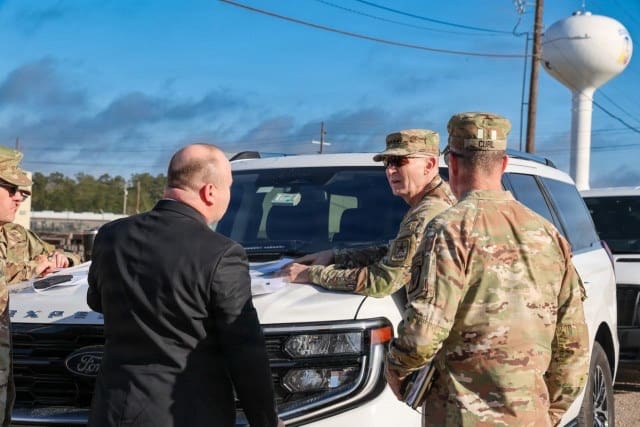
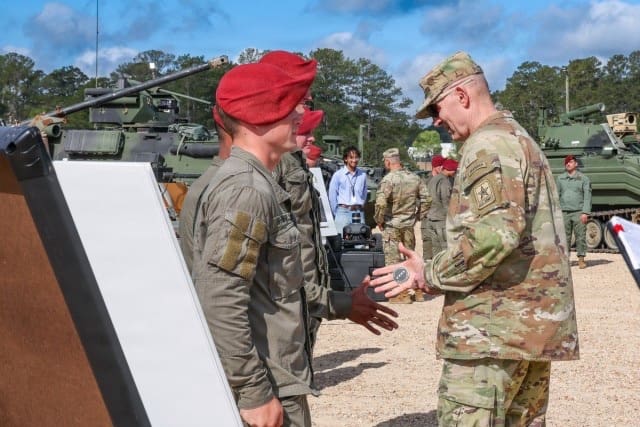
FORT BRAGG, N.C. — In support of the Department of War’s transformation initiative, Fort Bragg and the XVIII Airborne Corps officially opened the Lt. Gen. James Gavin Joint Innovation Outpost on January 23, 2026.

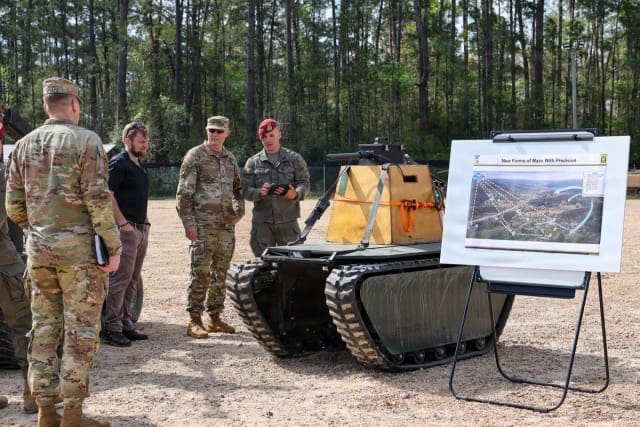
As the first facility of its kind, building on U.S. Army Division innovation labs, the JIOP serves as a center that bridges tactical and operational challenges with rapid innovative solutions. Designed as a hub for military personnel, academia, and industry, the JIOP aims to collaboratively address problems faced on the modern battlefield.

The facility is named in honor of Lt. Gen. James Gavin, who commanded the 82nd Airborne Division during World War II, leading the division through pivotal moments such as D-Day, Operation Market Garden and the Battle of the Bulge. Following World War II, Gavin became the head of U.S. Army Research and Development and was renowned for his innovative concepts, including the use of helicopters to transport infantry ? air assault ? and the development of modern air cavalry.

“We are honored to name this facility after Lt. Gen. James Gavin, a true visionary who understood the importance of innovation,” said Lt. Gen. Greg Anderson, XVIII Airborne Corps commanding general. “The JIOP will carry on his legacy by fostering the kind of bold thinking and collaboration that he championed throughout his career.”

Appropriately named after Lt. Gen. Gavin, the JIOP focuses on rapid innovation for the modern and future global battlefields.

“The future of warfare is here,” said Rob Braun, XVIII Airborne Corps Chief Technology Officer. “It’s driven by technology and success is impossible without partnerships. The Lt. Gen. James M. Gavin Joint Innovation Outpost is an investment in that future, where we will develop and test cutting-edge capabilities while forging enduring new partnerships with the best of the military, industry, and academia to meet the future head on.”

While the U.S. Army currently collaborates with industry through the Assistant Secretary of the Army for Acquisition, Logistics and Technology office, the JIOP represents the first concerted effort to focus on rapid innovation coordinated with industry and academia at the operational level. The JIOP will connect Soldiers from all ranks and levels to innovative teams capable of developing solutions for current battlefield challenges.

“Every piece of technology we develop at the JIOP has one ultimate purpose: to enhance the lethality and survivability of our Soldiers on the battlefield,” said Col. Thomas Monaghan, director of the Joint Innovation Outpost. “This is about ensuring our warfighters can dominate any adversary, anywhere in the world.”

In addition to addressing modern battlefield problems, the JIOP will foster and strengthen ties between Fort Bragg and regional academic and industrial partners. “At the JIOP, we are creating a dynamic ecosystem where our Soldiers can collaborate directly with the brightest minds in industry and academia,” said Anderson. “This partnership is essential for accelerating innovation and maintaining our competitive edge.”

In recent years, Fort Bragg and the XVIII Airborne Corps have led the way in Soldier innovation through events like Dragon’s Lair and exercises such as Scarlet Dragon. Dragon’s Lair is a competition similar to Shark Tank, where Soldiers pitch innovative technological solutions that range from battlefield applications to improvements in daily quality of life. Scarlet Dragon involves industry partners field testing new technologies with the XVIII Airborne Corps and its subordinate units.

Looking ahead, Dragon’s Lair will feed the JIOP with innovative ideas, which will then flow into Scarlet Dragon for testing, creating a quick, tri-series process to rapidly address challenges for Soldiers in modern and future combat environments. “Fort Bragg has always been a proving ground for Army innovation, and the JIOP is the next chapter in that legacy,” added Monaghan.

MAJ Matthew St. Clair

Standardising the Edge

January 26th, 2026

~ How rugged USB-C connectors power interoperability across C5ISR systems ~

Modern defence operations rely on seamless communication across land, sea, air, space and cyber domains. As joint and coalition missions become more complex, the systems behind them need to connect, share data and adapt in real time. These demands are driving significant changes in how defence communications are designed and deployed.

Rugged USB-C connectors, originally developed for everyday electronics but now built to military-grade standards are becoming key to this evolution. They simplify system integration and help maintain connectivity at the tactical edge. Here, Alex Raymond, European product manager at military connector specialist PEI-Genesis explores the growing importance of USB-C connectors in C5ISR systems.

C5ISR, short for Command, Control, Communications, Computers, Cyber Defence, Intelligence, Surveillance and Reconnaissance sits at the core of today’s defence strategies. It includes everything from rugged laptops and tablets to target acquisition systems and command post shelters.

To perform reliably, C5ISR platforms need physical infrastructure that supports power, data and video transmission under harsh conditions. Rugged USB Type-C connectors for harsh environments deliver all three in a compact, robust format, streamlining integration while enhancing system reliability, connectivity and upgradeability in the field.

The importance of USB-C connectors

Traditional military connectors are often custom-built for specific equipment. While durable, these connectors often make it harder for systems to work together, especially in joint-force operations where interoperability is critical. USB-C takes a different approach. It offers a standard, universal interface that supports multiple functions. When housed inside a ruggedised, military-grade shell, it holds up in demanding environments and reduces the number of connectors and cables needed in the field.

This kind of consolidation is particularly useful in environments where space and weight are limited, like soldier-worn equipment, UAV control units or tactical command systems inside armoured vehicles. Rather than relying on separate ports for power, data and video, a single USB-C connection can handle all three. That streamlines the hardware layout, cuts down on design complexity and makes it easier to build modular systems that can be upgraded or adjusted without a full redesign.

Simplifying the connector setup also delivers practical benefits in the field. Fewer cable types mean more efficient logistics, faster deployment, and quicker turnaround on repairs, all of which are critical when operations are time-sensitive and conditions are unpredictable.

Supporting open architectures

As defence agencies move toward open systems architectures like CMOSS in the US and LOSA in the UK, the goal is to make systems more modular, upgradeable and interoperable. This shift allows military platforms to incorporate new technologies more rapidly, rather than waiting for lengthy redesign cycles.

The move toward modular system design is playing a key role in speeding up digital transformation across the defence sector. As technologies like software-defined radios, edge computing and real-time analytics become more widespread, the need for adaptable hardware is growing. Rugged USB-C connectors help meet that need, giving operators the flexibility to add or replace components without having to rework entire systems.

This trend is also influencing how engineers approach field readiness. USB-C connectors streamline setup and help cut down on errors by combining multiple functions into a single port. For personnel operating under pressure, being able to plug in one cable instead of managing several, cuts down failure points and gets systems operational faster.

This kind of straightforward, operator-first functionality is becoming a key consideration in procurement, especially as defence programs aim to boost agility and ease the demands placed on frontline units.

Enhancing sustainability and lifecycle support

A strategic advantage of USB-C standardisation lies in how it supports equipment lifecycle and sustainability. By offering a universal connection across multiple systems, USB-C reduces the need for bespoke, platform-specific components. This lightens the load on supply chains and makes field maintenance more efficient.

With fewer distinct parts to manage, armed forces can maintain higher readiness levels and lower overall support costs. It also aligns with long-term upgrade plans, where new technologies can be integrated into older platforms without requiring complete system overhauls. That combination of operational efficiency and reduced hardware waste offers both practical and environmental benefits.

Amphenol Socapex’s USB-C connectors deliver the full capabilities of USB Type-C, including high-speed data, power delivery and video transmission within a rugged MIL-DTL-38999 Series III shell. Built for extreme environments, these connectors feature IP68 sealing, EMI shielding and resistance to vibration and corrosion, making them the perfect choice for use in demanding defence applications.

PEI-Genesis supports system integrators by offering rapid connector assembly, expert engineering support for complex requirements and value-added services,such as connector modification and custom cable assembly. This ensures quick, dependable integration across both legacy and mixed-technology defence systems.

As the battlefield becomes more digital and decentralised, small hardware decisions have big strategic effects. Rugged USB-C delivers a compact, flexible solution for simplifying system design, supporting modularity and improving cross-domain connectivity. These connectors are helping defence organisations align with the demands of agile, multi-domain operations.

To find out more about Amphenol’s Socapex USB-C connectors or to browse more military grade connectors offered by PEI-Genesis, visit www.peigenesis.com.

SHOT Show 26 – Viktos Vintage Vietnam Jeans

January 26th, 2026

I’ve long been a fan of Viktos clothing which combines vintage elements with modern materials and construction. Inspired by a clothing mod by a Navy SEAl, these jeans include woodland cargo pockets. They’ve added a few embellishments to the pants to give them a salty appeal.

The design is solid for range work with plenty of pockets for ammo and gear.

In case you were interested in the shoes, here’s a close up. Even the high tops have some Vietnam inspired flair at the tongue.

viktos.com

SHOT Show 26 – SIG SAUER OSCAR6 Spotting Scope with Mil Reticle

January 26th, 2026

During their Defense Range Day, SIG SAUER showed us a new variant of the OSCAR6 HDX PRO Spotting Scope equipped with a Mil Reticle.

This 20x fixed optic offers OmniScan™ Optical Image Stabilization Technology stabilization as well as diopter adjustment to accommodate individual vision.

In addition to a remote tape switch for the WARP laser there is a cage to mount the WARP above the optic.

The Weapons Attached Ranging Platform (WARP) SWIR uses 1550 nm SWIR wavelength (undetectable under NV) ranges 4,000 yd and includes environmental sensors and compass as well as embedded Applied Ballistics Elite software.

The new OSCAR6 will be available by the end of the year.

SHOT Show 26 – FAST SideKar from UNITY Tactical

January 26th, 2026

UNITY Tactical’s new FAST SideKar is the best product I saw at SHOT Show. It’s simple, straight forward design updates and improves the M240 Medium Machine Gun and other similar platforms.

This optic and laser riser-style mount adds additional Picatinny rail space to the feed tray cover and moves the laser away from the barrel which is known to cause heat and cable issues. Instead, the laser is still mounted on its side but back near the optic on a 9 o’clock M1913 rail next to the optic. This new location will help speed up zeroing due to a reduced offset. But don’t worry, the laser isn’t emitting right over the top of the barrel. It remains offset to the side and the beam won’t be directly affected by the heat coming off the top of the barrel or indirectiy due to expansion of the mount beside the barrel.

No more long remote tape switches and no more heat damage to the laser from hot barrels. Additionally, the laser is not in the way in the event you’ve got to wrestle with a barrel during a swap.

An added benefit is that the mount acts as a riser offering a bit of additional height to make it easier to gain a sight picture while wearing PPE.

Made from 7075-T6 Aluminum, the SideKar is Type III Hardcoat Anodized.

It is my understanding a version is under development for the M250.

Available now! A unit can buy these and put them right to work.

unitytactical.com/fast-Sidekar

SHOT Show 26 – Spiritus Systems Updates Backpanels

January 26th, 2026

Designed to the proposed Universal Carrier Attachment Standard (UCAS) standard, the new Assault Backpanel Mk2, MOLLE Backpanel, and Turtle-style Panel were on display at SHOT Show. All three feature a tool slot which facilitates self retrieval.

Assault Backpanel Mk2

MOLLE Backpanel

Here are a couple of pouches to be used with the MOLLE Backpanel.

Turtle Panel

Here’s a shot so you can see the attachment zippers.

No word on when they’ll hit the market.

www.spiritussystems.com

A ‘Tail’ of Service: Famous ‘Doggles’ Dog Nick Retires After Eight Years

January 26th, 2026

FORT GEORGE G. MEADE, Md. — The beloved military working dog known across the force for greeting users when logging in to military devices is now retired from active service.

Affectionately called “Doggles,” MWD Nick served eight years in the U.S. Army, seven of those here.

Nick specialized in explosives detection, where he helped technicians as they confronted and defeated explosives around the world. Some of the biggest assignments that Nick and handler Staff Sgt. Justin Peyton have worked include 58 United States Secret Service missions, the North Atlantic Treaty Organization Summit, the Democratic National Convention, the Army’s 250th anniversary celebration, state funerals and the United Nations General Assembly.

“My favorite assignment was the United Nations meeting in New York City,” Peyton said. “We got to walk around the city, see sights and meet lots of people.”

The famous photo came from Nick’s nine-month deployment to Al Assad, Iraq with his previous handler, Spc. Joseph J. Lane. During this deployment, Lane and Nick supported the 5th Infantry Regiment, 1st Brigade Combat Team, 25th Infantry Division.


“The goggles are worn to protect MWDs from debris and harsh weather,” said Lane in a 2023 interview. “In that photo, Nick was wearing them at the range for familiarization. We were at the range for night fire, and we flew in Black Hawks with night vision goggles.”

Nick’s photo was selected from among hundreds to be used by the Department of Dense Global Directory.

“When they saw Nick’s photo, the creators knew that was the one they wanted,” Peyton said.

Since becoming the face of the DoD Global Directory, Nick garnered a cult following among service members and Department of War civilians. A morale patch made by a small artist has been sold thousands of times.

“It has been nice to see lots of people take to him and fall in love with him,” Peyton said.

“This dog’s career is a direct reflection of the high standards and operational lethality we demand from every team in our unit,” said 2D MP Detachment (MWD) Commander Capt. Patricio Quezada, as he reflected on Nick and Peyton’s time with the unit. “Their success was built on the relentless work of a dedicated handler who exercised patience and translated that into an unbreakable bond between dog and handler.”

When adopting a military working dog after their service, handlers have priority. Nick will be living out the rest of his years with Peyton, his wife Lauren and two children.

“Knowing that Nick kept Justin safe for so long, knowing that he protects my husband, has given me a lot of comfort,” Lauren said. “We are looking forward to giving him a comfortable life in retirement.”

By Abigail Carey