TYR Tactical

Emerging Technology and Irregular Warfare: Launching a New Focus Area

February 3rd, 2026

Technology Is Redefining Irregular Warfare. Here’s What That Means

There’s no agreed-upon playbook for emerging technology in the gray zone, and no consensus on what’s next. Experts debate competing timelines. The policy community commissions studies that become outdated before publication. And those working in these environments face split-second decisions that involve technologies that didn’t exist in doctrine, dilemmas that weren’t in ethics training, and environments where old assumptions no longer apply. What’s more, for every strategic advantage a new technology offers—whether in the realm of artificial intelligence (AI), autonomous systems, cyber and electronic warfare, crypto, cognitive warfare, biotech, etc.—it also introduces new risks that we don’t always see coming.

By the time institutions have done the analysis, calculated the risks, and agreed on how these technologies have changed irregular warfare and how to respond, the operating environment is already different. It can take decades for defense organizations to change and adapt. Technology evolves in months. The gap is already wide, and it’s only growing. The result is a dangerous reality in which practitioners are forced to make irreversible decisions without clear guidance, but with high-stakes consequences that may not even be fully understood until it is too late.

We can’t close that gap with studies and strategies alone. We need to connect the people closest to the challenges and build a community that learns faster than adversaries adapt.

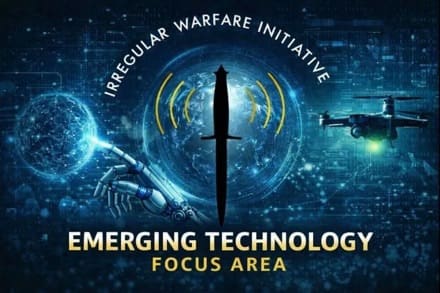
That’s why the Irregular Warfare Initiative is launching a new focus area: the Emerging Technology and Irregular Warfare Focus Area.

What sets this effort apart is both the challenges we are tackling and the people we are engaging. We intend to take seriously the strategic and operational tensions that emerge as new technologies are adopted and embedded in irregular warfare. And we will bring together communities that don’t always talk to each other to grapple with those tensions collectively.

The Challenges We Are Tackling

Technology in irregular warfare creates genuine tensions between competing priorities that aren’t easily resolved. At the heart of these tensions are questions about how to maximize operational advantages while managing expanding risks, and who gets to determine those tradeoffs. While individual technologies introduce distinct risks and benefits, our focus is not on the tools themselves, but on the tensions they generate, and how those tensions play out across different contexts and stakeholders and in exploring new directions and fresh proposals for navigating them. Some of these core dilemmas include:

Decisionmaking & Accountability – Technology enables faster, better-informed and more precise decisions, but only if our existing decisionmaking processes evolve in parallel. But by reshaping decision dynamics in decentralized and ambiguous environments, these tools also introduce new risks related to accountability, civilian harm, and the ability to maintain political control and influence.

Diffusion & Escalation – Dual-use, low-cost, high-impact technologies enable individuals, nonstate actors, and terrorist networks to adapt lethal irregular warfare tactics, evade traditional financial intelligence, and exploit deniability. At the same time, their diffusion accelerates escalation dynamics and demands new concepts and approaches to restraint and control in gray zone conflicts.

Legitimacy & Effectiveness – As artificial intelligence, autonomous systems, and cyber capabilities outpace laws and regulations, tensions arise between operational effectiveness and maintaining public legitimacy, especially when confronting adversaries that reject these constraints. In operating environments where information moves fast and decisions can’t wait, both effectiveness and legitimacy require new approaches to measuring impact, managing risk, and adapting in real-time.

Influence & Trust – Emerging technologies offer new tools for enhancing diplomatic and humanitarian effectiveness, critical components of securing influence among populations in irregular warfare. In contested environments, however, adversaries can exploit these same technologies to undermine public trust through surveillance, algorithmic bias, misinformation, and dependency creation.

The People We Are Engaging

This platform is built for and by everyone working across irregular warfare: government, military, civil society, private sector, humanitarians, academics, development actors, partners, and local communities. We believe experience matters as much as credentials. Ground truth matters as much as theory. And the hard lessons learned in one theater should inform decisions in another, in real time, not years later through formal doctrine updates. Most importantly, we believe the people navigating these challenges can’t wait for perfect answers. They need better options now, founded on clear principles to guide decisions under uncertainty.

How We Work

As we tackle these challenges, this Focus Area will be guided by the following principles:

Problem-driven – Our starting point will be the problems practitioners face on the ground, not technologies in search of applications. We want to identify what works, what doesn’t, and what principles can guide decisions when perfect information doesn’t exist. When doctrine exists but practitioners aren’t using it, we want to figure out why and identify solutions.

Whole-of-Government and Whole-of-Society Perspectives – Technology in irregular warfare doesn’t just affect military operations. It reshapes societies, influences populations, and creates dependencies that outlast any single intervention. These issues demand a coordinated response across the government and a systems approach that recognizes how technology’s societal impacts might reinforce or undermine strategic objectives over the long term.

Future-focused – What’s important in confronting the challenges above is not merely analyzing last year’s conflict, but remaining focused on what’s coming next. Responding adaptively to the emerging technologies, tactics, and dilemmas that will shape tomorrow’s irregular warfare environment will ensure we are staying ahead of the problem, not playing catch-up.

Join the Conversation

As IWI develops this Focus Area going forward, we want to hear from you. Submit an article. Join us on a podcast. Send us an email at EmergingTech@irregularwarfare.org. Engage on social media where these conversations reach beyond traditional circles to developers, humanitarians, local partners, and others navigating the same technology dilemmas.

We’re interested in emerging issues where the problem hasn’t been clearly defined, where consensus is lacking, or where solutions remain elusive. We also want to bridge gaps where doctrine exists but isn’t being applied. Help us understand why and what needs to change. What matters is the quality of the argument, the evidence behind it, and the technology’s impact on irregular warfare, not whether it meets an arbitrary definition of “emerging.” Contributions will not be dismissed on the grounds that a technology is too established, not novel enough, or insufficiently disruptive.

Technology will continue reshaping societies and conflicts at an accelerating pace. The only question is whether we learn fast enough to stay ahead, or whether we’re perpetually reacting to problems that could have been anticipated.

Practitioners on the ground can’t wait for perfect answers. They need better options, clearer principles, and a community learning together in real time. That’s what we’re building. And we want you to help us build it.

February 2, 2026 by Kristina Kempkey, Jeffrey Szuchman

Kristina Kempkey is a senior leader with over two decades of experience working at the intersection of national security and foreign policy in high-risk environments. She has led and advised major efforts with USAID, the U.S. Department of Defense, and the United Nations, working alongside military, diplomatic, and civilian partners across Africa, Eastern Europe, and South Asia. Her work centers on applying emerging technologies to real-world security, stabilization, and institutional challenges. She brings a practitioner’s understanding of interagency operations, coalition building, and decision-making under uncertainty. She has contributed to research with the Council on Foreign Relations and West Point on national security and military strategy. As a Fellow at the ML Alignment and Theory Scholars (MATS), Future Impact Group (FIG), 21st Century India Center at UC San Diego, and the Center for AI and Digital Policy (CAIDP), Kristina informs practical policy recommendations and operational insights for governments and security institutions navigating the risks and opportunities of advanced AI.

Jeffrey Szuchman’s work examines how emerging technologies shape governance and security in fragile and conflict-affected settings. He has held leadership roles at USAID in Washington, DC and in Africa, including as Deputy Director for Democratic Governance, Peace & Security in Kenya, where he managed multi-million dollar grants in security, governance, and peacebuilding, and advised on integrating digital safeguards and responsible AI principles into national strategies. He has also led teams at USAID in Liberia and in Washington, DC, where he served as Acting Director of Policy, leading agency-wide strategic planning and directing cross-functional teams on issues ranging from digital transformation, stabilization, and conflict prevention. Prior to USAID, he was a Professor of Global Studies at Zayed University in Abu Dhabi. He holds a PhD and MA in Near Eastern Languages and Cultures from UCLA.

Main Image generated by ChatGPT using DALL·E, OpenAI (January 2026).

The views expressed are those of the authors and do not reflect the official position of the Irregular Warfare Initiative, Princeton University’s Empirical Studies of Conflict Project, the Modern War Institute at West Point, or the United States Government.
Army Security Cooperation Group-South: First of Its Kind Stands Up in Georgia

February 3rd, 2026

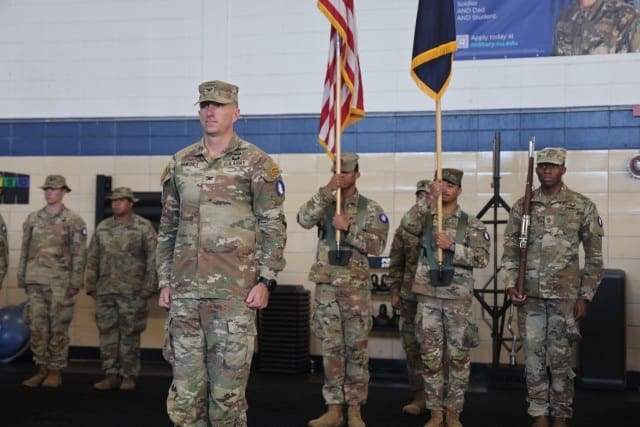
FORT BENNING, Ga. – On January 27, 2026, the Army Security Cooperation Group – South (ASCG-S) conducted a small ceremony on Kelley Hill, Fort Benning, Georgia to commemorate its ongoing transformation. ASCG-S, formerly 1st Security Force Assistance Brigade (1st SFAB), has become central to security cooperation in Panama, through its assumption of the Joint Security Cooperation Group-Panama (JSCG-P) and the combined Jungle Operations Training Center (JOTC) missions.

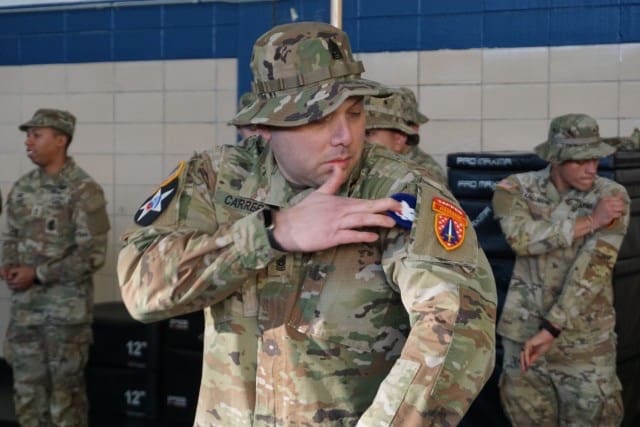
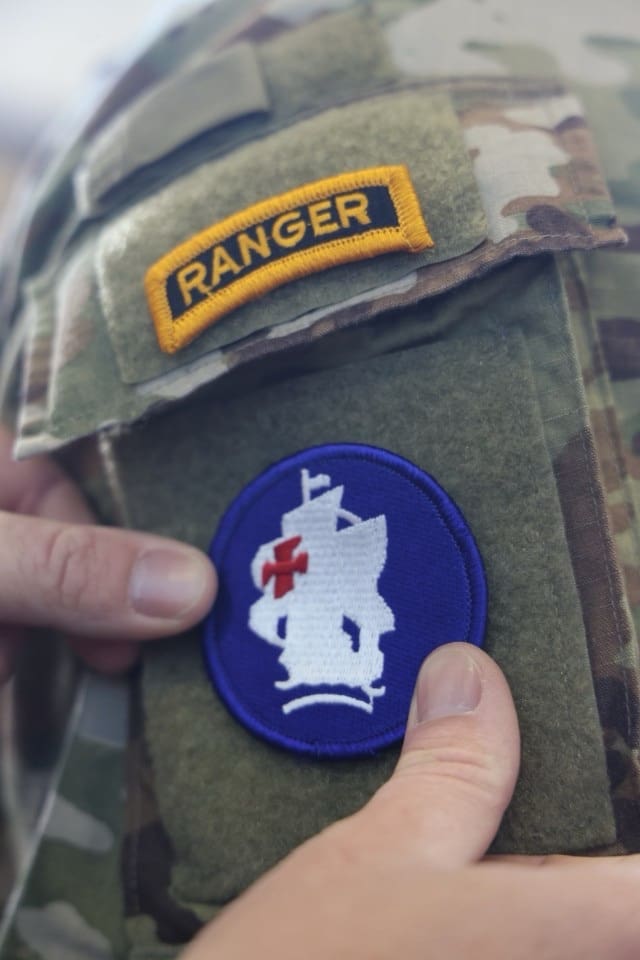
The ceremony was presided over by Col. Keith W. Benedict and Cmd. Sgt. Maj. Pedro Chavez, the command team for the ASCG-S. During the ceremony – coinciding with the furling of the colors and near-term departure of two organic battalions and one National Guard battalion from 54th SFAB. Col. Benedict reflected on 1st SFAB’s legacy and how it’s accomplishments and achievements will have long-lasting effects on the U.S. Army and our regional partners. Those bound for Panama then donned their jungle boonie headgear, and all donned the U.S. Army South’s 6th Army patch.

1st Security Force Assistance Brigade was activated in October 2017 to fill the growing requirement for Advisors for Afghan security forces, alleviating the existing practice of pulling leaders from their formations to help Afghan units. 1st SFAB conducted one deployment to southwest Asia, where Cmd. Sgt. Maj. Timothy Bolyard, the senior enlisted advisor of 3rd Squadron, 1st SFAB made the ultimate sacrifice. After the Afghanistan tour, 1st SFAB became regionally aligned to the Southern Command area of operations, where they conducted security force assistance with Colombia, Argentina, Panama, and Honduras, among other partners.

The Army Security Cooperation Group – South is a unique unit within the Army, that falls under the newly-established United States Western Hemisphere Command (USAWHC), leading efforts to deepen and widen interoperability with Panamanian partners on strategic terrain within the 2025 National Security Strategy’s priority region. “Our soldiers are excited to build upon their experience working in Panama to establish a digitized training environment and work with our partners,” states Col. Benedict, “to test and evaluate our warfighting capabilities in one of the most challenging jungle environs in the world.”

Under the new force restructure, ASCG-S has assumed responsibility for JSCG-P, which is working with the government of Panama to increase cooperation efforts between the U.S. Military and Panamanian security forces. JSCG-P is also crucial to the staging and reception of all U.S. military personnel coming to Panama to learn from partners and to test their mettle. “We are actively seeking jungle expertise and look forward to units across the joint force and the international community joining us this summer for Panamax 2026,” CSM Chavez states, “I assure you, this environment isn’t for the timid or entitled.”

JSCG-P is working with Panamanian partners to re-invigorate a combined JOTC at Aeronaval Base Cristobal Colon (formerly Fort Sherman). Panamanian security forces have run a unilateral course like the U.S. Army-run, combined course that existed for Panama for nearly 40 years until 1999. Now, once again JOTC students and cadre from both U.S. and Panamanian security forces convene in the “Green Hell.” The current course is 18 days and goes over primitive fire and shelter training followed by tracking and patrol exercises that test the students’ resilience and perseverance.

The activation of the ASCG-S is yet another visible step in the Army and U.S. military’s ongoing effort to revitalize security in the western hemisphere and with the regional partners therein. The Army Security Cooperation Group-South is excited to evolve into a premier jungle force capable of enabling training and readiness for and looking for units to train in this environment and individual soldiers seeking opportunities to enter the triple-canopy arena.

MAJ Val Bryant

Draganfly Selected to Provide Draganfly Flex FPV Drones and Training to US Air Force Special Operations Command Units in Partnership with DelMar Aerospace

February 2nd, 2026

Tampa, Fla. —  February 2, 2026 — Draganfly Inc. (NASDAQ: DPRO; CSE: DPRO; FSE: 3U8A) (“Draganfly” or the “Company”), an award-winning developer of drone solutions, software, and robotics, today announced an award to provide Flex FPV Drones and Training to U.S. Air Force Special Operations Command units with partner DelMar Aerospace Corporation, a leading provider of advanced uncrewed aircraft systems (UAS) training, tactics, techniques, and procedures (TTPs), for U.S. Government customers. 

The partnership with DelMar brings together Draganfly’s operationally proven uncrewed platforms with DelMar Aerospace’s expertise in delivering cutting-edge, mission-relevant UAS instruction to Government operators. Initial training activities include First Person View (FPV) UAS instruction, with a comprehensive curriculum covering FPV assembly, repair, flight operations, advanced mission planning and execution. 

The award is to provide foundational FPV training with Draganfly Flex FPV Drones to U.S. Air Force Special Operations Command units. Training will take place at DelMar Aerospace’s Camp Pendleton UAS range training facility, a controlled environment purpose-built to support advanced instruction that replicates a range of battlefield scenarios. The first training cohort is scheduled to begin in mid-February. 

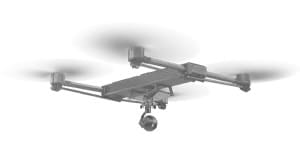
Draganfly’s Flex FPV serves as the modular backbone for future small UAS configurations, uniquely capable of meeting evolving Department of War operational requirements. The Flex FPV’s innovative design enables rapid transition across operating profiles, allowing a variety of flight characteristics and payload capacities to be deployed with a single unit. This adaptability enables widespread adoption via a common training and sustainment baseline while providing a unique and compelling value proposition to any tactical drone program.

 “Our shared focus is on readiness and combat capability,” said Cameron Chell, CEO of Draganfly. “Partnering with DelMar Aerospace helps ensure operators are training on systems and tactics designed for real-world conditions, with the Flex’s modularity and reliability required to adapt as missions and threats evolve.” 

DelMar Aerospace will lead instruction delivery, curriculum development, and standards alignment, ensuring training remains tactically relevant while compliant with U.S. Government contracting and security requirements. 

“This collaboration is about developing operators who are prepared to employ uncrewed systems effectively in demanding environments,” said Stanley Springer, DelMar Aerospace’s Chief Operating Officer. “Our focus is disciplined training grounded in combat-proven TTPs and operational realism.” 

This announcement reflects ongoing work in support of U.S. Government programs. Specific operational details are not being disclosed.

SHOT Show 26 – DFND Tahoe Wool Mesh Baselayer

February 2nd, 2026

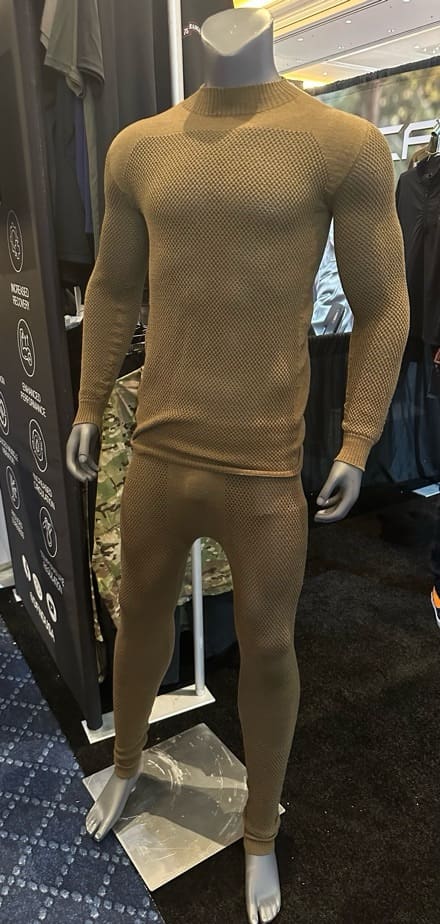
We’ve mentioned DFND’s Tahoe Wool Mesh Baselayer in the past but it’s starting to gain traction.

Mesh baselayers have long been used in the Nordic countries but haven’t caught on in the US. However, as US troops work more with our NATO allies on the Northern Front, they have been exposed to this time tested technology.

DFND has invested in the ability to manufacture these garments in the US so, combined with US sourced wool, we now have a Berry compliant supply chain. The top and bottom are seamless for comfort and offered in sizes Small – XXLarge in Black and Coyote.

dfndusa.com/collections/wool-base-layers

SHOT Show 26 – SureFire M64OT PRO High-Candela Weaponlight

February 2nd, 2026

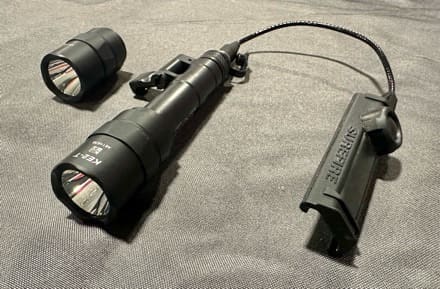
SureFire exhibited their new M64OT PRO High-Candela Weaponlight.

This Turbo weaponlight is IPX7 rated and offers 700 lumens / 70,000 cadelas for a 1.5 hour runtime. The body incorporates the Low-Profile Mount (LPM). Offered in Black and Tan versions.

No pricing yet.

SHOT Show 26 – Apex Defense USA RailRunr Military Hip Pack

February 2nd, 2026

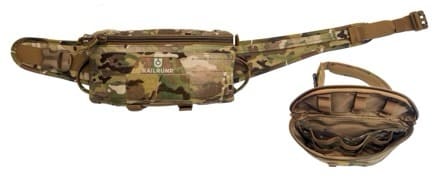
During my meeting with Apex Defense USA they showed me a new waistbag system designed by Tsuga. Originally developed for mountain biking, they showed it to some SF medics who were immediately drawn to the concept. Since then, Apex Defense and Tsuga have been working with the SOF medical community to refine the bags which are now called the RailRunr Military Hip Pack.

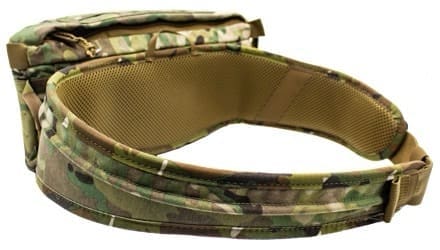
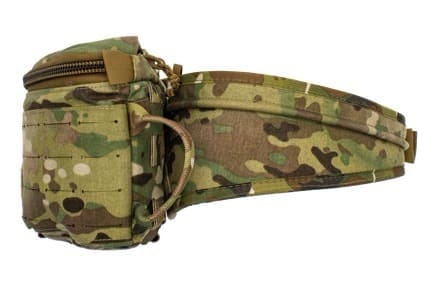
What makes RailRunr standout from other waist bags is that you don’t have to twist the entire waist bag around to the front to access the contents. Instead, the bag moves along a track on the padded belt so you can keep the belt snug the entire time. This also reduces chaffing from twisting the entire rig round and round.

This video shows how it works.

Inside is a removable bandolier divider, two internal pockets, and upper elastic loops to keep your kit organized and secure.

Offered in 3l and 5l configurations, the RailRunr is made from Squadron laminate and integrates N52 Neodynium Magnets to keep the bag in place on the belt while in its stored position.

I’d like to point out that although the medics are interested in this bag, it could be used for a wide variety of applications, just like other waist bags.

Colors include Black, Red, Coyote, and MultiCam.

For those interested in ordering, pre-orders are being taken now with the first articles shipping in April. All Bulk orders and Dealer opportunities are available through Apex Defense USA. Contact sales@apexdefenseusa.com.

MSRP pricing is: 3L – $451.43ea | 5L – $481.43ea (Includes Pouch and Belt).

SHOT Show 26 – Shaw Concepts

February 2nd, 2026

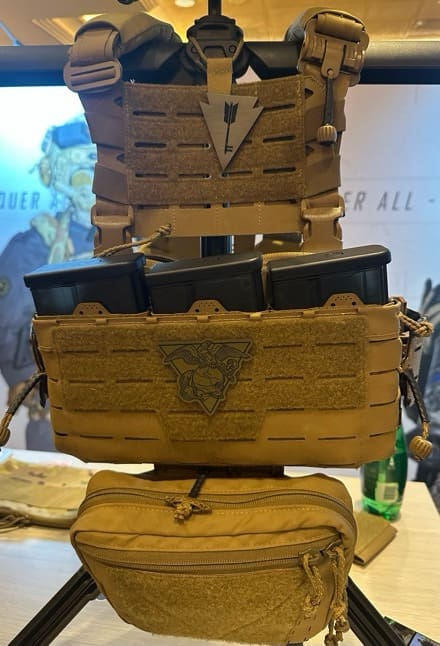
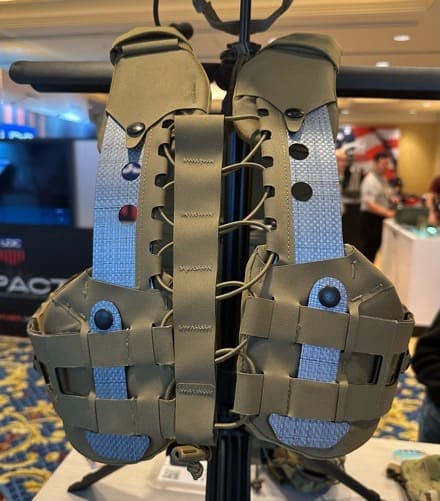
Shaw Concepts is always a fountain of innovation and thy displayed quite a few upcoming products but the one I want to concentrate on is an as-yet-unnamed harness which can be configured as chest rig or plate carrier.

Both modular and scalable in nature, it will accept a bib, panels and dangler at the front. You can also add armor plates by using Shaw Speed Bags. The front plate is attached to the front of the rig via Velcro, is an easy and quick way to scale the protection level.

At the rear, the plate attaches via custom Metal Hardware and T-Stoppers.

The rear is stiffened using Tegris to assist with load carriage and stability.

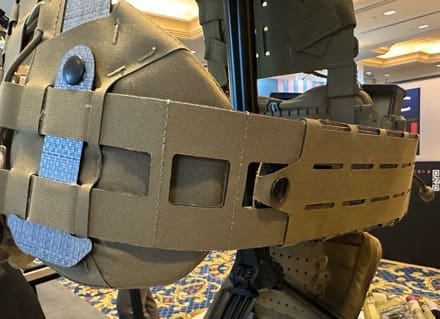
The Shaw harness also incorporates an S-Lok sleeve cummerbund which is available in 3”, 5”, and a narrow plate carrier height. The patent pending S-Lock uses the same technology as the Usurper belt to set the length of the cummerbund.


The rear of the harness is height adjustable and the shoulder straps are length adjustable. Additionally, the shock cord allows some flex for breathing yet the stiffened spine nears the weight of the load.

There is a metal toggle buckle to attach the shoulder straps to the front panel but these can be replaced with FS Tubes and you can easily add shoulder pads to the shoulder straps.

Assault zip-on panel (no final name) uses UCAS standard zippers for compatibility with other brands.

Likely to launch July 4th along with several other new items.

SHOT Show 26 – Silvus Technologies

February 2nd, 2026

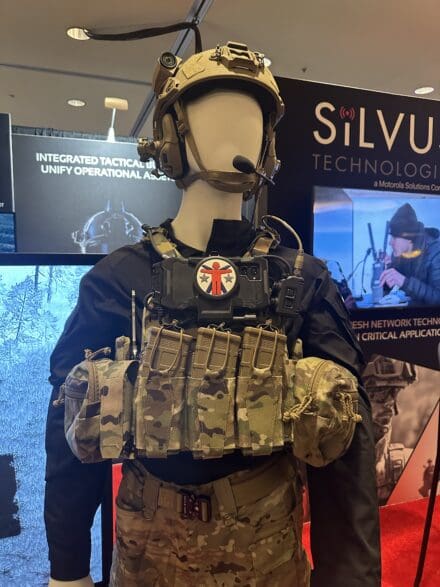
Silvus Technologies showed us their next generation Tactical Networking System.

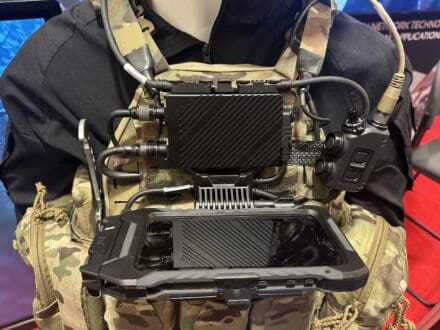
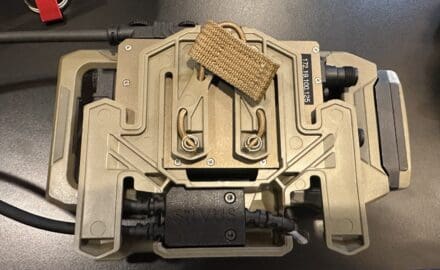
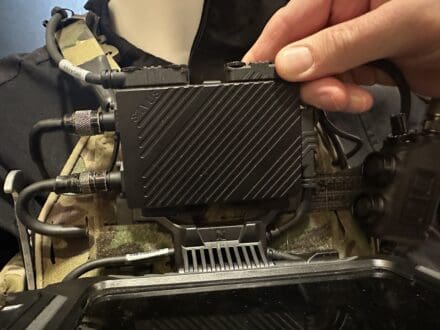
This low SWaP system combines their new ultra-slim StreamCaster MINI 5200 MANET radio with the industry standard Samsung EUD mounted in a low-profile Juggernaut case chest mount.

Powered by Silvus’ MN-MIMO waveform, the SM5200 creates a self-forming, adaptive mesh that supports high-throughput data, HD video, and ATAK in real-time, all while remaining fully compatible with the entire StreamCaster family.

SM5200 Features:

– 2W native, 4W effective TX power

– 100 Mbps throughput

– 550+ node scalability

– Dual PTT / RoIP interface

– I/O connectors – ETH/USB/RS232

– AES-256 / FIPS 140-3 encryption

– Access to Spectrum Dominance 2.0 with LPI/LPD, Anti-Jam, and Advanced Threat Protection capabilities that thrive in EW contested environments

silvustechnologies.com/products/streamcaster-mini-5200