Phantom Lights

Archive for the ‘Contracts’ Category

USMC Issues Notice of Intent To Sole Source Purchase Up To 50,814 M27 IAR From H&K

Sunday, August 13th, 2017

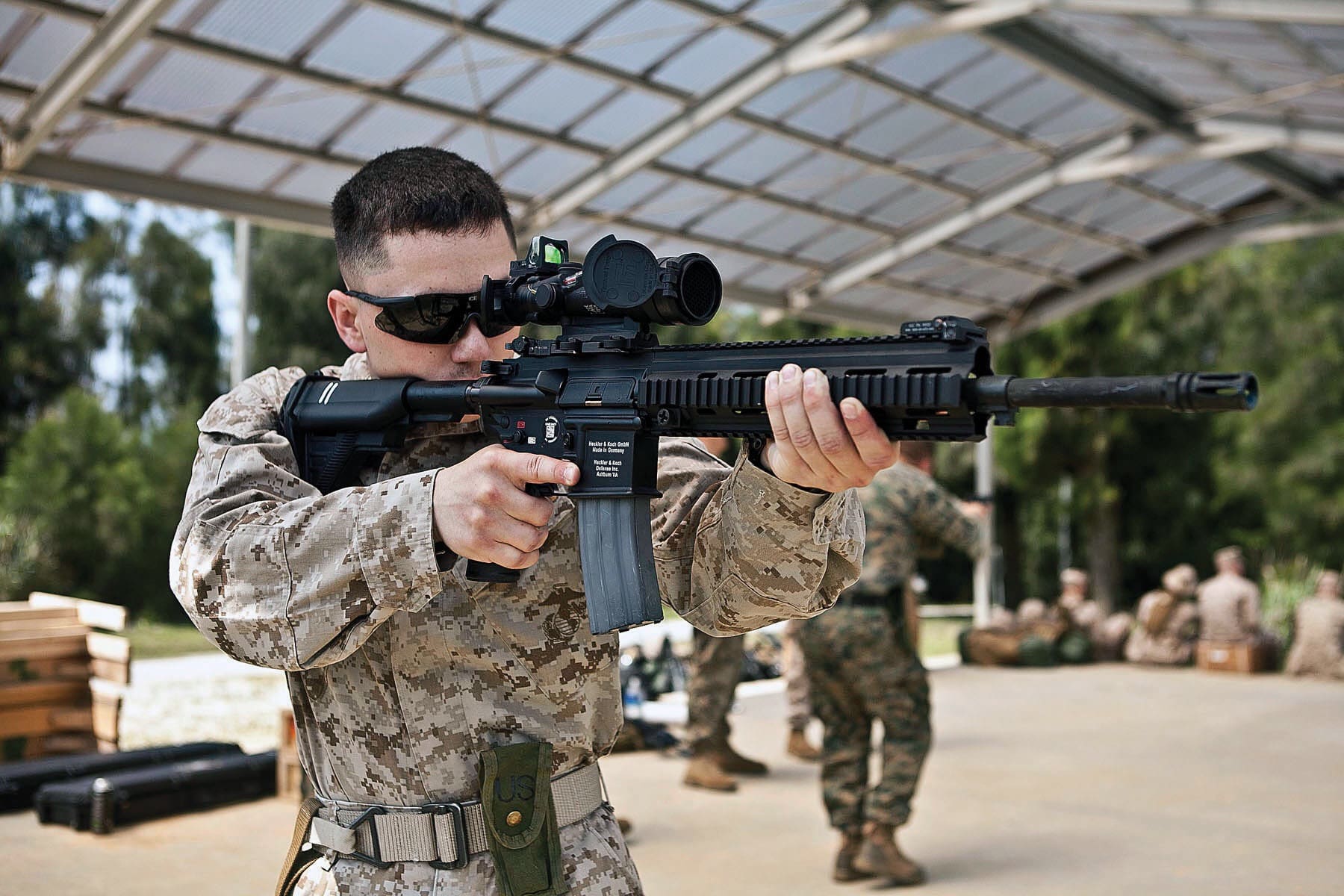
Back in February, MARCORSYSCOM issued an RFI to industry seeking companies capable of manufacturing the 5.56mm NATO M27 Infantry Automatic Rifle, designed by German manufacturer Heckler & Koch and based on their HK416 rifle. Based on internal evaluations, the Marine Corps had determined that it wanted to expand use of the M27 within the rifle squad. Released under the guise of “market research”, “Request for Information (RFI) M67854-17-I-1218 For Marine Corps Systems Command (MARCORSYSCOM), Quantico, VA Infantry Automatic Rifle (IAR)” was used to create a a sole-source “Justification and Approval” in order to purchase the rifles directly from manufacturer H&K without going for an open solicitation. Although several companies who manufacture 416 clones answered the RFI, MARCORSYSCOM evaluated those submissions, and determined that only H&K was capable of producing the weapon they had adopted as the M27.
Late last week, MARCORSYSCOM released Notice of Intent to Sole Source – M27 Infantry Automatic Rifle (IAR). Based on that earlier RFI, it found only one Responsible Source (based on (FAR 6302.1 (a)(2)(ii)) and intends to solicit and negotiate with Heckler & Koch (H&K), for up to 50,814 – M27 Infantry Automatic Rifles (IAR).

Companies who still feel they can meet the Marine Corps’ needs may submit a capability statement, proposal, or quotation, which shall be considered by the agency, only if received by the closing date and time of this notice. A determination not to compete the proposed requirement based upon the responses to this notice is solely within the discretion of the Government. They’ve got until 08/28/2017 to state their case.

Some of you may remember that RFI, which specified 11,000 rifles. Many attempted mental gymnastics to explain how just 11,000 rifles could possibly be enough to equip the Marine Corps. However, I maintained that the figure was just a nice round number, based on H&K’s annual production capacity from a study performed during the initial M27 purchase. Based on the scuttlebutt I was hearing, I knew the actual number would be much higher. While 50,000 guns isn’t enough to pure fleet the Marines, it does support the premise, “Every Marine might be a Rifleman, but every Marine isn’t an Infantryman.” These are going to select Marines. Perhaps they’ll buy more down the road. Remember, it did take a long time to transition from M16s to M4s.

With the US Army just releasing their own solicitation for ~50,000 examples of 7.62mm Interim Combat Service Rifle, and a 417 variant being a favorite after adoption of the G28 as the Compact Semi Auto Sniper System and the ensuing directed requirement for 6,069 rifles in the Squad Designated Marksman role, it puts H&K in an interesting position. They’ve won the French Army’s rifle program with the 416, developed and are offering the 433 for the German Bundeswehr’s G36 replacement, and now face production of over 50,000 M27s for the Marines. That’s a lot of requirement for H&K’s factory in Oberdorf, Germany. I’m not saying they can’t do it, but delivery expectations for customers will have to be very carefully managed. Some in industry have posited that this Marine solicitation will take them out of the ICSR running. Time will tell.

For those of you under the impression that H&K as-yet-uncompleted factory in Columbus, Georgia will be used to manufactured CSASS, SDMR, IAR or ICSR, it won’t. As of right now, H&K’s vision is that factory will not be used to build defense products.

The Marine Corps is modernizing its service rifle to the M27, a fulfillment of a plan many feel was set in motion when it was first selected as a squad-level replacement for the M249 in 2010.
US Army Facilitates Purchase Of M80A1 Ammo For Interim Service Combat Rifle Hopefuls

Thursday, August 10th, 2017

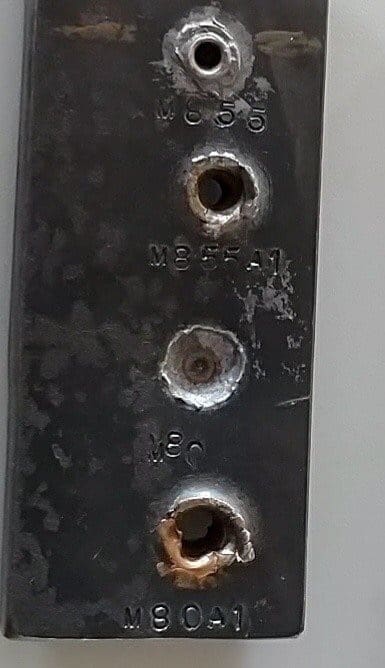
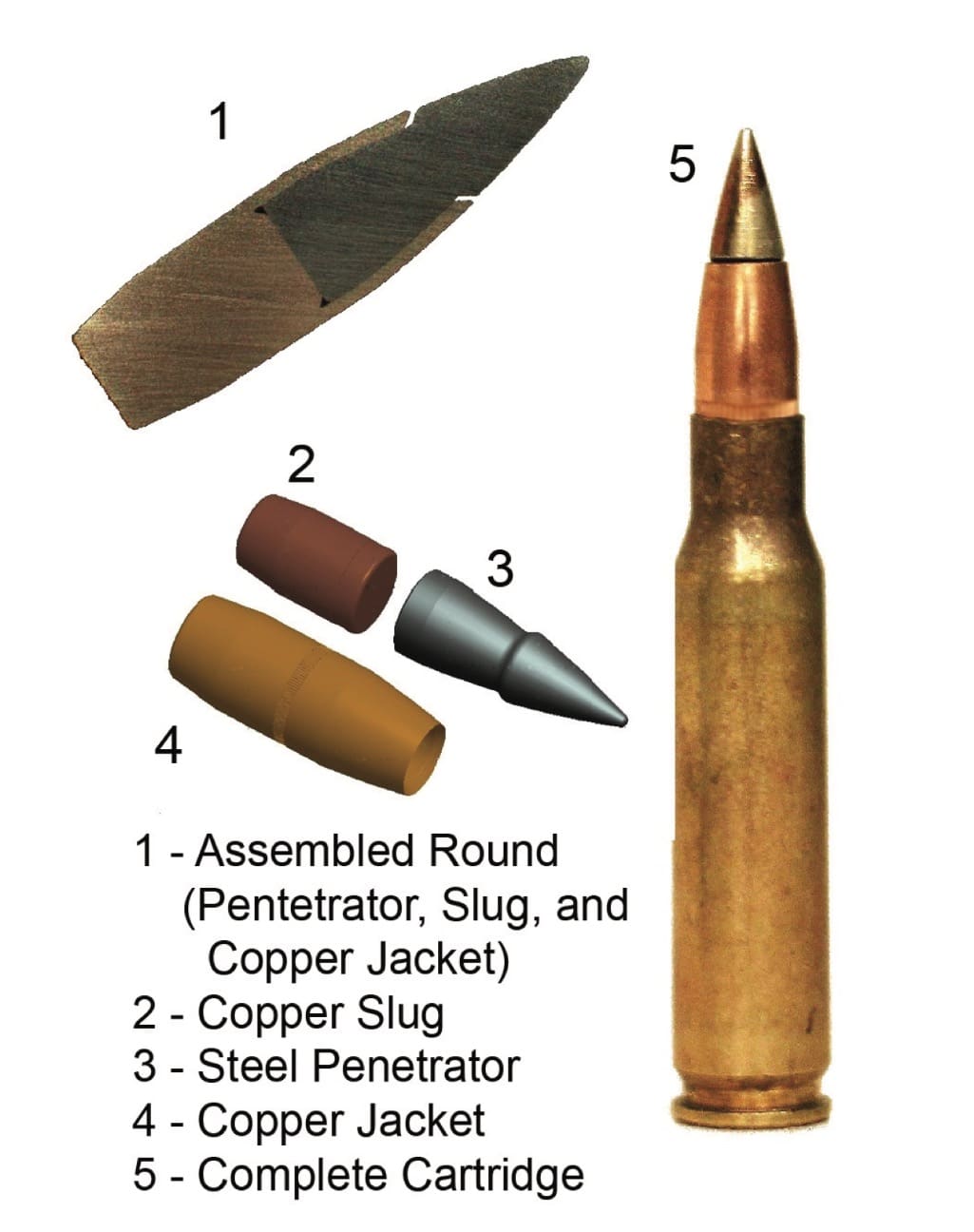
When the Army held the now suspended Individual Carbine trials a few years back, contractors had trouble acquiring the then new 5.56mm M855A1 Enhanced Performance Rounds for their in-house testing.  The Army assisted those companies in procuring the ammunition which is still not in wide circulation, particularly for the commercial market.

IMG_3455

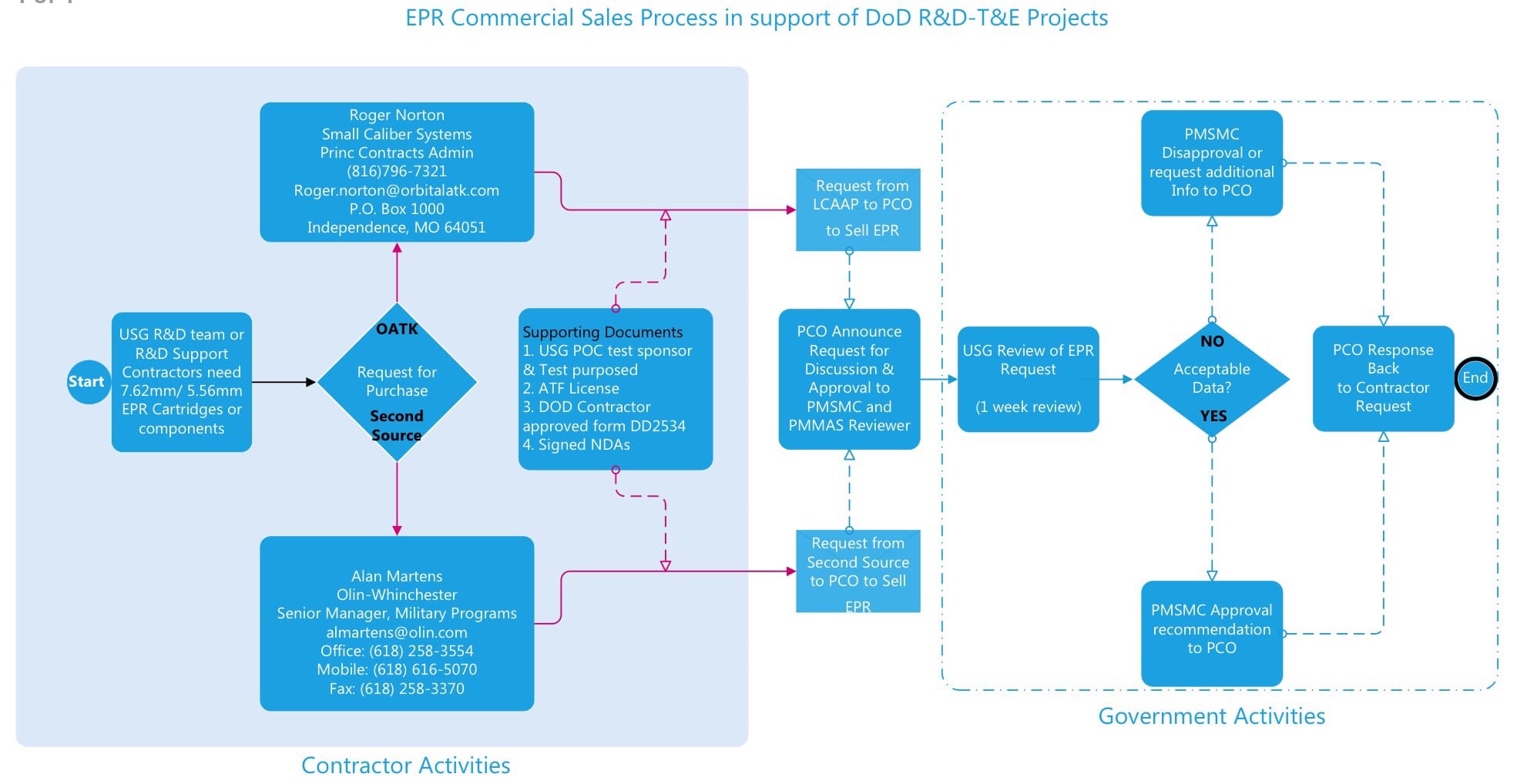
Now that the Army is looking for an Interim Service Combat Rifle which fires the larger 7.62mm version of the Enhanced Performance Round, M80A1, potential vendors are in a similar situation.  The Army has responded by issuing Attachment 0005, Flow Chart for EPR Commercial Sales to the solicitation on FedBizOpps. According to the program, the recommended path is to first contact the Olin-Winchester point of contact (POC) listed on Attachment 0005.

Of additional note, offerors may submit rifles with Mil Std- 1913 or M-LOK rails, with no length requirement. Additionally, as the solicitation does not specify much of anything aside from caliber and full auto capability, if an offeror submits more than one barrel length, they must submit full rifles.  They cannot just submit additional upper receivers.  

Marine Corps Is Looking At Commercially Available Suppressors, Issues Sources Sought Notice To Industry

Thursday, August 10th, 2017

Last week, the Marine Corps Systems Command (MARCORSYSCOM) issued a Sources Sought Notice, often also referred to a Request For Information (RFI) to industry for commerically available suppressors for the 5.56mm NATO M4, M4A1, and M27. The RFI is an important step in developing a realistic requirement which leads to a solicitation and eventually, procurement.

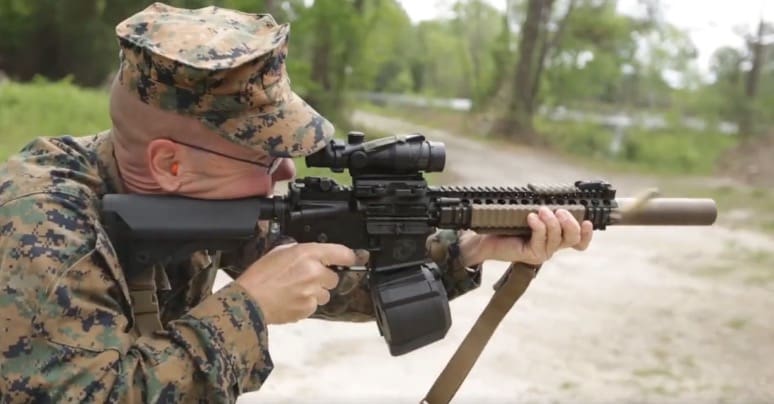
Marine Gunner Christian Wade (seen above) has been a big advocate of suppressing Marine weapons, even producing videos to educate Marines of their true capabilities. It’s good to see the Marines catching up with his vision.

They’ve certainly done their homework and have developed quite a list of what they are looking for. Additionally, they are keeping their options open, stating that future procurement quantities of suppressors could span between 18,000 and 194,000.

According to the RFI, at a minimum, suppressors should meet the following requirements:

1. The suppressor should be capable of detachment/attachment and disassembly/ reassembly by an operator in the field without the use of special tools for normal care and cleaning.

2. Suppressor should enable a noise level of 139 decibels or lower at either of the shooters ears.

3. Suppressor should be a design that minimizes the change in the host rifle internal operating system dynamics.

4. Suppressor may be of the over the barrel, or flush mount design and should not be longer than 20″ total barrel length (threshold), 18″ (objective).

5. Suppressor should be of the quick detachable design. A special muzzle device may be attached (by a unit Armorer) to the OEM weapon in order to facilitate installation and removal by an operator.

6. Must be able to withstand the sustained rate of the M27 IAR (capable of a rate of fire of 36 rounds per minute for 16 minutes, 40 seconds with firing starting at ambient temperature for a 600 round load).

7. The entire suppressor and muzzle device should weigh no more than 18 oz.

8. The use of the suppressor should not increase the dispersion of each respective weapon. It is acceptable for the weapon to experience a repeatable shift in the zero between unsuppressed and suppressed operating modes, but that shift should not exceed 3 MOA for each respective weapon.

9. The suppressed weapon should retain its dispersion through the life of the barrel (objective of 24,000 rounds)

10. The suppressor system is not required to have an internal projectile pathway which is the usual industry standard for a 5.56mm diameter round. The internal bullet channel may be larger than is typical of current suppressor designs. In other words, the suppressor may be able to be employed on multiple calibers (i.e. A059 Ball, AB49, AC12, AB57 etc.) without any modification to the suppressor. This attribute not only facilitates future caliber/weapon capabilities, but could also mitigate baffle strikes.

11. Suppressor should function with all Department of Defense Identification Code (DODIC) 5.56 mm ammunition, including A059 Ball, A063 Tracer, A080 Blank, AA33 Ball, AA53 Ball Special Match, AA69 Armor Piercing, AB49 Ball Carbine barrier, AC12 and AB57 Enhanced Performance Round.

12. Suppressor should not require permanent configuration changes to the weapon system.

13. Suppressor should not inhibit the mounting or operation of the M203 or M320 grenade launchers (objective).

14. Suppressor should not require the addition of a gas mitigating charging handle.

15. Should be able to accept a suppressor sleeve in order to reduce thermal signatures and mitigate operator burns.

16. All suppressor external surfaces should have a dull, low-reflective finish (to include pins, bolts, lanyards, sight posts, etc.). The external color of the system should be consistent with current camouflage colors and patterns.

18. The suppressor material should be able to accept approved USMC paint (e.g. rattle-can spray paint).

19. Suppressor should be resistant to corrosion, abrasion, impacts and chemicals, including standard Chemical, Biological, Radiological and Nuclear (CBRN) decontaminants.

20. The suppressor should resist maritime corrosion and/or effects of carbon/copper/lead fouling.


• MIL-L-46000C – Lubricant, Semi-fluid (Automatic Weapons)
• MIL-PRF-372D – Cleaning Compound, Solvent (Bore of Small Arms and Automatic Aircraft Weapons)
• MIL-PRF-14107D – Lubricating Oil, Weapons, Low Temperature
• MIL-PRF-63460D – Lubricant, Cleaner and Preservative for Weapons and Weapons Systems

22. The suppressor should not require a more frequent cleaning schedule than the weapon system.

23. The system, with suppressor attached should continue to operate and safely function after exposure to blowing dust, mud, salt fog, rain, and icing/freezing rain environments as specified in US Army Development Test Operations Procedure (TOP) 3-2-045 (Small Arms – Hand and Shoulder Weapons and Machineguns) dated Sep 2007.

24. The system, with suppressor attached should be able to withstand the shock from a user performing individual movement techniques in combat, and the vibrations of being transported in standard military aircraft and ground vehicles as loose cargo, without degradation of performance.

25. The system, with suppressor attached should continue to safely function after being dropped in any orientation from a 1.7 meter height onto a smooth concrete or steel surface at temperatures ranging from -25º Fahrenheit (F) to 140º F. The addition of the suppressor on the weapon system should not result in a discharge when dropped from this height.

26. The system, with suppressor attached should safely function through a temperature range of -25º F to +140º F without degradation of performance.

27. In addition to the suppressor, request information on the ability of industry to provide a BFA type suppressor (that looks like, operates like and weighs the same as the live fire suppressor). This BFA type suppressor should be capable of catching a live 5.56mm round. This BFA suppressor should also be easily distinguished as a training device only.

Those interested in providing information to MARCORSYSCOM have until September 6th.  Visit www.fbo.gov for full details. 

US Army Issues Solicitation For 7.62mm Interim Combat Service Rifle

Sunday, August 6th, 2017

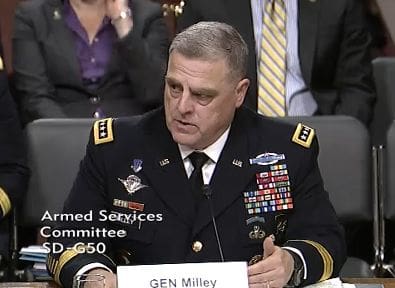
The US Army is concerned about overmatch of its Infantry forces and the proliferation of inexpensive, rifle caliber resistant body armor. So much so, that Chief of Staff of the Army, GEN Mark Milley has testified before the Senate Armed Services Committee on the need for a new 7.62 rifle and ammunition.

GEN Milley

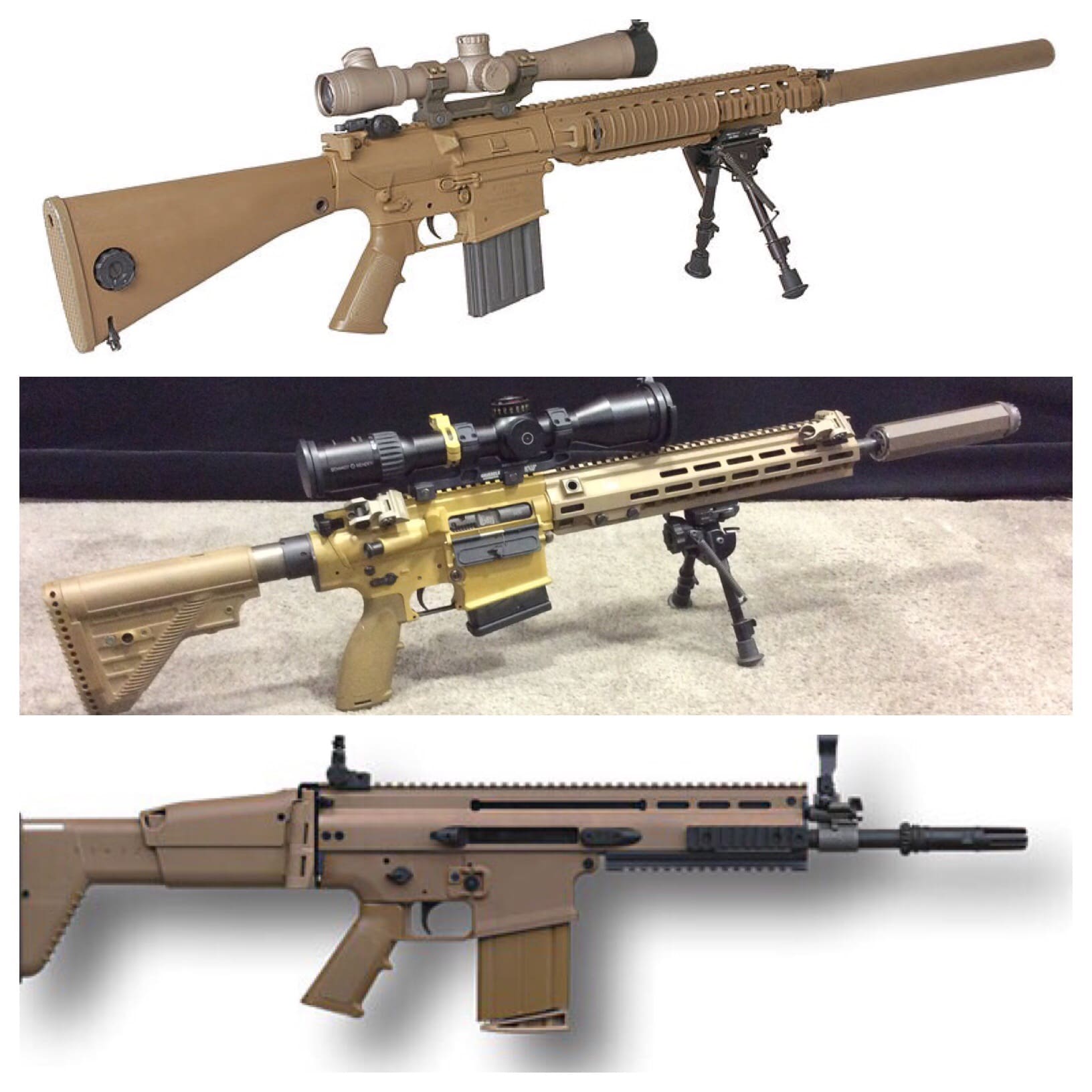
Word is that last Friday morning, the Army’s G8, LTG John M Murray was on the range, firing the three GOTS candidates which might fulfill the requirement: the KAC M110, H&K M110A1 (G28) and FNH Mk17 (SCAR Heavy). Later in the day, on 3 August, the US Army released a solicitation for the purchase of the 7.62mm NATO Interim Combat Service Rifle we began writing about back in April.

IMG_3398

Initially, it had sounded like the Army would just buy one of the three weapons mentioned above. But with an acquisition plan which includes downslecting to up to eight candidates and then awarding a final winner, it seems that the Army wants to see what industry has to offer.

The Notice states that the Army plans to purchase up to 50,000 examples of the rifle which must be in 7.62mm NATO, capable of semi and full-auto. It must also be designed for use with a suppressor. Interestingly, the ICSR’s attributes aren’t quite as stringent as they were two months ago, when the requirement was just an RFI to industry.

It must also be capable of reliably firing the new M80A1 Enhanced Performance Round (EPR) which is not yet in general circulation. Please recall that prior to the cancelled Individual Carbine competition, industry had a rough time sourcing 5.56mm M855A1 ammunition to conduct development.

IMG_0127

There has been much handwringing in industry over whether the Army would purchase one of the three government issue 7.62mm rifles for the Interim Combat Service Rifle directed requirement, or issue an open solicitation. The Army is asking for something that isn’t a commodity in their ICSR requirement: a full-auto 7.62mm rifle. They just don’t exist as production weapons, save the FNH SCAR Heavy and H&K 417, due to controllability issues. Out of the three GOTS rifles, only the Mk17 is full auto capable, making the need to turn to industry, inevitable.

IMG_3392

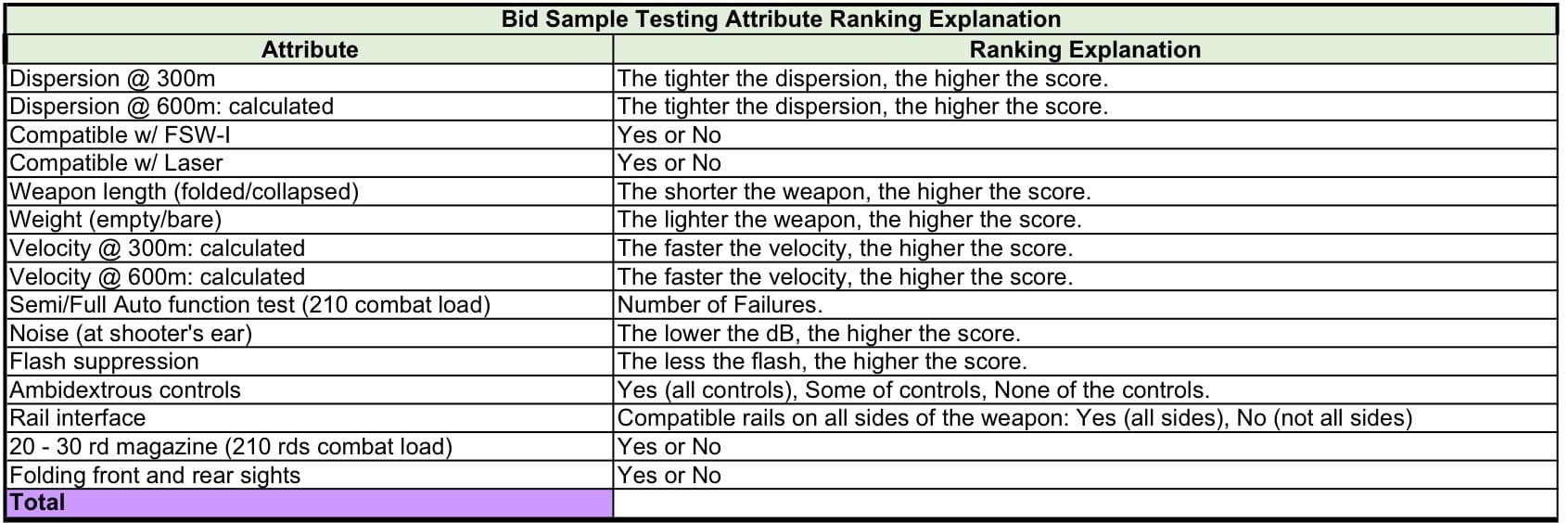
Offerors may submit more than one design. The Army will evaluate the candidate weapons based on the following criteria:

1. Dispersion (300m – function, 600m – simulation)
2. Compatible w/ FWS-I and laser
3. Weapon length (folder or collapsed)/ Weight (empty/bare) / Velocity (300m and 600m calculated)
4. Semi-Automatic and Fully Automatic function testing (bursts and full auto)
5. Noise (at shooter’s ear) / Flash suppression
6. Ambidextrous Controls (in darkness or adverse conditions) / Rail interface
7. 20-30 round magazine to support a 210 round combat load
8. Folding sights

NOTE 1: Attributes 2, 6, 7, and 8 above will be evaluated on a zero/full point basis. An Offeror whose bid sample receives zero (0) points for one (1) or more of these attributes will not be automatically eliminated from the competition; however, receiving a zero (0) score for one (1) or more of these attributes will adversely impact an Offeror’s overall score.

NOTE 2: The proposed candidate will be eliminated from the competition with no further evaluation if at any time the weapon becomes inoperable during testing.

They chose to issue a Commercial Opportunity Notice (CON) for Other Transaction Agreements (OTA) for this procurement action. The idea is to fast track the acquisition, with three phases.

It’s obvious the Army is in a hurry here. By September 6, 2017, they want offerors to submit:
a) White Paper Proposal
b) Safety Assessment Report
c) One (1) bid sample weapon system to include manual, cleaning kit, special tools (if required), enough magazines to support basic combat load of 210 rounds, and one (1) suppressor.

If a candidate weapon is one of up to eight selected for the follow-on OTA, the offeror will have to submit the following within 30 calendar days after notification:
a) Seven (7) weapon systems per configuration (if awarded OTA) with enough magazines to support the basic load of 210 rounds per weapons
b) Seven (7) cleaning kits
c) One (1) supressor
d) One (1) specialized tool kit (provide if required), and
e) Seven (7) manuals.

Eventually, they plan to issue an Indefinite Delivery, Indefinite Quantity for up to 50,000 examples of the ICSR. However, the Army reserves the right to adjust that amount, including purchasing more.

Notice that offerors are required to provide magazines sufficient for a 210 round basic load. There aren’t a lot of 30 round 7.62mm magazines on the market, so 20 rounders will suffice. Magpul currently offers a 25 round magazine in the SR-25 pattern that will likely be tapped.  Basic math dictates that any combination of 20 and 25 round magazines will yield 220 or 225 rounds of rather weighty 7.62 ammunition.  Interestingly, the Army wants to maintain its 210 round basic load of ammunition even though the 7.62mm M80A1 round will more than double its weight.

They must also submit a suppressor. However, we expect that there will be a suppressor competition down the road as well as a telescopic optic competition for the ICSR. There’s not much point in open sights for a weapon expected to engage targets out last 600m.

Finally, there’s the issue of the weapon’s name. It’s referred to as an “interim” rifle leading us to believe that the Army still wants to transition at some point, to an intermediate caliber, a concept we discussed at length during our initial reporting back in April. Don’t forget, USOCOM is currently evaluating cartridges in the 6.5mm family. Our money remains on the .260 Remington.

For full details, visit www.fbo.gov.

US Army Exercises Contract Option With Kraig Biocraft Laboratories Awarding Additional Funding To Develop And Deliver Spider Silk Technology

Wednesday, August 2nd, 2017

ANN ARBOR, Mich., -August 2, 2017- Kraig Biocraft Laboratories, Inc. (OTCQB: KBLB)

(“Company”), the leading developer of spider silk based fibers, today announced that the U.S. Army awarded the optional phase of its contract with the Company valued at more than $900,000. Under this exercised option, the Company will work to design, produce, and deliver additional recombinant spider silk materials tailored for the protective needs of our Soldiers. With this additional award the total contract is now valued at more than $1.0 million.


“When I founded this Company it was with the dream that one day we would work with the US Army to produce ultra-high strength materials in support of our Warfighters,” said Company CEO and founder, Kim K. Thomson. “The Army’s exercise of its option under our agreement validates that dream. Our team is honored to be working on this noble project and we intend to provide this very important customer with the very best high strength polymers using our recombinant spider silk technology.”

“We are extremely excited to continue our work with the US Army to deliver revolutionary materials to support the Warfighter,” stated Jon Rice, COO. “Under this new phase we will be working closely with our sponsor agency to match the performance of our spider silk to their specific use cases and protective applications. I would like to thank our team for the incredible amount of effort they’ve put in to make the first phase of this project a success and express my gratitude to our sponsor for the trust and confidence they’ve placed in us to deliver the next generation of spider silk solutions. The potential uses of spider silk are nearly limitless, but one of the greatest honors is being able to apply our technology to serving those who dedicate themselves to serving and protecting all of us.”

This additional work on the contract is scheduled to last roughly 12 months and is the Company’s second US Department of Defense award.

To view the most recent edition of Kraig’s Spider Sense quarterly newsletter and/or to sign up for Company alerts, please go to www.KraigLabs.com/newsletter.

DoD Plans To Save $72 Million On Afghan Uniforms By Spending $100 Million For New Ones

Tuesday, August 1st, 2017

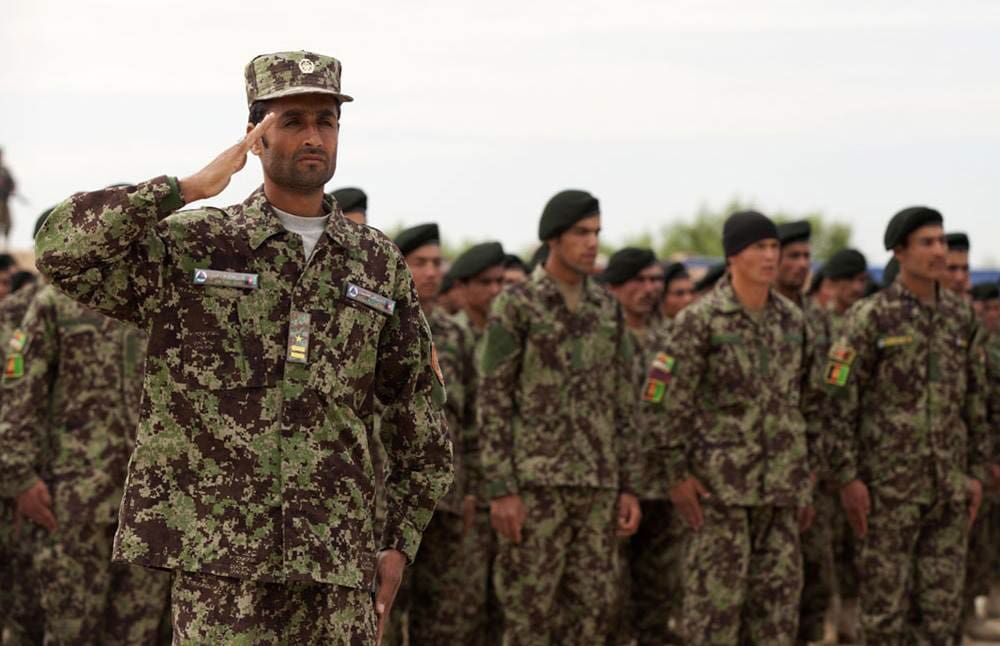
Last week, the Honorable John Sopko, the Special Inspector General for Afghanistan Reconstruction, testified before the House Armed Services Committee, concerning his organization's recent report on the Afghan National Army's proprietary camouflage pattern, licensed to Afghanistan by Canadian company Hyperstealth Biotechnology Corporation.  SIGAR maintains that the US government overspent on an untested and inappropriate camouflage pattern. Boy, does this story sound familiar. 

Of all the untold Billions of Dollars squandered on bad construction contracts and given away to Afghan warlords, SIGAR is fixated on what they have identified as $28 Million, they claim was overspent during a period of five years on camouflage uniforms for the Afghan National Army.  Furthermore, the SIGAR report, and Mr Sopko's testimony alleges that the situation will result in a further $72 Million in overspending over the next decade, if it's not changed.

The Department of Defense's  answer to the situation? Why, spend even more money of course. The plan is to direct the US Army's Natick Soldier Systems Center to conduct a camouflage study and completely recapitalize the entire ANA with new uniforms in a camouflage pattern owned by the US Army. SIGAR estimates that will save us about $72 million. While Mr Sopko has yet to disclose how much this scheme is going to actually cost, I did a back of the napkin estimate based on what was spent in the past. To replace their uniforms in a timely manner, will be excess of $100 Million; well in excess. When you do the math, that potential savings of $72 quickly becomes a $18 Million+ deficit.  Not to mention the disruption of the ANA, as a side effect. 

When this new camouflage pattern is finally pursued, no commercial patterns will be considered, lest the Army have to pay a royalty. The point here isn't to offer our Allies the best available camouflage, but rather the cheapest and no one is taking the interests of the Afghans into consideration in this unilateral action. Amazingly, the last time Natick conducted a camouflage study for Afghanistan, the US Army selected a commercially developed pattern developed by Crye Precision, called MultiCam, over the camouflage developed by Natick.

The Army later conducted a massive camouflage modernization effort under the direction of Natick. The results of the Phase IV Camouflage Improvement Effort have never been released to the public and the Army ultimately created and fielded an inferior version of Crye's MultiCam which they were already using, in order to save a buck or two. 

In addition to the known elements such as established supply chain costs associated with this action, there are Millions of Dollars in potential, additional costs to the American taxpayer and industry. For instance, we have no idea how much the Natick study will actually cost the taxpayer because the salaries of government employees and use of equipment and facilities are looked at as sunk costs by DoD rather than being properly tracked and accounted for. Furthermore, it will take time (and drive up costs) to develop a supply chain for a new pattern. Printers will have to "learn" how to print it.

Industry will also have surge to create a sufficient number of completely new camouflage uniforms to support the transition for the ANA.  This will result in an increased transportation burden costing an untold amount out of money.  Then there's the question of how much money was spent to conduct this investigation and produce this report.  It doesn't seem like the taxpayer is getting a lot of bang for its buck. 

Interestingly, Mr Sopko also informed the legislators that a criminal probe had been launched regarding the matter, which, short of evidence of malfeasance, begs the question, why? Considering the pallets of $100 bills handed off to fickle Afghan warlords over the past 16 years, we are going to criminally investigate something where we actually saw a return on investment? The ANA actually received uniforms which provides them a common identity as an element of Afghan national power. Additionally, the uniforms work at night, when the ANA operates, and are in a tightly controlled camouflage pattern which is difficult for the enemy to acquire.

If I were an acquisition or contracting officer who made things happen in spite of the plodding framework created by the DFAR at any point since the war began, I'd be very concerned about this precedent. Because, if they're going to take a look at the Afghan National Army's camouflage expenditure, they are bound to look at other fast-tracked acquisition programs. In fact, someone probably ought to take a hard look at what DoD was up to regarding uniforms, during the same period.

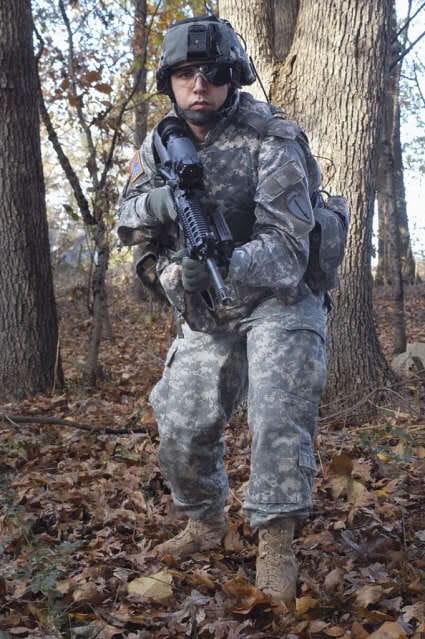
Lest I remind everyone, this is what our Soldiers were wearing during the same period the SIGAR report is concerned with. It's also a camouflage pattern that wasn't tested, and not only wasn't suitable for use in Afghanistan, but for anywhere else it turns out. What's more, it was developed by the same organization that SIGAR wants to developed the ANA's next pattern, Natick Soldier Systems Center. 

It gets worse. The US taxpayer spent untold Billions of Dollars on that US Army pattern. The Army admitted to $5 Billion expenditures in 2012, but they kept spending after that, and their number was based solely on program Dollars at DLA.  It's almost impossible to really capture how much was spent in local purchase, at the sister service level, and on UCP ancillary items for major end items.  The real number is closer to $10 Billion than five. If they want to launch a criminal investigation based on fraud, waste and abuse, UCP is a great place to start.

If SIGAR wanted to actually improve things for Afghanistan, they could make these recommendations:

1. Simplify and standardize the cut and construction of Afghan uniforms across the board.

2. Negotiate a better licensing fee with the owner of the ANA's camouflage.

3. Replace the Camo patterns of the other Afghan forces which are forced to continue to wear the same patterns as their enemies.

Points one and two would help bring down costs of the ANA uniform and point three would result in a safer and more effective Afghan security infrastructure.  

Mr Sopko's team at SIGAR has done some great work, but they need to do much better on this issue. Spending more money than is saved is not a win.  Instead, this is a big loss, both for the American taxpayer and our ally, Afghanistan.

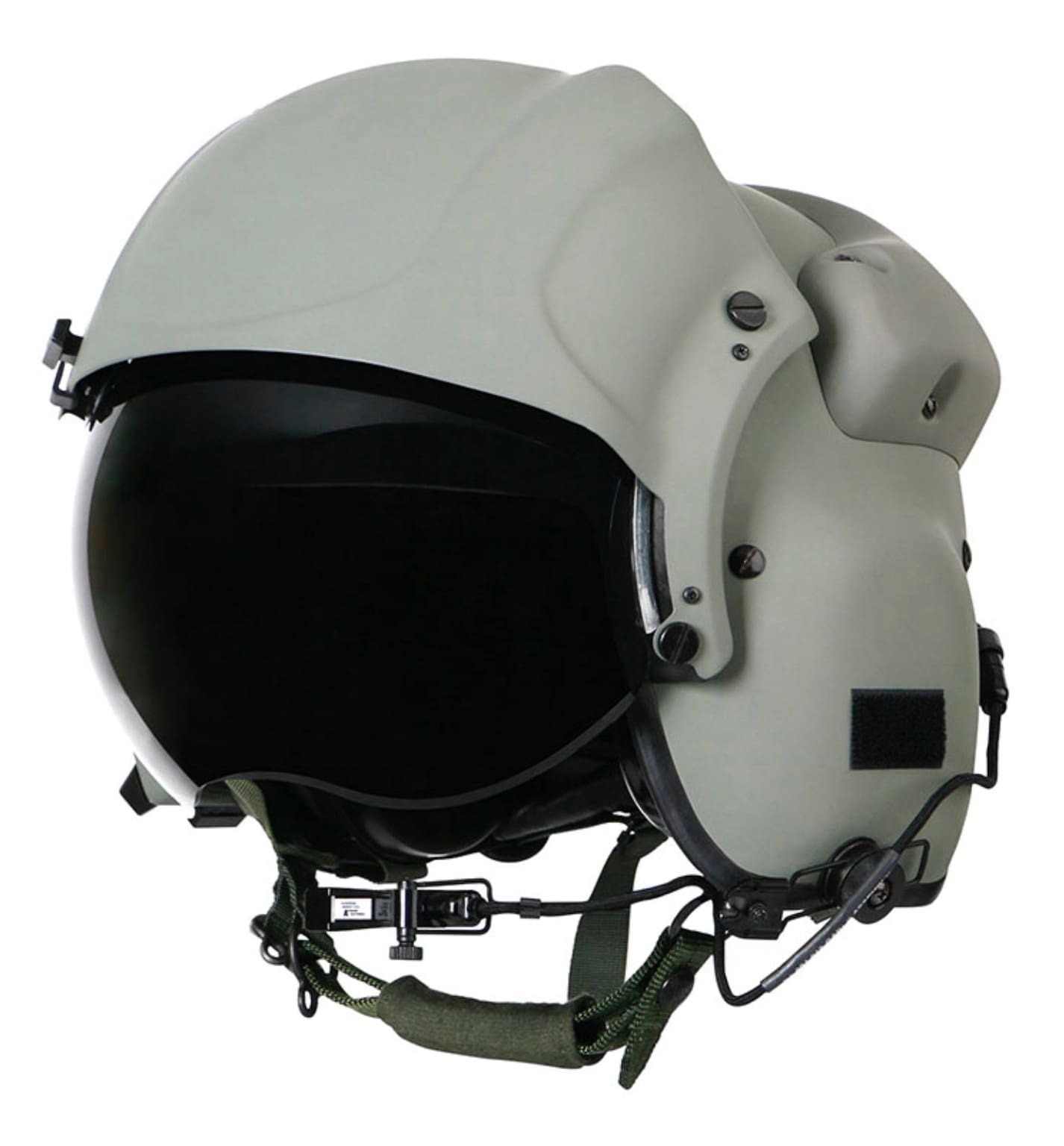
Gentex Awarded $13M U.S. Army Contract for Apache Aviator Integrated Helmet

Tuesday, July 25th, 2017

Direct contract enables better pricing, and streamlined engineering and integration support

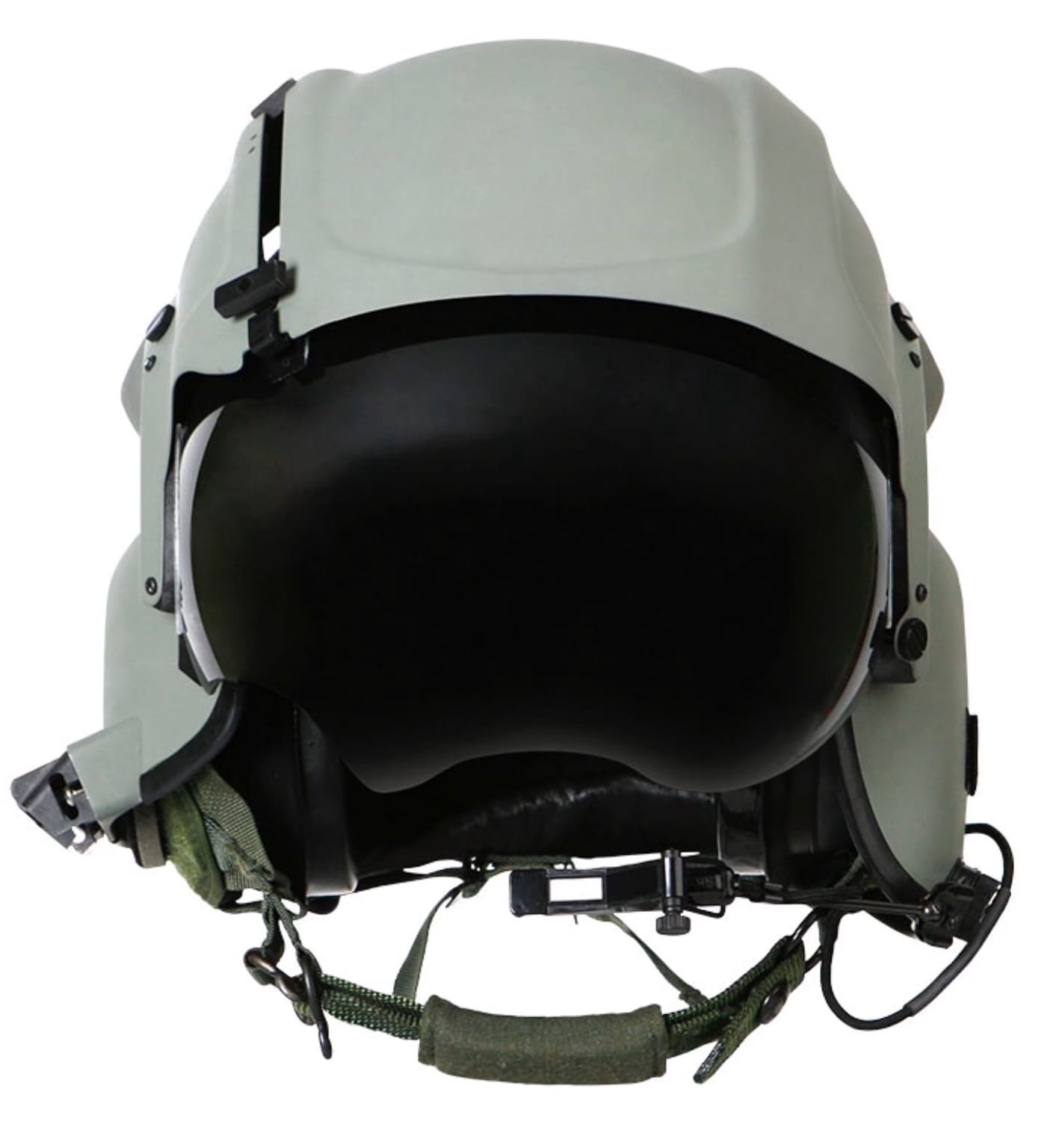
Simpson, PA, July 24, 2017. Gentex Corporation, a global leader in personal protection and situational awareness solutions for defense forces, emergency responders, and industrial personnel has been awarded a $13,443,811 firm-fixed-price contract by the U.S. Army for the delivery of Apache Aviator Integrated Helmets (AAIH).

IMG_3118

Worn by Apache helicopter crews, the AAIH is an integrated helmet, display, and sight system with improved safety features and comfort that provides situational awareness and targeting information. The integrated helmet is a key component of the next generation Apache helicopter, the AH-64E, which will be flown by over 15 countries.

IMG_3119

Prior to the competitive win, Gentex had been supplying the helmet to the Army as a subcontractor under a prior agreement. “We’re proud to have been chosen to continue producing this next generation aviator helmet for the Army,” said Robert McCay, vice president aircrew systems, Gentex Corporation. “Providing the helmet to the Army directly allows for better pricing, and streamlined engineering and integration support.”

The AAIH is based on the highly successful Gentex HGU-56/P Rotary Wing Helmet System, which Gentex has been supplying to the U.S. DoD since 1993. Work for the AAIH contract will be conducted at Gentex’s large capacity manufacturing facility in Simpson, Pennsylvania, and is expected to be complete by June, 2022.

USSOCOM Seeks Body Worn Sensors

Tuesday, July 18th, 2017

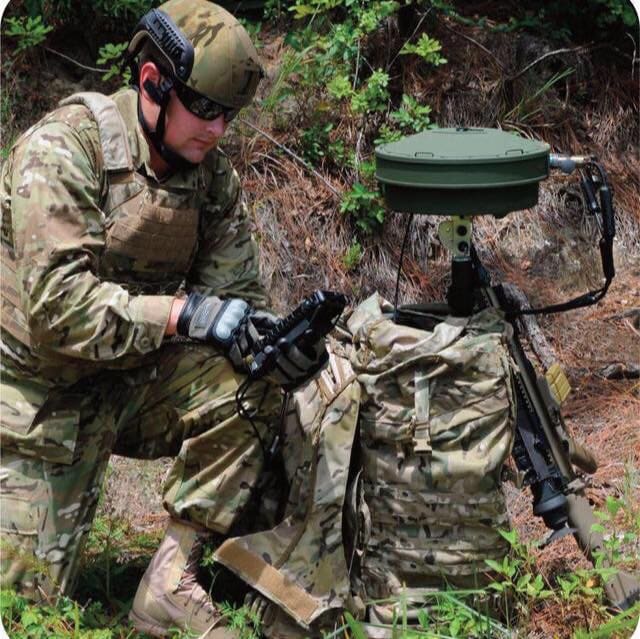
Not long ago, we mentioned Joint Threat Warning System, USSOCOM’s program of record for SIGINT collection systems. For ground-based collection, that is the AN/PRD-13(V)2. By default, it is also the system used by the US Army, which seems to have checked out of developing tactical SIGINT systems. Many capabilities which SOCOM adopts in the SI realm, also find their way into US Army LLVI.

USSOCOM, Special Operations Forces Acquisition Technology and Logistics (SOF AT&L), Program Executive Officer for Special Reconnaissance, Surveillance and Exploitation (PEO – SRSE), Program Manager for Joint Threat Warning Systems (PM-JTWS) recenty released an RFI to industry for Body worn sensor with low Size Weight and Power (SWaP). As communications systems become more sophiticated, so must the equipment designed to collect against them.

According to the RFI, the Program Manager is specifically interested in signals intelligence technologies, ideas and solutions which advance in the following Key Interest Areas:

1) Body worn sensor with low Size Weight and Power (SWaP)
2) Low profile DF antenna

JTWS is seeking potential solutions with the below criteria as initial guidance but not formal direction:

• Hardware:
o Software Defined Radio Threshold –
-Ability to conduct surveys of special/advanced Signals of Interests (SOIs)
-Provide Narrowband automatic signal detection
-Ability to search (scan) special frequency bands
-Ability to search (scan) operator created search parameters or tables
-The system shall have the ability to be sanitized upon command
-The system shall have the ability to be zeroized upon command
-Zeroize feature shall include a fail-safe device to prevent inadvertent zeroizing

o Software Defined Radio Objective –
-Survey capability between the frequency range of 3 – 6,000 MHz
-Provide Wideband automatic signal detection
-Allow for remote zeroization and sanitization

o Antenna Threshold –
-Multiple cables lengths and calibration tables for different operational environments
-Antenna repair kit
-Convenient antenna and cable kit
-Shall conform to platform specific requirements for use on a full range of platforms
-Man-packable antenna shall come with the ability to be mounted off the body for operations on-the-halt

o Dedicated SIGINT Communications Architecture Threshold –
-LOS Meshed Network / Self-Healing connectivity to support collaborative operations

o Dedicated SIGINT Communications Architecture Objective –
-Beyond Line of Sight (BLOS) Meshed Network / Self-Healing connectivity to support collaborative operations
-Low Probability of Interception (LPI) and Low Probability of Detection (LPD) waveforms

o Data Storage Devices Threshold –
-Removable, replaceable and separated from operating system storage
-Store a minimum of 100 GB of data storage in a removable form factor
-Clear identification markings for emergency destruction

o Data Storage Devices Objective –
-Encryption for data-at-rest
-Digitally record, catalog and store a minimum 500 GB of data in a removable form factor

o Environmental and EMI/EMC conditions
-Compliant with MIL-STD-810F and MIL-STD-461F as required, or commercial requirements in accordance with operational platform

o Global Positioning System (GPS)
-Receive, display and metatag collected sensor data with GPS-based position, time stamp and/or platform navigation data from either internal or external source(s)
– ystem clock time synchronization to the sensor; if GPS loses synchronization the sensor time will be maintained until GPS is reacquired
-Comply with CJCSI 6140.01.

o Weight Threshold –
-Sensor shall weigh no more than 12 lb with batteries, less antenna(s) and ancillary cabling

o Weight Objective –
-Reduction of weight between 3 lb to 9 lb

o Batteries Threshold –
-Sensor shall be powered by hot-swappable MIL-SPEC batteries for a minimum of eight (8) continuous hours using batteries carried by the operator
-Sensor shall store a Hold Up Battery (HUB) in an effort to prevent loss of data during unexpected system power down

o Batteries Objective –
-Increase operating time on batteries to a minimum of twelve (12) hours

• Data:
o Sensor will detect, collect, locate and process multiple data types
o Sensor will output common audio and data formats
o Exchange of data utilizing File Transfer Protocol (FTP), IPV6 and Secure file transfer protocol (SFTP)
o Ability to exchange data with other sensors and networks

• GUI:
o Human Machine Interface (HMI) / Graphic User Interface (GUI) Threshold –
-Interface with RaptorX
-Display frequency spectrum type observation of signals (separable into up to three {3} spectral displays selectable by the operator)
-Ability to adjust the basic receiver tuning via a spectral display
-Selectable visual and/or aural indications of a newly detected signal within five (5) seconds of the signal’s presence
-Display status of all channels
-Ability to start or stop recording on any channel from the GUI
-Ability to convey sensor status in the form of a Built In Test (BIT), with corresponding error codes
-Support searching in both manual and automated modes
-Include frequency-spectrum separable for up to three spectrums between 3 – 6000 MHz
-Provide audio / graphic monitoring on spectral display with minimum update rate of 3 Hz.
-Adjustable basic receiver tuning via the spectral display (volume, frequency, squelch, span)
-Display results in near-real time across the JTWS family of systems
-Overall system and all subsystem visual output shall be on a single, common display, with screens for each subsystem or system function set selectable
-Provide enough display area to simultaneously view and manage user defined functions/features of sensor (i.e. higher resolution displays or enhanced user interfaces)
-Displays shall be readable in bright sunlight when in direct frontal view by the operator
-Equipment shall not disrupt operator user of night vision goggles when not viewing system display
-Variable brightness control from zero illumination to its maximum, sufficiently illuminated for nighttime operations and daytime operations
-Display emitter location data/results in real-time on a user defined map (e.g., Ellipse, Heat map, LOB, point target)
-Upon user request, display operator geographic location (GPS) and compass orientation to equipped sensors
-Transmit positional data across networks
-Display estimated signal source location on a moving map display
-Color-code or otherwise provide distinguishing display of each signal being tracked
-Displays shall be NVG compatible
-User shall be able to play back historical libraries with the ability to combine previous and current information
-Produce an output data stream compatible with current DOD geospatial mapping programs

o Human Machine Interface (HMI) / Graphic User Interface (GUI) Objective –
-Provide acquired information to onboard / off board (when selected by operator) processing elements for intelligence and Command & Control (C2) purposes (for both organic and external / off board force employment) and provide updates to onboard / off board Common Operation Picture (COP)
-User interface for mapping, audio control, sensor control and data manipulation

o Audio Processing real-time and post mission audio manipulation Threshold –
-User Interface (UI) shall provide audio controls for volume, frequency, squelch, span, noise reduction and advanced filtering
-Audio output compatibility with various interphone systems / headsets
-Provide reduction of signal noise to improve raw collection for audio quality and speech detection
-Provide selectable real-time filtering of audio
-Displays shall provide for dual audio outputs
-Displays shall route audio to operator(s) from any four simultaneous signals

o Audio Processing real-time and post mission audio manipulation Objective –
-Route audio to operator(s) from any four simultaneous signals, each present for at least two seconds; each audio stream 100% complete
-Quickly retrieve and play back a segment of audio data collected within the past 15, 30, 45, or 60 seconds in order to further analyze the data
-Buffer real-time audio, so that upon resumption the operator will be able to recall missed audio during playback times
-Provide the user the option to post process audio for language identification, speaker identification, gender identification, speech detection and group identification via post mission analysis using audio processing software
-Provide the user the option to process audio in near real-time for Language identification, speaker identification, gender identification, speech detection and group identification. Also audio should be available via post mission analysis using audio processing software.

• Software:
o Information Assurance to comply to ICD 503 protection level 3, Integrity Level Of Concern (ILOC) medium, Availability Level of Concern (ALOC) medium or equivalent Office of the Director of National intelligence (ODNI) directives/publications

Remember, this is still just an RFI and the information will be used to inform requirements. However, if as a company, you don’t participate, the government may not be aware of a capability you can provide and won’t issue a requirement for it. They need to know the art of the possible. The Government requests submissions NLT 28 JUL 17.

For more information visit www.fbo.gov.