Pirata Series from OTB Boots - Coming March 2026!

Archive for the ‘Guest Post’ Category

USMC Amphibious Combat Vehicle Achieves Major Milestone

Thursday, December 10th, 2020

The US Department of Defense announced today:

BAE Systems Land and Armaments L.P., Sterling Heights, Michigan, is awarded an $184,444,865 fixed-price-incentive (firm target) modification to previously awarded contract M67854-16-0006 for amphibious combat vehicles (ACV).  This modification provides for the procurement of 36 full rate production ACVs and other associated production costs for the Marine Corps.  Work will be performed in York, Pennsylvania (60%); Aiken, South Carolina (15%); San Jose, California (15%); Sterling Heights, Michigan (5%); and Stafford, Virginia (5%).  Work is expected to be completed in November 2022.  Fiscal 2021 procurement (Marine Corps) funds in the amount of $184,444,865 are being obligated at the time of award, none of which will expire at the end of the current fiscal year.  The Marine Corps Systems Command, Quantico, Virginia, is the contracting activity (M67854-16-C-0006).

Marine Corps’ Program Executive Office Land Systems issues a story about the program:

Marine Corps will begin fielding Amphibious Combat Vehicle
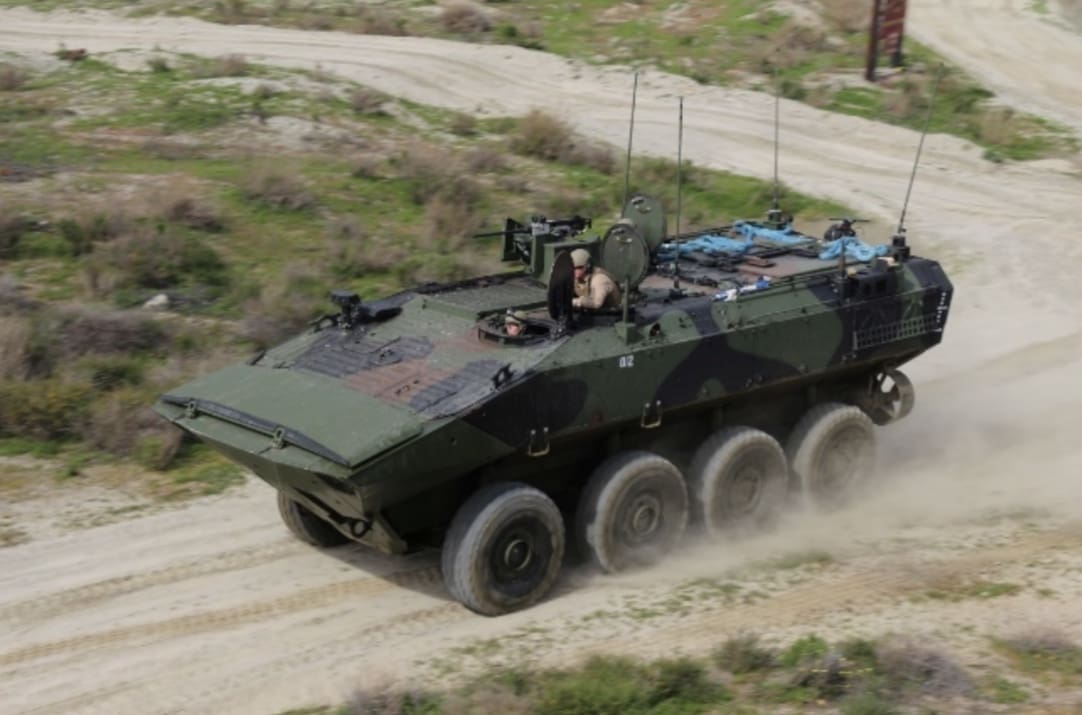
Marine Corps Base Quantico, Va.— The Marine Corps’ new Amphibious Combat Vehicle has achieved two new major milestones.

On Nov. 13, the Marine Corps’ Capabilities Development Directorate approved the Initial Operational Capability of the ACV. Marines with 1st Marine Division aboard Marine Corps Base Camp Pendleton, California, were the first to receive the vehicle.

The Program Manager Advanced Amphibious Assault program office at Program Executive Officer Land Systems manages the system.

“We’re providing Marines with a modern, armored personnel carrier that offers tremendous capability with respect to survivability,” said Col. Kirk Mullins, program manager for Advanced Amphibious Assault at PEO Land Systems. “The ACV gives the Marine Corps a capable platform operational across the full-range of military operations.”

Then, on Dec. 8, Assistant Secretary of the Navy (Research, Development and Acquisition) James Geurts approved the vehicle for Full-Rate Production. This means the Marine Corps can build and field higher quantities of the ACV at a sustained rate over the next several years.

What is the ACV?

The ACV is a next-generation, eight-wheeled vehicle designed to move Marines from ship to shore. The vehicle will be the primary means of tactical mobility for the Marine infantry battalion at sea and ashore, replacing the Corps’ aging Assault Amphibious Vehicle.

The ACV provides organic, direct fire support to dismounted infantry. The vehicle’s ability to leverage waterways to carry Marines and equipment make it well-suited for various operating environments, including Expeditionary Advanced Base Operations.

It is net-ready, secure, interoperable, operationally effective and built for future growth. In the future, the Corps intends to develop, procure and field three additional variants that specialize in command and control, recovery operations and increased firepower.

“The fielding of the ACV is significant because we’re replacing the AAV, which has been effective for decades but was fielded in 1972,” said Mullins. “We’re providing Marines with a modern, more capable combat vehicle that is more adaptable to today’s battlefield.”

Col. David G. Bardorf, the director of Ground Combat Element Division at the Marine Corps’ Capabilities Development Directorate, said the ACV has progressed significantly since its initial requirements discussions in 2014. Combat Development and Integration was responsible for developing the requirements set that would be needed to replace the older platform.

“Reaching IOC is a testament to those involved in this program and the constant communication between the stakeholders: requirements, program managers, and [the vendor],” said Bardorf. “In the end, the Marine Corps is receiving an upgrade in capability ahead of schedule. We look forward to the program moving forward towards Full Operational Capability.”

Mullins said the vehicle is projected to reach FOC in fiscal year 2028.

Marines excited for new vehicle

In 2019, PEO Land Systems oversaw extensive testing involving the ACV that confirmed the vehicle’s ability to not only take on challenging surf, but also complete a long swim from ship to shore. The testing also indicated that the ACV has greater survivability and mobility than the AAV.

In 2020, Marine Corps Operational Test and Evaluation Activity performed independent operational testing involving the ACV’s achieved suitability, effectiveness and survivability. Results from the assessments, as well as feedback from Marines trained to employ the vehicle, came back positive.

Mullins believes the ACV achieving IOC and FRP is a significant achievement for the Marine Corps, as Marines will receive an innovative vehicle that further supports their missions in various combat environments for years to come.

“As program manager, I’ve spent a lot of time speaking with Marines who have trained with this vehicle in a variety of test environments,” said Mullins. “The feedback we’ve consistently received has been overwhelmingly positive. Marines seem to really love the vehicle.”

Story by Barb Hamby, PEO Land Systems

Photo by by Ashley Calingo
Mystery Ranch – RFAK & VLAK

Thursday, December 10th, 2020

An essential aspect of preparedness is medical supplies and training. The ability to self-stabilize and package yourself, potential patients, or family members will depend on your ability to respond quickly to any situation. MYSTERY RANCH offers two basic medical pouches.

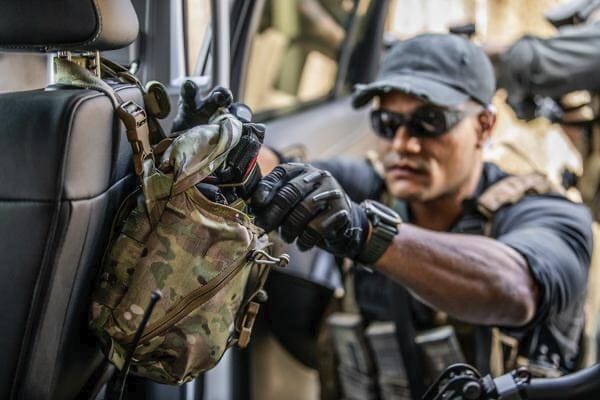
VLAK in use. Photo by: TacGas

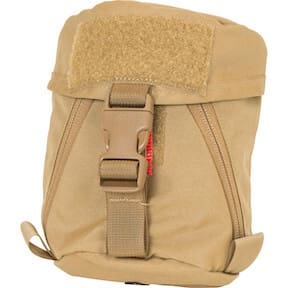
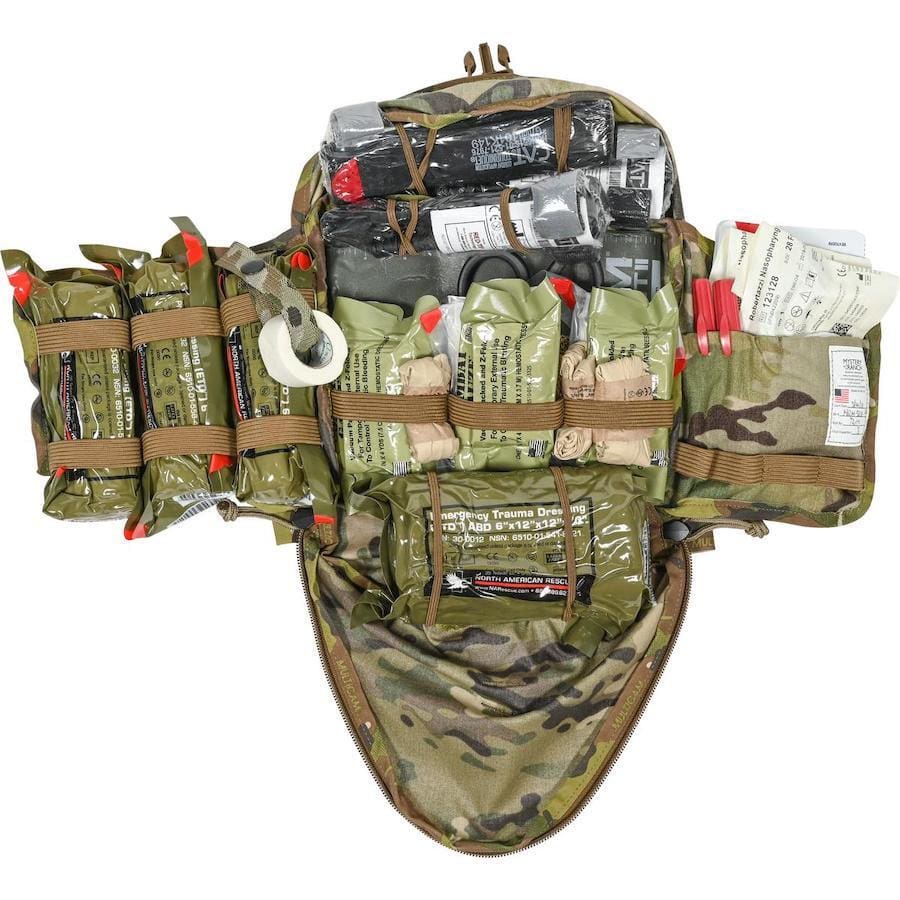
The Removable First Aid Kit (RFAK) and Vehicle Litter Aid Kit (VLAK) are two small medical pouches from MYSTERY RANCH built to handle essential medical tasks with expandable-organization in mind. Their application excels with on-person or vehicle-based missions – from the residential, tactical urban, mission-essential or wilderness backcountry environments.  

RFAK and VLAK both offer quick, one-handed visual access to your essential medical supplies organized inside – allowing for pressure or stabilization while accessing the necessary medical solution stored inside.

The history of MYSTERY RANCH medical kits:

IFAK (Individual First Aid Kit) and VLAK (Vehicle Litter Aid Kit) were initially designed around 2010 in response to an RFP for a SOCOM Tactical Combat Causality Care program. Both pouches were designed with quick one-handed entry, ensuring fast rip-open access to med supplies. This design was based on the previously developed Rip-Zip pockets, turned upside down for this application. 

The Ranch was a sub-contractor on the bid, providing nylon that the prime contractor would kit out with the medical supplies. The prime contractor wasn’t awarded the contract, but SOCOM quickly reached out praising the design built by MYSTERY RANCH. Since then, these have been staples of the Ranch’s in-line program. 

RFAK – Removable First Aid Kit

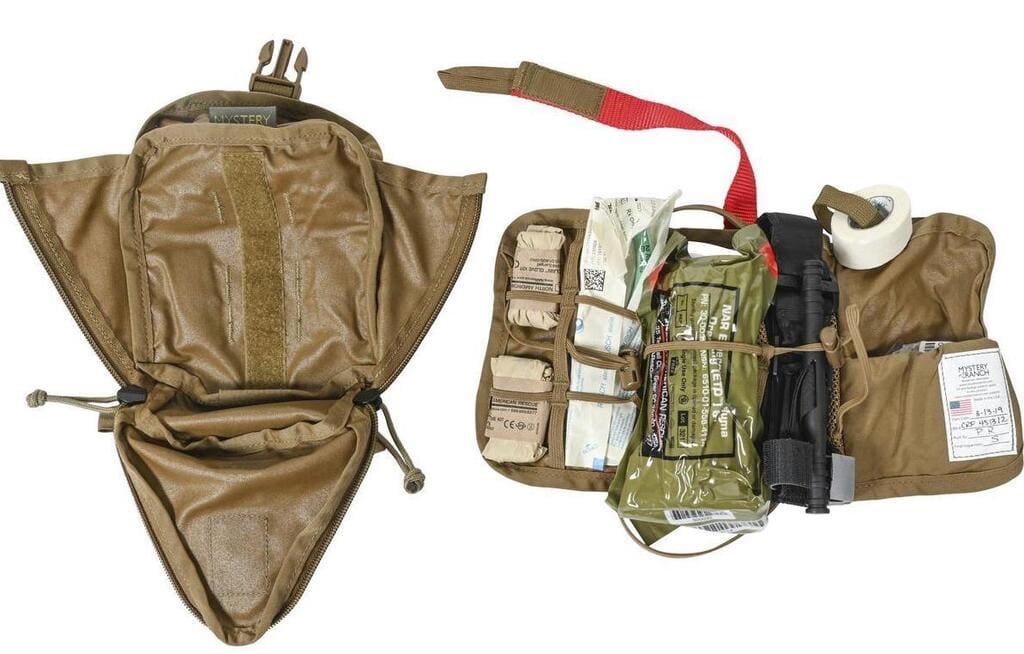
The original MYSTERY RANCH IFAK was redesigned in 2016 based on user feedback from those downrange. The primary redesign element was the ability to remove the internal medical kit while the IFAK outer stayed attached. As shown below, the internal component are now removable so that with one hand, a user could pull the entire contents out of the shell in a tight little bundle. This allowed self-administration of aid or the ability to toss the bundle to someone else who needs it. With this design change, we re-named the product RFAK (Removable First Aid Kit). The RFAK is a compact, yet expandable and removable, individual first aid kit. It features a MOLLE attach system and is sized to keep a low profile. 

No matter if this is placed on your kit, in your go-bag, or in any of your day-to-day belongings. The RFAK contains enough space for an individual’s essential medical supplies.

VLAK – Vehicle Litter Aid Kit

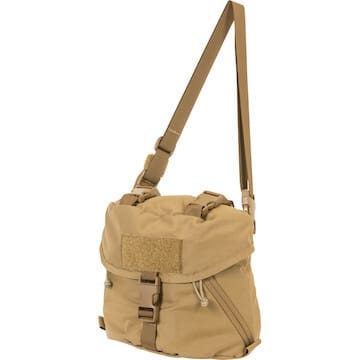
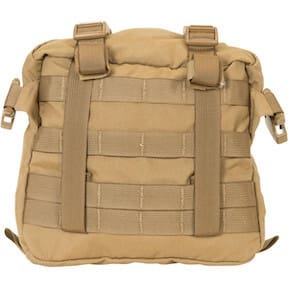
The VLAK is the next step-up in medical kit size, while maintaining the same single-handed utility and MOLLE attachment as the RFAK. It includes a long, detachable strap connected to the top to sling it over a vehicle headrest, or your shoulder while heading to the X. It can also be attached to an assault vest and body armor. 

VLAK is a common acronym for this type of larger IFAK designed to be primarily vehicle based for responders to a mass casualty event. This size adapts to family or crew needs with vehicle mobility in mind. The VLAK is sized to hold two RFAK’s worth of gear, to either refill RFAK’s or triage several patients. The VLAK was designed to address medical resupply storage in vehicles. 

The Litter in the name refers to its ability to carry a compressed and ultra-light litter under the two compression straps on the top of the VLAK. As such, it is larger than the RFAK so that it can carry larger and additional medical items along with standard medical gauze, clotting agent, etc.  

RFAK and VLAK Manufacturing and Distribution

Both of these medical pouches are currently made in the USA and are Berry Compliant, and available for civilian purchase. 

We also manufacture an Asia-sourced version that is supplied to the Norwegian Military, as MYSTERY RANCH is a subcontractor for most of the Nylon on Norway’s current TCCC (Tactical Combat Casualty Care) program. Some version of most of our medical packs and pouches are being issued widely there since 2018. 

We are pleased to collaborate with our friends at North American Rescue for kitting out our medical packs for these photos and videos. Please contact NARescue customer service to order medical contents as shown.

*Contents not included with MR pack. 

Combat Divers Submerge Inside Cheyenne Mountain

Thursday, December 10th, 2020

CHEYENNE MOUNTAIN AIR FORCE STATION, Colo. —

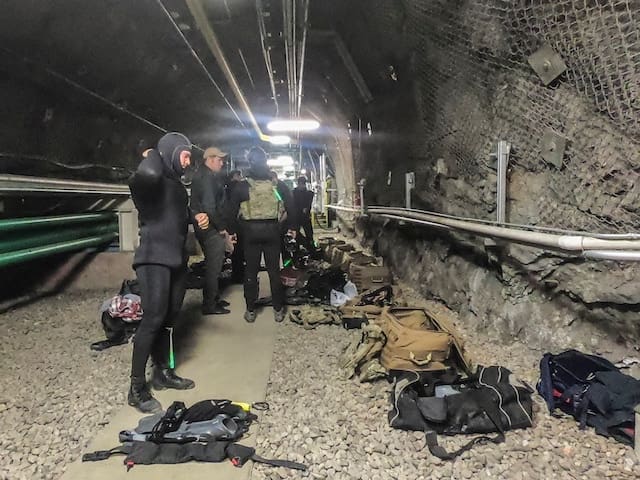
A Special Forces Operations Detachment – Alpha (SFOD-A) with 10th Special Forces Group (Airborne) put their combat dive skills to use November 5, 2020 where one would least expect: in the heart of the Cheyenne Mountain Complex. 

Inside the complex are three reservoirs that hold water for a variety of uses, including cooling the mountain’s generators and expelled exhaust. Because the mountain is designed to function independently, the water systems are vital to the success of the mountain’s operations. Assessing the Structural integrity of the reservoirs and ensuring the water is flowing freely through the cave systems that connect them keeps things running smoothly. 

“They originally contracted with a civilian company to get this done,” says the Officer in Charge of the Dive LIfe Support Maintenance Facility at 10th SFG (A). “My brother, an Air Force Logistical Officer tasked to the Space Force, recommended they get in contact with (us) to do it for free.”

The facility manager of the complex and the DLSMF and a chosen combat dive SFOD-A set out to accomplish the mission.

“Dive operations don’t happen very often in special forces,” says the OIC. “This was a good chance for us to go out and showcase our capabilities as a legitimate maritime force within (Special Operations Command) to actually do a real world mission. It’s not infiltrating into enemy country or territory, but it was a chance for us to show everyone that we do have this capability and it’s important to keep the capability within the Special Forces community.”



10th SFG (A) to establish and develop relationships outside of the Army and Special Operations Command. It started a relationship with the Cheyenne Mountain complex to provide future opportunities for real world missions, training and equipment testing. These relationships are essential to interoperability within different branches of the military enhancing our overall capabilities as one united force. 

By Sgt Angela Walter, 10th Special Forces Public Affairs

Finally! Department of the Air Force Removes Waist Measurement from Physical Fitness Assessment Composite Score

Monday, December 7th, 2020

WASHINGTON (AFNS) —

The Department of the Air Force announced physical fitness assessments will now resume April 2021 and will no longer include the waist measurement component.

To ensure social distancing practices remain in place during the ongoing COVID-19 pandemic, and to give Airmen and Space Professionals time to prepare, testing was delayed from October to January and is now further delayed to April.

While the waist measurement is permanently removed from the assessment, height and weight measurements will resume October 2021.

“We trust that our Airmen understand the standard of good physical health practices and we are all finding innovative ways to stay fit,” said Air Force Chief of Staff Gen. Charles Q. Brown, Jr. “We also trust that leaders will take the appropriate steps to keep their Airmen safe while making every effort to provide fitness options during the pandemic.”

Fitness assessment cells, fitness center staff, physical training leaders and members performing fitness assessments will adhere to physical distancing protocols and other local precautions as determined by installation commanders once assessments resume.

Commanders may delay official fitness assessments beyond April 2021 if necessary, based on the recommendation of local public health officials, the continuation of closed fitness centers and extended state-wide restriction of movement and gatherings.

Space Professionals will adhere to the physical fitness policy of the Department of the Air Force.

Airmen and Space Professionals may determine their next fitness assessment due date by visiting the Official Physical Assessment Due Date Matrix on myPers which will be updated and available Dec. 8. Fitness assessment due dates will primarily depend on the date and score of the last official test.

“Originally, we hoped to resume testing by January 2021,” said Chief Master Sgt. of the Air Force JoAnne S. Bass. “However, based on the number of cases nationwide, the right thing to do is focus on keeping our Airmen and their families safe. Delaying and reevaluating the PT test is the best option for our people.”

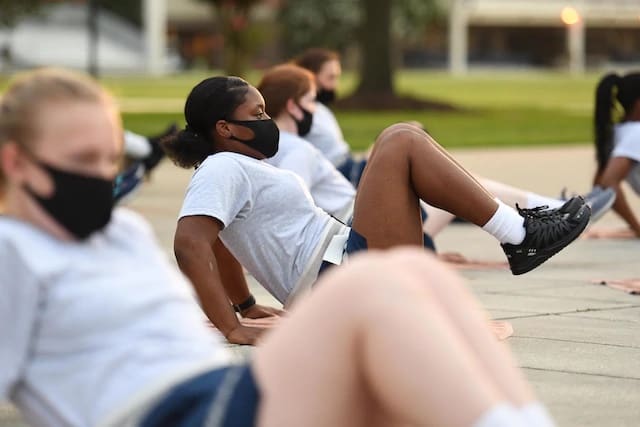
The test will still consist of a 1.5 mile run, 1 minute of pushups and 1 minute of situps. However, the composite score will be calculated with full points for the waist measurement portion until system changes can be made.

Department leaders are also looking to reevaluate certain testing criteria moving forward.

“Along with removing the waist measurement, we are also exploring alternative strength and cardio components to our current Air Force fitness assessment,” Brown said. “We believe these potential test structure changes will impact Airmen in a positive way and help with a holistic approach to health and fitness standards.”

For more information, Airmen and Space Professionals should contact their fitness assessment cells and visit the COVID-19 Fitness Guidance page on myPers.

Secretary of the Air Force Public Affairs

SCUBAPRO Sunday – How Elvis saved the U.S.S. Arizona

Sunday, December 6th, 2020

I ran this last year, but I wanted to do it again as I think it is great story.

The Japanese attacked on Pearl Harbor killed 2,403 military and civilians personal. A further 1,178 people were injured in the attack. 19 ships were sunk or damaged, and 188 aircraft destroyed. The efforts of the greatest generation raised all but three (The Arizona, The Utah, and The Oklahoma).

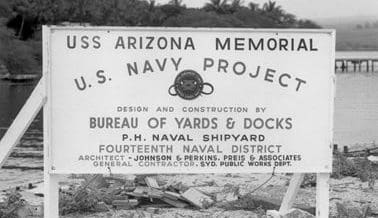
The wreck of the Arizona immediately became a memorial. Passing ships rendered honors to the Arizona and her crew throughout WW2 and still due to this day. Proposals for a permanent memorial started as early as 1943, but not until 1949 did an organized effort began to take shape with the creation of the Pacific War Memorial Commission (PWMC). As the PWMC considered ideas to formally recognize the role of Hawaii during the war, which would include a memorial to the Arizona, Admiral Arthur Radford had a flagstaff placed on the wreck in 1950. He ordered that the colors be raised at the site every day. This modest memorial was later expanded to include a wooden platform and a commemorative plaque.

In 1958, President Dwight Eisenhower signed Public Law 85-344 that allowed the PWMC to raise money on the Navy’s behalf for the construction of a memorial to the Arizona. A fundraising goal of $500,000 was set and the initial response from the public was promising. An episode of the popular T.V. series This is Your Life dedicated to Medal of Honor recipient Rear Admiral Samuel Fuqua. (Then Lieutenant Commander Fuqua serving as the U.S.S. Arizona ship’s Damage Control Officer and first lieutenant, and was on board her during Japan’s December 7, 1941, attack on Pearl Harbor. Though knocked unconscious by a bomb that hit the ship’s stern early in the attack, he subsequently directed firefighting and rescue efforts. After the ship’s forward magazines exploded, he was her senior surviving officer and was responsible for saving her remaining crewmen.)

That initial call for donations raised over $95,000. However, the project quickly stalled as donations dried up. By the start of 1960, only $155,000 had been raised.  

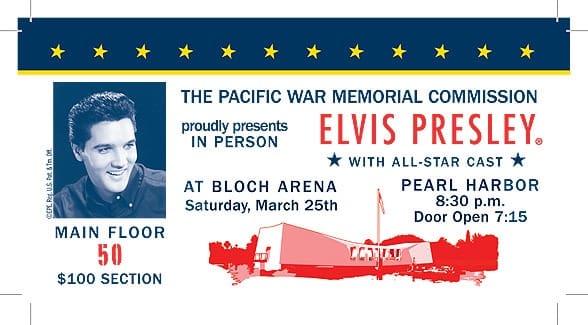
“Colonel” Tom Parker read about the struggling campaign in a newspaper and spotted an opportunity. As Elvis Presley’s manager, he was eager to get a bit of positive publicity for his client who had been out of circulation for a couple of years after being drafted into the U.S. Army. Parker surmised that a benefit concert for the U.S.S. Arizona Memorial would raise much-needed awareness of the fundraising campaign while also demonstrating that Elvis still had drawing power. Elvis was not only pleased to be able to perform for an audience. He was a patriot who genuinely believed in the cause and wanted to help.

The PWMC accepted Elvis’s generous offer and began making arrangements with the Navy to use the 4,000 seats Bloch Arena at Pearl Harbor as the venue for the concert. It was the same arena that had hosted the “Battle of Music” the evening before the attack in 1941. The “Battle of Music” was a spirited competition to determine the best ship band in the Pacific Fleet. Although they had been eliminated from contention, the band from Arizona was present and played dance music for the attendees. They would never perform again. The entire band was killed in the explosion on the ship the next morning.

With the venue secured and the show scheduled for March 25, 1961, Parker set ticket prices ranging from $3 to $100 and announced that everyone would have to buy a ticket to see the show. Rank usually has its privileges. Still, Parker seemed to take pleasure in rebuffing admirals and generals who approached him about complimentary tickets. When he said he everyone had pay, he meant everyone had to pay — even the performers. Elvis bought a $100 ticket for himself then bought dozens more to give to staff and patients at a military hospital.

After a brief introduction by Rear Admiral Robert Campbell of the 14th Naval District, Elvis took the stage as hundreds of teenagers screeched in excitement. The King looked resplendent in his signature gold lame jacket with silver sequin lapels. He let out a brief yell of his own in response to the ecstatic audience before launching into his hit “Heartbreak Hotel.” All accounts state that Elvis was in peak form, giving an enthusiastic and energetic performance that included favorites “All Shook Up,” “Don’t Be Cruel,” “Are You Lonesome Tonight,” and “It’s Now or Never.” He finished the show with a rollicking version of “Hound Dog,” during which he slid across the stage on his knees. The 15-song set, and 45 minutes of stage time were among the longest of his career. The concert would also be his last for 8 years.

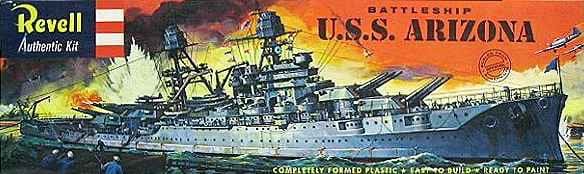
The benefit was a resounding success. Ticket sales accounted for $47,000 with additional donations ($5,000 coming from Elvis), pushing the total take to over $60,000. Funding for the memorial was still well short of its target. Still, the electricity of Elvis had generated the jumpstart the campaign needed. In 1961, Hawaii Senator Daniel Inouye got legislation passed to secure another $150,000 in federal funds. Money began to flow from other sources. The combination of public funds and private donations (including $40,000 from Revelle raised through sale of model kits of the Arizona) reached the goal of $500,000 by September 1961 – just 5 months after the concert. The end of the year completed construction on the memorial.

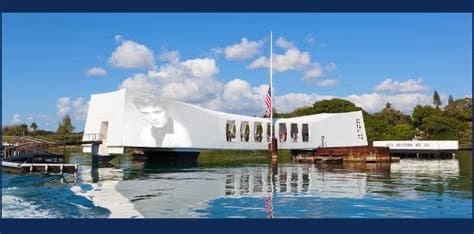
The U.S.S. Arizona Memorial was officially dedicated on May 30, 1962. Elvis certainly took pride in his role in building a permanent memorial to the crew of the Arizona. He made several visits to the site on subsequent trips to Hawaii. The memorial has reached its own iconic status and welcomes 1.5 million visitors a year.

Elvis did not forget the Arizona, and the Navy did not forget Elvis. When Elvis passed away in 1977, the Navy showed its gratitude by placing a wreath for him at the U.S.S. Arizona Memorial.

Much of today’s upkeep comes from the fundraising of the American Veteran (AMVETS), a veteran’s service organization that helped to secure around $250,000 in total for the memorial during the 1950s. The organization is responsible for the upkeep of the white marble wall inscribed with the names of the men who perished aboard the U.S.S. Arizona. In 1983, and again in 2014, AMVETS raised funds needed to replace the deteriorating Wall of Remembrance.

AFSOC’s SOF DT Undergoes Transformation

Saturday, December 5th, 2020

HURLBURT FIELD, Fla. —

As Air Force Special Operations Command drives towards transformation to the “AFSOC of Tomorrow” by developing its human capital, the Special Operations Forces Developmental Team instituted a more rigorous evaluation and scoring process to give SOF officers more specific feedback and purposeful career development. This enhanced process kicked off this year with the Apr. 20-24, 2020 SOF DT.

 “Over the last five to seven years, development team scoring hasn’t changed,” said Maj. Brandon Webster, Chief, Command Force Development. “There was no clear path on how we wanted to develop an individual, and we wanted to give officers more options and transparency on the future of their career.”

Historically, the DT only scored records for officers who were being considered for promotion to Lieutenant Colonel. The new process now incorporates scoring to begin with Captains, allowing for feedback and mentorship at a much earlier point in an officer’s career.

“Looking at an officer earlier on allows us to be intentional,” said Webster. “We now have the ability to look at a Captain’s records and tell him or her where they stand against their peers, and what their career pathway could look like five to ten years down the road based on where they’re at right now.”

DT record scoring provides objective data for more informative assignment placement, hiring for special duty positions, flying assignments outside of an officer’s normal aircraft, and the addition of sub-developmental pathways.

 “Overall, we’ve revamped the entire DT process. We’re focusing a lot more time on the individual to provide substantial feedback and mentor our officers at all levels, beginning at the rank of Captain,” said Webster. “It is the DT’s responsibility to ensure the right officer is placed in the right job at the right time, with the right training, education, and experiences.”

The fall DT, held Oct. 19-23, consisted of group scoring for Captains, Majors, and graduated squadron commanders. Each officer’s developmental vector will follow a percentile format, giving members direct feedback on where they fall among their peers.

“Synchronizing our efforts provides senior leadership the ability to manage officers and strengthen our future force,” said Webster. “The transformation of the SOF DT is one-step closer to building the SOF officers we need for tomorrow.”

Story by Capt Savannah Stephens, AFSOC Public Affairs

Photo by SSgt Rose Gudex

FirstSpear Friday Focus – ACM 600 Wool Lineup

Friday, December 4th, 2020

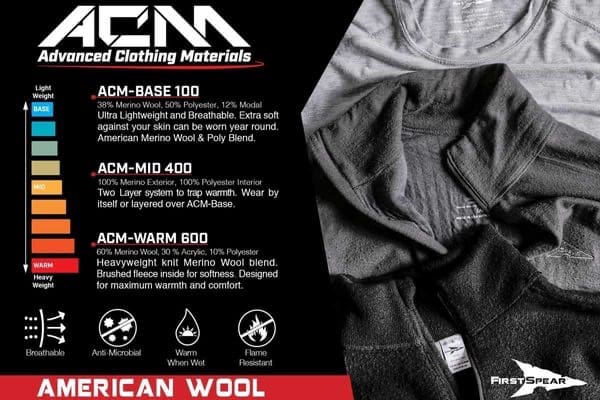
Gear up for winter. FirstSpear Advanced clothing material (ACM) is 100% sourced verified American Wool combined with high-quality materials you come to expect. In addition to warmth, wool is wrinkle-resistant, retains shape, is durable and moisture-wicking.

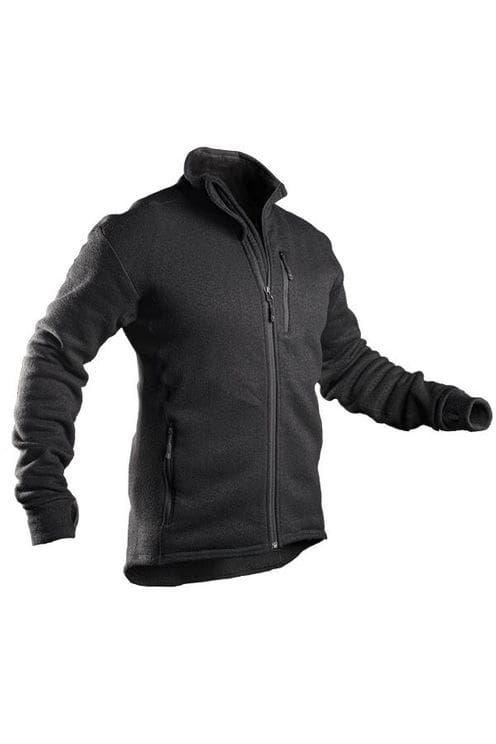
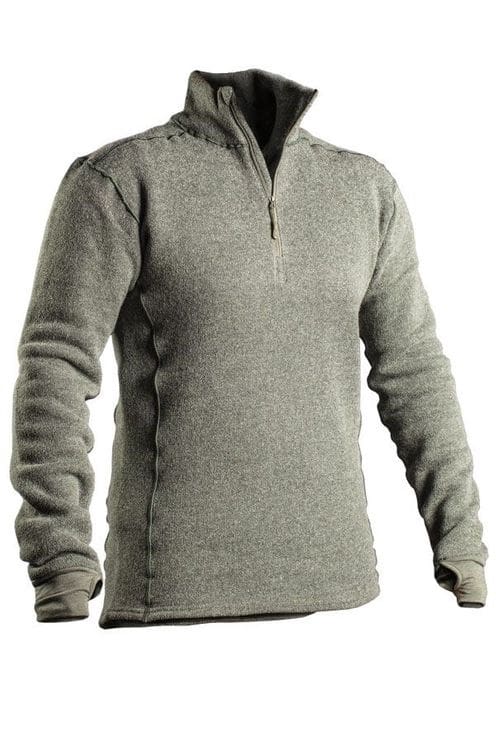
The FS Woobie Quarter Zip is comprised of the warmest 600 ACM lineup. It utilizes a 50/50 blend of the American Merino Wool and polyester and is 100% made in America. Built with a stand-up collar, low profile neck zipper and wrist overs with thumb holes, the Woobie is made to keep you warm in the coldest of climates. The slightly longer tail/contour adds comfort and warmth, preventing exposure and your shirt tails riding up during long days at the range or heading out the wilderness for a backcountry hunt. The ACM-Warm 600 is a heavyweight Merino Wool blend with super soft brushed fleece interior, designed for coldest temperatures. Additionally the lineup also include the Woobie Full Zip, which includes all the above mentioned features with a full-zip up jacket, two side pockets and chest pocket. Available in black, heather grey, FS sand and FS commando.

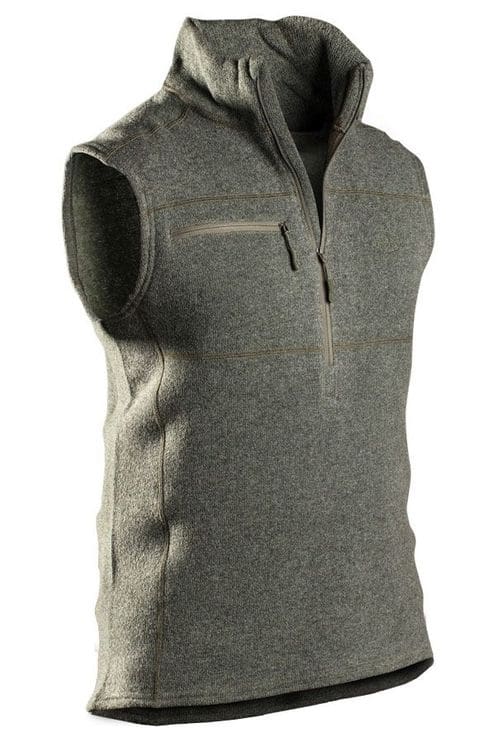
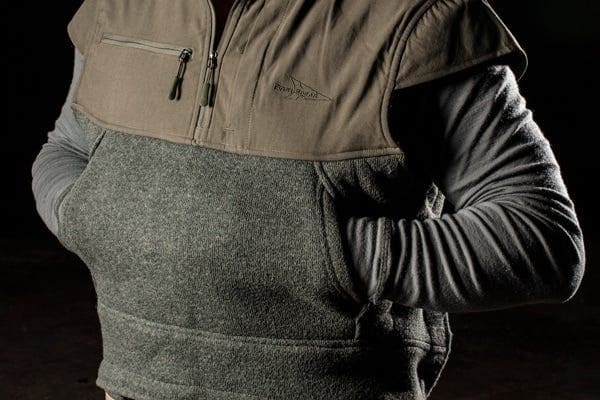
Not only does the 600 ACM lineup include the quarter zip Woobie, it also includes the Technical Woobie, the Everyday Vest (EDV) and Stalker Vest.

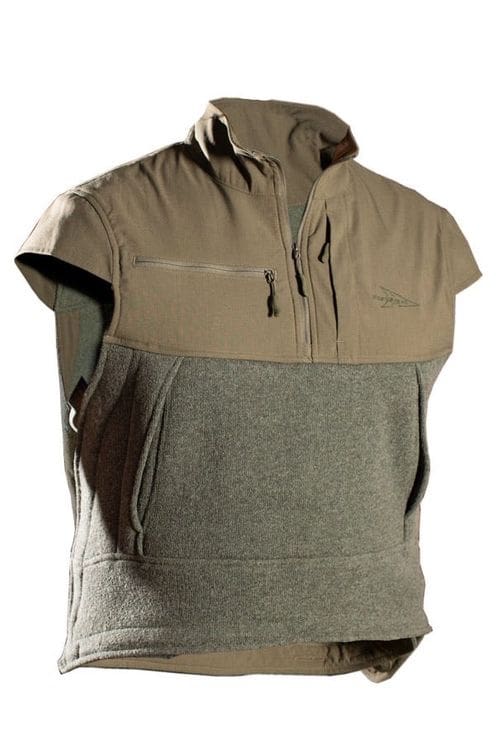
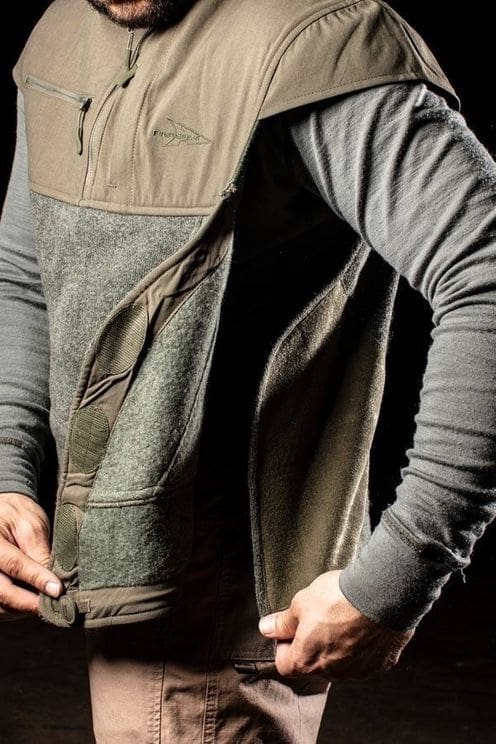
Some key features of the Stalker vest include the ability to remove the garment while wearing a vest thanks to the adjustable and can be opened from the sides via hook/loop and secured, if desired, with button. Sides can also open to increase ventilation. Generous hand warmer pocket and smaller internal pocket within sized for hand warmers. A very cool feature FS incorporated are button holes inside the hand warmer pockets along with cord loops along your internal zipper seams which allow the user to route ear buds or communication cables for discreet cable management. Available in black, black/heather, FS Sand and Commando.

For more information about FirstSpear check out First-Spear.com.

MarCorSysCom Fielding New Cold Weather Boot in 2021

Wednesday, December 2nd, 2020

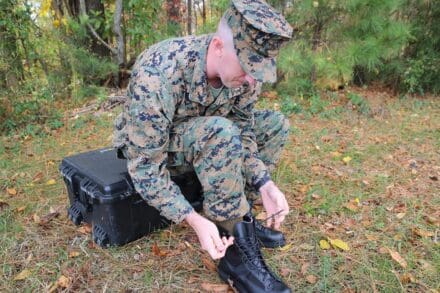
MARINE CORPS BASE QUANTICO, Va.—This fiscal year, Marine Corps Systems Command plans to begin fielding a new boot that protects Marines in cold-weather climates.

The Marine Corps Intense Cold Weather Boot is a full-grain, leather boot designed foruse in temperatures as cold as -20 degrees Fahrenheit. The ICWB allows Marines to complete various missions that might involve hiking or skiing in arduous, cold weather environments without having to change boots.

“In order to effectively conduct your mission in a cold weather environment, you need to be warm,” said Todd Towles, project officer of Cold Weather Gear with the Program Manager for Infantry Combat Equipment at MCSC. “This boot helps to accomplish this goal.”

The Marine Corps currently employs a temperate and an extreme cold weather boot. The Temperate Weather Marine Corps Combat Boot is designed for employment in conditions between 20 to 60 degrees Fahrenheit, while the Extreme Cold Weather Vapor Barrier Boot is intended for use in environments between -65 to -20 degrees Fahrenheit.

However, Marines have said the TWMCCB does not provide enough warmth in sub-zero temperatures because the boot is not designed for such environments. They often have to switch to the Vapor Barrier boot, which can cause excessive sweating if worn extensively in environments above -20 degrees Fahrenheit, said Towles.

The ICWB fills a capability gap left by these two boots. The ICWB will be used in temperatures ranging from -20 degrees to 20 degrees Fahrenheit. Towles said the boot can last up to 18 months or longer if cared and maintained correctly.

“The Intense Cold Weather Boot is not going to have the same insulation capabilities that the Extreme Cold Weather Boot provides, so the foot shouldn’t sweat as much,” said Towles. “It’s also less bulky than the Extreme Cold Weather Boot.”

From 2018 to 2020, MCSC held several user evaluations involving an early version of the ICWB, made of suede, in Iceland, Norway, Alaska and Montana, as well as at the Mountain Warfare Training Center in Bridgeport, California. Curtis Johnson, a logistics management specialist with MCSC, said Marines felt that the suede boot was well-constructed and durable but also thought it was bulky and did not dry well once wet.

Leveraging this feedback, MCSC then acquired a full-grain boot in 2020. Marines indicated the full-grain boot dried well but didn’t provide enough warmth in below-zero temperatures. CWO2 Christopher Latham, an infantry weapons officer for 3rd Battalion, 6th Marine Regiment, assessed the updated boot at Bridgeport earlier this year.

“When the temperature dipped into the negative-degree range, your feet became very cold,” said Latham. “I believe that we need more insulation in the boot to get down into the negative temperatures.”

The program office then added an additional 200 grams of insulation to the boot. If a Marine is wearing the boot for extended periods of time in sub-zero temperatures, MCSC provides a protective overboot for additional warmth if needed. The improved ICWB is also less bulky than the earlier prototype and comprises a black, leather boot to repel moisture.

“The first prototype ICWB we tested received mixed reviews, but the second prototype with the added insulation has been well-received by Marines thus far,” said Johnson. “The boot is similar to the boots they wear every day.”

The program office expects the ICWB to begin fielding in the second quarter of fiscal year 2021. Towles believes the ICWB will serve the warfighter well in the coming years.

“The ICWB lightens the load for the Marines by their needing only one boot for fighting and ski missions, as opposed to in the past when Marines had to maintain two boots,” said Towles. “I believe these boots will further support Marines in cold weather environments and help them achieve mission success.”

Photo by Matt Gonzales, Marine Corps Systems Command

Story by Marine Corps Systems Command