Aquaterro

Army Melds Virtual Technology with Real Weaponry to Optimize Soldier Training

June 30th, 2022

AUSTIN, Texas – To address the need to simulate the effects of key weapons systems more accurately during live training exercises, the Army recently developed the Synthetic Training Environment Live Training System (STE LTS) program.

The STE LTS program will accelerate the evolution of cutting-edge equipment and software to amplify and expand the realism of the operational training environment.

The program specifically seeks to offer improvements to engagements – known as the 12+5 – involving direct and indirect fire; counter-defilade; dropped, placed and thrown objects; guided and autonomous weapons; directed and radiant energy weapons; chemical, biological, radiological and nuclear / plume; and information warfare. It plans to accomplish this task through implementation of enablers in the categories of calculations, network, sensors, terrains and transmitters.


Creation of the STE LTS spans multiple stages from concept development to final product fielding and is thus a collaborative endeavor of Army Futures Command’s Synthetic Training Environment Cross-Functional Team (STE CFT), the Program Executive Office for Simulation, Training and Instrumentation (PEO STRI), the U.S. Army Operational Test Command and the U.S. Army Training and Doctrine Command Project Office Live, among other Army training experts and stakeholders.

The system, which is being built out as part of a five-year, middle-tier acquisition rapid prototype authority managed by the PEO STRI Agile Acquisition Response (STAAR) Team, has been evolving swiftly since its 2021 inception in large part due to the Army’s strategic execution of STE LTS Soldier touchpoints and STAAR Testbed engineering assessments of vendor prototypes.

Soldier touchpoints provide a unique, hands-on venue for Soldiers to test and offer honest feedback on vendor prototypes designed to fulfill STE LTS 12+5 requirements.

Soldier feedback and STAAR assessments often translate into iterative adjustments and upgrades that bring training capabilities closer and closer to meeting Soldiers’ needs.

The opportunity to conduct rigorous testing early in the acquisition life-cycle allows the Army to invest in – or divest from – new technologies more efficiently.

Funneling energy and resources into an improved live training system is important because constraints in training can become constraints on actual battlefields.

“There are two primary objectives for this program. Modernization of existing live training capabilities due to performance constraints and component obsolescence is key, but equally important is the representation of weapons that cannot be trained during force-on-force engagements due to legacy technology limitations,” explained Curtis Leslie, Director of the STAAR Team.

“We’re collaborating with the Army’s science and technology community, traditional and non-traditional industry partners and a bevy of stakeholders to push the limits and provide next-generation technologies that will enable the Army to effectively represent kinetic and non-kinetic battlefield effects, to include near-peer adversary systems for OPFOR units, and ensure the Army maintains overmatch across current and emerging warfighting domains,” Leslie said.

Currently, roughly 60 percent of the Army’s weapons portfolio is being exercised in force-on-force live training environments. The STE LTS program aims to increase the percentage of weapons being used – particularly those that capitalize on breakthrough technologies – to enable a more dynamic training experience for Soldiers.

By combining promising technologies with robust end-user feedback, the Army is improving its ability to develop and implement training that imitates real-life missions.

“We’re making training more realistic,” summarized Lt. Col. T.J. Naylor of the STE CFT.

Naylor, who leads STE LTS capability development, explained that the Army is “looking to improve the amount of weapons the warfighter is able to bring to their training that they could actually use in combat.”

While previous live training mechanisms introduced new-at-the-time simulation enablers, such as lasers, recent advances in terrain imaging and virtual reality ecosystems have opened the door to more precise and interactive technologies.

These next-generation technologies include devices that can be appended to or integrated into existing weapons to enable a digital fire – one that can be traced and evaluated in a manner akin to that of a real fire, but that is visible only to computers and the individuals using those computers.

Such technologies can enhance a Soldier’s ability to operate and maneuver with real weaponry, as well as the Army’s ability to create realistic surrogates when necessary.

The capacity to analyze the digital impact of a weapon’s deployment also means unit commanders can provide more nuanced direction and adjustments during and after live training scenarios.

Equipped with these new resources and a focus on strengthening future readiness, the Army is “at the forefront of pushing the boundaries of technology to improve the capabilities of training, whether that’s through improved laser or non-laser systems, such as geo-pairing or geo-optic training solutions,” Naylor said.

By Maureena Thompson, Army Futures Command

HX to the Rescue! Rheinmetall Donates Two Robust, High-Mobility Trucks to German Federal Agency for Technical Relief THW

June 29th, 2022

Rheinmetall MAN Military Vehicles GmbH (RMMV) has donated two high-mobility HX 4×4 vehicles to THW-Bundesvereinigung e.V., Germany’s Federal Agency for Technical Relief. Official handover of the keys took place on 22 June 2022 at the Rheinmetall stand at Interschutz 2022 in Hannover, the world’s leading trade fair for first responder technology.

The two new HX vehicles were meticulously customized in cooperation with MEILLER-Kipper company of Munich and special truck maker Freytag Karosseriebau to meet the needs of the civil protection and disaster relief organization Technisches Hilfswerk (THW). Thanks to their robust design, high mobility and 1.5-metre wading capability, the trucks are tailor-made for tough terrain and flood zones. A round roof hatch gives the crew an excellent 360-degree view as well as providing an additional means of entering and exiting the vehicle. These HX vehicles lend themselves to a wide variety of transport tasks and can also pull trailers of the kind used by THW. One of the two donated vehicles will be deployed at the local THW chapter in Dülmen in North Rhine-Westphalia, the other in Limburg in Hesse.

The disastrous 2021 flood in the Ahr valley prompted Rheinmetall MAN to donate the trucks. The MEILLER Kipper company supported the project by donating the three-side tippers, which were then installed by Freytag Karosseriebau. To get relief supplies into the disaster zone and deliver donations directly to the areas affected, Rheinmetall’s joint venture partner MAN lent the disaster relief workers several all-terrain-capable RMMV trucks.

The Rheinmetall MAN Military Vehicles HX family are among the most widely used trucks for armed forces and security services as well as other government agencies. Over 15,000 are now in service worldwide. A family of military off-the-shelf vehicles, HX trucks are systematically designed for maximum robustness, mobility, ergonomics, and modularity – all unique selling points. These vehicles have proved to be highly effective in disaster relief and aid operations, including in the Ahr valley in 2021, during bushfires in Australia, and floods in New Zealand.

Rheinmetall was exhibiting at Interschutz for the first time. Widely considered to be the world’s leading trade fair for firefighters, rescue services, disaster relief, civil defence and security, the event is held every five years. This year it took place in Hannover from 20 to 25 June. Among the systems on show were the SX-GTLF triple combination pumper from the plant fire brigade in Unterlüß, an HX 77 with a CSM Excavator build-on, and an HX60 three-side tipper.

Wiley X – Wx Mist Windbreaker

June 29th, 2022

Wiley X is offering a few jackets in addition to their well-known eye and hand pro. The Wx Mist Windbreaker features a zip front closure, scuba neck, and mesh-lined three-panel hood. It’s made from 100% polyester fabric with interior water-resistant coating.

www.wileyx.com/wx-mist-mens-windbreaker

Tasmanian Tiger Supported TEAM5 Medical Foundation Returns From Nepal

June 29th, 2022

In March 2022, TEAM5 Medical Foundation traveled on its first post-COVID humanitarian aid mission to the Palpa regions of Nepal, providing much-needed medical relief for indigenous peoples in the rural and mountainous areas of the country. Tasmanian Tiger®, a TEAM5 Silver Sponsor, provided support with product and financial donations to the non-profit SOFMED veteran foundation.

TEAM5 Medical Foundation member meeting with patients in rural Palpa regions of Nepal.

Knoxville, Tenn. (June 2022) – Tasmanian Tiger®, a tactical nylon line of products distributed exclusively for the US market by Proforce Equipment, Inc., welcomes the return of the TEAM5 Medical Foundation from its mission to provide medical relief to several remote villages in the Palpa region of Nepal. TEAM5 is a non-profit SOFMED veteran foundation providing medical relief to some of the world’s most overlooked populations in hard-to-reach places.

The Nepal expedition, originally scheduled before COVID-19 restrictions, was finally launched in March of this year. The TEAM5 team, consisting of a highly trained medical team comprised of professionals from the USA, UK, Croatia, and Nepal, are all volunteers. Many TEAM5 volunteers traveled over 25 hours in flight to arrive in Katmandu, only to then ride in a 4×4 for an additional 12-hours in order to reach the campsite. After reconciling some political challenges, the team still faced Nepal’s notoriously famous tough terrain. Moving the team from low-ground camps to high-altitude camps, coupled with 95-degree days with 100 percent humidity did not deter TEAM5 members from reaching out to as many patients as possible.

TEAM5 founder and team leader, Eric Linder, said, “TEAM5 is comprised of all volunteers. Members take their holiday vacations away from their families to help those less fortunate. This was, no doubt, a very challenging mission, both mentally and physically, but our team, created from several countries, including the USA, United Kingdom, Croatia, and Nepal, all worked seamlessly to provide advanced western care to those who would never have had the opportunity before.”

Tasmanian Tiger’s Silver Sponsorship supported TEAM5 through financial and product donations. The team relied on an assortment of TT Medical packs, the TT Mission Pack MK II, the larger TT Modular Gunner Packs, the TT Mission Pack MKII’s, and TT Transportation Bags. Included in the Tasmanian Tiger product donation were many of the smaller, yet just essential gear items, such as the TT Passport RFID B pouch.

Andreas Schechinger, CEO of Tatonka GmbH, added, “Our company fully supports the TEAM5’s selfless efforts to help people, who would not otherwise have an opportunity to receive this kind of western medical relief. Tasmanian Tiger has long held the belief that it is good business for a company to respect its employees, and provide for them a socially responsible, and sustainable environment in which to create, produce, and thrive, because, like TEAM5, Tasmanian Tiger believes it is good business to make the world a better place.”

“I would also like to thank our amazing sponsors from backpacks from Tasmanian Tiger, sleeping bags and clothing from SNUGPAK, uniforms from Massif, headlamps by US Elite, Lumidaid for their solar lights, WileyX for the sunglasses, Leatherman tools, The SPOT satellite communications, the Las Vegas Sands Corp, and for the medication and supplies, including the crash kits from Medaire/ISOS,” Linder added. “And finally, we are pleased to announce that we will be heading to the high mountains and jungles of Peru in September. With the full support of the Peruvian military, including logistics, air and ground support, we have been invited to live on a forward base, while we treat those indigenous who are located in the VRAEM. We look forward to your continuing support.”

Donations to TEAM5 Medical Foundation can be made here: https://www.team-5.org/donate.

Stay in the conversation by following on Facebook, Twitter, and Instagram. All sales inquiries can be directed to tt@tasmaniantigerusa.com.

Nepal TEAM5 Members take a moment to capture themselves in Nepal. (Starting top row, l-r) Saskia Pia Muller (MD, Emergency Medicine), Bryan Vande Sand (HM, ST [USAF/USN Corpsman/Surgical Tech]), Christophe (local guide), Chris Duncan (MD Intensive Care), Ollie Neece (EMTP-CC, Critical Care and Rescue Paramedic). Bottom row: Laura Thomson (RN, Critical Care Nurse), Eric Linder (RMP, FAWM [Remote & Austere Medical Specialist]), and  Burjour Langdana (DDS, Oral Surgery).

TacJobs – The Murray Road Agency Seeks Media Specialist

June 29th, 2022

CHARLESTON, South Carolina – June 28, 2022 – The Murray Road Agency seeks a master multi-tasker with excellent organizational skills for the role of Media Specialist. Candidates should be proficient with Ad Serving Technology, Excel, data/resource management platforms, publishing software and other common creative and communication programs. The Media Specialist should also be a proficient communicator and able to ensure that the quality and responsiveness of service meets or exceeds expectations in a variety of marketing-related areas. This position will be located in Charleston, South Carolina.

Responsibilities:

• Key member of media buying team
• Direct interaction with media buying clients
• Handle day-to-day ad trafficking
• Assist in reporting on advertising performance
• Manage and trouble-shoot processes with clients, media partners and others involved in media buying
• Report on ad performance
• Play a role in developing and implementing best practices and processes to improve operational efficiencies
• Provide regular reports and updates for clients and other partners

Qualifications:

• Bachelor’s degree in marketing, business or related field
• 2-3 years of experience
• Administration or digital marketing experience
• Proficiency in MS Office, with exceptional knowledge of Excel and PowerPoint
• Working knowledge of cloud sharing, Google Docs, and Dropbox
• Knowledge of project and task management tools such as Basecamp, Trello and Monday
• Strong working knowledge of Ad Serving Technology
• Meticulous attention to detail and excellent follow-through 

• Ability to meet time-sensitive deadlines
• Ability to work effectively within a team and independently
• Excellent time management, able to handle multiple assignments under tight deadlines and pressure, and prioritize and communicate effectively
• Excellent organization skills
• Related job and internship experience
• Demonstrable ability to multi-task and adhere to deadlines
• Good knowledge of market research techniques and databases
• Experience with the outdoor industry (hunting, fishing, firearms related, camping, etc.)

Interested applicants should send a resume, cover letter and link to any relevant work to info@murrayroadagency.com.

SPD X MKII Paradive Watch

June 29th, 2022

Inspired by a Heritage US Military Dive Watch and Exclusive Collaboration with MKII Watches

Prometheus Design Werx under their sub-label Special Projects Division, introduces an exclusive dive watch collaboration with MKII Watches for Summer 2022. The Paradive is a dive watch evolved from the US MIL-W-50717, featuring a mechanical SII NE15 automatic movement, a double domed sapphire crystal with AR coating, 316L SS case, diver elapsed bezel, and waterproof to 20ATM/660’. The design and aesthetic are classic, spartan and purpose driven; the consummate “tool watch”. Exclusive details include their SPD Kraken Trident graphic on the dial and an orange tipped sweep hand. The original versions were issued to US Special Forces and CIA maritime units from the 1960s to the early 1980s, and unavailable commercially. This modernized version will be available to the general public.

The exclusive SPD X MKII Paradive collaboration will include black and OD green PDW Ti-NATO straps and an Expedition Watch Band Compass Kit.

The Design and R&D Team at PDW states:

“I’ve known Bill of MKII Watches for around 20 years now and have been a longtime admirer of his work, from his early days with Seiko mods to his contemporary inhouse models inspired by timeless and iconic classics. The MKII Paradive is probably one of his most recognizable models and represents the core of his watch making ethos. It is a watch style as worn by the quiet professionals of an earlier, pre-digital era. We’re big fans of the clean, spartan, and purposeful design of the Paradive. It is an adventurer’s watch, a watch for those who let their actions do the talking. Our edition features the exclusive, subtle details of our SPD Kraken Trident logo on the dial, an orange tipped sweep hand, and a branded case back with serial number.”

The first 50pcs of the SPD X MKII Paradive will be available for $955.00, and a LTD ED Full Set (limited to 5 pcs) paired with a custom Loveless style Chute knife by Wesley Liversage for $1575.00, on July 4th, 2022 at 12:00 noon Pacific via their website, prometheusdesignwerx.com.

Sneak Peek – HSP Multitool Pouch

June 29th, 2022

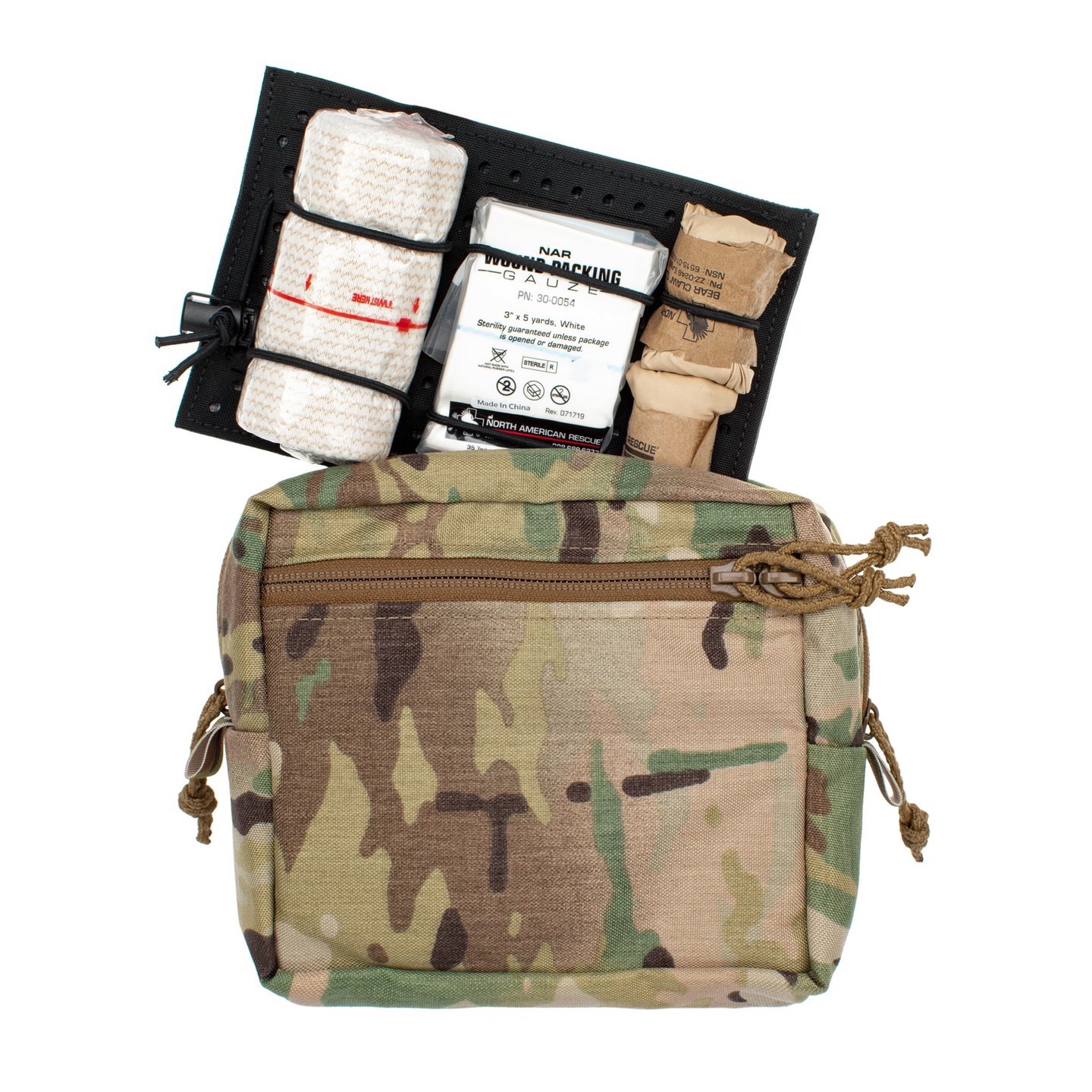
One of the most used pieces of kit is the multitool and Haley Strategic Partners is introducing a dedicated pouch which can be used for other comparable items like lights and mags.

Coming soon from HSP.

European Exercise Pushes Stryker Communications Ahead

June 29th, 2022

GRAFENWOHR TRAINING AREA, Germany — When conducting mounted to dismounted missions, Stryker Brigade Combat Teams cannot let a little steel get in the way of their network communications.

The 3rd Squadron, 2nd Cavalry Regiment is the first unit equipped with Capability Set 23’s — or CS23 — Integrated Tactical Network. This network, shortened as ITN, is providing Soldiers with flexible network and situational awareness capabilities from inside the hull out to the area of operations on the ground.

The unit recently completed a live-fire training event at Grafenwohr Training Area, with additional events held at Rose Barracks, during which program developers and evaluators from the Program Executive Office Command, Control, Communications Tactical, Combat Capabilities Development Command C5ISR Center and the Army Test and Evaluation Command assessed and measured the operational effectiveness, suitability, and survivability of ITN, including cyber capabilities, as part of their operations demonstration phase 1 with the unit.

The team will use Soldier feedback from the event to incrementally enhance the capability in preparation for Ops Demo Phase 2 in January, 2023. They will assess CS23’s ITN in a force-on-force regimental level exercise with 3rd Squadron.

“It certainly isn’t lost on me that 3rd Squadron has been presented with a once-in-a-lifetime opportunity to blaze the trail of ITN integration for not just our Regiment, but for other Stryker Brigade Combat Teams across the Army,” said Lt. Col. Mark Bush, 3rd Squadron, 2nd Cavalry Regiment. “I believe our squadron possesses a myriad of talent at every echelon that is capable of providing cogent and applicable feedback regarding process for fielding and tactical implementation.”

The ITN provides a simplified, independent, mobile network solution comprised of a commercial solutions kit that can be rapidly inserted into the existing tactical network. These capabilities provide commanders with flexible, secure and resilient communications across echelons and will be pivotal to the 3rd Squadron’s mounted, on-the-move and at-the-quick-halt missions as part of their arsenal within the European Command area of operations.

“I am extremely excited that we were able to deliver the latest CS23 networking technologies to the Wolfpack squadron,” said Matt Maier, Project Manager for Interoperability, Integration and Services, assigned to Program Executive Office Command, Control, Communications Tactical. “I think mounted capabilities will be a game changer for units as we achieve the capacity, resilience and convergence goals for the Army’s Unified Network.”

The ITN has been a major component to the Army’s Capability Sets, which began fielding in fiscal year 2021, and are continuing to field in FY 2023, 2025 and 2027. In this end-to-end tactical network approach, each capability set builds off the previous and relies heavily on Soldier feedback.

CS23 ITN includes new capabilities that provide cellular hotspots for vehicles, which allow mounted Soldiers to connect to cloud-based resources with a secure VPN over host nation cellular services as part of their Primary, Alternate Contingency and Emergency Plan. Additional CS23 capabilities provide new Wi-Fi and updated GPS vehicle routing capabilities and multiple-input and multiple-output radios for high-speed command post data exchanges, with both mobile and static command posts.

As did the Infantry Brigade Combat Teams that received CS21’s modernized network systems over the past year, 3rd Squadron is now experiencing firsthand the difference between conducting operations using existing systems versus newer commercially enhanced networked capabilities.

“The biggest thing about ITN is that it is truly an integrated tactical network,” said Staff Sgt. John Mock, 3rd Squadron, 2nd Cavalry Regiment network communications officer in charge of network integration for the unit.

“We aren’t using independent systems that are great on their own but ultimately don’t talk to one another. Now, we can share [ ], messaging services and graphics to allow ease of communications on the battlefield to improve the site picture for our commander for better decision making.”

Radios are the primary capability used for ITN communications across the echelons, and for this exercise, the Wolfpack platoons used the PRC-163 Leader Radio for dismounted operations and the PRC-162 Manpack for both dismounts and inside the vehicles.

Spc. Elliott Mazner, who has served in numerous 3rd Squadron, 2nd Cavalry Regiment platoon positions from rifleman to squad leader, covered down as squad automatic weapon gunner for this event. His familiarity with ITN during previous exercises provided him with a strong base to evaluate and provide feedback on these network communications.

“I’m impressed with 163’s ability to communicate outside the truck,” Mazner said. “It’s a radio sitting in someone’s kit with an antenna [outside], but it’s still able to get past the armor in the truck, reach another truck through that armor and communicate with another 163 inside that truck.”

The Android Tactical Assault Kit end-user device is the sister component to the radios for overall situational awareness. It displays real-time friendly and enemy location information, which allows leaders better decision-making capabilities.

“Using the ITN displays details just like it was a Tinder profile for the enemy, where we’re able to see what we’re looking at and the commander can make instant decisions,” Bearden said. “If you don’t have this capability there will be more casualties on the battlefield, which is why this capability is amazing.”

The primary waveform used with ITN is the TSM waveform, which is a commercial mesh waveform that requires line-of-sight and provides a barrage relay, where every radio is a repeater for all network traffic. Providing simultaneous voice, data and position location information, TSM operates in the Secure-But-Unclassified enclave, which enables encrypted data to be transmitted over military or commercial networks, the Internet, cellular networks or compatible but non-military waveforms.

The unit relied heavily on TSM during the multi-national exercise Saber Strike 22 exercise conducted last October, which required movement from Rose Barracks, Vilseck, to Latvia.

“Most useful to our participation in Saber Junction was the voice-over-distance function enabled by the mesh network of our mission command systems,” Bush said. “Experiencing the clarity in communications over long distances, all enabled by individual radios acting as repeaters for each other, was extremely impressive.”

Not that the capabilities performed flawlessly; between the distance covered coupled with early Soldier ITN adopters, the unit faced some challenges as it continued to train on the various ITN components.

“I am very aware that introduction of unfamiliar technology always comes with a steep learning curve,” Bush said. “However, our squadron’s experience of implementing the ITN capability providing very real assurance to NATO allies has been second to none. The situational awareness provided for across digital and voice mediums, for both mounted and dismounted combat troops, has been one of efficiency [that] I have not experienced in 18 years of active service.”

According to Mock, his unit understands that there will be growing pains employing ITN in large scale deployments, but thus far, with every growing pain they have run into, they have come out stronger by identifying the fault and coming up with a plan of action to resolve it.

3rd Squadron received an initial ITN fielding in 2021, and since then it has had many opportunities to see how its feedback has impacted network capabilities.

“Between the initial ITN fielding and CS23 Ops Demo, the key points we brought up, whether large-scale problems or small, such as placing a button in a certain place, have been implemented,” Mock said. “The training was leaps and bounds better. The equipment has adapted to us very well and we have adapted to the equipment significantly.”

Now that the exercise has concluded, the Army’s Operational Test Command will gather the instrumented data, surveys and round table information collected during the daily After Action Review meetings to prepare an initial findings report, with a full report planned following Ops Demo Phase 2, noted Maj. Greg Stueve, Operational Test Command test officer for ITN.

The unit will continue to train on ITN at home during low density training events, where Soldiers will go through battle drills using their radios and end-user devices, all the while continuing to provide critical feedback to the ITN team, Bearden said.

“Soldier feedback in support of Army network communications modernization is a must,” Bush said. “We wouldn’t ask our Soldiers to fight with a weapons system that the end-user hasn’t tested. I believe the same principle applies when considering platforms that enable the Soldier’s ability to communicate.”

Bearden agreed.

“This is what survivability on the modern battlefield looks like,” he said. “This is what modernization looks like.”

By Kathryn Bailey, PEO C3T Public Affairs